Shinobu Kocho, the Insect Hashira, is Demon Slayer's most unsettling speaker precisely because she never stops sounding polite. Physically too weak to behead a demon, she compensates with wisteria poison and a register that never cracks: 敬語 (keigo) sentence endings — 〜ですね, 〜ですよ, 〜ましょう — deliver threats, insults, and confessions in the same sunny, unhurried voice. She apologizes to people while telling them everyone hates them, offers to kill "gently," and, once, tells Tanjiro the smile is a mask over grief she can't put down. This page collects ten signature lines spanning her self-introduction, her cruelty-as-courtesy toward Genya and Tanjiro, her confession of exhaustion, and her final confrontation with Doma — Japanese beside the official VIZ English, page-verified against the bilingual tankōbon corpus.
Shinobu Kocho's quotes — Japanese vs official English
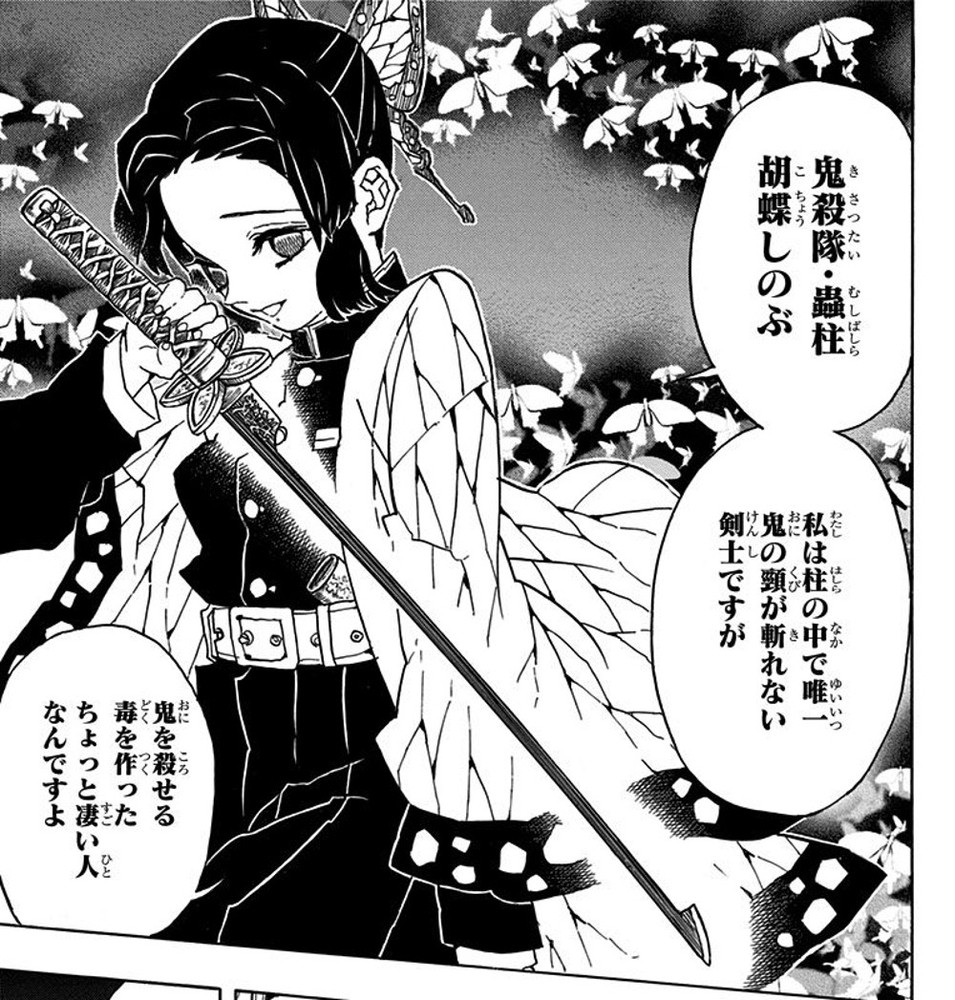
私は柱の中で唯一鬼の頸が斬れない剣士ですが、鬼を殺せる毒を作ったちょっと凄い人なんですよ
Watashi wa hashira no naka de yuiitsu oni no kubi ga kirenai kenshi desu ga, oni o koroseru doku o tsukutta chotto sugoi hito nan desu yo
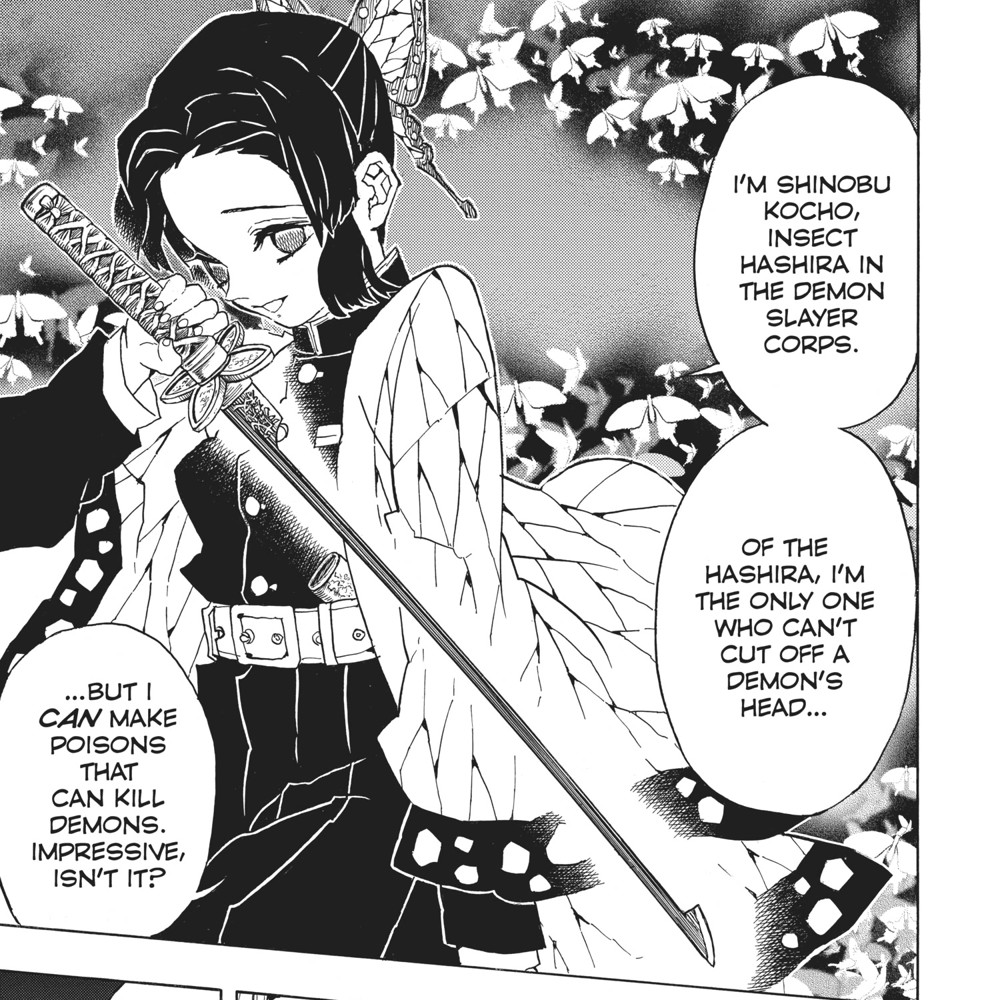
“OF THE HASHIRA, I'M THE ONLY ONE WHO CAN'T CUT OFF A DEMON'S HEAD... ...BUT I CAN MAKE POISONS THAT CAN KILL DEMONS. IMPRESSIVE, ISN'T IT?”
Literally: I'm the swordsman who, alone among the Hashira, can't cut off a demon's neck — but I'm a bit of an amazing person who made a poison that can kill demons, you know.
Vol. 5, p.144 — introducing herself, mid-swing, to a spider-demon mother on Mount Natagumo
ああ失礼しました。死んでるからもう聞こえませんね。うっかりです
Aa, shitsurei shimashita. Shinderu kara mou kikoemasen ne. Ukkari desu.
“OH, I'M SORRY... YOU CAN'T HEAR ME ANYMORE—YOU'RE DEAD. MY BAD!”
Literally: Oh, how rude of me. Since you're dead, you can't hear me anymore, can you. How careless of me.
Vol. 5, p.144 — cheerfully apologizing to the demon she has just poisoned to death, moments after killing her
あぁそれ…すみません、嫌われている自覚が無かったんですね
Aa, sore... sumimasen, kirawarete iru jikaku ga nakatta n desu ne
“OH DEAR... I GUESS YOU NEVER REALIZED THAT PEOPLE HATED YOU. SORRY.”
Literally: Oh, that... sorry, I guess you had no awareness that you were hated.
Vol. 6, p.10 — casually confirming to Genya Shinazugawa that everyone really does dislike him
危ないですから離れてください。坊やが庇っているのは鬼ですよ
Abunai desu kara hanarete kudasai. Bouya ga kabatte iru no wa oni desu yo
“THAT'S DANGEROUS. SO GET OUT OF THE WAY AND... YOU'RE LYING ON TOP OF A DEMON.”
Literally: It's dangerous, so please get away. The thing the boy is shielding is a demon, you know.
Vol. 6, p.11 — asking Tanjiro, with a smile, to move off Nezuko's transport box so she can kill her
それよりも私は坊やの方から話を聞きたいですよ
Sore yori mo watashi wa bouya no hou kara hanashi o kikitai desu yo
“I'M MORE INTERESTED IN QUESTIONING THE BOY.”
Literally: More than that, I'd like to hear what the boy has to say.
Vol. 6, p.39 — overruling Giyu Tomioka on how to handle Tanjiro's trial at Corps headquarters
そうですね…私は…いつも怒っているかもしれない
Sou desu ne... watashi wa... itsumo okotte iru kamo shirenai
“WELL... I GUESS... ...YOU COULD SAY I'M ANGRY.”
Literally: Well... as for me... I might always be angry.
Vol. 6, p.144 — answering Tanjiro's question about why she smells angry despite always smiling
姉が好きだと言ってくれた笑顔を絶やすことなく…だけど少し…疲れまして
Ane ga suki da to itte kureta egao o tayasu koto naku... dakedo sukoshi... tsukaremashite
“...WITHOUT LOSING MY SUNNY DISPOSITION, WHICH MY SISTER ALWAYS LIKED... BUT... IT REALLY TIRES ME OUT.”
Literally: Without letting the smile my sister told me she loved go out... but it... has tired me a little.
Vol. 6, p.146 — confessing to Tanjiro that keeping up the smile her late sister Kanae loved has become exhausting
蟲の呼吸 蜂牙の舞い「真靡き」
Mushi no Kokyū, Houga no Mai "Manabiki"
“INSECT BREATHING, DANCE OF THE BEE STING: TRUE FLUTTER!”
Literally: Insect Breathing, Bee Fang Dance, "True Flutter."
Vol. 16, p.164 — technique callout, thrusting through Doma's hand mid-duel in the Infinity Castle
貴方の顔色全然変わってない…貴方のことを気の毒だと、死の間際にカナエさんが言っていた
Anata no kaoiro zenzen kawatte nai... Anata no koto o kinodoku da to, shi no magiwa ni Kanae-san ga itte ita
“YOU'RE NOT SAD. NOT EVEN A LITTLE... AS SHE DIED, KANAE SAID SHE WAS SORRY FOR YOU.”
Literally: Your face-color hasn't changed at all... as she died, Kanae said she pitied you.
Vol. 18, p.122 — confronting Doma, the demon who killed her sister Kanae, over his unmoved expression
私の刀で一度に打ち込める毒の量はせいぜい五十ミリ
Watashi no katana de ichido ni uchikomeru doku no ryou wa seizei gojuu miri
“AT MOST, I CAN DELIVER 50 MILLIGRAMS OF POISON IN ONE BLOW WITH MY SWORD.”
Literally: The amount of poison I can drive in at once with my sword is at most fifty milligrams.
Vol. 19, p.32 — explaining, in clinical detail, the poison-dosage math behind her plan to let Doma eat her alive
All lines are byte-exact captures from a bilingual corpus of the Japanese tankōbon and the official VIZ Media edition.
Shinobu's first person is 私 (watashi), the neutral, gender-unmarked "I" — unremarkable on its own, but everything built around it is deliberate. Where Giyu Tomioka clips his sentences to the bone and Kyojuro Rengoku shouts in exclamation points, Shinobu never drops out of 〜です/〜ます. Her self-introduction is the clearest thesis statement in the series: 「私は柱の中で唯一鬼の頸が斬れない剣士ですが、鬼を殺せる毒を作ったちょっと凄い人なんですよ」 — "Of the Hashira, I'm the only one who can't cut off a demon's head... but I can make poisons that can kill demons. Impressive, isn't it?" VIZ's rendering keeps the confident tag question, but the Japanese does something subtler: 〜ですよ is the same soft, information-sharing sentence-ending a shopkeeper uses to recommend a good melon. She is filing her own greatest weakness and her method of killing under the identical register — no boast, no defensiveness, just pleasant disclosure. The line is the reason insect-breathing techniques are named 舞い ("dances") instead of 型 ("forms"): her whole fighting style is built to compensate for exactly the weakness she just announced in a shopkeeper's voice.
The cruelty-as-courtesy pattern shows up whenever she's actually being vicious. To Genya Shinazugawa, who's just demanded to know why she said people hate him: 「あぁそれ…すみません、嫌われている自覚が無かったんですね」 — "Oh, that... sorry, I guess you never realized people hated you." すみません ("sorry") is doing real grammatical work as an apology marker, glued directly onto a diagnosis of his social failure — the two halves of the sentence are performing opposite emotional jobs while sharing one register. Minutes later, crouched over Tanjiro shielding Nezuko's box, she asks him with the same 〜てください softness she'd use to ask someone to pass the salt: 「危ないですから離れてください。坊やが庇っているのは鬼ですよ」 — "That's dangerous, so please get out of the way. The thing you're protecting is a demon, you know." The politeness isn't a performance she drops when the stakes rise; the stakes ARE the performance. Compare her later, genuinely unguarded moment discussing her sister with Tanjiro, where the register holds even as the content turns to grief — see the 顔色 (kaoiro) pitfall entry for how this exact voice curdles into open accusation against Doma, and 参る (mairu) and the humble verb for how her own household runs on the same keigo grammar she wields as a weapon.
The most revealing scene in the corpus breaks nothing structurally — the keigo never lapses — but the content underneath it does. Asked point-blank by Tanjiro whether she's angry, she answers: 「そうですね…私は…いつも怒っているかもしれない」 — "I guess... you could say I'm angry, always." Two pages later, describing the smile she's maintained since her sister Kanae's death: 「姉が好きだと言ってくれた笑顔を絶やすことなく…だけど少し…疲れまして」 — "...without losing the smile my sister said she loved... but it... really tires me out." 疲れまして ("it tires me") is still polite masu-form, still gentle in shape, but the content is a direct admission that the mask has a cost. VIZ's "WITHOUT LOSING MY SUNNY DISPOSITION" and "IT REALLY TIRES ME OUT" land the meaning cleanly; what's harder to carry into English is that she says this in exactly the same grammatical register she uses to threaten demons — the smile and the threats are the same discipline, not two different Shinobus.
Her final confrontation with the Upper Rank demon Doma inverts the pattern just once, and the inversion is the point. 「貴方の顔色全然変わってない」 — "Your face-color hasn't changed at all" — drops the polite copula entirely; VIZ's "YOU'RE NOT SAD. NOT EVEN A LITTLE." states her verdict outright where the Japanese states only the evidence. It's the one line in this set where the mask genuinely slips into flat, declarative anger — worth reading against the 顔色 pitfall entry tracking exactly this line's journey into English. Then, planning to be eaten alive so her poison can work from inside a demon strong enough to kill her outright, she reports the dosage like a lab result: 「私の刀で一度に打ち込める毒の量はせいぜい五十ミリ」 — "At most, I can deliver fifty milligrams of poison in one blow with my sword." The keigo is back, unbroken, describing the exact mechanics of her own planned death. English has "clinical" as a register, but it doesn't usually also mean "polite to the person about to eat you" — Japanese keigo, applied to a battle plan that ends in your own death, does both at once, and that double duty is the whole of what makes Shinobu's voice inimitable.