The Moment
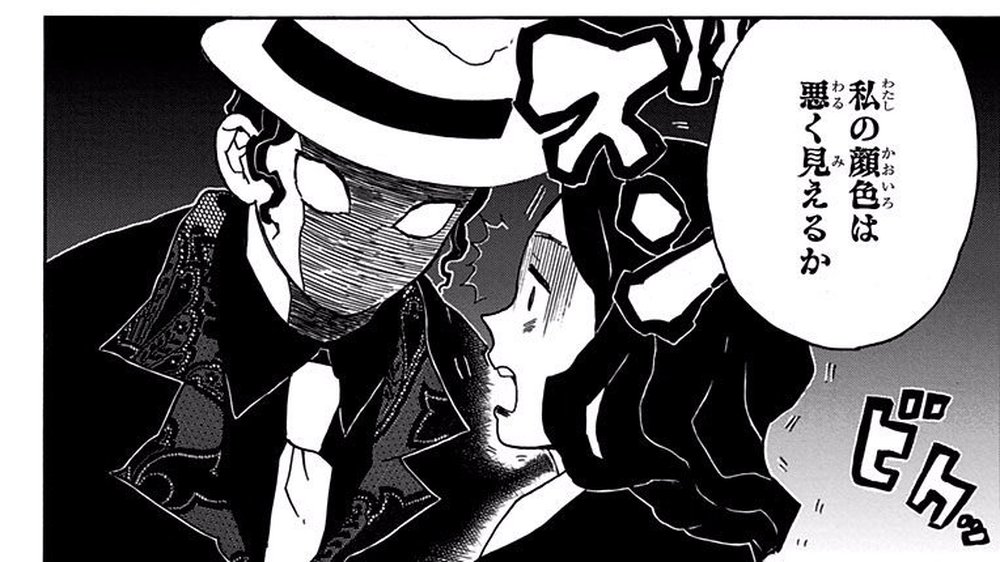
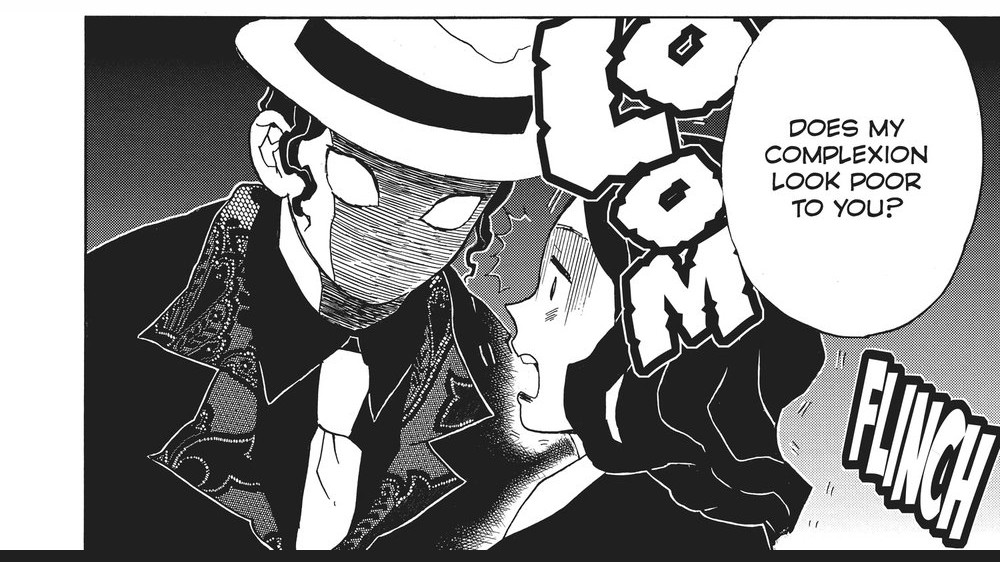
Volume 2, Chapter 14 — "Kibutsuji's Wrath / The Smell of Enchanting Blood." A demon in a wide-brimmed hat and a lace-cuffed suit stops a well-dressed young man in a back street, sneering: 「おいおい随分いい服着てやがるなあお前 青白い顔しやがってよぉ 気に入らねぇぜ 今にも死にそうじゃねえか」 — "HEY, HEY, THOSE'RE SOME FANCY DUDS YOU'RE WEARIN'! AND WITH THAT PALE FACE OF YOURS... AND I DON'T LIKE IT! ...YOU LOOK HALF-DEAD!" It isn't idle insult. Moments later the man's little brother is dead, and onlookers are screaming that he isn't breathing. The demon turns, unhurried, to the surviving sister and asks, with a formality that lands harder than any shout would:
「私の顔色は悪く見えるか」
Watashi no kaoiro wa waruku mieru ka
VIZ's English edition prints: "DOES MY COMPLEXION LOOK POOR TO YOU?" (Vol. 2, p.142.)
Grant the rendering its due: "complexion" is the correct dictionary gloss, the sentence is clean, and "poor" is a reasonable match for 悪く. But sit with what just happened. This demon didn't kill because the boy insulted him — he killed a bystander over a comment about someone else's pallor, and now, unprompted, he needs to know how his own face reads. The panic under his monotone spills out over the next page: 「私の顔はあおじろいか?」「病弱に見えるか?」「私は限りなく完璧に近い生物だ」「死にそうに見えるか?」 — "IS MY FACE PALE? DO I LOOK SICKLY? I AM AN ENTIRELY DIFFERENT CREATURE. DO I LOOK LIKE I'M DYING?" — before he forces his own blood on the girl, warning that a human body can't survive the transformation. The entire scene is staged around one anxiety: whether his 顔色 gives him away. "Complexion" tells you what he's asking about. It doesn't tell you why asking it, out loud, to a stranger he's about to kill, is the most frightening thing he says.
The Original
顔色 (kaoiro) is 顔 (kao), "face," plus 色 (iro), "color" — but Japanese 色 is a wider word than English "color." It doesn't only name hue; it names the visible quality a thing gives off. 声色 (kowairo) is "voice-color" — vocal tone, the register an actor puts on. 色をなす, "to take on a color," is the set phrase for flaring into visible anger. 気色ばむ (keshikibamu), "to color with feeling," means to visibly bristle. Japanese keeps reaching for 色 whenever it wants to say the inner state showed on the outside — and 顔色 is that logic applied to the one surface everyone is already looking at: the face.
So 顔色 is not simply "the color of one's face," the way an English chart might log a patient's complexion once, on admission, and move on. It's the face treated as a live instrument reading — the place health, fear, and mood are all expected to register, moment to moment, and which the people around you are expected to check. That checking has its own dedicated verb: 顔色をうかがう (kaoiro o ukagau), literally "to peer at someone's face-color," idiomatically "to read a person's mood off their face" before you speak — the employee gauging a boss's temper before asking for time off, the child gauging a parent's mood before confessing to a broken vase. And when a face declines to give up its reading, there's a phrase for that failure too: 顔色一つ変えない (kaoiro hitotsu kaenai), "not to change one's face-color even once" — the stone-faced non-tell, whether it comes from nerve, from cruelty, or, as one scene below suggests, from not quite being human enough to have anything to show.
As vocabulary, 顔色 itself sits at roughly JLPT N4 — ordinary enough that it shows up in beginner textbook health-check dialogue (「顔色悪いですね、大丈夫ですか?」). The idiomatic extensions built on top of it, 顔色をうかがう and 顔色一つ変えない, run closer to N2, and each one assumes the same premise the plain noun does: that a face is a surface under observation, not a private one.
VIZ's Choice
Every confirmed appearance of 顔色 in the volumes we have on file, Japanese against the official English on the same page:
| Vol. / p. | Speaker | Japanese | VIZ English |
|---|---|---|---|
| 2 / 142 | an unnamed demon | 私の顔色は悪く見えるか | DOES MY COMPLEXION LOOK POOR TO YOU? |
| 14 / 132 | a villager, to Muichiro Tokito | 顔色がものすごく悪いんですが本当に大丈夫ですか? | YOUR COLOR IS REALLY BAD. ARE YOU SURE YOU'RE ALL RIGHT? |
| 18 / 122 | Shinobu Kocho, to Doma | 貴方の顔色全然変わってない | YOU'RE NOT SAD. NOT EVEN A LITTLE. |
| 18 / 122 | Doma, to Shinobu | 人間と同じく血は巡ってるから顔色は変化する | (cut — no corresponding line on the English page) |
Four appearances, four different fates for one word. In Volume 14, VIZ reaches for the most literal option on the shelf and it works beautifully: "YOUR COLOR IS REALLY BAD" keeps the face-as-symptom logic almost kanji-for-kanji, and it's exactly what a worried companion would say. That's the ceiling for this word in English — plain "color" gets closer to 顔色 than the fancier "complexion" ever does, because "color" can still be checked, the way 顔色 demands.
The other two outcomes show what happens once 顔色 stops being a symptom and starts being evidence. Shinobu isn't asking Doma how he feels; she's citing his unchanged face as proof of what he doesn't feel. VIZ has to choose between keeping the face-reading (clunky: "your complexion hasn't changed at all") and just handing the reader her conclusion — and it takes the second option, restructuring the whole exchange around "YOU'RE NOT SAD. NOT EVEN A LITTLE." And when the manga turns 顔色 toward pure physiology — Doma's explanation of why a demon's face can still show color — English doesn't even attempt a compression. The line is simply absent from the page.
The Gap
"Complexion" is inert; 顔色 is under surveillance. English "complexion" is a noun a dermatologist logs once. 顔色 is a noun that assumes an audience, checking it in real time — that's the entire premise of 顔色をうかがう, a set phrase with no single-word English equivalent. "DOES MY COMPLEXION LOOK POOR TO YOU?" asks about a fact; 私の顔色は悪く見えるか asks a demon's paranoid, ongoing question about what a witness is reading off him right now. The clinical noun can't carry that anxiety on its own — the scene has to do all the work "complexion" leaves undone.
The verdict swallows the evidence. 貴方の顔色全然変わってない is Shinobu citing an observation: the visible surface hasn't moved. "YOU'RE NOT SAD. NOT EVEN A LITTLE." states her conclusion instead. Both land the same accusation, but the Japanese shows its work — this is a demon-slayer's trained eye, reading a face the way she'd read a wound — and the English skips straight to the verdict, quietly erasing the fact that Shinobu is a witness, not just an accuser.
Exposition built on 顔色 doesn't compress — it disappears. Doma's 人間と同じく血は巡ってるから顔色は変化する is doing real narrative work: explaining, mid-fight, which parts of a demon still betray it and which don't. English has no single term that bridges "blood flow" and "visible face color" the way 顔色 does, so rather than write an awkward two-clause equivalent, VIZ cuts the line outright. The idiom doesn't survive translation here; it's simply not attempted.
What If
Focusing on the headline line, since it carries the most weight — the demon's question, and what each option costs:
- "Do I look pale to you?" — clean, natural spoken English. Cost: loses that 色 specifies a color, not a general pallor, and sounds like ordinary concern rather than a killer's clinical self-check.
- "Does the color in my face look wrong to you?" — stays closest to the kanji anatomy. Cost: nobody talks like this; the line stops sounding like dialogue and starts sounding like a gloss.
- "Do I strike you as unwell?" — surfaces the real fear underneath the question. Cost: abandons the face-and-color imagery completely — the idiom becomes an abstraction.
- "Does my complexion look off to you?" — keeps VIZ's noun but sharpens "poor" into "off," a more clinical, more unsettling register. Cost: still can't carry that 顔色 is something habitually read by others, not assessed once and filed away.
No option is free, because English simply doesn't have a noun that means both "the color of a face" and "the thing people are always checking on that face." Every choice above picks one half and lets the other go.
Take-away
顔色 looks like an easy cognate — face, color, done — until you notice that Japanese 色 means "visible tell," not just "hue," and that a whole idiom family (顔色をうかがう, 顔色一つ変えない, 顔色なし) treats the face as something habitually monitored rather than merely observed. English's "complexion" only ever does the observing.
Three rules of thumb to carry off this page:
- Whenever 色 turns up outside a paint chart — 声色, 気色, 顔色 — read it as "visible tell," not "hue." The kanji is doing the work of "the outward sign of an inner state."
- When 顔色 (or any of its idioms) is cited as evidence for a verdict, check whether the English kept the evidence or jumped straight to the verdict. Losing the face-reading step is the most common way this word goes missing in translation.
- Watch for total omission, not just softening, when a 顔色 line is doing expository rather than emotional work — English has no efficient single term for it, so translators sometimes cut rather than compress.
Naruto runs the opposite play on the same idiom: when a shaken companion says 「どうした?ああ顔色が悪いぜ...」 to a bleeding Sasuke, VIZ's English doesn't touch "color" at all — it swaps in an entirely different image, "WHAT'S WRONG? YOU'RE AS WHITE AS A SHEET," trading Japanese's face-color-as-readout for English's own stock idiom of drained color. Same word, opposite translation strategy: Demon Slayer's English keeps circling "complexion" and "color"; Naruto's English reaches for a simile instead. Neither fully owns what 顔色 owns.
For two more body-part idioms from the same series that English can't quite hold onto, see the objectless nose of 鼻が利く and the withheld glance of 目もくれない — or browse the Demon Slayer translation notes index.
Every Japanese and English line quoted above is a byte-exact capture from the cited editions — 鬼滅の刃 Vol. 2, 14 & 18 (Japanese) and Demon Slayer: Kimetsu no Yaiba (VIZ Media) at the corresponding panels — via our bilingual page database; see Sources below.