The Moment
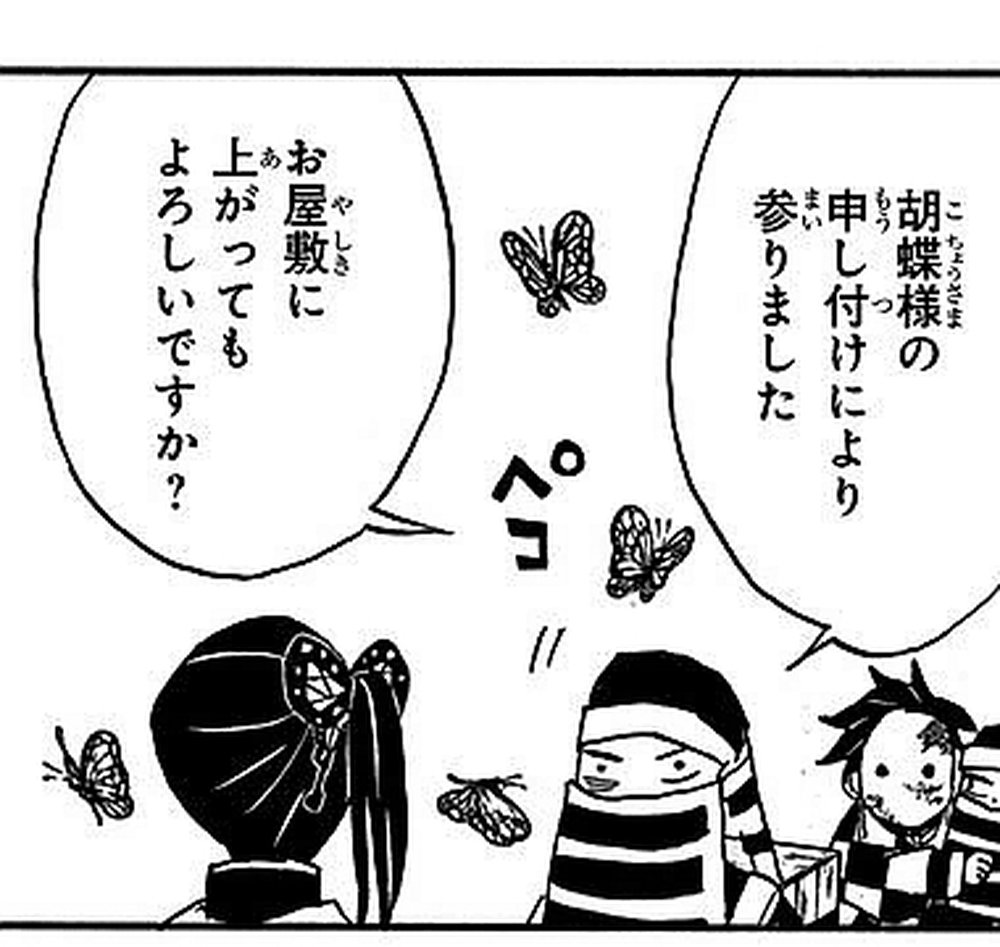
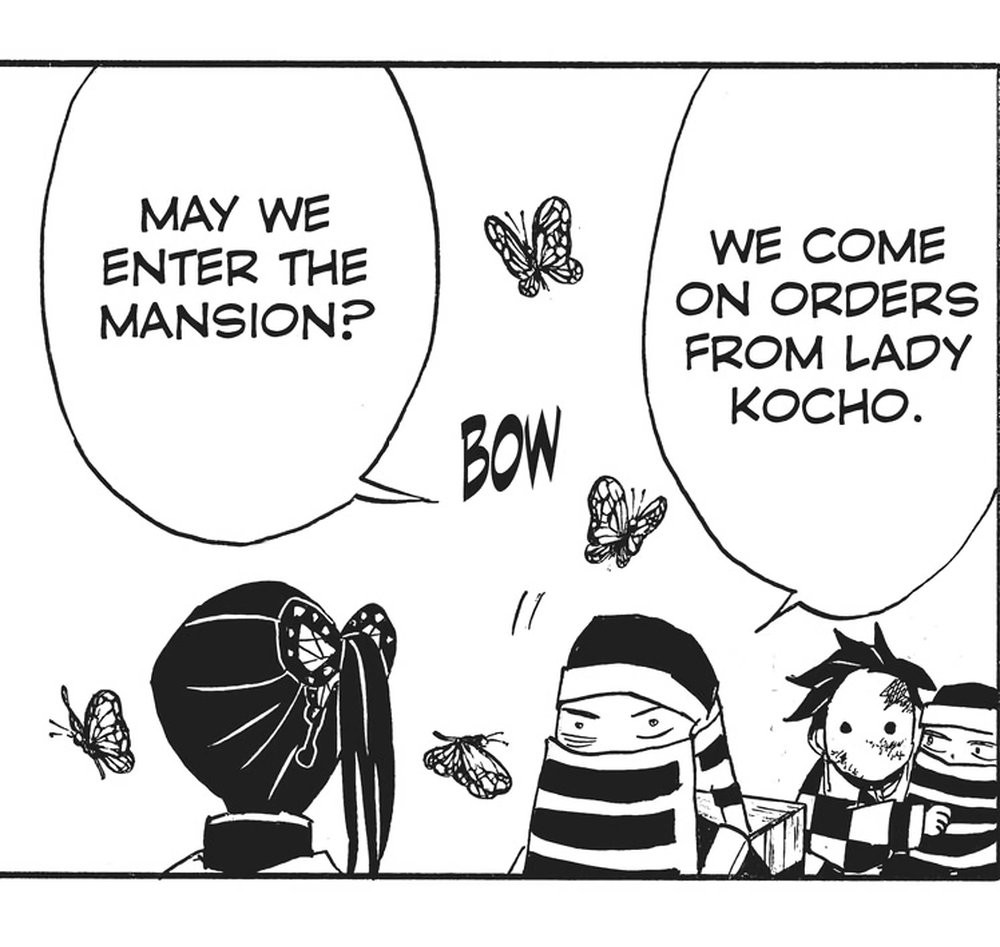
Volume 6. At the gate of the Butterfly Mansion — Shinobu Kocho's estate, the Corps' own infirmary — two visitors wait to be let in. One is a young girl in Corps uniform, silent, blank-faced, a butterfly hairpin holding back her hair; a nearby onlooker will soon supply her name: 「栗花落カナヲ様だ」 ("KANAO TSUYURI."). Kanao only bows — the sound effect ペコ prints beside her — and says nothing. It's her companion, a masked kakushi (one of the identity-hidden support staff who keep the Corps running without ever putting a face to a demon), who does the talking:
「お屋敷に上がってもよろしいですか?胡蝶様の申し付けにより参りました」
Oyashiki ni agatte mo yoroshii desu ka? Kochō-sama no mōshitsuke ni yori mairimashita.
VIZ's English edition prints: "MAY WE ENTER THE MANSION? WE COME ON ORDERS FROM LADY KOCHO." (Vol. 6, p.103).
Grant the rendering its due: it's clean, natural English, and it gets the CONTENT exactly right — they're there because Shinobu ordered it. What it can't carry is the one grammatical fact every Japanese reader absorbs instantly, without even noticing they've absorbed it: the verb the kakushi reaches for, 参る, is not the everyday 来る "come." It is the humble one. Before she has explained anything about why she's there, her grammar has already told the household she considers herself beneath it.
The Original
Take the verb apart before you take the sentence apart, because 参る hides two different lives inside one kanji.
参 alone (kun'yomi まい, on'yomi サン) clusters around "presenting oneself somewhere": 参拝 (sanpai, visiting a shrine to worship), 参上 (sanjō, presenting oneself before someone important), 参加 (sanka, joining in), 持参 (jisan, bringing something along with you), 降参 (kōsan, surrendering — literally "coming down to present yourself"). The verb 参る grew directly out of that sense: to go and present yourself, formally, somewhere you have no automatic standing to be.
From there it hardened into pure grammar: kenjougo, the humble-language slot that BOTH 行く (iku, "go") and 来る (kuru, "come") empty into whenever the going or coming touches someone who outranks the speaker. This is the detail worth sitting with, because English has no fork here at all: 参る doesn't care which direction you're physically moving. A kakushi walking TOWARD the Butterfly Mansion and Kyojuro Rengoku walking AWAY from his father's house both say 参る, because keigo isn't tracking geography — it's tracking who stands above whom. Two opposite footsteps, one identical grammatical bow.
The set phrase every learner meets first is 行って参ります (itte mairimasu) — literally "I will go and [humbly] come [back]" — the everyday goodbye said on the way out any Japanese front door, taught around N5 long before anyone explains that its second half is kenjougo grammar. Its mirror is ただいま参りました (tadaima mairimashita), the formal cousin of "I'm home." 参る used more deliberately — 稽古に行って参ります, 御報告に参りました — sits closer to N3–N2, filed under the wider keigo system rather than everyday set phrases.
One trap worth flagging for anyone who goes looking for 参る in the wild: 参 is ALSO the formal safeguard-numeral for 三 "three" — the kanji equivalent of writing THREE in block capitals on a check so nobody can quietly alter it — and it turns up constantly in this very manga as 参ノ型 ("Third Form") and 上弦の参 ("Upper Rank Three"). Same character, completely unrelated word. An OCR pass across this corpus actually mistook a technique caption reading 参ノ牙 ("Third Fang") for 参ります — proof, if any translator needed it, that 参 is a small minefield even for machines.
VIZ's Choice
Every clean appearance of the humble verb 参る in the volumes we have on file, alongside the official English:
| Vol. / p. | Japanese | VIZ English |
|---|---|---|
| 6 / 103 | 胡蝶様の申し付けにより参りました | WE COME ON ORDERS FROM LADY KOCHO. |
| 8 / 113 | 御報告に参りました | I'VE COME TO REPORT... |
| 8 / 116 | ご命令通り柱の一人は始末して参りましたので御安心くださいますよう… | AS YOU COMMANDED, I KILLED ONE OF THE HASHIRA. ALL IS WELL. |
| 8 / 128 | …お伝えに参りました | HE ENTRUSTED ME WITH MESSAGES FOR HIS FATHER AND BROTHER. |
| 8 / 165 | 行って参ります | "...I'LL BE BACK!" |
| 12 / 72 | 見つけ次第取り押さえて連れて参りますので | WE'LL BRING HIM BACK AS SOON AS WE FIND HIM... |
| 15 / 143 | 私はこれから風柱様の稽古に行って参ります | I'M GOING TO TRAIN WITH THE WIND HASHIRA. |
| 20 / 99* | 参る | HERE I COME. |
*The Vol. 20 line is a rare case where the bilingual database's page pairing breaks down — the Japanese page (099) has no English page mapped in the dataset. We confirmed the real VIZ rendering by opening the printed English edition directly: it sits one page later than the Japanese original, on p.100, a pagination offset worth knowing about for anyone working in this stretch of the series.
Eight speakers, one verb, and once you know who's talking the table turns into a small cast list. Row 1 is the unnamed kakushi escorting Kanao. Rows 2 and 3 are both Akaza, reporting to Muzan Kibutsuji — once about the hunt for the blue spider lily, once (falsely triumphant) about killing a Hashira. Row 4 is Tanjiro Kamado, delivering Kyojuro Rengoku's dying words to Rengoku's younger brother Senjuro. Row 5 is Kyojuro Rengoku himself, as a boy, calling out 行って参ります to his own father on the way out the door — a flashback recovered mid-grief, several chapters after his death. Row 6 is the swordsmith village's elderly chief, Tecchin Tecchikawahara, promising a young Genya Shinazugawa that his missing swordsmith will be found and brought back. Row 7 is Kanao Tsuyuri again, years later, using the identical 行って参ります to announce she's off to train under the Wind Hashira — the same fixed goodbye Rengoku once used, now spoken by someone who will eventually stand where he stood. Row 8, the outlier, is a Hashira mid-duel with Kokushibo, spitting 参る as a one-word combat challenge.
Notice what VIZ never once does: mark any of these eight lines as more deferential than plain English chit-chat. "We come," "I've come to report," "I'll be back," "we'll bring him back," "I'm going to train with" — competent, natural, register-neutral English, every time, regardless of whether the speaker is an anonymous support worker, the story's most infamous villain's chief lieutenant, or its most beloved dead hero as a child. That flattening is systematic, not a one-off slip — because English's go/come pair genuinely has nowhere to put the information VIZ would need to keep.
The Gap
Every register cue funnels through a door English's grammar doesn't have. "Go" and "come" don't know how to be humble; they're the same word for a stranger and a Hashira. So the moment 参る shows up, a translator is choosing between under-translating (plain "come," losing the bow) or over-translating (adding stage directions like "humbly" that no character would actually say out loud). VIZ, sensibly, chooses under-translation every time — which is the right call for readability, and the reason a whole layer of the manga's social fabric goes missing anyway.
Villainy speaks fluent keigo, and English can't let the reader hear the joke of it. Akaza's 参る toward Muzan is grammatically identical to the kakushi's 参る toward Shinobu's household — same humble verb, same bow. VIZ's competent "I've come to report" and "AS YOU COMMANDED, I KILLED ONE OF THE HASHIRA" read as generic henchman-speak, but the Japanese is doing something sharper: showing that Muzan's demons are bound by exactly the same submission grammar as the Corps, one organization built on mutual respect and the other on terror. Same verb, opposite emotional temperature, and English can't hear the rhyme.
The bow wears down into a cliché, and translation can't preserve an erosion. 行って参ります said by a child leaving home (Rengoku) and by a trained Hashira-in-training leaving on a mission (Kanao) sit at opposite ends of the phrase's life — one still half-feels its own formality, the other has worn it down to a reflex — but VIZ's two solutions ("...I'LL BE BACK!" vs. "I'M GOING TO TRAIN WITH THE WIND HASHIRA.") differ only in CONTENT, not in how much weight the phrase is carrying, because English never had that weight lying around to lose in the first place.
What If
No fix is free; here's the menu and its prices, for the headline line:
- "We have come, by Lady Kocho's own order." — the passive-leaning "by [name]'s order" gives an English reader a courtroom-formal cue that something deferential is happening. Cost: reads stiff and legalistic, more subpoena than bowing teenager.
- "If it please you, we come on Lady Kocho's orders." — borrows English's own fossil of self-lowering language, so the reader gets SOME marker of a bow. Cost: sounds archaic and British, the wrong century of formality for a modern shonen panel.
- "This one comes at Lady Kocho's instruction." — replacing "I/we" with the self-effacing "this one" gestures at the grammatical self-lowering without inventing new content. Cost: reads translated, a little stilted — fantasy-novel English, not manga English.
- Keep VIZ's line, and let the panel do what the words can't. The SFX ペコ (a bow) already sits right beside the Japanese; nothing stops an English edition from keeping it as a visual footnote. Cost: still nothing in the WORDS marks the deference — the reader depends entirely on noticing the art.
The deeper point: every fix that tries to SAY the deference sounds imported or archaic in English, because English never built a live, ordinary-register slot for "I am now grammatically lowering myself." The closest living cousins — "if it please you," "this humble narrator" — are all borrowed from centuries English no longer speaks in.
Take-away
参る isn't rare, and it isn't hard to gloss — "come/go" gets the plot across every time. What it loses is a whole coordinate axis Japanese tracks constantly and English doesn't track at all.
Three rules of thumb to carry off this page:
- When you meet 参る, don't ask which direction — ask WHO the motion is aimed at. That's the only variable Japanese keigo is tracking; direction is irrelevant to the grammar, however loud it is in the scene.
- Learn 参る's two lives together: the worn-smooth cliché (行って参ります, said by half this cast at some point) and the deliberate, weighed use (御報告に参りました, 稽古に行って参ります) — the same verb, doing very different amounts of emotional work depending on how often it's said.
- Don't confuse 参る the verb with 参 the numeral — the kanji moonlights as a tamper-proof "three," and any manga with named ranks or numbered techniques will be full of both.
参る sits in the same keigo family this hub has already mapped from other angles — the humble "I," 小生; the vanishing "you," 貴方; and honorific rank turned into an insult, 御身分. Together they sketch a grammar of rank running under nearly every relationship in this manga, hero and demon alike — for more of it, browse the Demon Slayer translation notes index.
Every Japanese and English line quoted above is a byte-exact capture from the cited editions — Demon Slayer: Kimetsu no Yaiba Vol. 6, 8, 12, 15 & 20 (Japanese) and Demon Slayer: Kimetsu no Yaiba (VIZ Media) at the corresponding panels — via our bilingual page database; see Sources below.