The Moment
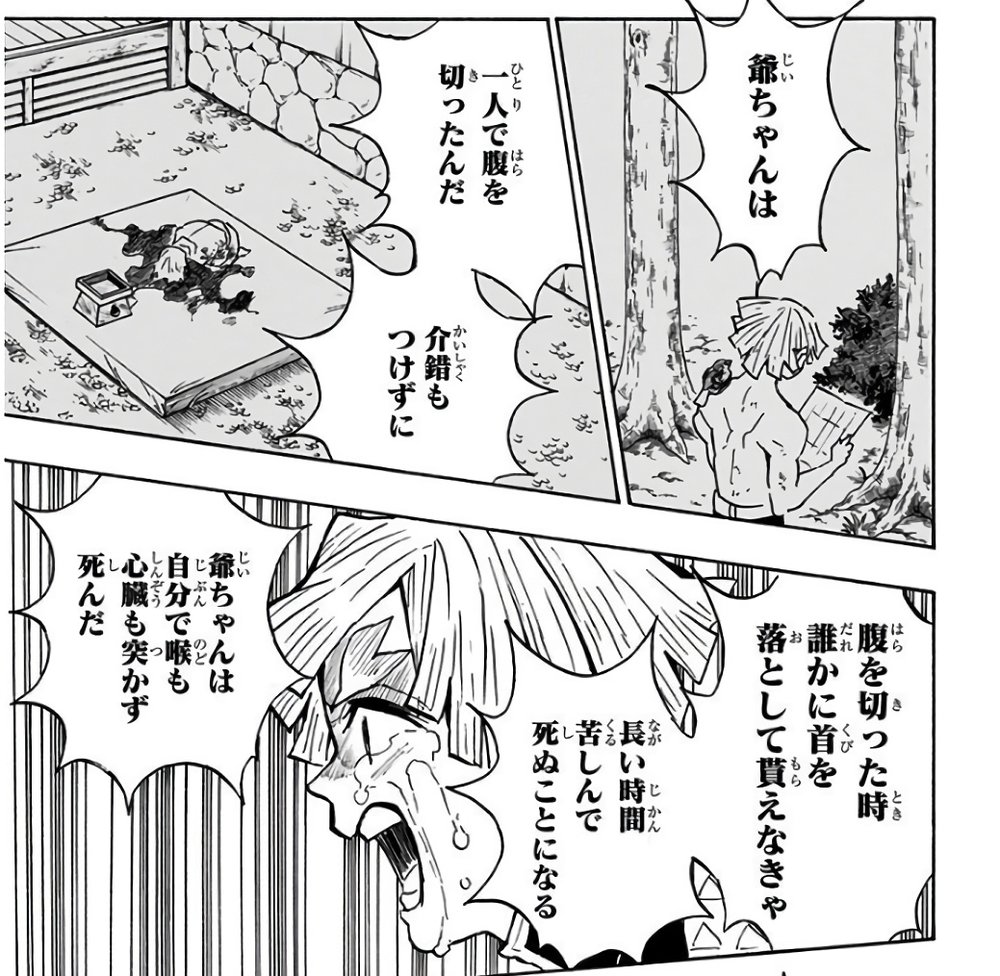
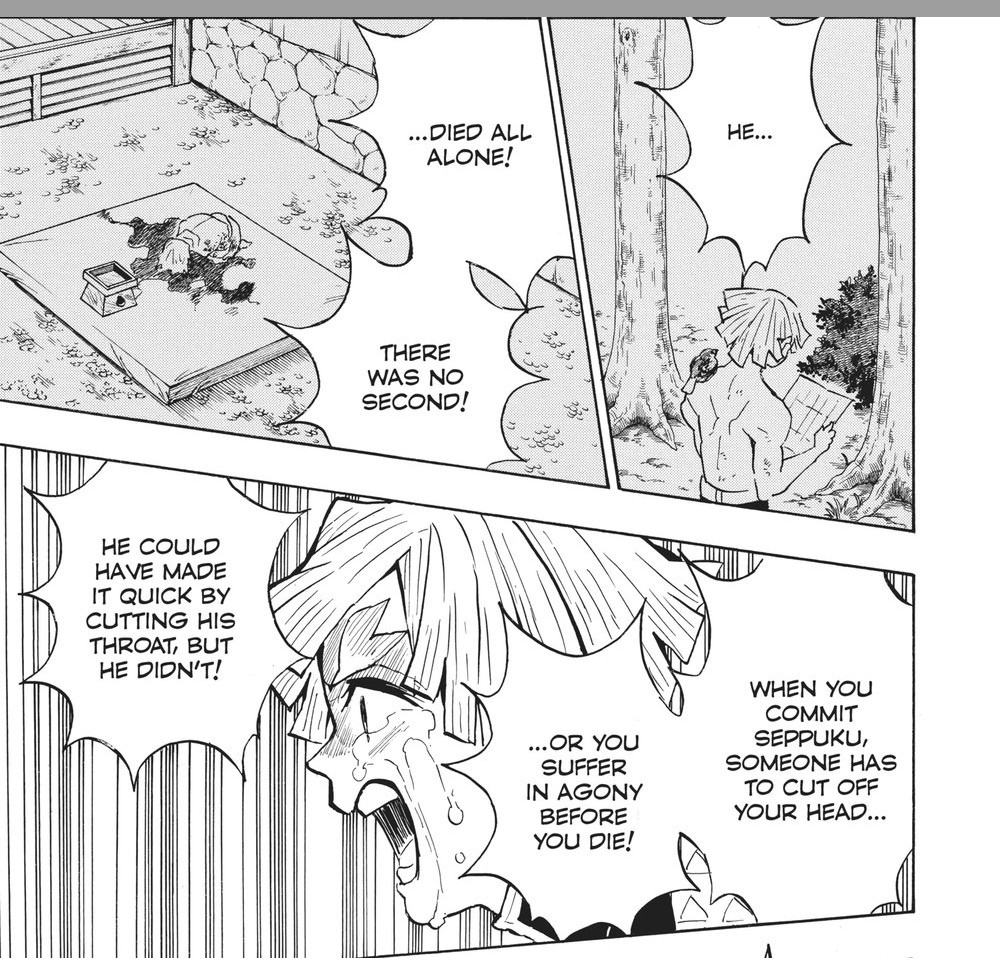
Deep in Muzan's Infinity Castle, Zenitsu Agatsuma finally stands in front of Kaigaku — the senior disciple who trained beside him under old Jigoro Kuwajima, the former Thunder Hashira they both called 爺ちゃん ("Gramps"), and who is now a demon. Zenitsu has something to tell him before they fight. The panels cut to memory: the old man kneeling alone under the trees; then a low wooden pallet, a small offering stand, a body slumped over a black stain.
「爺ちゃんは 一人で腹を切ったんだ 介錯もつけずに」
Jī-chan wa — hitori de hara o kitta n da — kaishaku mo tsukezu ni
VIZ's English edition prints, across the same three bubbles: "HE... ...DIED ALL ALONE! THERE WAS NO SECOND!" (Vol. 17, p.39).
Zenitsu keeps going, sobbing the mechanics of it at the man who caused it: 「爺ちゃんは自分で喉も心臓も突かず死んだ」 — "HE COULD HAVE MADE IT QUICK BY CUTTING HIS THROAT, BUT HE DIDN'T!" — 「腹を切った時誰かに首を落として貰えなきゃ」「長い時間苦しんで死ぬことになる」 — "WHEN YOU COMMIT SEPPUKU, SOMEONE HAS TO CUT OFF YOUR HEAD... ...OR YOU SUFFER IN AGONY BEFORE YOU DIE!" And then the accusation: 「雷の呼吸の使い手から」「鬼を出したからだぞ!!」 — "ALL BECAUSE THE WIELDERS OF THUNDER BREATHING... ...HAD PRODUCED A DEMON!!"
Grant the translator its due first, because "second" has the most distinguished pedigree an English rendering could ask for. A. B. Mitford's Tales of Old Japan (1871) — the classic Victorian eyewitness account of a seppuku — already explained the 介錯 to English readers as a gentleman's office, closer to a duelist's second than to an executioner. VIZ is not improvising; it is quoting a hundred and fifty years of English writing about Japan. And notice the quiet redistribution on this page: the bubble that literally says "he cut his belly alone" becomes "...DIED ALL ALONE!", and the belly-cutting resurfaces two bubbles later as "WHEN YOU COMMIT SEPPUKU..." — the translation knows its readers own the word seppuku but not the ritual's machinery, so it turns Zenitsu's scream into a compressed lecture.
The Original
Take the two words apart — they are a matched set.
切腹 (seppuku) is 切 setsu, "cut," + 腹 fuku, "belly": the formal, Sino-Japanese, on-reading compound. Underneath it Japanese keeps the plain native phrase 腹を切る (hara o kiru), "to cut one's belly" — same act, opposite register. The noun is the institution: the warrior-class death penalty and atonement rite of the Edo period. The verb phrase is the act a particular man performs on a particular morning. Demon Slayer uses both, pages apart, and — as we'll see — VIZ hears the difference.
介錯 (kaishaku) is 介 kai, "to come between, to attend on" — the 介 of 紹介 (introduction), 介護 (nursing care), 介入 (intervention) — plus 錯 shaku, "to interlace, to cross," the 錯 of 交錯. The compound once meant simply attending on someone; by the Edo period it had narrowed to one office. The kaishaku stands behind the kneeling man with sword raised, and the instant the belly is cut, brings it down. The mercy is structural: the belly wound kills slowly, so the kaishaku's stroke is what spares hours of agony. The office went to the most trusted, most skilled swordsman available — often a comrade or kinsman — and being asked was both an honor and a terrible duty.
The grammar of the headline line is a scandal detector. 介錯もつけずに: つける "to appoint," も "even," ずに "without doing" — without even appointing a kaishaku. And it is the second beat of a drumbeat of refusals: 喉も心臓も突かず — "without piercing throat or heart." The Japanese page is built on も…ず, the pattern of deliberate, stacked refusal. Neither noun appears on any JLPT list — this is cultural-historical vocabulary beyond N1 — but the ずに frame is ordinary mid-level grammar (N3–N2). The hard part isn't the grammar; it's the institution the grammar is pointing at.
VIZ's Choice
Here is every appearance of 切腹 and 介錯 in the volumes we have on file — plus the letter that starts it all, where the native phrase 腹を切る appears in deadly earnest:
| Vol. / p. | Speaker | Japanese | VIZ English |
|---|---|---|---|
| 6 / 63–64 | Urokodaki's letter, read to the Hashira | もしも禰豆子が人に襲いかかった場合は 竈門炭治郎及び…鱗滝左近次 冨岡義勇が腹を切ってお詫び致します | "SHOULD NEZUKO EVER ATTACK SOMEONE... ...TOGETHER WITH TANJIRO KAMADO... ...I, SAKONJI UROKODAKI, AND GIYU TOMIOKA WILL MAKE AMENDS BY SLICING OPEN OUR STOMACHS." |
| 6 / 66 | Sanemi Shinazugawa | ……切腹するから何だと言うのか | SO WHAT IF HE'LL COMMIT SEPPUKU?! |
| 6 / 122 | Zenitsu, mid-tantrum | 土下座して謝れよ切腹しろ!! | BOW DOWN DEEPLY AND APOLOGIZE! OFFER TO COMMIT SEPPUKU! |
| 12 / 129 | Kotetsu, scripting insults for Tanjiro | 切腹しろ恥知らず | "COMMIT SEPPUKU! YOU'RE SHAMELESS!" |
| 17 / 39 | Zenitsu, to Kaigaku | 介錯もつけずに | THERE WAS NO SECOND! |
| 23 / 200 | Yoshiteru, Zenitsu's modern-day descendant | 切腹しろ切腹!! | THEN I DEMAND HE COMMIT SEPPUKU! |
Read down the right-hand column and a rulebook emerges.
Rule one: borrow what English already owns. 切腹 is never translated — five scenes, five COMMIT SEPPUKUs. The word crossed into English in the nineteenth century (alongside "hara-kiri") and sits in the dictionary; VIZ can print it and trust the reader.
Rule two: translate what English never took. 介錯 has no dictionary residence, so it gets the Victorian equivalence — the duelist's "second" — and then two bubbles of emergency explanation, because the equivalence no longer explains itself.
Rule three: the native idiom gets English anatomy. The letter's humble pledge 腹を切ってお詫び致します becomes "WILL MAKE AMENDS BY SLICING OPEN OUR STOMACHS" — no loanword, just flesh. And in Vol. 6, p.66, when Sanemi scoffs at that very pledge — 「……切腹するから何だと言うのか」「死にたいなら勝手に死に腐れよ」 ("SO WHAT IF HE'LL COMMIT SEPPUKU?! IF HE WANTS TO DIE, HE CAN ROT!") — the register shifts from verb phrase to institutional noun, and VIZ shifts with it, from anatomy to loanword. That is genuinely fine-grained translation work.
There is even a counter-current: on the Vol. 17 page itself, Zenitsu's plain 腹を切った時 ("when the belly is cut") is upgraded to "WHEN YOU COMMIT SEPPUKU" — the loanword drafted to do naming work the moment the ritual has to be explained to the reader.
And watch what happens to the comic imperative. 切腹しろ!! is bare-order grammar, period-drama thunder deployed as mock outrage — Zenitsu shrieking at Tanjiro and Inosuke in the rehab yard, or little Kotetsu solemnly scripting insults for Tanjiro to deliver (「そして奴にこう言うんです」 — "AND THEN TELL THAT GUY..."). English can't comfortably order a living person to commit seppuku in the second person, so VIZ twice installs scaffolding: "OFFER TO commit seppuku," "I DEMAND HE commit seppuku." The bare command survives only inside Kotetsu's quotation marks. The scaffolding is a small betrayal of the grammar and a small gift to the joke — pompous legalese suits a tantrum.
The Gap
A refusal becomes an absence. 介錯もつけずに says the old man appointed no one — も…ずに stacks scandal on deliberate choice, one more refusal in the page's drumbeat: no kaishaku, no thrust to the throat, none to the heart. Maximum penance, chosen clause by clause. "THERE WAS NO SECOND!" states a circumstance — as if the ceremony had been understaffed, as if no one happened to be available. The Japanese line indicts the old man's terrible resolve; the English line reports a logistics failure. (VIZ does keep the agency one bubble later — "HE COULD HAVE MADE IT QUICK... BUT HE DIDN'T!" — proof the translator felt the loss and paid it back where the bubble had room.)
The wrong ceremony. A second belongs to a duel: an office of fairness between enemies, guarding the protocol of a contest. A kaishaku is mercy between comrades inside a rite of atonement; nothing is contested, and the sword falls in kindness. Mitford's Victorian readers, raised on dueling codes, could feel the analogy's precision. A modern reader hears "THERE WAS NO SECOND!" and, likely as not, parses a riddle — no second what? — which is exactly why the next two bubbles have to stop grieving and start lecturing.
The loanword traveled alone. English borrowed seppuku but left its supporting cast behind, so a century of English usage quietly taught that seppuku is a solitary suicide. This scene needs the opposite default: the two-man rite as normal, and dying alone as the aberration — the whole horror of Zenitsu's line lives in that gap. If your mental image of seppuku has no second sword in it, Zenitsu is screaming about a detail you never knew was missing.
What If
The menu and its prices:
- "HE DIDN'T EVEN HAVE A SECOND TO END IT!" — keeps VIZ's borrowed office but restores the も…ずに outrage and the mercy function. Cost: still duel vocabulary, still pistols at dawn.
- "WITHOUT A KAISHAKU — NO ONE TO STRIKE OFF HIS HEAD!" — borrows the true term and glosses it in the same breath, the way the series handles its own technique names. Cost: spends a scream on a vocabulary lesson.
- "AND HE LET NO ONE STAND BEHIND HIM WITH A SWORD!" — paints the office instead of naming it; the artwork explains the rest. Cost: the longest option, and the ritual's name vanishes entirely.
- "NO SECOND. NO MERCY STROKE." — names office and function in six words. Cost: staccato swagger where the Japanese trails off into grief (…ずに).
Every option pays the same tax: English carries the act's name without the ritual's cast, so the translator must either import a new word mid-scream or rebuild the missing officer from local parts.
Take-away
切腹 and 介錯 are a lesson in how words emigrate: one got a passport, the other never left. When a Japanese institution is famous enough, translation stops — the word simply appears in English dress. Its dependents, though, stay behind and get renamed with whatever local furniture lies nearest: a duelist's second, standing in a garden where no duel is happening.
Three rules of thumb to carry off this page:
- Watch the noun/verb split. 切腹 (institution) vs 腹を切る (act) is a register pair Japanese maintains on purpose — and a good translation, like VIZ's here, borrows the institution and translates the act. When the loanword shows up, ask what register just walked in with it.
- Loanwords travel alone. English adopted seppuku, not kaishaku; it adopted samurai, not the whole household. When a translated period scene hands you an oddly specific English office — a "second," a "steward," a "herald" — try back-translating: there is usually a precise Japanese title underneath.
- も+〜ずに is a scandal detector. "Without even —ing" marks deliberate refusal, not mere absence. When you meet it, someone chose the harder path — and a translation that reports the absence without the choosing has quietly changed who is responsible.
For more of the sword-culture lexicon this series forces a translator to rebuild, see 一刀両断 and the single stroke English can't cut; for another scene where Japanese addresses death in its own ritual grammar, see the Buddhist send-off in 成仏してください — or browse the Demon Slayer translation notes index. And for the mirror case in another sea entirely — a Buddhist death-order answered with a Christian epitaph — see our One Piece piece on 往生しろ and "REST IN PIECES".
Every Japanese and English line quoted above is a byte-exact capture from the cited editions — 鬼滅の刃 Vol. 6–23 (Japanese) and Demon Slayer: Kimetsu no Yaiba (VIZ Media) at the corresponding panels — via our bilingual page database; see Sources below.