The Moment
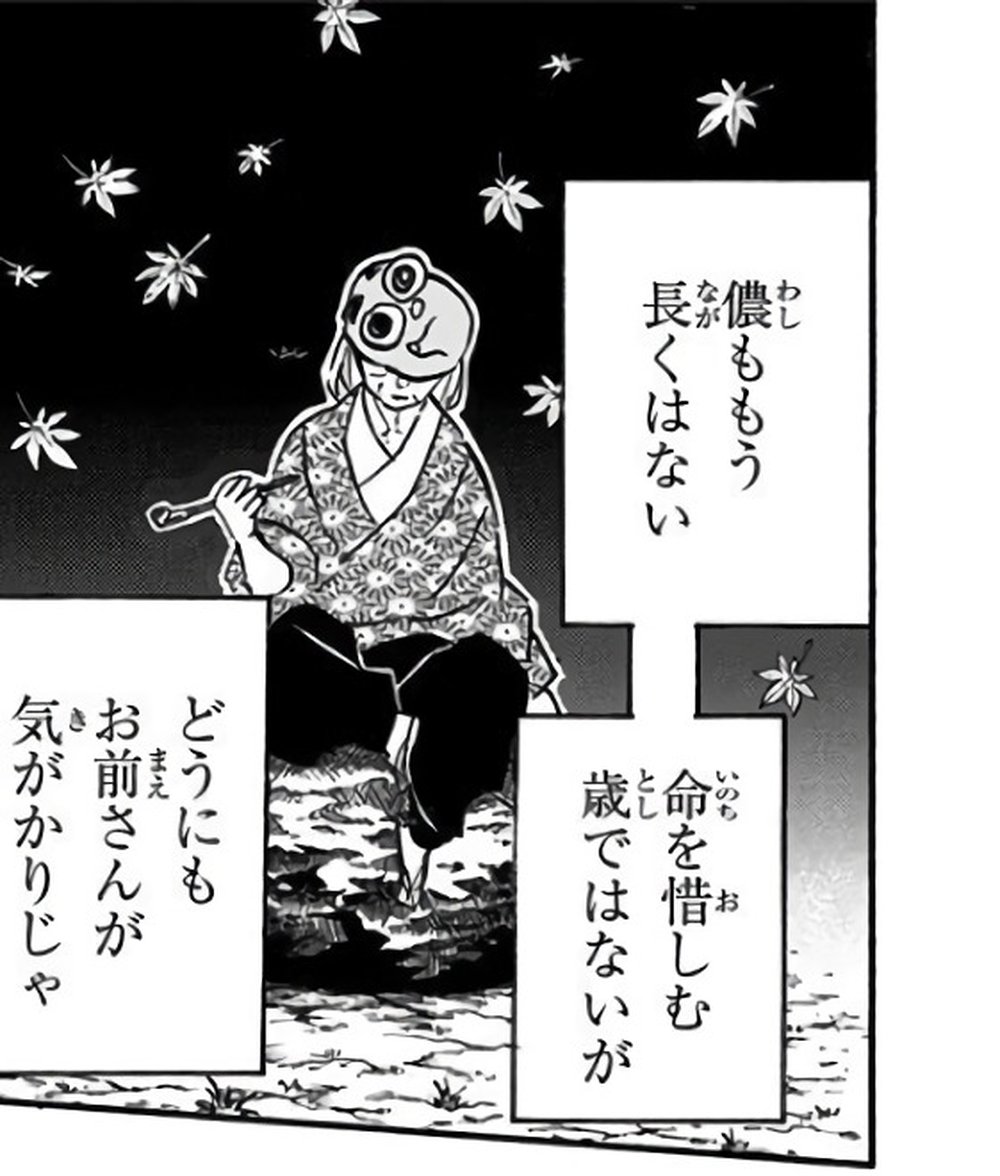
Deep in the Swordsmith Village arc, Jigoro Kuwajima — retired Thunder Breathing master, trainer to both Zenitsu Agatsuma and the traitor Kaigaku — has decided his life is over. The corps' first-ever demon came out of his own line of students, and he intends to answer for it. A page earlier, Mitsuri Kanroji and Genya learn how Zenitsu's first swordsmith, Tetsuido, died young of heart disease, never living to see the boy he equipped grow up. Now, alone at night under a rain of maple leaves, Kuwajima addresses that dead man's memory:
「儂ももう長くはない 命を惜しむ歳ではないが どうにもお前さんが気がかりじゃ」
Washi mo mō nagaku wa nai. Inochi o oshimu toshi de wa nai ga, dō ni mo omaesan ga ki ga kari ja.
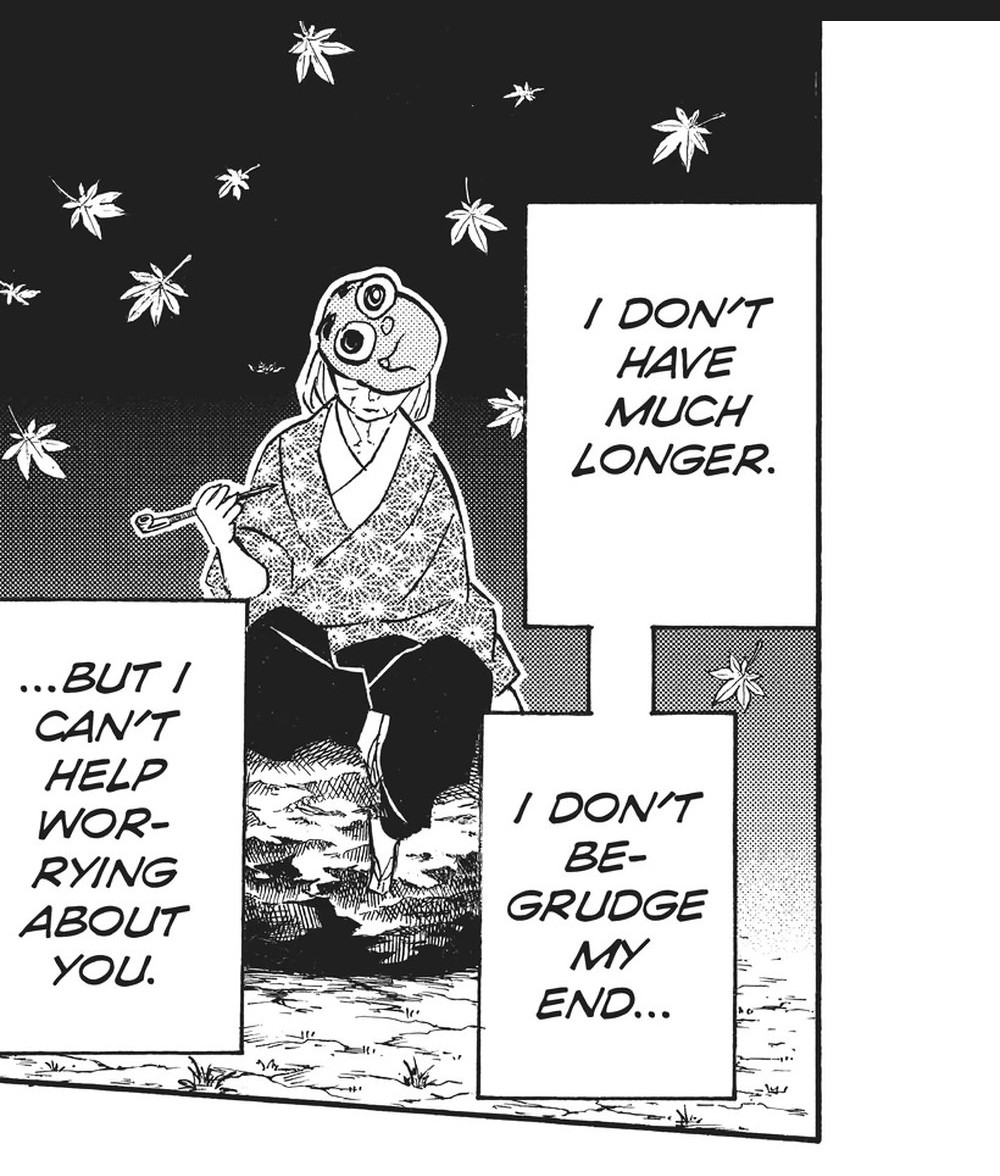
VIZ's English edition prints: "I DON'T HAVE MUCH LONGER. ...BUT I CAN'T HELP WORRYING ABOUT YOU. I DON'T BEGRUDGE MY END..." (Vol. 14, p.81).
Grant the rendering its due: the line breaks are placed with real care, the plainness is intentional, and "I don't have much longer" is exactly what a tired, resolved man says — no more, no less. Nothing here is wrong. But sound out the Japanese and the English side by side and one word goes missing that never had a chance to survive translation in the first place: 儂, read わし. It is doing more work in that sentence than any of the words VIZ actually translated.
The Original
儂 is a single kanji standing in for an entire word — nothing to split apart, unlike a compound. It's a phono-semantic character: 亻, the "person" radical, supplies the meaning class (a self, a person), while 農 (nō, "tiller, agriculture") supplies the historical sound. Related graphs meaning "I" or "this person" appear in old Chinese dialect poetry; the character had been doing first-person duty for centuries before Japanese ever adopted it — purely to write the native pronoun わし, a rougher, contracted cousin of わたくし/わたし, built on the same わ- root you already know from 我 (ware) and 我々 (wareware).
Once you have the pronoun, the rest of the line is almost nothing: 儂 (I) + も (too, also) + もう (already) + 長くはない (won't be long) — "I, too, already, won't be long [for this world]." Four completely ordinary words. The one irregular choice in the sentence is the pronoun deciding, unassisted, to sound eighty years old.
This is 役割語 (yakuwarigo, "role language") — linguist Satoshi Kinsui's term for the pronoun-and-copula bundles Japanese fiction uses to stamp a character's age, gender, and class onto a line before the content even lands. わし is the standard textbook example of 老人語 (rōjingo, "old-man speech"): grammatically no ruder than 私, but unmistakably aged and male on contact. The genuinely strange part, which Kinsui himself points out, is that real elderly Japanese speakers mostly don't talk this way — they say わたし or わたくし like everyone else. わし is a fictional convention so consistent across a century of storytelling that it now feels more like "how old men talk" than the demographic reality it was never accurately describing.
Kuwajima's grammar stays gentle throughout this line — はない, not the blunter じゃない — but の は particle work and the quiet も (comparing his own dwindling time to Tetsuido's, dead too young) carry real feeling. And two lines later, in the same breath, the copula shifts: どうにもお前さんが気がかりじゃ — わし's regular grammatical other half, the old-man だ. Two role-language markers, stacked in five lines, doing character work that no summary of the plot would ever mention. Chase the meaning, not a JLPT number: 儂 sits outside the Jōyō kanji list entirely, but functionally it reads at a colloquial N4 level — a beginner meets it in volume one of almost any manga with an old man in the cast and never needs it explained twice.
VIZ's Choice
Every verified 儂/ワシ occurrence we can confirm on the page, across the volumes on file, speaker by speaker:
| Vol. / p. | Speaker | Japanese | VIZ English |
|---|---|---|---|
| 1 / 95 | Sakonji Urokodaki | 儂は鱗滝左近次だ | I AM SAKONJI UROKODAKI. |
| 1 / 114 | Sakonji Urokodaki | 儂は〝育手〟だ | I AM A TRAINER. |
| 12 / 70 | Tecchin Kotetsukawahara | ワシこの里の長の鉄地河原鉄珍 | I'M THE CHIEF OF THIS VILLAGE—TECCHIN TECCHI-KAWAHARA. |
| 14 / 81 | Jigoro Kuwajima | 儂ももう長くはない | I DON'T HAVE MUCH LONGER. |
| 17 / 73 | Jigoro Kuwajima (spirit) | お前は儂の誇りじゃ | I'M PROUD OF YOU. |
Compare this to the scatter in our One Piece 因縁 piece, or the wrong-direction convergence in 往生しろ・成仏してください: this table shows neither. It shows total uniformity — five appearances, three speakers, across a comic self-introduction, a mission statement, a deathbed confession, and a line spoken by a ghost, and every single one resets to unmarked English "I" or "I'm." Urokodaki's stern 儂 in the very first volume of the series and Kuwajima's dying 儂 sixteen volumes later are typeset identically on the Japanese page and land identically flat in English. Tecchin's katakana ワシ — a register notch folksier, Kansai-flavored, comic — reads no differently in translation than either of them. The word never had a foothold to lose unevenly; it simply had no foothold anywhere in English to begin with.
The Gap
No pronoun family to reach for. English's "I" serves a six-year-old and a ninety-year-old with the same three letters. Japanese fiction runs an entire character-identification system through pronoun choice alone — 儂 versus 俺 versus 僕 versus あたし tells a reader who's talking before the sentence finishes — and none of it has an English shelf to sit on. The translator's only real move is to relocate the cue into word choice or let it go quietly, and here it goes quietly.
The kanji/katakana grading disappears. Gotouge draws a line between solemn 儂 (Urokodaki, Kuwajima) and folksy ワシ (Tecchin) purely through typesetting — real to any reader's eye, a distinction with zero grammatical content and zero English orthographic equivalent. Both spellings become identical "I"/"I'm," so a dying master and a giggling comic-relief chief speak the same register in translation, though they never do in the original.
Continuity across death goes silent. Kuwajima's ghost says 儂の誇りじゃ in Volume 17 with the exact pronoun he used while dying three volumes earlier — the word itself is proof that it's still him, unnamed, addressing Zenitsu from wherever spirits speak from. "I'M PROUD OF YOU" could be anyone's line. Only the drawn face tells the English reader who's talking; the Japanese sentence already told its reader on its own.
What If
No option here is free — a look at the bill for each:
- "Reckon I ain't got much longer." — folksy, non-standard grammar restores an age-coded voice through dialect. Cost: it's a specific American regionalism transplanted onto a Taisho-era Japanese man — the wrong country's old man.
- "This old man hasn't got long left." — spells the age cue out directly so no reader can miss it. Cost: 儂 doesn't mean "old man," it just sounds like one; naming the effect trades an implicit cue for an explicit one and loses the economy of a single loaded syllable doing all that work silently.
- "I haven't much longer, I'm afraid." — a mild, elder-coded English understatement that keeps the resignation. Cost: "I'm afraid" is a politeness hedge the flat, tired Japanese never reaches for, and the construction reads distinctly British in a story that is not.
- Keep VIZ's line exactly as printed, and let the art carry the rest. Cost: an honest concession rather than a fix — some register information may simply be undeliverable in prose alone and has to be recovered from Kuwajima's drawn face and posture, not his words.
The deeper lesson: every fix above either imports a foreign regional voice or explains the joke instead of telling it. That is what happens when a language's entire age-and-gender pronoun system meets a language that only kept one pronoun for everybody.
Take-away
儂/わし does no grammatical work at all — swap in 私 and every sentence in this article still parses. Its entire job is to tell a Japanese reader, instantly and for free, that an old man is talking. English's "I" cannot do that job under any circumstances, so the translator's only real choice is where else in the sentence to hide the clue, or whether to let the art carry it alone.
Three rules of thumb to carry off this page:
- A pronoun can be pure character data, with zero semantic content. When 儂, おいら, 拙者, or あたい show up, they are naming a speaker's age, gender, and background before the verb even arrives — read them like a stage direction, not a word.
- Kanji versus katakana on the exact same pronoun is itself a register choice. 儂 and ワシ say the same word and sound like different people; watch for a mangaka switching a character's own spelling mid-series as a tonal shift.
- A role-language pronoun surviving into death is a authorship signature, not a coincidence. If a spirit, a flashback, or a photograph "speaks" in the same pronoun a character used alive, that's the writer confirming identity through voice alone — worth noticing even when the plot never says so directly.
For this same first-person-pronoun cluster from its other angles, see This Insignificant Self's Prey: 小生 (a demon's bookish, self-effacing "I") and A Trainful of Country Boys: おいら (young and rustic, the opposite pole from this article's old men). For the "you" that completes the same register spectrum, see Too Polite to Say Your Name: 貴方. And for this exact death scene read through its ritual grammar instead of its pronoun, see Borrow the Ritual, Translate the Mercy: 切腹・介錯 — Zenitsu narrating the very night this article's headline panel comes from. わし's formal-register opposite lives one work over: Naruto's ninja dog Pakkun growls 拙者, the archaic samurai's humble "I," out of the same yakuwarigo wardrobe pointed at a different axis entirely. Or browse the Demon Slayer translation notes index.
Every Japanese and English line quoted above is a byte-exact capture from the cited editions — 鬼滅の刃 Vol. 1, 12, 14, 17 (Japanese) and Demon Slayer: Kimetsu no Yaiba (VIZ Media) at the corresponding panels — via our bilingual page database; see Sources below.