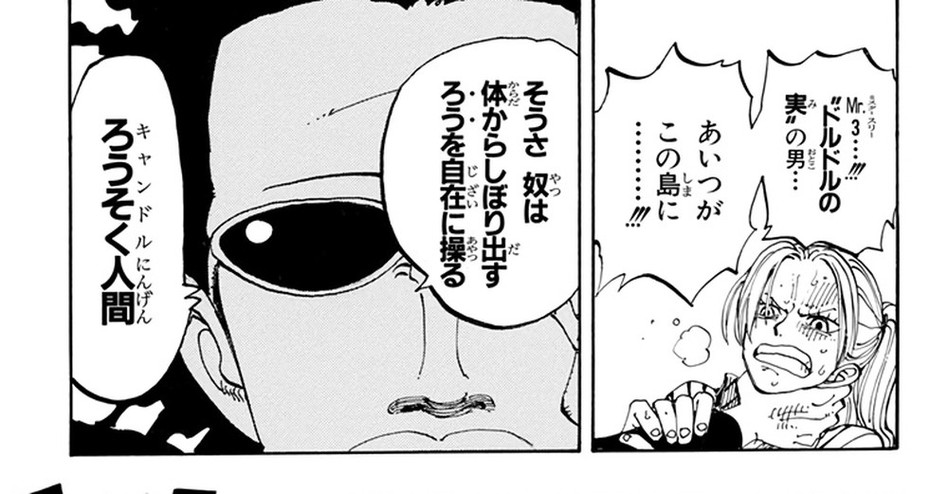
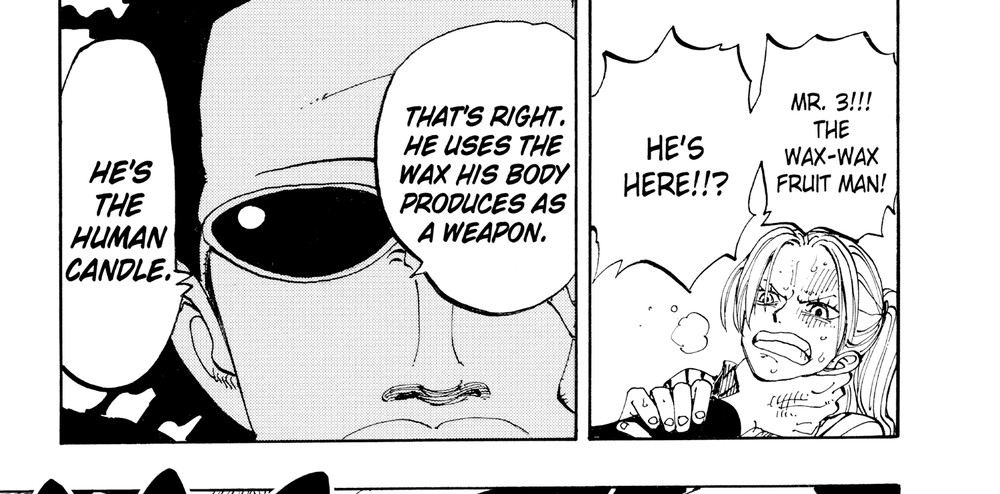
Mr. 3's fruit is the most translationally boring entry in this dictionary, and that is worth pointing out precisely because every other entry here has at least one wobble. Across ten corpus citations spanning Vol. 14 (his debut arc on Little Garden), Vol. 18–19 (the Baratie/Arlong stretch, referenced retroactively), and Vol. 54–56 (Impel Down, where Galdino resurfaces as an escaped convict helping Luffy), VIZ never once deviates from "Wax-Wax Fruit" or the compound "Wax-Wax [X]" attack-naming pattern: Wax-Wax Arts, Wax-Wax Art Harpoon, Wax-Wax Ball, Wax-Wax Release. Compare that to Buggy's Bara-Bara (Chop-Chop Cannon vs. Chop-Chop Harpoon for the same move, three pages apart) or Foxy's Noro-Noro ("Slow-Slow Beam" rendered at least four different ways within forty pages) and the contrast is stark — this is what disciplined series-Bible translation looks like when it works.
That consistency is doing real narrative work, too. Mr. 3's power reappears eight volumes and roughly 800 pages after his introduction, when Galdino turns up at Impel Down (Vol. 56, p.88) and re-identifies himself unprompted: "THAT'S RIGHT. I'M A WAX MAN. I ATE THE WAX-WAX FRUIT!" A reader picking the series back up after a long gap gets the exact same vocabulary they learned in Vol. 14 — no retranslation, no rebranding. It is a small thing, but it is the kind of continuity that lets a 1,000+ chapter series still read as one coherent story in English.
The fruit's name itself sits at an interesting distance from its power. Unlike バラバラ (already means "in pieces") or ノロノロ (already means "slow"), ドルドル isn't a word Japanese readers would recognize on sight — it has to be inferred from context, the same way English readers infer "Wax-Wax" only once they see candle wax pouring out of Mr. 3's palms. Both languages ask the reader to learn the word from the scene rather than bringing pre-loaded meaning to it, which may be part of why the translation never had reason to drift: there was no competing "obvious" gloss to second-guess.