Robin's baseline register is the outlier among the Straw Hats: even fighting, even joking, she defaults to 敬体, the polite です/ます conjugation most of her crewmates reserve for strangers or superiors. It isn't submissiveness — it's armor. A woman who spent two decades being hunted learns to sound like she's never rattled, and keigo is the easiest way to sound unrattled in Japanese: it puts a measured distance between the speaker and whatever she's saying, whether that's small talk or a threat. When she tells a defeated Alabastan spy 「くだらない質問しないで...あなたはただ案内をすればいい」— "don't ask stupid questions, just take me there" — the politeness of her surrounding speech makes the line colder, not warmer.
Her other signature marker is 〜かしら — the soft, musing sentence-ending that reads as feminine, slightly old-fashioned curiosity in most speakers, and that Robin bends toward two completely different effects. In Alabasta, working Crocodile's organization as Miss All Sunday, she uses it for what this site calls dark deadpan: cheerfully unbothered commentary on violence she's either committed or about to. Confronted over beating an Alabastan guard, she doesn't deny it — she asks 「あなた達がうちの社員達にしたこととどう違うのかしら」, "how's that any different from what you did to my men, I wonder," turning an accusation back on her accuser with a question mark instead of an exclamation point. Cornering another opponent she needs information from, she delivers 「あなたの命運も...ここまでかしらね」— "your luck's run out here, I suppose" — VIZ's flat "YOUR LUCK HAS RUN OUT" trades away exactly the thing かしら was doing: turning a death sentence into idle speculation, as if she's mildly curious how it'll go rather than the one deciding it. That かしら register is famous enough in-universe that two volumes later another character does a "Robin impression" by simply appending it to a worried sentence about Nami — Oda flagging, mid-story, that かしら has become her voice's fingerprint.
The same ending does entirely different work once the crew is family rather than cover. Post-timeskip, alone after two years training with the Revolutionary Army, she has a rare unguarded moment of self-address: 「誰かの為に強くなりたいなんて考えた事もなかった...ルフィ..あなたのお父さんの下で世界の流れに身を投じれば...少しは強くなれるかしら」— "I never once thought about wanting to be strong for someone else... Luffy... if I throw myself into the world's current under your father, will I grow a little stronger, I wonder." VIZ's "WILL I BE ABLE TO GROW STRONGER BY SEEING THE WORLD THROUGH YOUR FATHER'S EYES?" is a fair, readable line, but it swaps her literal image — 身を投じる, throwing her whole body into history's moving current, the same verb used for someone jumping into a river — for the gentler "seeing through his eyes." The かしら survives as a question mark; the physical risk of the metaphor underneath it doesn't. It's the same soft ending as her Alabasta threats, aimed inward for once instead of at an enemy — proof the grammar itself is neutral, and the menace or vulnerability was always coming from what she chose to wonder about.
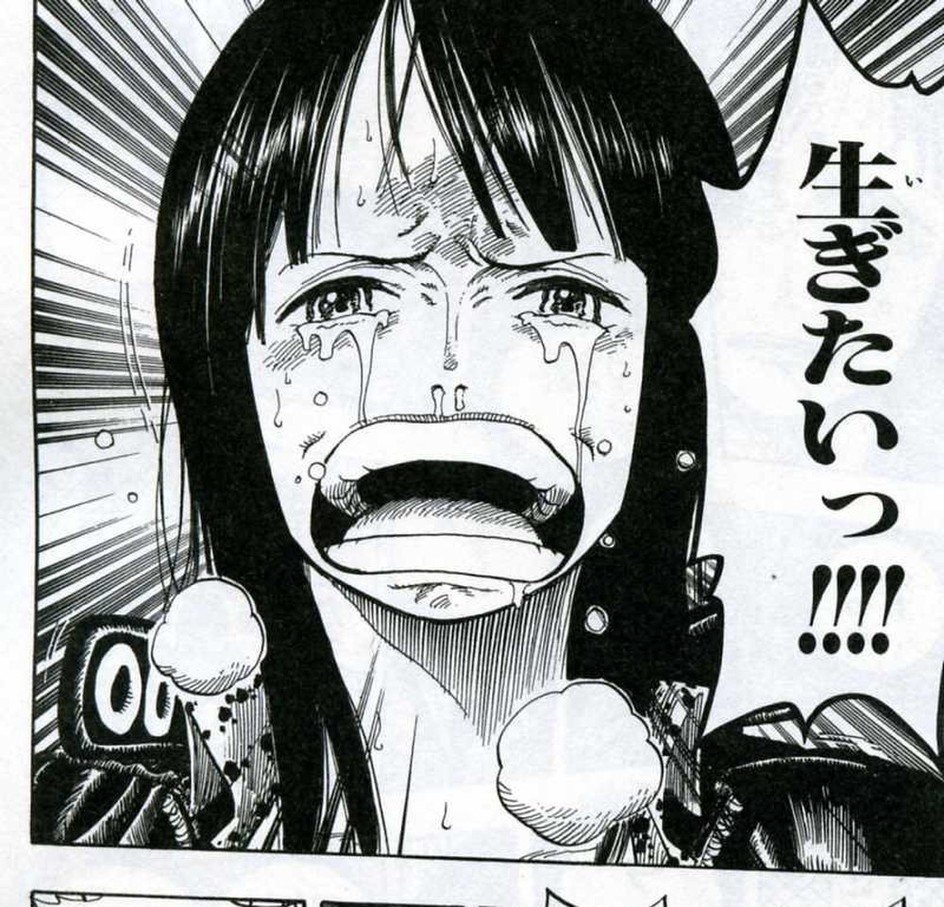
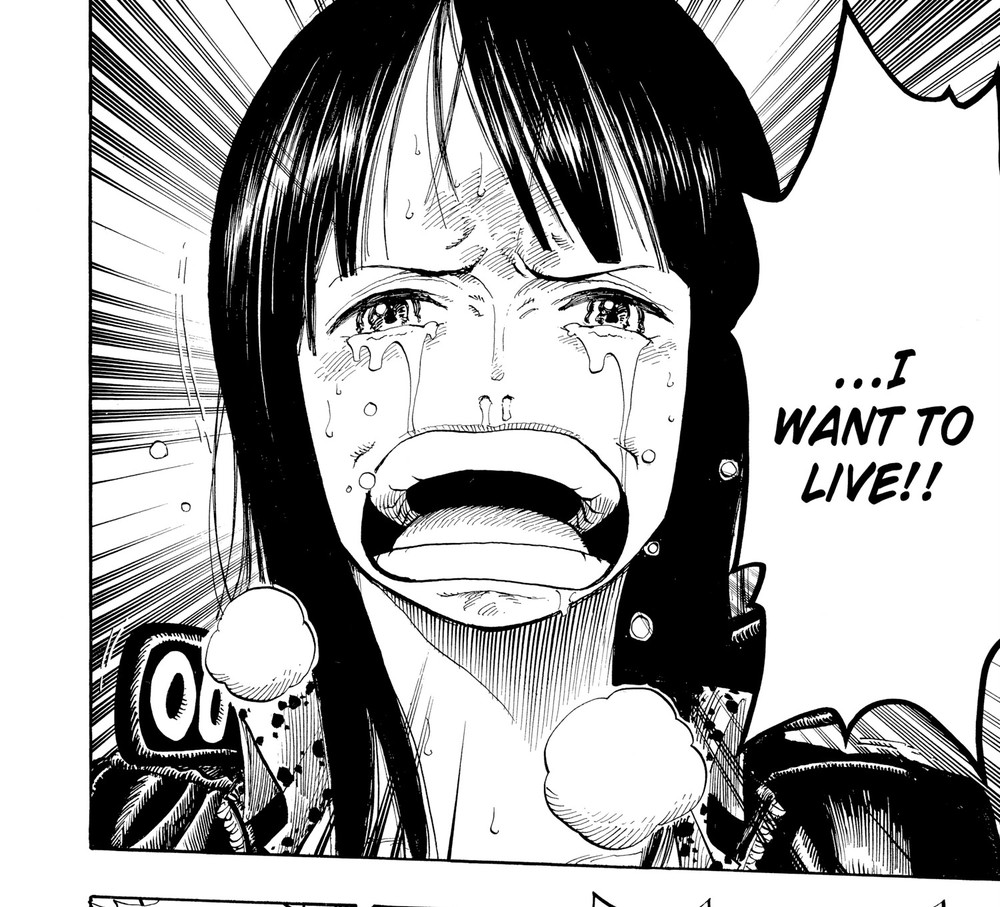
All of that register discipline exists to make one scene land, and it's the reason this page's anchor quote has almost none of it. At the climax of Enies Lobby, twenty years of civil unstoppable politeness and mask-perfect かしら collapse into six words with no です, no わ, no hedge: 「生ぎたいっ!!!!」— "I want to live!!" Oda even misspells it for her: the printed page voices き into ぎ — 生ぎたい, a sound-symbolic dakuten that spells the sob directly into the verb, the way manga sometimes voices a syllable to show a voice breaking mid-word. VIZ's "...I WANT TO LIVE!!" can carry the volume but not the crack. It's the plainest sentence she's said in the entire corpus, and it's plain because Luffy has just spent a page screaming at her to drop the register — 「生きたい」と言えェ!!!言えェ!!!, "SAY THAT YOU WANT TO LIVE!" — refusing to accept the polite self-erasure she'd built her whole survival strategy on. Her reply the moment before, 「もし本当に少しだけ望みを言っていいのなら...私は」— "if I'm really allowed to make just one small wish... I—" — is still hedged, still asking permission with the conditional もし; the scream itself has none of that left. For the answer waiting on the other side of a plea like this, see how Luffy meets Nami's own eight-years-silent request for help with a single unhedged word in the same arc — two different women, two different grammars of asking, one crew that answers both without qualification. Robin's Devil Fruit attack names carry a softer, more theatrical version of the same distance her speech keeps: 「フルール〝百花繚乱〟」and 「クラッチ」— half-French botanical names and bare English loanwords stapled onto plain katakana — read as costume, a fighting style with its Hana Hana no Mi dressed in language as composed as everything else about her, right up until the one page where it isn't.
Even her enemies clock the same detached, needling register from the outside: in the Skypiea arc, Satori sneers 「許さないとは.....恐れ入る...」at her open defiance — a self-lowering keigo verb weaponized into sarcasm, which this site tracks in full in 恐れ入る, the humble verb English keeps splitting into thanks, apology, and being impressed. It's a small, telling detail that the word for "being awed into humility" gets aimed at Robin specifically: even a man trying to kill her reaches for a keigo verb to describe her composure.