The Moment
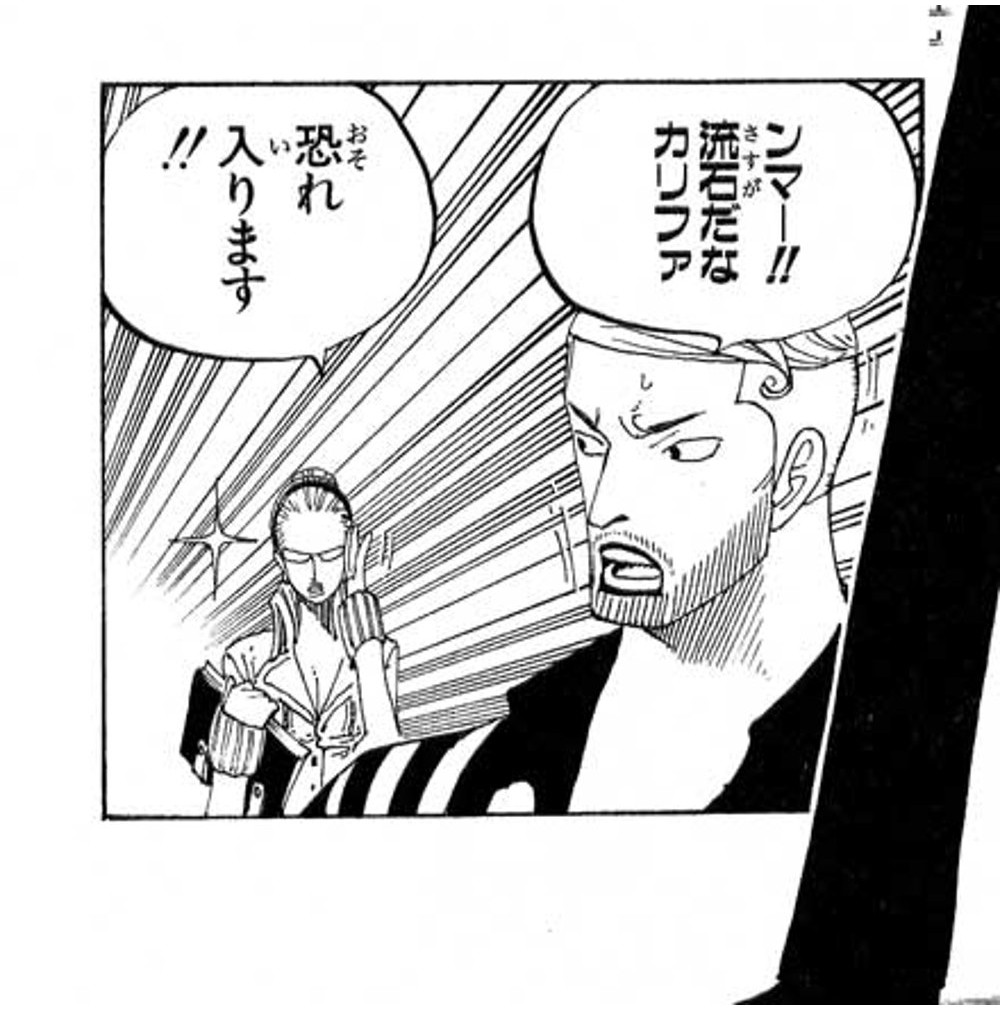
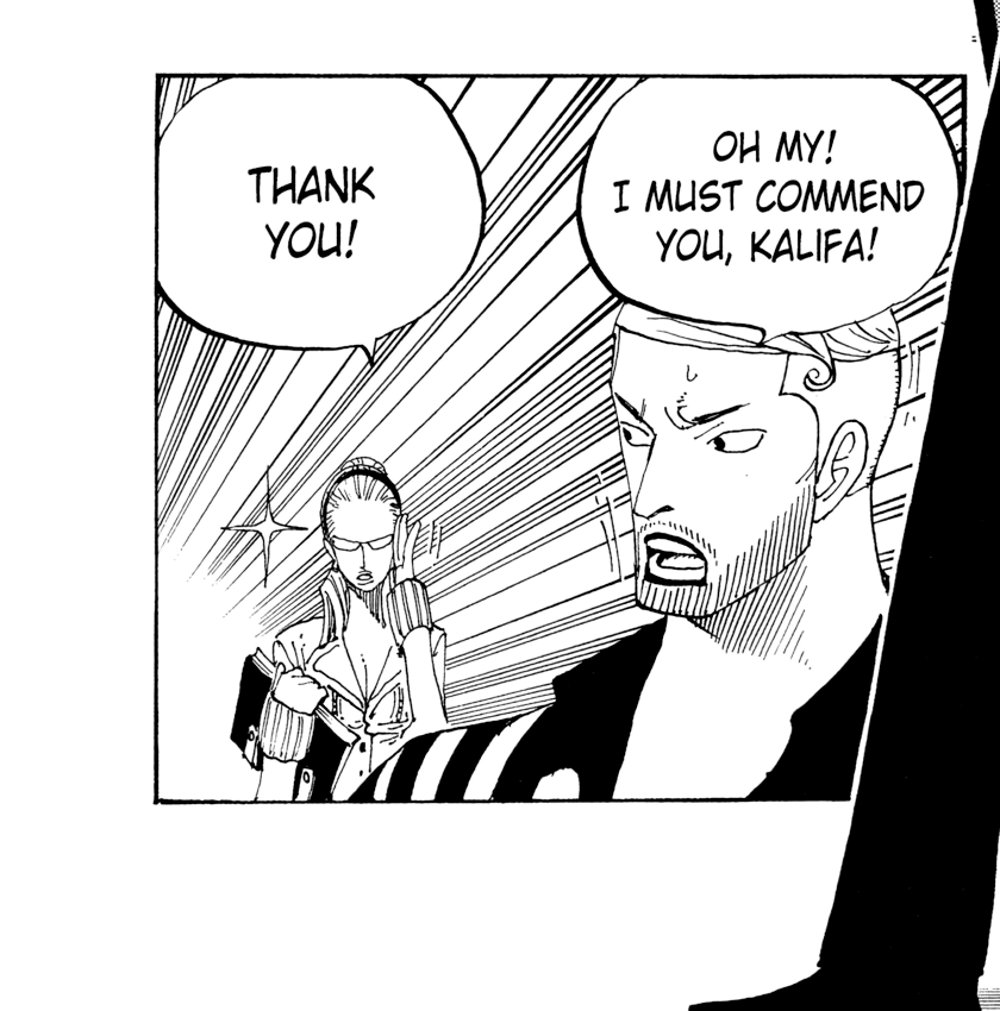
Water Seven, outside the Galley-La Company mansion — the same building, the same two people, as this series' companion piece on 無礼者. Iceberg, the town's mayor and Galley-La's company president, has just adopted a stray mouse mid-conversation with his secretary and is workshopping a name for it: そしてこのネズミはさっき拾った名前は..そうだな “ティラノサウルス! — "AND I JUST PICKED UP THIS PET MOUSE. ITS NAME IS... WELL... TYRANNOSAURUS." He turns the moment into an assignment — エサとカゴを用意せねば, "I'LL NEED SOME RODENT FOOD AND A CAGE" — and Kalifa, portfolio in hand, has already anticipated him: 手配済みですアイスバーグさん!!, "IT'S ALL PREPARED, MR. ICEBERG!" Iceberg turns, genuinely pleased:
「ンマー!!流石だなカリファ!!」
Nmā!! Sasuga da na, Karifa!!
"OH MY! I MUST COMMEND YOU, KALIFA!" Kalifa lowers her head, composed as ever, and answers with two words:
「恐れ入ります!!」
Osoreirimasu!!
VIZ's English edition prints: "THANK YOU!" (Vol. 34, p.198).
Grant the rendering its due first: "thank you" is exactly the right length, register, and emotional temperature for a two-beat exchange between a boss and a composed subordinate. It isn't a bad translation of anything Kalifa is FEELING. What it can't hold is what Kalifa is DOING, grammatically: not simply thanking Iceberg, but performing a small, reflexive act of shrinking — placing herself, for one beat, below the man who just praised her. 恐れ入る means, at the root, "to enter fully into awe." Kalifa isn't only grateful. She's letting the compliment overwhelm her, on cue, the way a well-trained secretary is supposed to.
The Original
恐れ入る (osore-iru) fuses two pieces, and both are worth owning.
恐れ (osore) is the noun form of 恐れる, "to fear, to be afraid of, to be awed by" — the same root sitting inside 恐怖 (kyōfu, "terror"), 恐ろしい (osoroshii, "frightening"), and 恐竜 (kyōryū, "dinosaur," literally the "fear-dragon"). This is real fear vocabulary, not a bleached-out politeness marker.
入る here is read いる, not the everyday はいる ("to enter"). This いる is a separate, more literary reading that Japanese bolts onto the stem of another verb as an intensifying auxiliary, meaning roughly "to enter fully into [that state], to be completely overtaken by it." The same いる shows up in 感じ入る (kanji-iru, "to be moved to the very core"), 恥じ入る (haji-iru, "to be utterly ashamed"), and in the thoroughly everyday 気に入る (ki ni iru, "to strike one's fancy" — literally "to enter into one's spirit/mood"). If you already know 気に入る, you already own half the grammar behind 恐れ入る.
Put the pieces back together and 恐れ入る is literally "to enter fully into fear/awe" — to be so overwhelmed by someone's kindness, rank, or sheer nerve that you visibly shrink. From that one physical image, the word's whole semantic spread follows naturally and without contradiction: overwhelmed by someone's KINDNESS toward you → gratitude ("I'm much obliged"); overwhelmed by the IMPOSITION you're placing on someone → apology ("I'm terribly sorry to trouble you"); overwhelmed by someone's SIZE, skill, or audacity → being impressed ("that's remarkable"). English sorts these into three unrelated speech acts, filed under three unrelated words. Japanese files all three under one act: being awed into humility. Context — not vocabulary — tells a listener which flavor is in play.
Grammatically, 恐れ入ります is simple: the polite ます-form of a plain godan verb, nothing irregular about the conjugation. What makes it interesting sits one level up. It isn't a substitute-verb the way 召し上がる or いらっしゃる are — those two REPLACE a plain verb (食べる, いる/来る/行く) outright to elevate someone else's action. 恐れ入る describes the SPEAKER'S OWN interior state instead: I am the one who has entered into awe. That makes it kenjōgo-adjacent — self-lowering rather than other-raising — even without belonging to the small closed list of true kenjōgo verbs like いただく or 申す. Business-Japanese materials commonly place it around N2, sometimes filed under N1 when a course treats keigo set-phrases as their own advanced category.
VIZ's Choice
Five appearances of 恐れ入る/恐れ入ります across the volumes on file, side by side with VIZ's English:
| Vol. / p. (JP → EN) | Speaker | Japanese | VIZ English |
|---|---|---|---|
| 5 / p.134 | Usopp, boasting after a lucky cannon shot | 恐れ入ったらおれをキャプテンと呼んでいいぜ | IF YOU'RE IMPRESSED, JUST CALL ME "CAPTAIN." |
| 5 / p.185 | A Baratie waiter, working up to an awkward question | お客様「へボイモおそれ入ります」が [代金はお持ちで?] | PARDON, MON-SEWER, BUT... [...CAN YOU PAY?] |
| 29 / p.18 → p.16 | Satori, mocking Nico Robin's defiance | 許さないとは.....恐れ入る... | YOU WON'T FORGIVE ME? HOW BRAVE. |
| 31 / p.173 → p.170 | Ohm, needling Luffy's climb with an iron weight chained to his leg | あの重りをつけたままとは恐れ入る...!? | IMPRESSIVE THAT HE GOT UP THIS FAR WITH THAT BARREL WEIGHING HIM DOWN. |
| 34 / p.189 → p.198 | Kalifa, accepting Iceberg's praise | 恐れ入ります!! | THANK YOU! |
Group these five by facet and a pattern falls out immediately. One occurrence (Kalifa) reads as pure gratitude. One (the waiter) reads as an apology cushioning a demand — お客様「ヘボイモおそれ入ります」が代金はお持ちで? roughly means "Sir, terribly sorry, but — can you pay?", and "PARDON, MON-SEWER, BUT..." catches that cushioning function almost perfectly, right down to the trailing "but." The remaining three all sit in the "impressed" family — and even within that one family, VIZ never repeats itself. Usopp's line is reflexive and boastful: 恐れ入ったら, "if you [find yourself] awed," turned into a taunting condition — "IF YOU'RE IMPRESSED, JUST CALL ME 'CAPTAIN.'" Ohm's line is a flat, almost admiring adjective: "IMPRESSIVE THAT HE GOT UP THIS FAR." And Satori's line — 許さないとは.....恐れ入る..., aimed at a defiant Nico Robin who has just refused to forgive him — drifts furthest of all, landing on "HOW BRAVE," a word about courage that has quietly replaced a word about awe.
That last jump is worth sitting with. "Brave" isn't a mistranslation of the scene's tone — Satori is being sarcastic either way — but it is a translation of a different word. 恐れ入る in his mouth is weaponized humility: he is performing the vocabulary of being overwhelmed by someone's admirable defiance while his intent is pure contempt, the register clash doing the sarcastic work. "How brave" gets the contempt across using an entirely different mechanism — praising the ACT (bravery) rather than ironically confessing to being AWED by it. Two ways to be sarcastic; only one of them is what 恐れ入る is actually built to do.
The Gap
The self-lowering vanishes. 恐れ入る isn't grammatically about the listener at all — it's a first-person confession of having been overwhelmed. "THANK YOU!" is polite, but it's polite in English's ordinary way: a gesture outward, not an admission of having shrunk. The direction of Kalifa's small bow — I have entered into awe of you — disappears the moment the sentence becomes a plain expression of thanks.
恐れ, the fear at the root, survives in none of the four English solutions. "Thank you," "pardon... but," "impressive," and "how brave" are all comfortable, socially warm English phrases. None of them carries so much as a trace of the somatic image underneath 恐れ入る: being physically overpowered by someone else's kindness, size, or nerve. The word that gave 恐竜 its name (the "fear-dragon") is doing quieter, gentler work here — but it's still the same fear, and English drops it every time.
"Impressed" itself splinters into three unrelated ideas. Usopp, Ohm, and Satori all use the identical verb, 恐れ入る, to mean roughly the same thing — grudging or gleeful awe at someone's performance. VIZ answers with a taunt ("IF YOU'RE IMPRESSED"), a flat adjective ("IMPRESSIVE"), and an entirely different virtue ("HOW BRAVE"). A word that repeats itself three times in Japanese never repeats itself once in English — proof that VIZ isn't scattering a hard word inconsistently so much as solving three genuinely different English sentences from three identical Japanese ones.
Sarcasm loses its specific engine. Satori isn't merely being rude to Robin; he's dressing contempt in the clothes of formal humility, using a self-lowering verb to fake being impressed by someone he intends to kill. "HOW BRAVE" keeps the sarcasm but swaps the machinery — praising a virtue rather than ironically confessing awe. The insult survives. The specific, keigo-shaped weapon Oda hands Satori does not.
What If
For Kalifa's line, the menu and its prices:
- "You flatter me!!" — keeps the self-deprecating shrinking-before-praise. Cost: reads slightly coy or flirtatious in English, a register 恐れ入ります doesn't carry here.
- "I'm honored, sir!!" — keeps the awe and the self-lowering direction. Cost: drops the apology-adjacent humility; sounds purely grateful, with none of 恐れ入る's built-in awkwardness at being praised at all.
- "Not at all, sir — you're too kind!!" — the natural English move for deflecting a compliment, functionally close to what Kalifa is doing. Cost: nearly doubles the word count for a two-beat manga line, and adds an explicit self-negation ("not at all") that isn't literally present in the Japanese.
- VIZ's actual choice, kept as printed: "THANK YOU!" — compact, natural, correctly polite. Cost: it's a "thank you" any two equals could exchange; nothing marks that Kalifa has just performed a small, reflexive act of self-lowering in front of her employer.
Notice the shape of the trade every time: English can recover the gratitude, or the awe, or the self-lowering — never quite all three in one breath, because 恐れ入る was never really saying just one of them to begin with.
Take-away
恐れ入る is what Japanese reaches for whenever a speaker needs to shrink — before someone's kindness, before an imposition they're making, before someone's nerve or skill — and lets the listener's context decide which shrinking is meant. English keeps thanks, apology, and admiration in three separate boxes; Japanese keeps them in one humble verb built on real fear.
Three rules of thumb to carry off this page:
- 恐れ入る always points inward, never outward. Unlike 召し上がる or いらっしゃる, which elevate someone else's action, this verb reports the speaker's own state of being overwhelmed. When you meet it, ask what's doing the overwhelming — kindness, imposition, or nerve — before picking an English equivalent.
- The 〜入る pattern is a reusable intensifier, not a one-off. 感じ入る, 恥じ入る, 気に入る, 痛み入る — once you've spotted いる riding on another verb's stem, you can read "fully entering that state" into all of them.
- A humble verb can be sincere or a weapon — the grammar won't tell you which. Kalifa's 恐れ入ります and Satori's 恐れ入る are the identical word aimed in opposite directions; only the scene tells you whether someone is bowing or sneering.
This piece continues the keigo cluster opened by いらっしゃいませ and the sonkeigo greeting VIZ turned into "Welcome, squid-face" and 召し上がる and the deference English can't conjugate — 恐れ入る is the third verb from that same textbook chapter, with 存じる, the humble verb for "to think/know," still to come. More translation notes at the One Piece translation notes index.
Every Japanese and English line quoted above is a byte-exact capture from the cited editions — ONE PIECE Vol. 5, 29, 31, 34 (Japanese) and One Piece (VIZ Media) at the corresponding panels — via our bilingual page database; see Sources below.