Glossary · Giyu Tomioka
鬼殺隊
Demon Slayer Corps
The demon-hunting organization — literally the "demon-killing corps" — that Giyu serves as Water Hashira and Tanjiro joins on his advice.
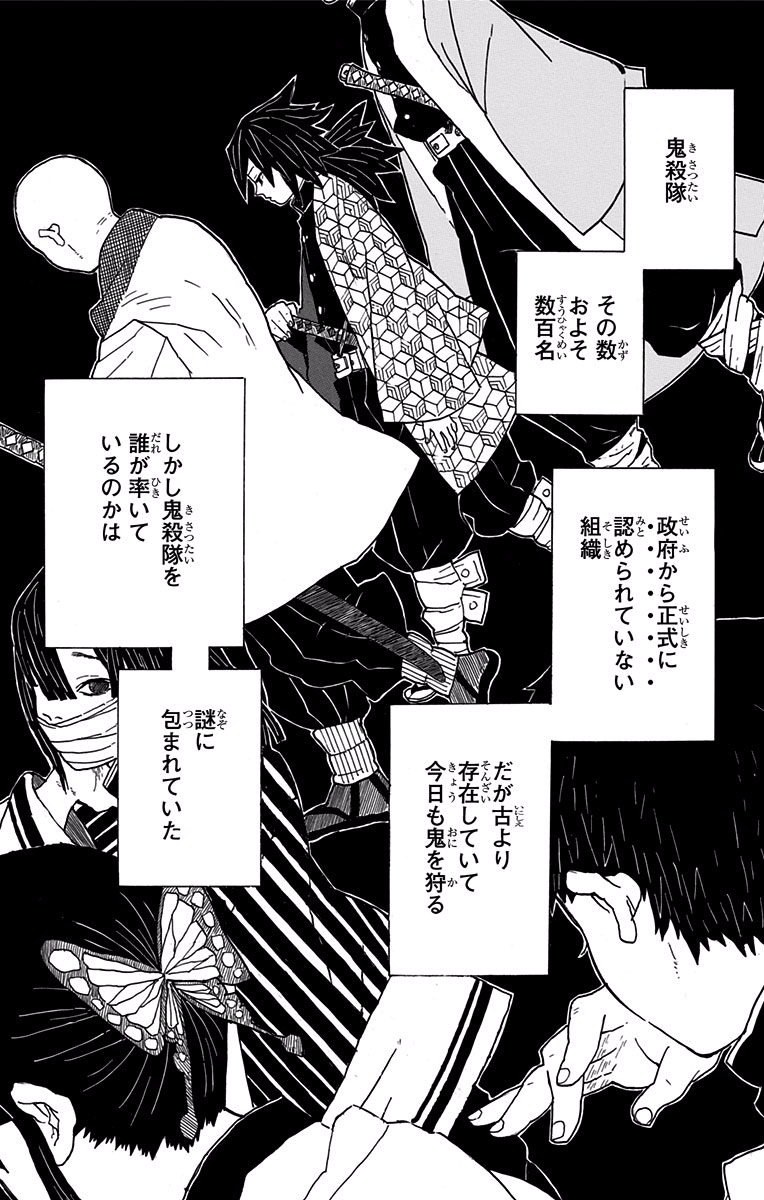 鬼滅の刃 第1巻 p.112 ©吾峠呼世晴/集英社
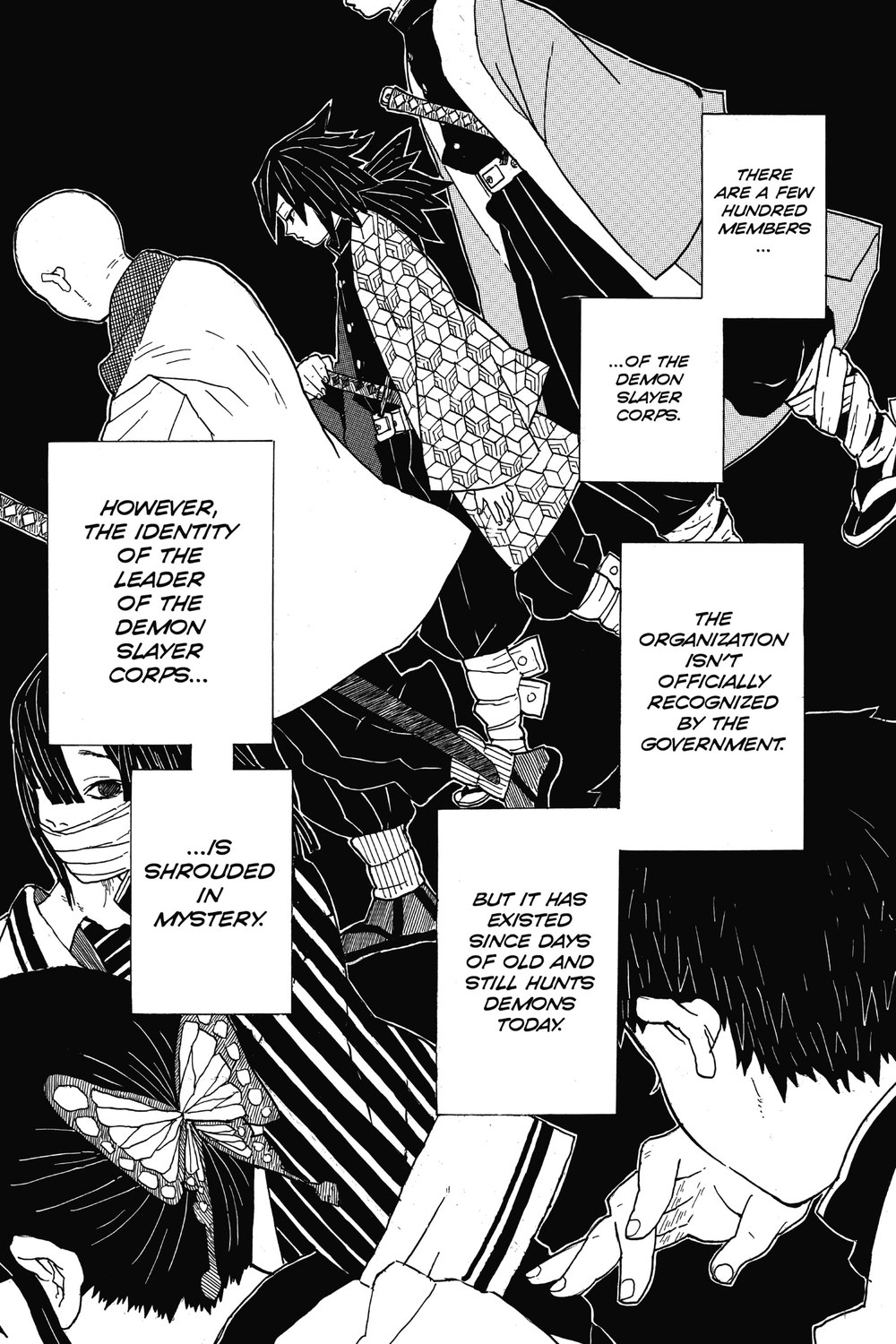 Demon Slayer: Kimetsu no Yaiba Vol. 1 (VIZ Media), p.112 ©Koyoharu Gotouge / Shueisha · VIZ Media
For the first three chapters, the organization Giyu serves has no name. Old Saburo, sheltering Tanjiro for the night, credits the safety of the dark roads to onigari-sama (鬼狩り様, "the honored demon hunters"): a folk word with an honorific stuck on it, the way you talk about something you only half believe in (Vol. 1, p.16; VIZ has "demon slayers"). The institution itself is finally named at the opening of Chapter 4, across a black full-page montage of silhouetted swordsmen — Giyu among them, recognizable by the geometric-pattern haori: 鬼殺隊, with furigana supplied. Kisatsutai.
How to read it (and how not to)
The compound parses as 鬼殺 (kisatsu, "demon-killing") plus 隊 (tai, "corps, unit"). Both halves are on'yomi, the Chinese-derived readings Japanese tends to reach for when coining institutional names: 鬼 read き as in 鬼籍 (kiseki, "the register of the dead"), 殺 read さつ as in 殺人 (satsujin, "murder"). The suffix 隊 is the same one that builds 軍隊 (guntai, "army"), 部隊 (butai, "military unit") and 消防隊 (shōbōtai, "fire brigade"), so the whole coinage sounds like something with a chain of command. 鬼殺 itself is not a dictionary word; Gotouge assembled it. But it is assembled the way real organizational names are assembled, and it reads that way: compact, formal, five mora — ki-sa-tsu-ta-i.
Because the word is invented, a plausible-looking wrong reading circulates: oni-koroshi-tai, built from the everyday kun'yomi 鬼 (oni) and 殺す (korosu, "to kill"). You will meet it in fan wikis, and it has crept into older data files. The manga settles the matter on the word's first page: the furigana printed beside 鬼殺隊 on p.112 of the Japanese Vol. 1 reads きさつたい, and later furigana printings agree — the Chapter 45 title page in Vol. 6 spells it out again. If you keep one thing from this entry, keep that.
The kun'yomi word the series does use is 鬼狩り (onigari, "demon hunting"). Villagers say it, and so do demons; Muzan speaks of 鬼狩りの柱, "the Hashira of the demon hunters." Japanese keeps both registers running side by side, an official name for the organization and a folk name for the trade, and part of this entry's story is what happens to that pairing in English.
A private army the law refuses to see
The introduction page is blunt about the Corps' legal standing. その数およそ数百名, "There are a few hundred members." 政府から正式に認められていない組織, "The organization isn't officially recognized by the government." だが古より存在していて今日も鬼を狩る, "But it has existed since days of old and still hunts demons today" (Vol. 1, p.112, both editions).
That unrecognized status is not backdrop; it keeps generating plot. Corps swordsmen carry blades no civilian is permitted to carry, which is why one of them, boarding a train in Vol. 7, has to insist 火急のこと故帯刀は不問にしていただきたい, "This is an urgent matter, so don't mind the sword!" (p.40, both editions). And there is no public gate into the organization: entry runs through the Final Selection on Mount Fujikasane, which a candidate must simply survive (Vol. 1, p.114). Giyu is the one who points Tanjiro toward that gate — "tell him Giyu sent you" — while carrying his own unhealed memory of the same threshold: he survived his Selection, and passed, but…
Inside the Corps, the only law is its own: ten ranks from mizunoto at the bottom up to hashira, and a code, 隊律 (tairitsu, "corps regulations"). Both bind Giyu into one of the series' quieter ironies. The top-ranked officer of the demon-killing corps drew his sword to protect a demon, and at the Vol. 6 trial the Serpent Hashira says so out loud: 隊律違反は冨岡も同じだろう, "Kocho says Tomioka broke corps rules too" (p.38, both editions). The man who lectured Tanjiro in Chapter 1 about 生殺与奪の権, the right to decide who lives and who dies (a four-character compound with its own pitfall story), serves an organization with that same 殺 fixed in the middle of its name. In this series the kanji is never far from anyone.
When the Corps ate the series title
In Japanese, the series title and the organization's name are different coinages. The title is 鬼滅の刃 (Kimetsu no Yaiba, roughly "blade of demon destruction"), built on 滅, "destroy, extinguish." The Corps is built on 殺, "kill." Gotouge came within one kanji of fusing them: the author's column on p.110 of Vol. 1, two pages before the Corps is even named, lists rejected working titles, among them 鬼殺の刃 (Kisatsu no Yaiba), which VIZ's own note glosses as "Sword of the Demon Killer."
In English, the fusion happened anyway. The series is Demon Slayer: Kimetsu no Yaiba. The organization is the Demon Slayer Corps. One member is a Demon Slayer. Three Japanese words that never touch — 鬼滅, 鬼殺隊, 鬼狩り — funnel into a single English phrase.
The cost is visible on the page. With 鬼狩り and 鬼殺隊 both mapped to "demon slayer," the folk-word/official-name split has nowhere to go, and VIZ's wording wobbles exactly where the Japanese doesn't: in the Final Selection arc, the hand demon's 鬼狩り comes out as "a demon slayer" on one page and Tanjiro's echo of it as "demon hunter" on the next (Vol. 1, pp.174–175, VIZ edition).
But score the gains too. English readers get something Japanese readers never had: a cover that names the story's central institution every time you glance at it, and a clean, countable job noun — you can become a Demon Slayer — where Japanese makes do with the colorless 隊士 (taishi, "corps member"). VIZ also chose "Corps" over flatter options like "squad": a word for a military body with history in it, and a fitting one for an outfit the government refuses to see. The merger flattens a distinction and builds a brand. Not wrong. Consolidated.
For Giyu, both halves of the English name chafe a little. A Demon Slayer who shields a demon; a Corps officer who privately doubts he has a place in the Corps at all. The organization's name is the first thing in this series he stands at a quiet angle to. The rank that came with it (hashira) is the second.
First appearance
Vol. 1, p.112 of the Japanese edition (鬼滅の刃 第1巻), the black montage page that opens Chapter 4, with furigana きさつたい; the same page falls on p.112 of VIZ's Demon Slayer: Kimetsu no Yaiba Vol. 1. Villagers use the folk word 鬼狩り "demon hunters" as early as p.16.
Related terms
Sources
- 鬼滅の刃 第1巻 p.16・p.110・p.112・p.114・pp.174-175(集英社・日本語版)
- Demon Slayer: Kimetsu no Yaiba Vol. 1 (VIZ Media, English edition), p.16, p.110, p.112, p.114, pp.174-175
- 鬼滅の刃 第6巻 p.32・p.38(集英社・日本語版)
- Demon Slayer: Kimetsu no Yaiba Vol. 6 (VIZ Media, English edition), p.32, p.38
- 鬼滅の刃 第7巻 p.40(集英社・日本語版)
- Demon Slayer: Kimetsu no Yaiba Vol. 7 (VIZ Media, English edition), p.40