Glossary · Giyu Tomioka
柱
Hashira
"Pillar" — the nine highest-ranked swordsmen of the Demon Slayer Corps. 柱 is the load-bearing column of a house, and also Japanese's counter for gods. VIZ keeps it romanized ("WATER HASHIRA: GIYU TOMIOKA"); Giyu insists he doesn't deserve the rank.
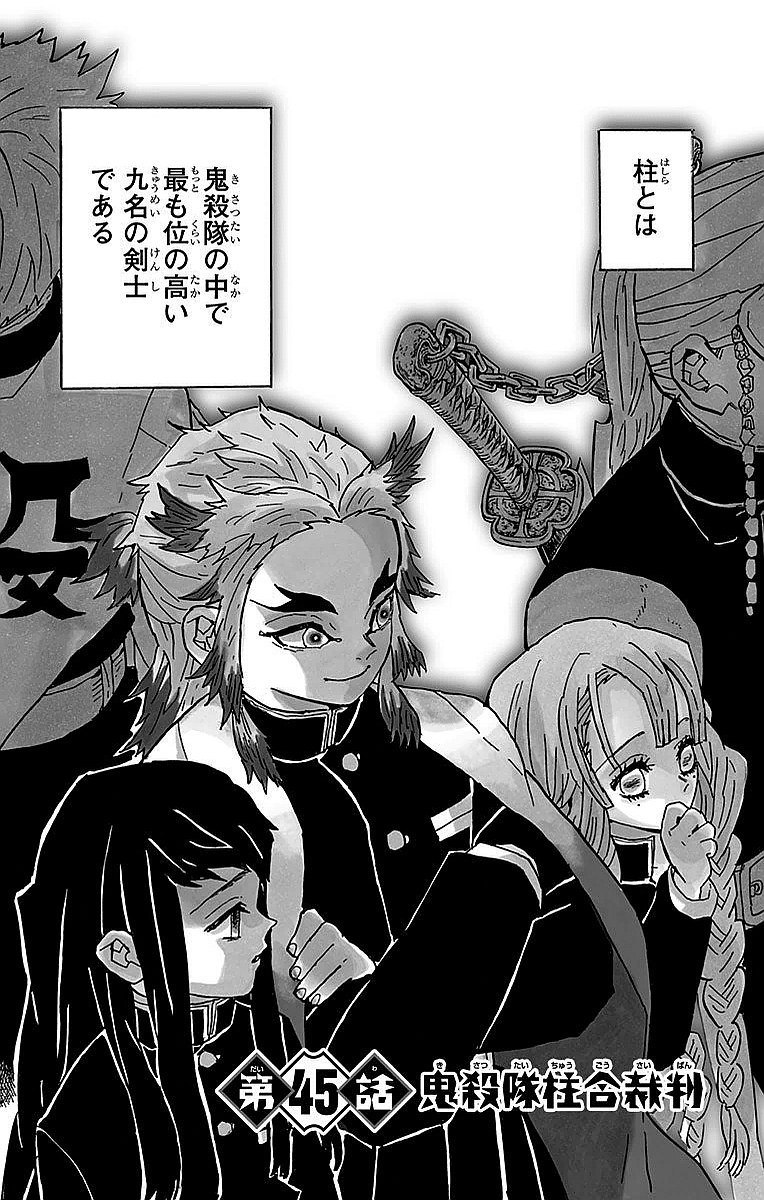 鬼滅の刃 第6巻 p.32 ©吾峠呼世晴/集英社
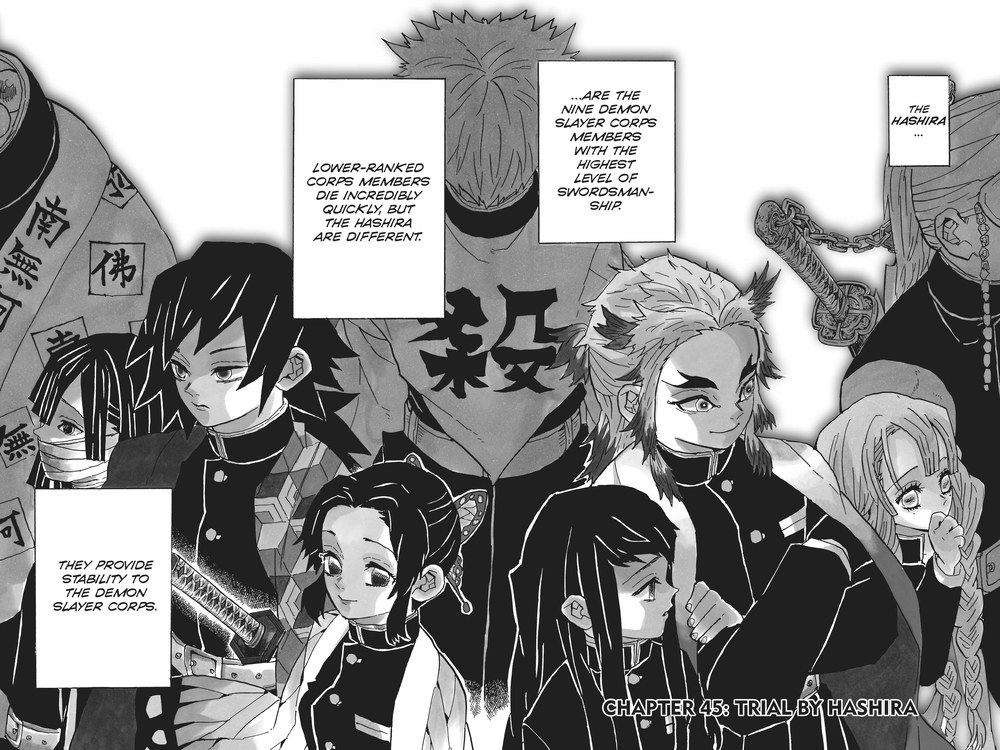 Demon Slayer: Kimetsu no Yaiba Vol. 6 (VIZ Media), p.32 ©Koyoharu Gotouge / Shueisha · VIZ Media
"As for the Hashira..."
Chapter 45 opens on a group portrait — nine swordsmen assembled, Giyu among them at the left edge, arms folded, saying nothing — and a stack of narration boxes that define the rank for the first time in plain words. 柱とは、鬼殺隊の中で最も位の高い九名の剣士である — "the hashira are the nine swordsmen of highest rank within the kisatsutai" (Vol. 6, p.32 of the Japanese edition; the same page in VIZ's Vol. 6). The chapter's title runs beneath the portrait: 鬼殺隊柱合裁判, which VIZ gives as "Trial by Hashira."
The word had been circling for two volumes before this page pinned it down, and the interesting thing is what it literally means. 柱 is not a military word at all. It is the word for a pillar.
A load-bearing word
柱 (hashira) is the load-bearing wooden column of a traditional Japanese house — the upright timber the roof rests on. The metaphor buried in the rank is architectural, not heraldic: pull the pillars out and the structure comes down. Japanese keeps the image alive in everyday speech through 大黒柱 (daikokubashira), literally "the great central pillar" of a house and, figuratively, the person a household leans on — the breadwinner, the mainstay.
The definition page reaches straight for that sense. Two boxes down from the portrait, the narration says 鬼殺隊を支えているのは柱たちだった — "it was the hashira who held up the Demon Slayer Corps." The verb is 支える (sasaeru, "to support, to prop up, to bear the weight of"), and set next to a rank literally named "pillar," it completes the picture the character draws: the pillars are the thing bearing the load. VIZ renders the line "THEY PROVIDE STABILITY TO THE DEMON SLAYER CORPS" (Vol. 6, p.32). That keeps the load-bearing meaning — which is the point of the sentence — but it trades the concrete image of a timber under strain for the abstraction "stability," and an English reader never quite sees the house. Not wrong. Flatter. The noun and the verb were doing a small piece of carpentry together, and only one of the two survives.
The word VIZ chose not to translate
Almost every rank and institution in this series gets Englished. The corps is the "Demon Slayer Corps," the breathing styles are "Water Breathing" and "Flame Breathing," the demons are "demons." The lowest rank, mizunoto, mostly comes through as itself, but the top rank makes the opposite call from most of the franchise's vocabulary: VIZ leaves 柱 romanized, as Hashira, and never once prints "Pillar" as the rank.
That is a deliberate signal. A translated rank name — "Pillar" — would read as a job description; the untranslated Hashira reads as something closer to a proper noun, a title with weight of its own. The Japanese text was already treating the word that way before VIZ had to decide anything. Its early appearances come wrapped in quotation marks: 〝柱〟, a typographic nudge that says this ordinary word is being used in a special sense here. A demon spits なんで〝柱〟じゃないんだ — "why isn't it a Hashira?" — when a mere lower-ranker turns up instead (Vol. 4, p.60), and the corps' leader says 〝柱〟を行かせなくてはならない, "I must send a Hashira" (Vol. 4, p.64). Even the earliest mention, a next-volume teaser at the back of Vol. 3, sets the word in quotes and VIZ answers in kind, printing the Hashira in quotation marks on first use.
What the English reader gains from the untranslated choice is real: a clean, memorable rank-word that behaves like a name, and none of the faint silliness that "the nine Pillars" might have carried in English. What that reader loses is the pillar itself — the house, the timber, the load. The word arrives as sound without its picture. The gain and the loss are the same decision seen from two sides.
Counting gods
There is one more thing sitting inside the word, and it is the reason 柱 feels heavier than "pillar." In Japanese, 柱 is also a counter — the classical unit for counting kami (神), the gods of Shinto. You count deities 一柱 (hitohashira), 二柱 (futahashira), the way you might count long thin objects with 本 or flat things with 枚. To count a god, Japanese reaches for the word "pillar."
So the rank name lands a Japanese reader on a word that elsewhere in the language is the unit for enumerating gods. That is resonance, not machinery, and it is worth being exact about the limit: the manga does not actually count its Hashira that way. The definition page counts them 九名 (kyū-mei, "nine persons"), with the ordinary human counter 名, not 九柱. The sacred overtone lives in the dictionary life of the word, not in the story's arithmetic — but it is there in the word the moment a Japanese reader meets the rank, and English has no comparable move available. "Pillar" or "Hashira," the alphabet cannot reach for the counter of gods.
水柱: the title with Giyu's name on it
The rank is almost never spoken bare. It takes a one-kanji elemental prefix and forms a compound — the 〜柱 pattern — and the compound rendaku's the reading, 柱 softening to 〜ばしら. Giyu's is 水柱 (mizubashira, "Water Pillar"). His title card spells it out plainly, name beside rank: 水柱・冨岡義勇, which VIZ gives as "WATER HASHIRA: GIYU TOMIOKA" (Vol. 6, p.38 of the Japanese edition; the same page in VIZ's Vol. 6), directly above 蛇柱・伊黒小芭内, "SERPENT HASHIRA: IGURO OBANAI."
That compound is exactly where the translation splits down the middle: the element gets Englished, the rank stays Japanese, and 水柱 comes out as the half-and-half "Water Hashira" — a hybrid that the pattern makes unavoidable and that has its own pitfall entry. Run the pattern across the corps and you get the same seam every time: 炎柱 as "Flame Hashira," 恋柱 as "Love Hashira," 蛇柱 as "Serpent Hashira." Each is an English element bolted to an untranslated rank.
The rank he won't hold
For Giyu the word is a wound as much as a title. He is introduced holding the corps' highest rank and privately convinced he has no right to it: I am not the Water Hashira, he tells Tanjiro, and behind that refusal is a man who doubts he has any place in the corps at all. The pillar metaphor turns quietly cruel on him: the one officer who insists he is not bearing the weight is, by rank, precisely one of the timbers the corps was said to rest on. His own invented Water Breathing form is nagi — water gone perfectly still — and even his rank is a load he says he is not carrying. The word means the thing that holds a structure up. Giyu spends the series unsure he is holding anything.
First appearance
The word is defined in Vol. 6, p.32 of the Japanese edition (鬼滅の刃 第6巻), the Chapter 45 opening portrait (柱とは…九名の剣士); the same page falls on p.32 of VIZ's Demon Slayer: Kimetsu no Yaiba Vol. 6 ("Trial by Hashira"). It appears earlier as a quote-marked term — 〝柱〟 — in the Mount Natagumo arc (Vol. 4, pp.60 and 64) and, earliest, in a next-volume teaser at the back of Vol. 3.
Related terms
Sources
- 鬼滅の刃 第6巻 p.32・p.38(集英社・日本語版)
- Demon Slayer: Kimetsu no Yaiba Vol. 6 (VIZ Media, English edition), p.32, p.38
- 鬼滅の刃 第4巻 p.60・p.64(集英社・日本語版)
- Demon Slayer: Kimetsu no Yaiba Vol. 4 (VIZ Media, English edition), p.60, p.64