Glossary · Giyu Tomioka
水の呼吸
Water Breathing
Giyu's combat style — 全集中・水の呼吸, "Total Concentration: Water Breathing." Ten inherited forms; Giyu added an eleventh of his own.
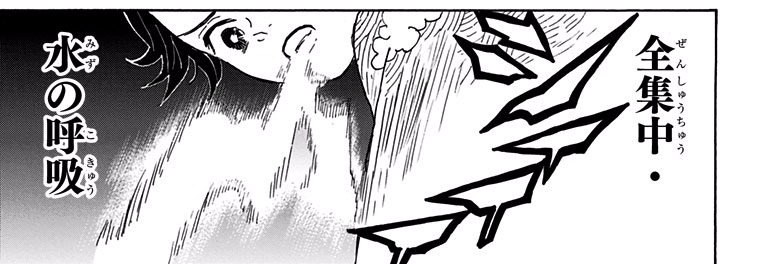 鬼滅の刃 第1巻 p.161 ©吾峠呼世晴/集英社
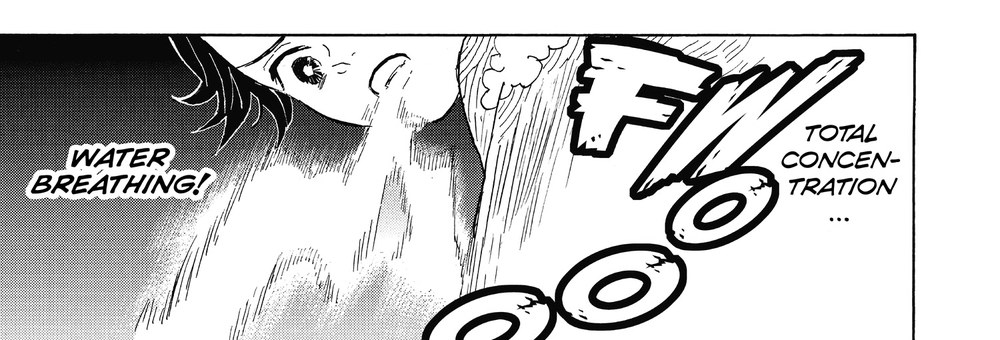 Demon Slayer: Kimetsu no Yaiba Vol. 1 (VIZ Media), p.161 ©Koyoharu Gotouge / Shueisha · VIZ Media
Six morae on a page turn
Final Selection on Mount Fujikasane. Two demons rush Tanjiro at once, bickering over which of them gets to eat him, and the answer comes back not as dialogue but as display text set beside his indrawn breath: 「全集中・」, then 「水の呼吸」 (Vol. 1, p.161 of the Japanese edition). It is the first time mizu no kokyū (水の呼吸, "Water Breathing") appears in print — spoken not by Giyu but by Tanjiro, the next student of the same teacher. VIZ's Vol. 1 lands the same two beats on its own p.161: "TOTAL CONCENTRATION... WATER BREATHING!"
Grammatically the name could hardly be plainer: 水 (mizu, "water"), the genitive particle の, and 呼吸 (kokyū, "breathing, respiration"). Kokyū is not an occult term. It is the everyday, clinical word for breathing, and its two kanji are a tiny diagram of the act itself: 呼 (exhale, as in 呼気 koki, "exhaled air") paired with 吸 (inhale, as in 吸気 kyūki, "inhaled air"). The whole name runs six morae — mi-zu-no-ko-kyu-u — a breath-length phrase whose literal content is breath.
A grammar, not a name
What p.161 actually introduces is less one technique name than a template. Sword styles across the kisatsutai are named on a single frame: [noun] + の + 呼吸. Swap the first noun and you have named a new school. The series demonstrates the slot within two volumes: Zenitsu erupts into 雷の呼吸 (kaminari no kokyū) — "THUNDER BREATHING" (Vol. 3, p.135 in both editions) — and six pages later Inosuke answers with his self-invented 獣の呼吸 (kedamono no kokyū) — "BEAST BREATHING" (Vol. 3, p.141), prefixed 我流 (garyū, "my own style"), which VIZ carries as "SELF-STYLE". Once you have parsed 水の呼吸, every style you will ever meet is pre-parsed.
The の in this frame is the genitive particle at its widest. It does not mark ownership — the water owns nothing — but affiliation and essence: breathing of water, breathing in water's manner, breathing that belongs to the school of water. Japanese leaves that range open, and the series exploits the openness: the same frame accepts an element, an animal, a celestial body, without the grammar creaking.
English has no particle to drop into that slot. What it has is its own productive naming machine, the noun-noun compound, and VIZ committed to it wholesale: WATER BREATHING, THUNDER BREATHING, BEAST BREATHING. Whatever noun Japanese feeds its frame, English feeds its compound the same noun. The system — the thing that lets a reader meet an unfamiliar invocation mid-battle and instantly file it as "a style, like water but thunder" — crosses the language barrier intact. Hold on to that; it is the structural gain to weigh against the local losses below.
The full invocation stack
In battle the name rarely travels alone. The full announcement runs in tiers, and Tanjiro's debut spreads the whole stack across three pages:
- 全集中 — the engine state. The calque "TOTAL CONCENTRATION" and what it preserves has its own article; the short version is that Urokodaki's discipline is first named 〝全集中の呼吸〟 in Sabito's rebuke — "THE BREATHING TECHNIQUE TAUGHT BY UROKODAKI! TOTAL CONCENTRATION BREATHING!" (Vol. 1, p.135 in both editions) — and note that even the base discipline is named on the same 〜の呼吸 frame.
- 水の呼吸 — the style.
- The numbered form — 壱ノ型, 弐ノ型... written with daiji, the formal ledger numerals (壱, 弐, 参, 肆...), a register English numbering cannot reproduce — FIRST FORM flattens it.
- The form's poem-name.
The original script even dresses the two levels differently: the style takes hiragana の (水の呼吸), while the form counter takes katakana ノ (肆ノ型) — one particle in two costumes, prose-soft for the element, chiselled and ledger-formal beside the numeral. No translation can show you that; it is a reason to look at the Japanese page even if you read none of it.
And when Tanjiro first completes the stack, the form he reaches for is 「肆ノ型 打ち潮」 — "FOURTH FORM, STRIKING TIDE!" (Vol. 1, p.163 in both editions). The first form named on any page is number four. The numbering reads as a catalogue of an inherited curriculum, not an escalation meter: you open the book to whichever page the moment demands.
Ten forms, and Giyu's eleventh
How big is the book? The series states it outright at Mount Natagumo, when Giyu finally announces a technique of his own against Rui (Vol. 5, pp.160–163 of the Japanese edition; the corresponding VIZ pages run one later, pp.161–164):
「鱗滝の技は拾まで」「拾壱ノ型は義勇が編み出した義勇だけの技」 "UROKODAKI'S TECHNIQUES GO UP TO TEN. GIYU DEVELOPED THE ELEVENTH FORM HIMSELF, AND ONLY HE COULD DO THIS TECHNIQUE."
Ten inherited forms, and an eleventh that exists nowhere else in the school. Its name is a single kanji, nagi — the windless dead calm of the sea — and VIZ's rendering of it, DEAD CALM, is one of the translation's clean wins. The invocation on p.160 is the same stack as Tanjiro's: 「全集中・水の呼吸 拾壱ノ型」, furigana confirming the readings zenshūchū, mizu no kokyū, jūichi no kata.
That page is also the quiet punchline of the style's naming logic. Ten forms of moving water — tides, waterfalls, whirlpools (the Sixth has its own entry) — and the one form original to the silent hashira is water that refuses to move. The man wears the rank title 水柱, itself translated down the middle as WATER HASHIRA, and claims he doesn't deserve it; his contribution to the curriculum is stillness.
What the calque keeps, and what stays home
Judged as a rendering of 水の呼吸, WATER BREATHING gives up three small things. The open genitive narrows: a bare English compound tilts toward "breathing water," and English fantasy readers arrive with that exact collocation pre-loaded — "water breathing" is the stock ability to survive underwater. The furigana channel disappears, along with the six-mora breath rhythm. And the hiragana-の / katakana-ノ costume change has no alphabetic equivalent.
None of this is a complaint against the choice. The first-contact ambiguity dissolves within a page of Tanjiro visibly breathing air; VIZ got the load-bearing thing, which is the template itself. And the English reader collects a compensation Japanese readers never see: in caps, across a splash page, WATER BREATHING has the punch of an incantation in a language that rarely grants nouns that power — and the -ING keeps the name what kokyū insists it is, not a weapon or an element but an ongoing act of the body. Ten forms, an eleventh, and underneath all of them: inhale, exhale.
First appearance
Vol. 1, p.161 of the Japanese edition (鬼滅の刃 第1巻) — Tanjiro's invocation at Final Selection; the same panel falls on p.161 of VIZ's Demon Slayer: Kimetsu no Yaiba Vol. 1.
Related terms
Sources
- 鬼滅の刃 第1巻 p.135・p.161・p.163(集英社・日本語版)
- Demon Slayer: Kimetsu no Yaiba Vol. 1 (VIZ Media, English edition), p.135, p.161, p.163
- 鬼滅の刃 第3巻 p.135・p.141(集英社・日本語版)
- Demon Slayer: Kimetsu no Yaiba Vol. 3 (VIZ Media, English edition), p.135, p.141
- 鬼滅の刃 第5巻 pp.160–163(集英社・日本語版)
- Demon Slayer: Kimetsu no Yaiba Vol. 5 (VIZ Media, English edition), pp.161–164