Glossary · Giyu Tomioka
凪
Dead Calm
The Eleventh Form Giyu invented — 凪, an everyday weather word for a windless, mirror-flat sea. A Japanese-made kanji (wind-frame + 止 "stop") and a two-mora name in a school of long ones. VIZ's DEAD CALM has its own Gem.
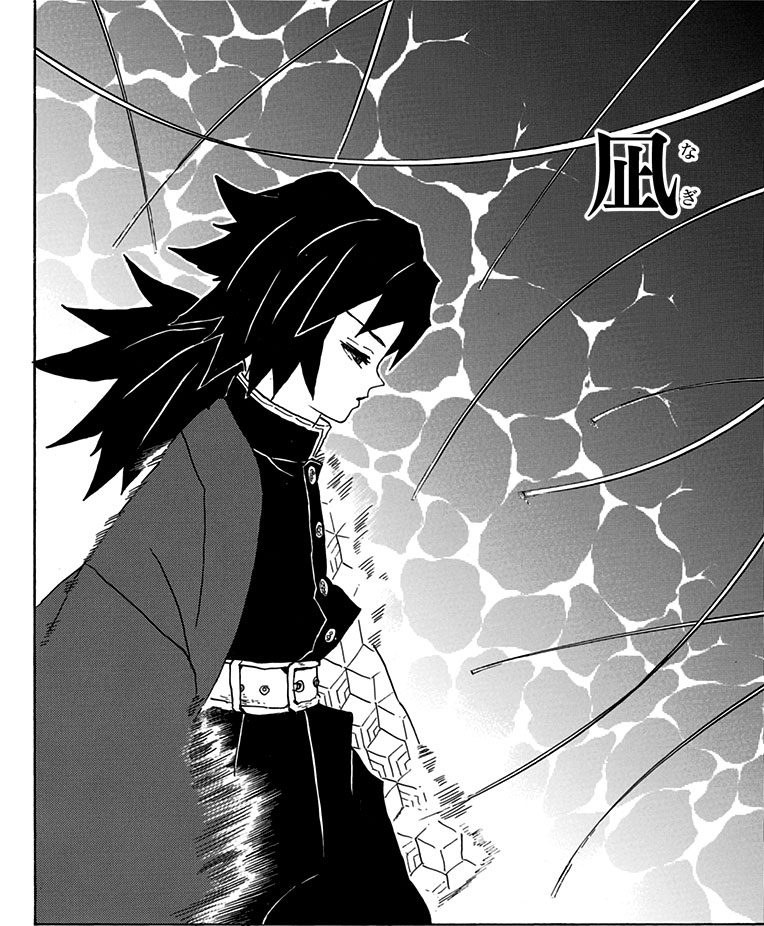 鬼滅の刃 第5巻 p.161 ©吾峠呼世晴/集英社
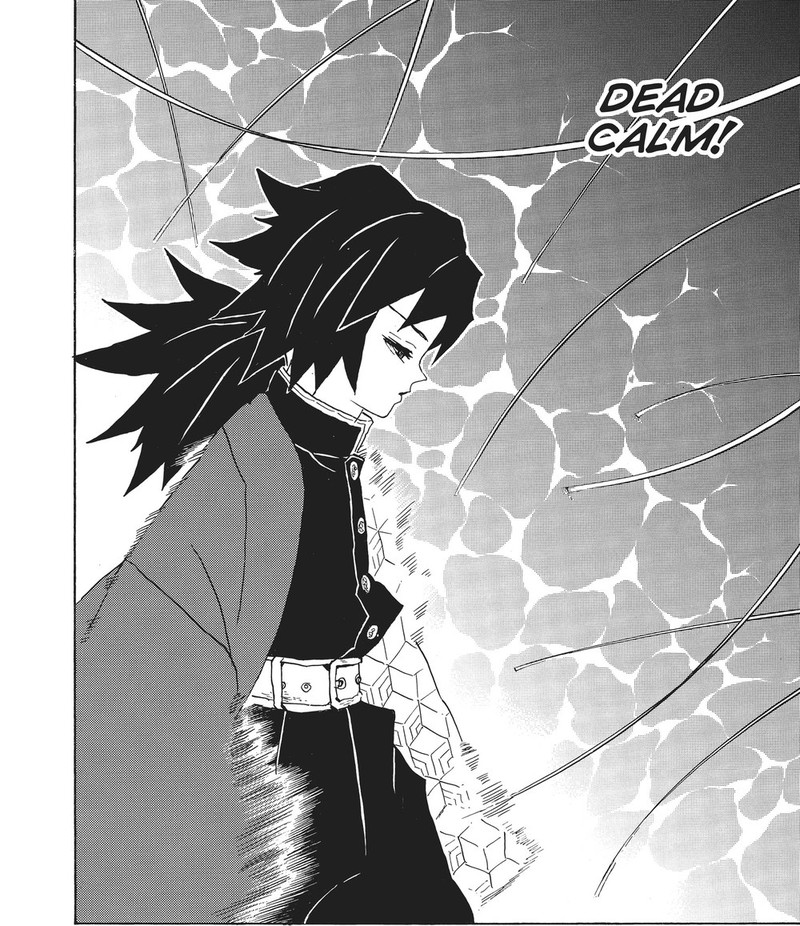 Demon Slayer: Kimetsu no Yaiba Vol. 5 (VIZ Media), p.162 ©Koyoharu Gotouge / Shueisha · VIZ Media
A single kanji in a school of long names
Mount Natagumo, Giyu against the demon Rui. Water Breathing forms usually arrive with names built like small poems — 打ち潮 (uchishio, "Striking Tide"), 水車 (mizuguruma, "Water Wheel") — clauses you can hear coming across the page. Then Giyu steps inside the demon's web and the panel hands him something else entirely: one character, drawn large as splash lettering in the upper corner, two kana of furigana printed beside it — 凪, nagi (Vol. 5, p.161 of the Japanese edition). VIZ's Vol. 5 places the same splash on its own p.162: DEAD CALM!
This is the Eleventh Form, the single form in the school that is Giyu's own invention rather than Urokodaki's inheritance — mizu-no-kokyu sets out that ten-plus-one structure, and the shape of it is worth holding onto here: the master's ten forms all name water in motion, and the student's one addition names water that has stopped. What this entry is about is not the technique but the word he reached for.
凪: a word that belongs to the sea
Nagi is not coined vocabulary and not a term of art. It is an ordinary Japanese weather word, the kind that turns up in a fishing forecast. It names the state of a sea with no wind on it: the waves flatten, the surface goes glassy, nothing moves. Coastal Japanese has two everyday compounds built on it — 朝凪 (asanagi, "morning calm") and 夕凪 (yūnagi, "evening calm") — for the slack, windless intervals at dawn and dusk when the land breeze and the sea breeze trade places and the air briefly stops.
The manga glosses the word in its own margin, in a narration box beside a drawing of a single boat sitting motionless on flat water: 凪とは、無風状態の海のこと、海水は揺れず鏡のようになる — "a nagi is a sea in a windless state; the seawater does not stir and becomes like a mirror" (Vol. 5, p.163 of the Japanese edition). VIZ carries the same gloss one page later, on p.164: "A DEAD CALM... IS A SEA WITH NO WIND AND NO WAVES. THE WATER'S SURFACE BECOMES LIKE A MIRROR." The definition the story gives you is a meteorologist's, not a swordsman's.
A kanji Japan built for itself
凪 is a kokuji (国字, "national character") — a kanji invented in Japan rather than borrowed from China. Its shape is a compact diagram of its meaning. The enclosing frame is かぜがまえ (kazegamae), the "wind" wrapper lifted straight off 風 (kaze, "wind"), and sitting inside that frame is 止 (to(meru), "stop"). Wind, enclosed and stopped. Because the character never travelled through Chinese, it carries no on'yomi at all; it has only native Japanese readings — nagi as a noun, na(gu) as a verb.
It belongs to a small family of weather kokuji built on that same wind-frame, and the family makes the logic obvious: 凧 (tako, "kite" — wind around 巾, "cloth") and 凩 (kogarashi, "the cold wind that strips the trees bare" — wind around 木, "tree"). Set 凪 beside its cousins and it reads as the one where the wind was shut off. A Japanese reader takes that in wordlessly, from the silhouette of the character, before any gloss is needed. It is the first thing the translation cannot carry across, and the reason to look at the Japanese page even if you read none of it.
凪ぐ: a form named for a verb of stilling
On the page after the splash, the narration turns the noun into its verb: 義勇の間合いに入った術は全て凪ぐ — "every technique that enters Giyu's range falls calm" (Vol. 5, p.164 of the Japanese edition). 凪ぐ (nagu) is intransitive: the wind dies, the sea flattens, the noise drops — the subject settles on its own, with nobody named as doing it. The same page pairs it with 無になる (mu ni naru, "to become nothing").
That grammar is the whole character of the technique. Most sword forms are named for an action the swordsman performs on the world; this one is named for a state the world falls into around him. Rui's threads cross into Giyu's radius and simply stop — not parried, not cut in a visible arc, just stilled. Naming a defensive, negating form after an intransitive verb of settling is an odd and precise choice, and it is only fully legible if you can see that 凪 is doing double duty as both the noun on the splash and the verb in the caption.
Two morae against the poems
Counted in mora, 凪 is short: na-gi, two morae, against the four of u-chi-shi-o and the longer strings that name most techniques in the corps. In a school where every form announces itself in a phrase, a form whose entire name is one kanji and two morae reads like a held breath — the name is nearly as brief as the silence it describes.
The brevity is a character note as much as a naming one. The Water Hashira (hashira) is the corps' quietest officer, a man who claims he doesn't deserve the rank, and his single contribution to a curriculum of roaring, wheeling water — the Sixth Form is a whole whirlpool — is a two-mora word for the sea going silent. A style whose other forms are built on the 〜の型 counter with formal ledger numerals (the daiji that FIRST FORM flattens) ends, in Giyu's hands, on a monosyllable-shaped stillness.
What "Dead Calm" carries across
Rendering a single kanji as two English words could easily have gone thin. It didn't: Dead Calm is a genuine English nautical term for exactly this windless, mirror-flat sea, and the match is close enough that the translation is one of the rare clean wins in the series — which is the argument of its own article, and not re-run here. Two things belong to the word rather than to the rendering, though. The kanji-picture — wind, shut off — is invisible to an English reader, who never sees the 止 sitting inside the frame. What that reader gets instead is a phrase that already arrives carrying dread: "dead" does work in English that 凪 does not do in Japanese, where the word is calm and even pleasant, the weather you hope for on a boat. The Japanese reader gets a meteorologist's serenity with a swordsman's edge hidden in it; the English reader gets the edge on the surface and the serenity underneath. Different orders, comparable weight.
First appearance
Vol. 5, p.161 of the Japanese edition (鬼滅の刃 第5巻) — the splash 凪 (furigana なぎ) as Giyu unveils the Eleventh Form against Rui on Mount Natagumo; the same splash falls one page later in VIZ's Demon Slayer: Kimetsu no Yaiba Vol. 5, on p.162 ("DEAD CALM!"). The word's in-panel definition and the verb 凪ぐ follow on Japanese pp.163–164 (VIZ p.164).
Related terms
Sources
- 鬼滅の刃 第5巻 p.161・p.163・p.164(集英社・日本語版)
- Demon Slayer: Kimetsu no Yaiba Vol. 5 (VIZ Media, English edition), p.162, p.164