Still water, and what sits under it
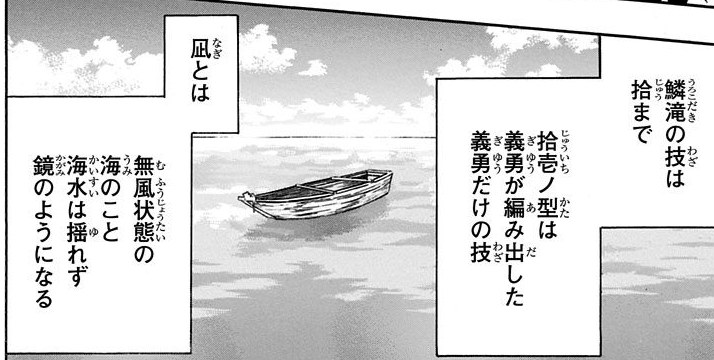
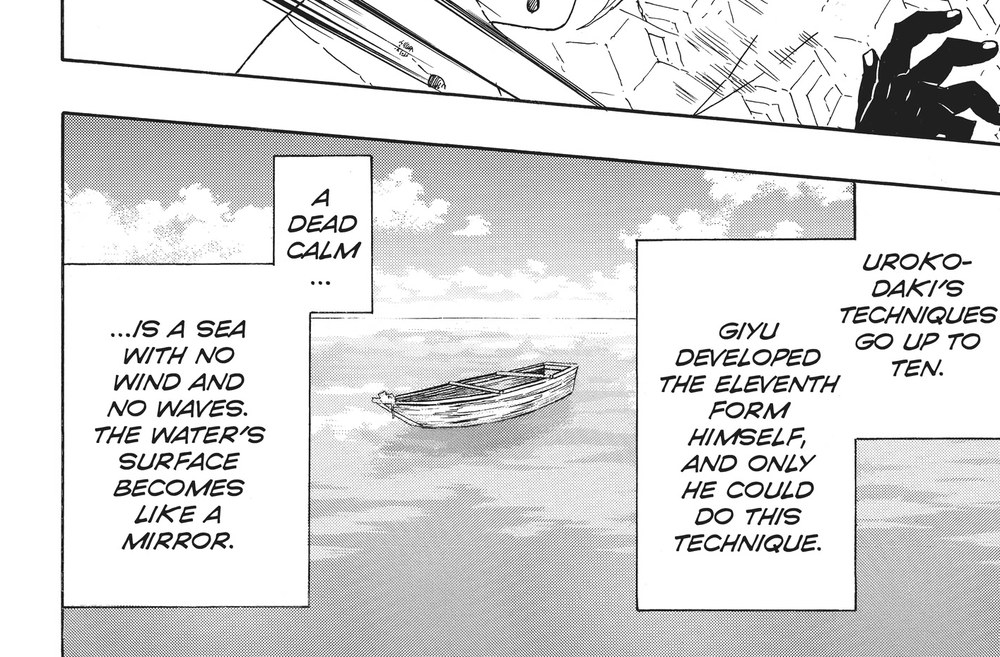
At the end of the fight with the demon Rui on Mount Natagumo, Giyu does the one thing no other swordsman in the kisatsutai can: he announces an Eleventh Form of a ten-form school. The page that explains it does not draw a sword-stroke. It draws a small wooden boat on a sea without a single ripple, and sets a caption beside it — 「凪とは 無風状態の海のこと 海水は揺れず 鏡のようになる」 (nagi to wa, mufū-jōtai no umi no koto; kaisui wa yurezu, kagami no yō ni naru — "a nagi is a sea in a windless state; the seawater does not sway, and becomes like a mirror") (Vol. 5, p.163 of the Japanese edition; the same page falls on p.164 of VIZ's Vol. 5). VIZ carries it as "A DEAD CALM... IS A SEA WITH NO WIND AND NO WAVES. THE WATER'S SURFACE BECOMES LIKE A MIRROR."
A mirror, and stopped water, set side by side. Japanese already has a four-character compound (yojijukugo) built from exactly those two pictures: meikyō shisui (明鏡止水).
Four kanji, two images
The compound is two two-kanji nouns bolted together:
- 明鏡 (meikyō) — 明 (mei, "bright, clear") + 鏡 (kyō / kagami, "mirror"): a polished mirror, unclouded, giving back a true reflection.
- 止水 (shisui) — 止 (shi / tomaru, "to stop, to halt") + 水 (sui / mizu, "water"): water that has stopped. Not "calm water" as a mood, but water whose motion has ended — a pond gone glassy, a windless sea.
Read aloud it is めいきょうしすい, seven mora, and it takes の to modify a noun (明鏡止水の心境, "a meikyō-shisui state of mind"). The 止 is the load-bearing kanji, and English translations tend to soften it: the standard gloss "still water" says quiet, where the Japanese says arrested. The water is not merely peaceful; the movement in it has been brought to a halt.
Where the mirror comes from
The lineage is worth stating carefully, because sources disagree. The Digital Daijisen traces meikyō shisui to the Zhuangzi (荘子), and the still-water image does live there, in the "Dé chōng fú" (徳充符) chapter: people do not look at their reflection in flowing water but in stopped water (鑑於止水), because only the motionless surface gives back a true face. The Seisenban Nihon Kokugo Daijiten, though, points instead to the Huainanzi (淮南子), whose text pairs the bright mirror and the still water in a single passage. So the phrase is a confluence of classical Chinese sources rather than one clean quotation — worth knowing before you assert a single origin. Both texts predate the arrival of Zen in Japan; later martial-arts writing borrowed the still-water mind on top of them, as the ideal of the fighter who reflects an opponent's every move without being stirred by any of it.
Across all of them the idea is constant: a mind so still that it mirrors the whole world exactly, and is disturbed by nothing. Serenity understood as clarity. That is the state the compound praises.
The same picture, read the other way
Here is the gap this entry is about. The manga's nagi is assembled from the two literal halves of meikyō shisui — a mirror (鏡) and stopped water (止水, spelled out as 揺れず, "does not sway") — and yet it is not serenity. One page on, the JP text names the swordsman's inner state 「無になる」 (mu ni naru, "to become nothing, to become void"); VIZ keeps the mirror sentence and lets the 無 go. In the idiom, the still mind is a full one — clear enough to hold everything at once. In Giyu, the same stillness works more like a lid. Dead Calm neutralizes every technique that enters his range not by serene reflection but by cancelling motion — the enemy's, and his own. The mirror is clear because nothing is allowed to move on it. nagi is water that has been made to stop, which is what 止水 says on the page and what the serene reading quietly leaves out.
Off the battlefield the same flatness reads as something colder. Giyu barely speaks and barely changes expression, and other members of the corps take that for arrogance — the exact misreading that gives taizen-jijaku its own entry. The serene-mirror ideal of meikyō shisui is admired wherever it is recognized; Giyu's version of it gets him disliked. And his own account of the quiet is not attainment but survival: he does not believe he has earned the rank he holds (I am not the Water Hashira), and the level surface sits over grief he has ordered himself not to show (don't cry, don't despair).
So meikyō shisui fits Giyu the way a shadow fits a body — same outline, no light inside it. A Zhuangzi sage stills the water through cultivation, and the calm is the reward for a settled mind. Giyu stills it through suppression, and the calm is the cost of one. Both surfaces are mirrors. Only one of them has anything behind it that the man would let you see.
The word never lands on the page — and DEAD CALM does
Full disclosure: 明鏡止水 appears nowhere in the manga's text. It is the phrase Japanese readers reach for about the Eleventh Form, because the caption on that page hands them the mirror and the stopped water and lets them supply the classical word themselves. What the page actually prints, in both languages, is 凪 → DEAD CALM.
As a rendering of the weather word 凪, VIZ's DEAD CALM is one of the translation's clean wins, and it keeps the still-mirror image intact. But note the swap riding along with it. English "dead" drags in mortality and menace that the Japanese 凪 does not carry: 凪 is an everyday, faintly pleasant word for the windless lull between sea breezes, the pause sailors simply wait out. Not wrong — heavier. And here the extra weight happens to be true. Giyu's stillness really does have a deadness in it that a bright Zhuangzi calm would not, so the English reader who meets DEAD CALM cold is handed an undertone that suits this particular swordsman better than the serene idiom itself does — a local gain sitting directly on top of a local loss. The Japanese reader gets the whole classical lineage folded into four familiar kanji; the English reader gets two words that quietly say something accurate about the man before the story has finished introducing him.