Translation Gem · Kyojuro Rengoku
Why VIZ's 'Rising Scorching Sun' nails the poetic punch of 昇り炎天
VIZ elevates a technique name from technical classification to poetic battle-cry by preserving the register shift from formal 弐ノ型 to lyrical 昇り炎天. The English rendering captures both the upward motion of 昇り and the visceral cosmic intensity of 炎天 while perfectly suiting the exclamatory, combat-delivery register.

Japanese (manga)
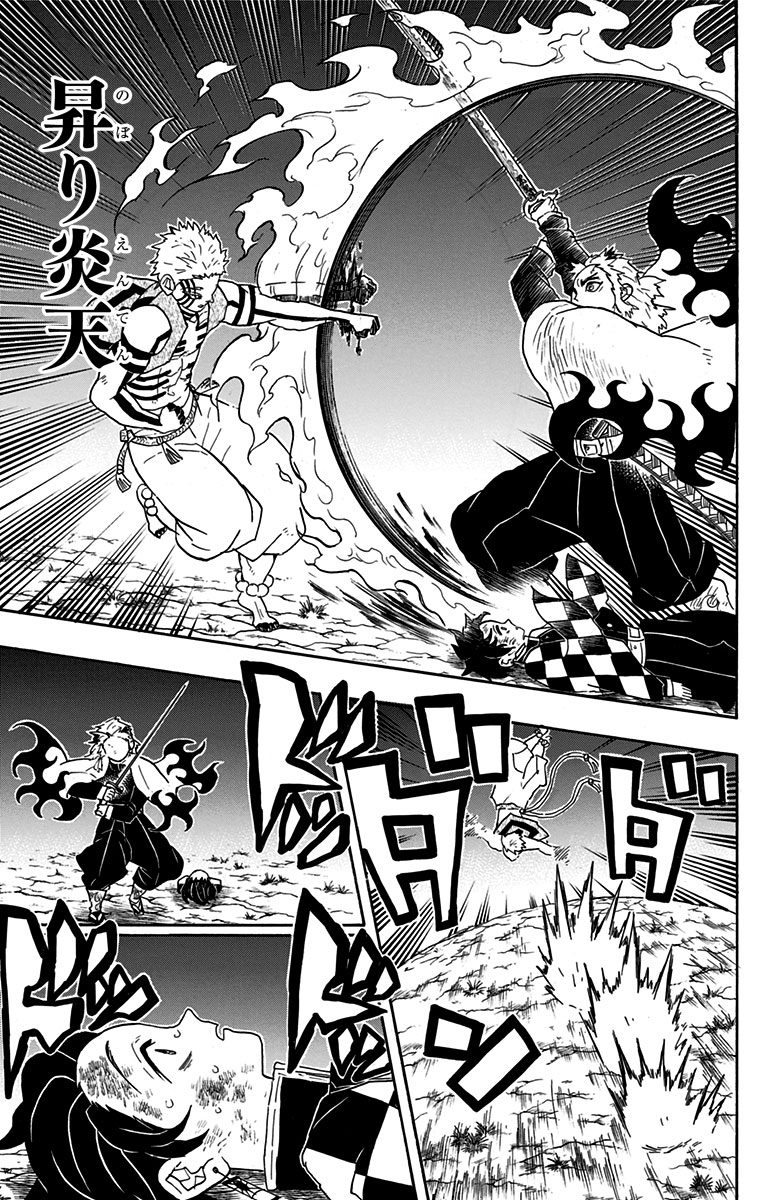
鬼滅の刃 第8巻 p.31 ©吾峠呼世晴/集英社
English (VIZ official)
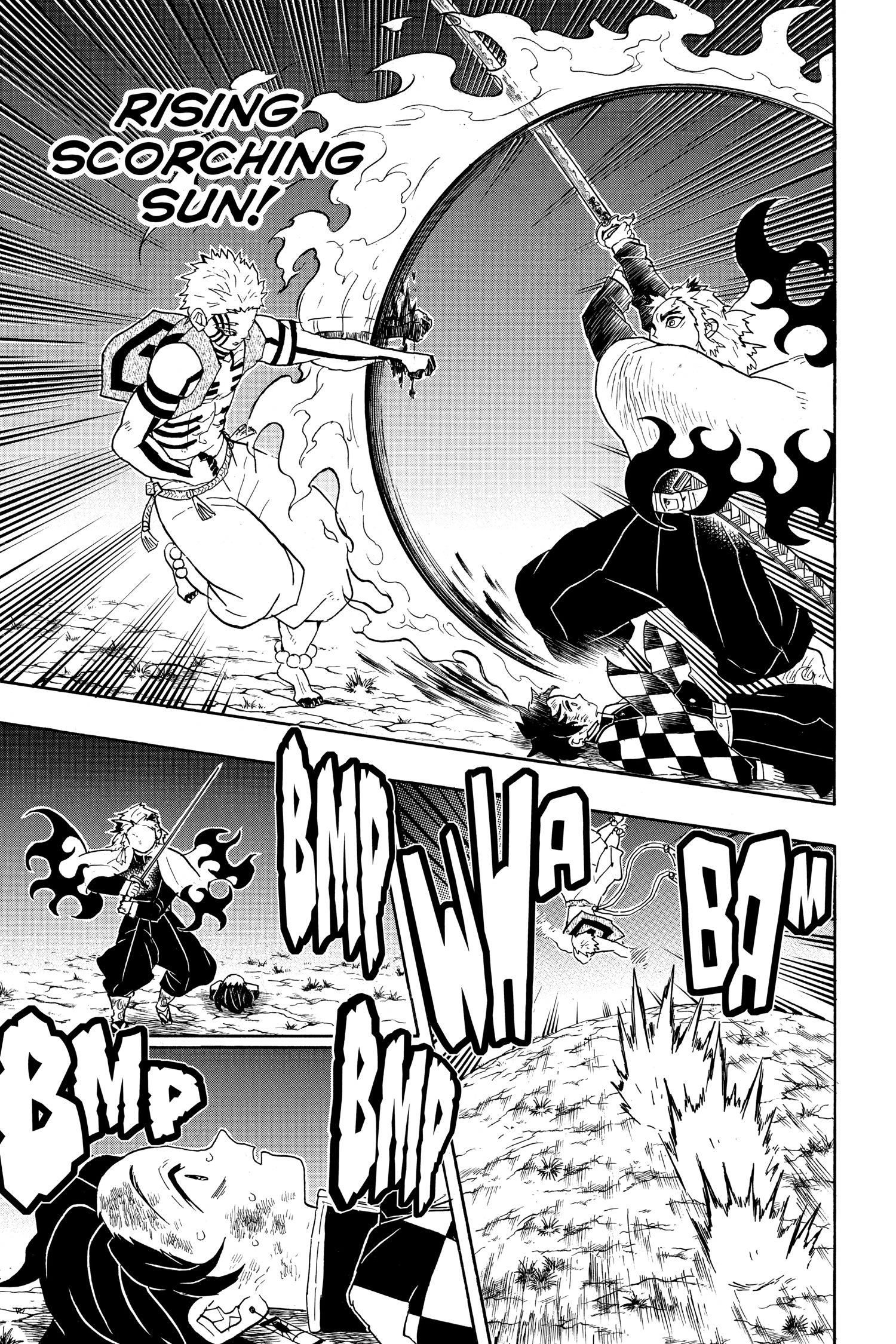
Demon Slayer Vol. 8 (VIZ Media), p.31 ©Koyoharu Gotouge/VIZ Media
Japanese (manga)
炎の呼吸 弐ノ型 昇り炎天
honō no kokyū, ni no kata, nobori enten
鬼滅の刃 Vol. 8, p.31
English (VIZ official) — ✓ nails it
"FLAME BREATHING SECOND FORM: RISING SCORCHING SUN!"
Demon Slayer Vol. 8 (VIZ), p.31
The Moment
Vol.8, page 31 in the Japanese edition; VIZ Vol.8 at the corresponding panel. The fight against Akaza is still in its first half. The train is wrecked, civilians are huddled where Rengoku has put them, and the Flame Hashira has been swinging long enough that the choreography on the page has started stacking technique names. Like the chapters of a book the reader is only allowed to read at sword-speed.
Second Form is the next chapter.
You know the rhythm. The blade lifts. The dialogue balloon arrives a beat ahead of the cut. The technique name lands in a typeface a hair larger than the surrounding dialogue. It sits in the convention English-language manga has settled on for shouted attack names: all caps, looser tracking, the colon carrying a ceremonial pause. In Japanese the same panel does the same job with vertical text and a square-shouldered font.
What he calls out is 「炎の呼吸 弐ノ型 昇り炎天」. VIZ rendered it FLAME BREATHING SECOND FORM: RISING SCORCHING SUN!
It is one of the best technique-name calls in the volume. Worth slowing down to see why a less literal translation outperformed several literal alternatives the VIZ Vol.7-8 translator (John Werry) could have reached for and didn't. The English captures the thing the Japanese technique-name register is performing under the hood: a cool stratification between the formal half (catalogue entry) and the lyrical half (battle-cry image). The Gem is in the strata.
The Original
「炎の呼吸 弐ノ型 昇り炎天」
Honō no kokyū / ni no kata / nobori enten [flame-GEN breathing / 2-GEN form / rising fire-heaven] (Note: 炎 reads honō in the school-name compound and en in the technique-name compound. The two readings are part of the register stratification the chapter explores.)
Three units, presented as separable in the panel: the catalogue clause, the form-rank clause, the lyric clause. The way Japanese typically names a technique. Take them one at a time.
炎の呼吸 is the catalogue clause. 炎 (honō) is "flame," sitting higher up the register than the everyday 火 (hi, "fire"). の is the genitive particle. 呼吸 (kokyū) is "breathing," the word the franchise has built its combat system around. The clause names the school: flame's breathing, the practice line Rengoku belongs to. The kanji 炎 has a second life in Sino-Japanese compounds as the on-form en, and the reader's ear is being prepped for that second reading by the first three morae. The register gear-shift between honō (kun) and en (on, the more Sinitic-elevated reading) is what the third clause will execute downstream.
弐ノ型 is the rank-and-file clause. 弐 is the daiji, the formal, used-on-banknotes-and-legal-documents variant of 二 (ni, "two"). Same numeral, in the register a clerk uses to make a number harder to forge. It reads ni, identically to 二; the form is silent in pronunciation and visible only on the page. ノ here is の written in katakana, an old-print convention that pulls the phrase further into ceremonial-document register. 型 (kata) is "form," the rehearsed unit of practice in a martial school. Read 弐ノ型 aloud and it sounds like 二の型. Look at it and you see Form II, embossed.
昇り炎天 is the lyrical clause. 昇り (nobori) is the -i stem of 昇る (noboru), "to rise / to ascend," carrying kinetic charge without the finite ending. The same 昇 appears in 日が昇る (hi ga noboru, "the sun rises") and in compounds like 上昇 (jōshō, "ascent"): the kinetic kanji of celestial or vertical rising. 炎天 (enten) is the compound, written with the same 炎 as the school name but read here in its Sino-Japanese voice (音読み / on'yomi: en). It pairs with 天 (ten, "heaven / sky") into a poetic two-character word with no clean English calque. The dictionary gloss (per デジタル大辞泉, Shogakukan, paraphrased) runs something like "a fiercely hot, blazing sky" or "the burning summer heavens": a high-summer noun a writer would reach for to describe August at noon, not a battle. Paired with 昇り, the noun returns to a verb-feeling: the rising fire-heaven, a sky going up rather than sitting overhead.
What the three units perform together is stratification. The first two clauses are administrative. The third is poetry. The reader hears Flame Breathing, Second Form, and is prepared for an entry in a manual. Then the manual goes lyric.
VIZ's Choice
FLAME BREATHING SECOND FORM: RISING SCORCHING SUN!
Display caps, colon-separated, exclamation-closed. The shape of the line in print carries some of the translation load before you read the words.
Werry was solving for the standard battle-cry constraints (balloon space, glance-readability, the all-caps-for-techniques convention) and for the harder problem inside the technique-name genre. A Japanese technique name is almost always two registers at once. An English translation can keep one register or the other but loses the layering the moment it goes monochromatic.
The translator kept the layering. FLAME BREATHING is the school name, calqued directly: 炎 → flame, 呼吸 → breathing. SECOND FORM renders 弐ノ型. The daiji variant is given up — the English ear cannot hear it in any case, since 弐 and 二 are pronounced identically — but the catalogue register holds through the formal "Second Form" rather than the conversational "Form Two." The colon is the deliberate hinge. On one side, the administrative half. On the other, the lyric.
RISING SCORCHING SUN is the lyric. 昇り becomes RISING, the present-participial verb that carries kinetic charge without finite tense, mirroring the -i stem the Japanese uses. 炎天 becomes SCORCHING SUN, which is not a calque (a calque would be FLAME HEAVEN or BLAZING SKY) but a translation by sensory effect. The compound's meaning isn't FLAME + HEAVEN unpacked; the compound's meaning is the feeling of a sky that is on fire. English has no single morpheme for that, so VIZ supplies the sensory experience instead: SCORCHING for the heat, SUN for the celestial body, and lets the reader's body fill in the rest.
The exclamation mark carries the JA emphatic load the Japanese balloons signal through heavier ink weight and a downstream effect line. The micro-loss, small and real, is the daiji 弐 itself, silent in either rendering. The reader who knows it is there is the reader with the Japanese in front of them. Worth noting, not worth grieving.
Why It Works
Four things stack here. They land in a specific order, and the order matters.
Register stratification is preserved, on a different axis. The Japanese clause sequence walks a clean staircase: ceremonial-catalogue (炎の呼吸 弐ノ型) into lyrical-poetic (昇り炎天). The English walks the same staircase: catalogue (FLAME BREATHING SECOND FORM) into lyric (RISING SCORCHING SUN). What makes this non-trivial is that English does not have built-in register-marking the way Japanese does. Japanese can flag formality through kanji choice (弐 over 二), particle convention (ノ in katakana), and Sino-Japanese reading (honō shading toward en) without changing the surface word. English has none of those levers. What it has is typographic convention and word choice, and VIZ uses both. The capital letters carry the formality. The colon carries the hinge. The words on the right side of the colon, SCORCHING and SUN, pivot away from administrative diction toward sensory English the way 炎天 pivots away from administrative honō toward lyrical en. The axis changes. The shape on the page holds.
炎天 is translated by effect, not by morpheme, and that was the right call. 炎天 is one of those Sino-Japanese two-character formations English keeps trying to translate by anatomy and keeps getting wrong. A morpheme-by-morpheme rendering gives FLAME HEAVEN, an ornamental noun phrase that could pass for a death-metal album. The reason morpheme-translation fails is that 炎天 is a literary unit in Japanese, not a sum of its kanji. It belongs to the same register as 蒼天 (sōten, "azure heavens"), 中天 (chūten, "mid-heaven"), 蒼穹 (sōkyū, "vault of heaven"): Sino-Japanese set-phrase nouns the language treats as semantic primitives, the kind of compound classical 漢詩 and modern lyric writing use as a single unit. VIZ recognised this and gave English readers the experience of 炎天 instead of its anatomy. You feel the heat first. You see the celestial body second. Sensory faithfulness over morphological faithfulness is the deepest call inside the line.
SCORCHING earns its place. Choose a single English adjective for 炎天's heat layer and most candidates pick a lane: HOT (too plain), BURNING (too literal), BLAZING (close, but stays in the fire register), FIERY (close, but tips ornamental), INFERNAL (over-determined toward catastrophic register). SCORCHING matches BLAZING for thermal intensity and adds an aggressive-edge connotation BLAZING lacks. To scorch is a verb of contact, a verb of leaving a mark. It fits inside a noun phrase (SCORCHING SUN) without losing its verbal charge. It is also phonetically muscular, two syllables with a hard consonant cluster, and sits well next to RISING and SUN: three words whose primary stress falls on the first syllable (RIS-ing, SCORCH-ing, SUN). The lyric clause reads as trochee, trochee, stressed monosyllable: strong-weak-strong-weak-strong, marching cleanly across the page. There is no perfect English word for what 炎天 carries in Japanese. SCORCHING is the best of the candidates a translator gets, and VIZ took it.
All-caps typography carries the performative shout the Japanese signals by panel convention. English-language manga has, over the last two decades, settled on all-caps as the parallel to the vertical text and heavier line craft Japanese manga uses for technique names. RISING SCORCHING SUN! in caps reads, on first glance, as shouted technique name. RISING Scorching Sun! in title case would not.
A note on cross-volume context. II-3 makes a similar argument about the Fourth Form (盛炎のうねり → BLOOMING FLAME UNDULATION): different lyric, same translator, sensory faithfulness over morpheme-by-morpheme. The Pitfall companion in I-3 takes the opposite case. On 壱ノ型 不知火 → UN-KNOWING FIRE, Werry made a more literal call and the English thinned out. As I-3 notes, EN fans have built their own parallel frame around that form through the ufotable animation and the technique's distinctive cut pattern, which is its own kind of landing. Two of these chapters land on the page. The third lands somewhere else. Consistency is not the right frame. Every technique name is a separate problem with its own constraint set, and the hit rate is the rate at which the translator identified what the specific line was asking for.
What If
A Gem chapter is generous, but it isn't a victory lap. Look at the worse alternatives long enough to feel the choice VIZ made.
RISING FLAME-HEAVEN. The morpheme-by-morpheme calque. Every kanji accounted for; every reader not already comfortable with Sino-Japanese compound logic lost. Flame-heaven in English reads either as a coinage in a translated fantasy novel or as a phrase out of an unfamiliar hymnal. Neither is what the panel is performing. The micro-loss for SCORCHING SUN was 弐. The macro-loss for FLAME-HEAVEN would have been the entire lyric layer.
ASCENDING BLAZING SKY. The measured calque. ASCENDING and BLAZING are functional English vocabulary, but the cumulative effect is meteorological. The sky is ascending and blazing is a sentence a weather reporter could write about a sunrise over Phoenix. There is no body in the line, no SUN you can feel on your skin, only a SKY as an abstraction overhead. The Japanese is rendering fire that is rising into the place where heat lives. The calque is rendering atmospheric phenomena.
RISING SUN. The stripped-down option. RISING is the kinetic verb, SUN is the celestial body, the line fits in the balloon with room to spare. The problem is that RISING SUN is also a translation of 日の出, sunrise, the everyday noun for the start of the day. The thermal load 炎 carries is gone. The 弐ノ型 of Flame Breathing is not sunrise. It is the moment in summer when the sun has been up long enough to start cooking the road. Without SCORCHING, RISING SUN drops the technique into postcard territory.
RISING FLAME SKY. A compromise. It keeps FLAME as the visible 炎 morpheme and adds SKY for 天. It loses the compound effect: FLAME SKY reads as a noun phrase bolted together, not a unit. FLAME, sitting between RISING and SKY, picks up neither the body-on-fire feel of SCORCHING nor the lift of SUN. The line goes monochrome.
Against these, VIZ took the rendering that handles the compound as a compound, picks an English noun (SUN) with a body the reader can place in space, and picks an adjective (SCORCHING) that carries thermal intensity without tipping ornamental. Move SCORCHING out and SUN goes postcard. Move SUN out and SCORCHING goes meteorology report. The line lands because both words pull their weight, in the order VIZ put them in.
Take-away
The best translation of a Japanese technique name is not, as it turns out, the most literal one. It is the rendering that hears what the Japanese line is performing — register stratification, sensory compounding, kinetic verb-stems — and picks the English moves (typographic convention, sensory word choice, trochaic stress) that produce the same effect under a different set of grammatical levers. RISING SCORCHING SUN does not look like 昇り炎天. It lands the same way on the page.
Hold the panel in mind with SCORCHING as the load-bearing word in the lyric clause, and you will hear it sit a beat heavier than RISING or SUN. That weight is Werry's signature on this line. II-3 is next, on the Fourth Form, where the rhythm asks for a different set of moves. But this one is among the cleanest. Sometimes the line that looks least like the original is the one that has read it best.
Sources
Linguistic analysis grounded in primary sources
- [manga_volume] 鬼滅の刃 Vol. 8, page 31
How this was made: a Japanese Demon Slayer otaku hand-picked the insight from a massive bilingual database pairing every original Japanese line with its official English edition. AI then translated and wrote up the analysis from those source quotes — every Japanese / English excerpt above is a byte-exact capture from the cited manga editions, not invented.