Translation Pitfall · Kyojuro Rengoku
You See "UN-KNOWING FIRE", We See Ocean Ghosts: The True Meaning of First Form
A classical term for mysterious sea lights, rendered awkwardly as "UN-KNOWING FIRE!" and losing its cultural resonance.
Japanese (manga)
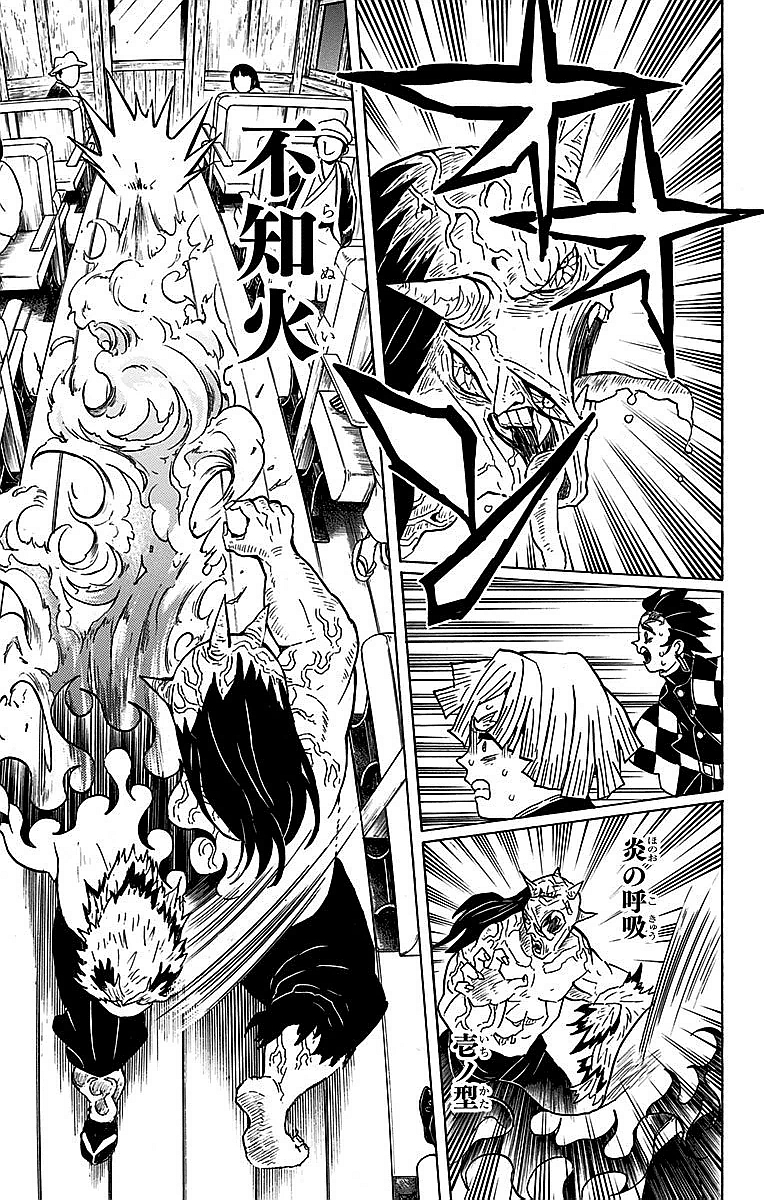
鬼滅の刃 第7巻 p.43 ©吾峠呼世晴/集英社
English (VIZ official)
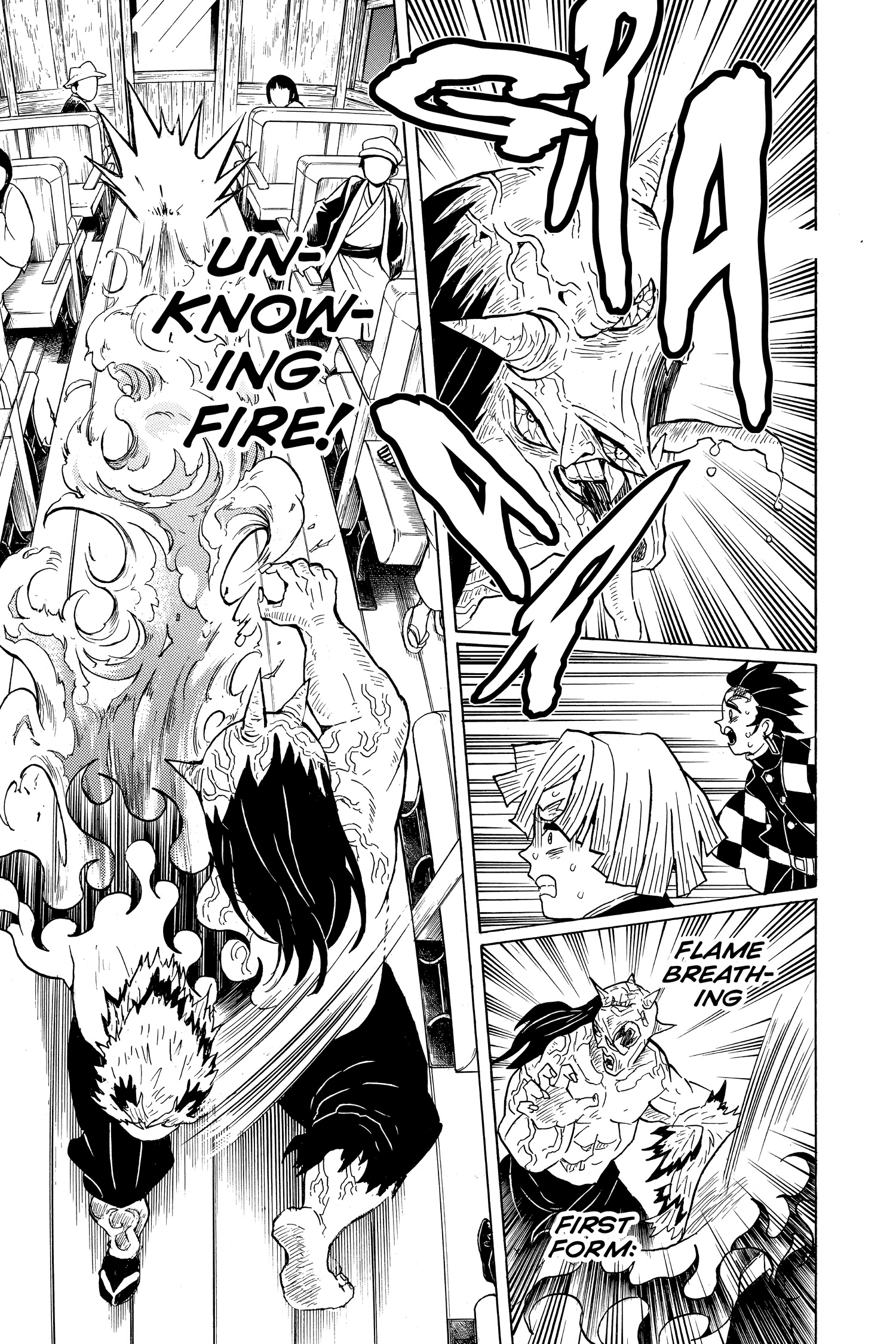
Demon Slayer Vol. 7 (VIZ Media), p.43 ©Koyoharu Gotouge/VIZ Media
Japanese (manga)
炎の呼吸 壱ノ型 不知火
shiranui
鬼滅の刃 Vol. 7, p.43
English (VIZ official)
"FLAME BREATHING FIRST FORM UN-KNOWING FIRE!"
Demon Slayer Vol. 7 (VIZ), p.43
The Moment
Vol.7, page 43 in the Japanese edition (VIZ Vol.7 at the corresponding panel). Rengoku draws.
Enmu's dream-trap has just collapsed, the train is shaking, and the page hands itself over to a single body in motion. Enmu, 下弦の壱, the Lower One in VIZ's rendering, is the last surviving Lower Moon at this point in the arc, and the form Rengoku draws here is the answer to him. The narration plates the technique name across the top of the spread the way every shōnen battle-manga does: vertical, weighty, the kanji given more visual real estate than the dialogue. This is the first of Rengoku's named forms the reader sees in combat, and it sets the tonal grammar for every Flame Breathing form that follows.
What it reads, in the original, is 「炎の呼吸 壱ノ型 不知火」. In the VIZ edition: FLAME BREATHING FIRST FORM UN-KNOWING FIRE!
You know this beat. You have probably watched the ufotable cut more times than is reasonable: orange-on-black, foxfire bloom around the blade, the first cut landing before the kanji have finished resolving. The English does most of what a technique reveal needs to do. It marks the style, numbers the form, hyphenates the name so the eye reads it as a proper-noun-shaped compound rather than a sentence.
What it could not bring across inside that lettering strip is that the name is also a ghost story.
The Original
炎の呼吸 壱ノ型 不知火
Honō no kokyū, Ichi no kata, Shiranui [flame-GEN breathing, form-of-one, shiranui]
Three pieces, read in sequence: the breathing style, the form-number, and the name.
The first piece, 炎の呼吸, is straightforward. Honō no kokyū, "Breathing of Flame." The の is the standard possessive-genitive particle, joining 炎 (flame) to 呼吸 (breathing). VIZ renders this as "Flame Breathing" across every form, which is the right call: the compound is set as a discipline name, and English needs a noun-noun compound to mark it.
The second piece, 壱ノ型, is where the typography carries register. 壱 is the formal variant of 一 ("one"), the kanji you find on banknotes, contracts, and ceremonial certificates rather than in a shopping list. Choosing 壱 for a technique-form number signals a catalogued discipline, the kind whose forms get inscribed in a transmission scroll rather than scribbled on a practice-floor whiteboard. The ノ is の written in katakana, an orthographic register-marker. Standard modern Japanese uses hiragana の; ノ is a traditional convention for technique names, transmission scrolls (densho 伝書), era-name documents, and other catalogued registers. The orthography signals what 壱 signals at the head of the phrase: a classical, scroll-style heading, not a casual list entry.
The third piece, 不知火, is what this chapter is really about.
On the kanji surface, the compound breaks down as 不 (negation prefix, "not") + 知 (knowing) + 火 (fire). Read character-by-character in standard on'yomi you would expect something like fu-chi-ka, a constructed reading that does not exist for this compound. The reading printed alongside the kanji is しらぬい (shiranui), and the relationship between the kanji and that reading is the interesting part.
This is a jukujikun (熟字訓): a reading attached to a multi-character compound as a whole, rather than assembled from each character's on'yomi or standard kun'yomi. Many jukujikun (大和 yamato, 田舎 inaka, 七夕 tanabata) attach a native word to a kanji compound where the surface sound is opaque to the individual characters. The kanji function as a piece of meaning-art; the sound has to be learned separately.
不知火 is jukujikun in the orthographic sense, but the word itself is etymologically transparent. しらぬい breaks down historically as 知ら (shira-, the negative stem of 知る shiru, "to know") + ぬ (the classical negative auxiliary, the same one in shiranu) + い (a vowel-only reflex of 火 hi, "fire," the same h-drop pattern visible in compounds like ほのお for 炎). The literal meaning the kanji record, fire that is not known, is exactly what the historical sound shira-nu-(h)i assembles. The orthography fixes the literal sense in writing even as the surface sound has eroded into a single native word.
So this is jukujikun of a particular kind: meaning and etymology are transparent through the kanji, but the modern surface reading is treated as a unit rather than as a phonetic spelling. For contrast: 大和 yamato is jukujikun where the sound is not derivable from the characters; neither 大 nor 和 contributes to yama-to phonologically. 不知火 shiranui is jukujikun where the sound is a historical reflex of the characters' classical readings, frozen by phonological erosion. Both are jukujikun by the standard definition. They sit at different points on the etymological-transparency axis.
VIZ's Choice
FLAME BREATHING FIRST FORM UN-KNOWING FIRE!
Look first at what VIZ's translator was solving for.
A technique-reveal balloon in shōnen manga is one of the most constrained lettering jobs in the medium. It has to land in roughly the typographic footprint of the original, a long vertical strip set off from the dialogue, and read at the speed of an animation cut, not a footnote.
Inside that constraint, the English lands several things. The hyphenation in un-knowing is the closest English typographic move to a kanji compound; it tells the eye to read the phrase as one unit, not as a sentence. The all-caps signals the declarative weight Japanese gets from the 壱 / 型 formal kanji. And the line offers a semantic gloss: a reader who has never seen the Japanese can construct, from un-knowing fire, some sense of mystery. The gloss even points, accidentally, at the historical etymology. A fire that is "not known" is exactly what shira-nu-(h)i literally says.
VIZ kept the semantic transparency by giving up the acoustic identity, which inside a balloon and a deadline is a real trade rather than a careless one. What it gives up is real, but it is not free to keep.
The Gap
Three things go on inside 不知火 that the English does not, and probably could not, carry. They stack.
The English doesn't actually parse.
"Un-knowing fire" reads, to a native English ear, as slightly broken. Unknowing is an English adjective, but it modifies a sentient subject: an unknowing accomplice, an unknowing victim. Applied to fire, it is left hanging. It is not clear whether the fire lacks knowledge, causes others to lack it, or is meant to function as a proper name where the grammar should not be parsed at all. The hyphen is the lettering's attempt to push the reader past the parse and into "treat this as a name." Real craft, but it leaves the line slightly off-key for a casual reader skimming the page.
Compare the Second Form, 弐ノ型 昇り炎天, which VIZ renders as "Second Form: Rising Scorching Sun." The English noun phrase parses cleanly; the reader's eye doesn't catch on the grammar. We pick that one up in II-2.
The cultural reference is what carries the weight.
The deeper loss is that 不知火 is not a freshly-coined compound. It is a word with a known referent: a natural phenomenon attached to a specific geography, with an aesthetic charge a Japanese reader picks up on first sight.
The shiranui are spectral lights, clusters of small flickering flames historically observed over the Yatsushiro Sea (八代海) and the adjacent Ariake Sea (有明海) on the western coast of Kyushu. The phenomenon is particularly attested over the southern reach of the Ariake system into Shimabara Bay (島原湾) and along the coast of what is now Kumamoto Prefecture (熊本県). The Yatsushiro Sea is the canonical shiranui locality in the Higo (modern Kumamoto) tradition; Ariake and Shimabara Bay form the adjacent, folklorically-linked body of water where the same lights are also seen. They appear in classical literature, early-modern travel accounts, and regional folklore going back centuries. Modern atmospheric science attributes the lights to temperature-inversion mirages of distant fishing-boat lamps. Pre-modern accounts had other explanations: drowned spirits, dragon-fire, yōkai mischief, the lamps of an underwater otherworld. The Shiranui-machi (不知火町) district within Uki City (宇城市), Kumamoto Prefecture, takes its name from the phenomenon. It was an independent town in Uto District until October 2005, when it merged into Uki City; the place-name survives now as a sub-municipal designation.
What a Japanese reader sees when 不知火 appears, in other words, is not a coined name. It is a word with a place and a folklore behind it: small flames dancing over dark water, attributed to spirits, observed for centuries on a specific coast. The image is at home in classical Japanese aesthetic vocabulary, the way will-o'-the-wisp is at home in English folk imagery, except specifically anchored to a real coast.
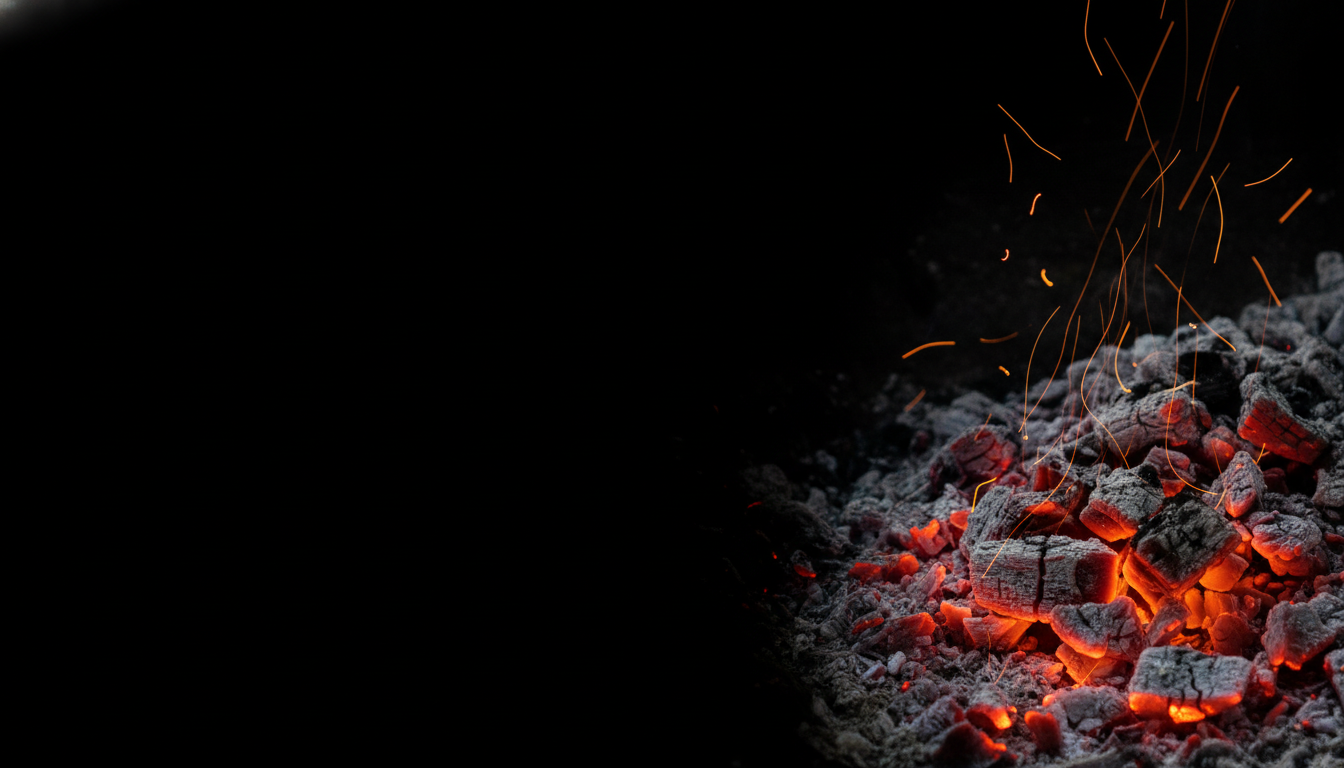
And then the image maps onto the technique. The First Form of Flame Breathing is a series of swift, low, flickering cuts at ground level, the blade tracing a horizontal arc, multiple impact points lit up across the strike line. Small flames travelling fast above a surface. The name is not a label. The name is the image. A reader who knows what shiranui refers to sees the technique's pattern in the word before the panel resolves.
The compound is the imagery.
Technique names in this manga operate on the same principle as classical poem-tags or seasonal kigo: compact kanji compounds that evoke a piece of natural imagery rather than describing the technique. 昇り炎天 (the Second Form) evokes the sun blazing up at noon; 炎虎 (the Fifth) a tiger of flame; 盛炎のうねり (the Fourth) the rolling swell of a wave. They are micro-haiku, pointing at images rather than describing the cut.
不知火 sits inside this catalogue as the one that points hardest at a real-world referent — closer to a place-name than to a poetic compound — and that is exactly what the English cannot carry. "Un-knowing fire" does not point at the Yatsushiro coast; it points at its own kanji, somewhat awkwardly. What the original was doing — pointing past the page to a piece of Japanese geography the reader brings in unprompted — has nowhere to land.
The two sides of the fandom built different things around the technique. Japanese-speaking fans, recognising shiranui on sight as a folk-image of foxfire over dark water, hold the First Form in a frame of slightly eerie naturalism: the coastal phenomenon pulled onto the train car. English-speaking fans, working from the VIZ name and the ufotable animation, hold the form through other signals: the orange-on-black palette, the foxfire bloom around the blade, the cross-cut with the Mugen Train soundtrack in fan edits. Both sides have the technique. The frames differ, and each is anchored to sensory material the other does not see.
A note ahead: I-5 picks up 「赫き炎刀」, the archaic adjective form Rengoku uses for his blade in the same fight. Technique-name register and weapon-naming register run in parallel, and the cumulative effect is a Rengoku whose vocabulary is calibrated, top to bottom, to a register older than the era he lives in.
Aine's Alternative
There isn't a right answer. There are choices with different cost structures.
Leave it untranslated as Shiranui, with a one-time gloss. The option closest to where the contemporary translation industry has been trending. Recent VIZ releases, Seven Seas titles, and Kodansha's later catalogue have shown more willingness to leave names and verbal tics as romaji when the original is doing something the English cannot replicate. Flame Breathing, First Form: Shiranui, with a translator's note glossing the term as "phantom sea-fire," preserves the acoustic identity, lets the name function as a name rather than as a parseable noun phrase, and lets the cultural reference be discoverable. The cost: the casual reader has to absorb a Japanese word in the middle of an action beat. Footnotes break panels.
"Phantom Sea-Fire." Gives up the acoustic identity but tries to carry the imagery: phantom for the supernatural register, sea-fire for the geographic anchor. Parses cleanly, fits the lettering. The cost: it reads as a coined name, which is exactly what 不知火 isn't.
"Will-o'-the-Wisp." The closest English folk-word for a comparable phenomenon. The cultural slot lands: every reader knows what a will-o'-the-wisp is. The cost is the relocation. Will-o'-the-wisp is European folk imagery, attached to bogs and graveyards; substituting it for shiranui swaps one folk geography for another and quietly Anglicises Rengoku's discipline.
"Ghost-Fire" or "Phantom Flame." Splits the difference. Compact, evocative, neutral. The cost is generality: ghost-fire could be any spectral flame, and the anchor to a Kyushu coast vanishes.
VIZ's choice prioritises literal semantic transparency over evocation. The alternatives sit at progressively greater distances from the kanji-by-kanji gloss and closer to the referential job the original is doing. The trade is between four things: fit in the lettering, parse in English, acoustic identity, cultural anchor. You cannot keep all four.
Take-away
Technique names in this manga are not labels. They are micro-haiku: compact compounds that point past themselves at images already in the reader's head, the way classical Japanese poetry has been doing for a thousand years. Shiranui is the form-name that points hardest. It points at a coast, an atmospheric phenomenon, and a folkloric explanation for it, all at once. The kanji are not arbitrary either: 不知火 records the literal meaning the surface sound shira-nu-(h)i assembled centuries ago from "fire that is not known." UN-KNOWING FIRE translates the kanji's surface; the deeper pointing-past-the-page to a Kyushu coastline and the folklore around it is the thing that didn't fit in the balloon.
Once shiranui has its full reference in place, the First Form reads differently. The flicker pattern, the low horizontal sweep, the lit impact points along the strike line are foxfire over dark water, brought into Flame Breathing as if the discipline took the coastal folklore and turned it into a sword cut. The image is the technique. The name is just the doorway.
I-5 picks up the same register problem on the weapon-naming layer, where Rengoku names his blade in the archaic-classical palette this chapter has just mapped onto the technique-naming side.
Alternative translations
- Shiranui (untranslated, with gloss: 'phantom sea-fire')
- Unknown Fire
- Phantom Flames
- Ghost Fire
- Will-o'-the-Wisp
- Sea Phantom Fire
Sources
Linguistic analysis grounded in primary sources
- [manga_volume] 鬼滅の刃 Vol. 7, page 43
How this was made: a Japanese Demon Slayer otaku hand-picked the insight from a massive bilingual database pairing every original Japanese line with its official English edition. AI then translated and wrote up the analysis from those source quotes — every Japanese / English excerpt above is a byte-exact capture from the cited manga editions, not invented.