Translation Gem · Kyojuro Rengoku
Why VIZ's 'BLOOMING FLAME UNDULATION' Nails the Poetic Surge of 盛炎のうねり
VIZ elevates a physical attack name by pairing the aesthetic verb 'blooming' with the musicality of 'undulation'—turning a kata description into lyric poetry.

Japanese (manga)
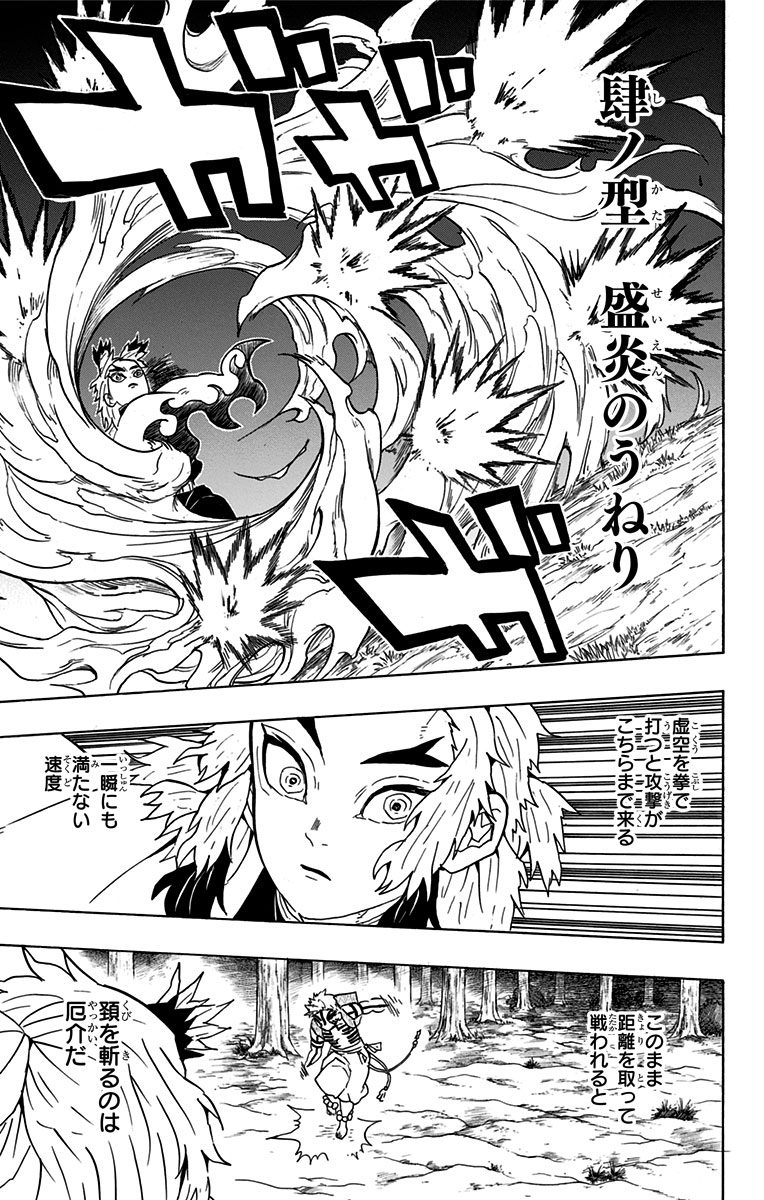
鬼滅の刃 第8巻 p.43 ©吾峠呼世晴/集英社
English (VIZ official)
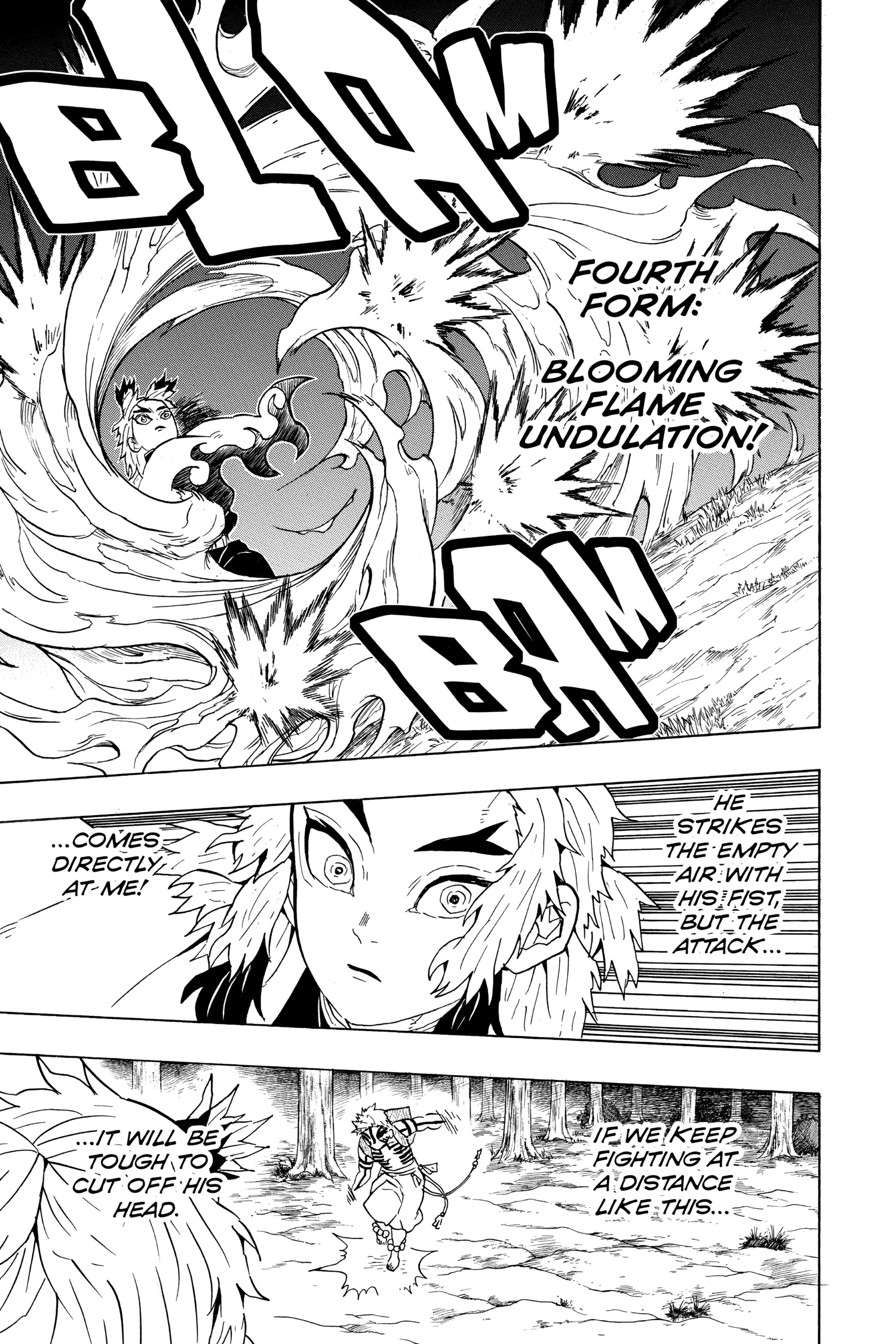
Demon Slayer Vol. 8 (VIZ Media), p.43 ©Koyoharu Gotouge/VIZ Media
Japanese (manga)
炎の呼吸 肆ノ型 盛炎のうねり
Honō no kokyū shi no kata seien no uneri
鬼滅の刃 Vol. 8, p.43
English (VIZ official) — ✓ nails it
"FLAME BREATHING FOURTH FORM: BLOOMING FLAME UNDULATION!"
Demon Slayer Vol. 8 (VIZ), p.43
The Moment
Vol.8, page 43 in the Japanese edition; VIZ Vol.8 at the corresponding panel. The fight has gone long enough that the technique names have started to braid into one another, the way they do when the choreography wants the reader to feel the swordsman cycling through his school. Akaza is still standing. Rengoku is still moving. Between them, the page keeps stacking forms, calling them out in caps, letting the lettering carry the half of the impact that the line art isn't already carrying.
Fourth Form is the next call.
You know this rhythm by now. The blade rises into the gutter; the balloon comes in at the top of the right page; the catalogue clause runs across two beats and the lyric clause crowns the third. Vertical text, heavier ink, the technique-name typeface set a notch above the surrounding dialogue. The Japanese page leans on old-print weight and Sino-Japanese kanji. The English page leans on all-caps and a colon. The convention has, by now, met itself in the middle.
What he calls out is 「炎の呼吸 肆ノ型 盛炎のうねり」.
This is a Gem chapter, and it pairs with the one before it. II-2 made the case for the VIZ Vol.7-8 translator (John Werry) rendering the Second Form's lyric, RISING SCORCHING SUN, by translating 炎天 through sensory effect rather than through morpheme. II-3 is the same argument run on a different lyric, with a different problem set. The Fourth Form isn't asking for thermal intensity. It is asking for music. The English line does something with consonants and vowels that the Japanese does through its own phonological levers: nasal recurrence, open-vowel sustain, kanji weight giving way to hiragana softness. Different mechanism, same effect on the ear.
The Original
「炎の呼吸 肆ノ型 盛炎のうねり」
Honō no kokyū / shi no kata / seien no uneri [flame-GEN breathing / 4-GEN form / peak·flame-GEN undulation]
The first two units carry the catalogue, the same way they do in the Second Form name. 炎の呼吸 is the school clause, flame's breathing, the practice line. 肆ノ型 is the rank-and-file clause: 肆 is the daiji (formal-numeral) variant of 四 (shi, "four"), the same kind of legal-document variant 弐 plays for 二 in II-2; ノ here is the genitive particle の written in katakana, an old-print convention that sustains the ceremonial register; 型 is the rehearsed form. Read aloud, 肆ノ型 sounds like 四の型. Look at it on the page, and the form has been engraved in. (II-2 walks through the daiji mechanic; we register the parallel and move on.)
What is new is the lyric clause: 盛炎のうねり.
盛炎 (seien, the Sino-Japanese on-on reading the work-knowledge canon and the I-3 draft both pin) carries the load. 盛 (sei in this compound; also mori / saka(n) / jō elsewhere) is the kanji of peak, flourishing, at the height of. The same 盛 turns up in 盛り上がる (moriagaru, "to swell up"), in 真っ盛り (massakari, "at full peak"; the same kanji, read here as sakari), in 全盛期 (zenseiki, "golden age"), in 繁盛 (hanjō, "thriving in business"). It doesn't pull toward raging the way 猛 does, and doesn't pull toward blazing the way 炎 itself does. It pulls toward the apex of a thing, with an aesthetic charge: flourishing, not out of control. 炎 here is read in its Sino-Japanese voice (en), the voice 炎天 used in II-2 to climb away from administrative diction. 盛炎 reads, accurately if loosely, as flame at flourishing peak: flame in the moment of its fullest aesthetic expression, before it falls back.
のうねり is the tail. の is the genitive particle. うねり (uneri) is a yamato-kotoba, a native Japanese word belonging to the native Japonic lexical stratum (the stock of vocabulary inherited from pre-Sinitic Japanese, as distinct from 漢語 kango loaned from Chinese), meaning undulation, swell, the long rolling motion of waves on open water. Morphologically it is the 連用形 of the verb うねる (uneru) nominalised, the same productive pattern that gives 流れ from 流れる. It is what a Japanese speaker reaches for to describe the swell of the sea between storms, or the long ridge-and-trough pattern of distant dunes. Not violent. Rhythmic, deliberate, sustained.
What 盛炎のうねり sets up is a yamato-on-kango doublet — what classical Japanese-language scholarship calls 和漢混淆 (wakan-konkō), the mixing of native (和語) and Sino-Japanese (漢語) vocabulary inside a single phrase. The Sino-Japanese compound supplies the dignified, almost calligraphic peak-image. The yamato tail supplies the kinetic, water-shaped motion. Two registers in three units. Compact.
VIZ's Choice
FLAME BREATHING FOURTH FORM: BLOOMING FLAME UNDULATION!
All-caps, colon-hinged, exclamation-closed. The page geometry is the same as II-2: catalogue half on one side of the colon, lyric half on the other. The typographic convention sends the this is being shouted signal that the original carries through balloon weight and font choice.
The constraints are the constraints of every technique-name panel: balloon space, glance-readability, the typographic settlement English-language manga has reached for shouted attack lines. The harder problem, again, is keeping the two registers stratified across the colon. Catalogue on one side. Lyric on the other. The English has to find lever equivalents for two Japanese mechanisms it cannot replicate directly: kanji-weight on the Sino-Japanese half, hiragana-softness on the yamato half.
FLAME BREATHING repeats the calque from II-2. FOURTH FORM renders 肆ノ型 by ordinal-formal English; the silent loss of 肆 as a daiji variant is the same micro-loss the Second Form took on 弐, invisible to a reader who only sees the English. Worth a one-line note, no more.
What Werry does on the lyric side of the colon is the call this chapter is here to credit. BLOOMING renders 盛: not RAGING, not SURGING, not even FLOURISHING. FLAME carries 炎 in the lyric-register reading. UNDULATION renders うねり, choosing a precision-poetic English cognate over the more familiar WAVE or SURGE. The three words land in a sequence that produces, in English, something equivalent in ear-effect to what the Japanese is doing through different phonological levers. The reading-aloud test passes in both languages. The choice was made inside the same balloon-space-and-typography constraints every technique-name panel imposes. That the choice landed where the music would carry extra weight is not free, and not what every translator would have caught.
Why It Works
Four moves are stacked inside the lyric clause, and they only land because they are stacked in this specific order.
BLOOMING re-weights 盛 toward aesthetic apex rather than raw fury. 盛 carries an aesthetic charge that the standard English candidates do not. RAGING is too violent; raging flame is a forest fire, not a martial technique at its peak. SURGING is closer in kinetic vector but misses the apex component; surging flame could describe the flame at any point in its arc. FLOURISHING gets the apex but tips into ornamental; flourishing flame sounds like topiary. BLOOMING holds both ends: organic surge (a flower opening) and aesthetic peak (the bloom is the moment the flower is most itself). It also imports a living-thing register that the Japanese compound sustains through 盛, the kanji you use for a person in their prime, a business in its season, a tree in its leaves. BLOOMING is the living word for an apex.
UNDULATION holds the yamato-kotoba register through phonetic length rather than lexical layer. English doesn't have lexical strata that map to Japanese; there is no "yamato-kotoba" tier, no orthographic signal that marks a word as belonging to an older layer. What UNDULATION has in lieu of stratum is length. It is a four-syllable Latinate noun in a line otherwise built from short, hard-consonant English (FLAME, BREATHING, FOURTH, FORM, BLOOMING). The length slows the line down at the end, the way うねり slows the Japanese line down through three open-vowel morae (u-ne-ri) holding their final vowels. WAVE would have been too quick, one mora, hard-stopped. SURGE would have been too violent, one syllable with a hard consonant cluster in the wrong temperament. UNDULATION sustains. That sustain is what the Japanese tail produces through its native-lexicon softness.
The Japanese line builds its music before the English gets a chance. Read the lyric clause aloud in Japanese first. Seien no uneri runs three nasal /n/ recurrences: the syllable-final ん of 盛炎 (the 撥音 closing seien), the /n/ onset of the genitive no, the /n/ mora inside uneri. This is what stylistics calls consonance rather than alliteration proper. Alliteration is technically word-initial consonant repetition; the /n/ here recurs word-internally and phrase-medially. The recurring nasal threads the compound and the tail together as a single sonic unit. Pitch-accent contour reinforces the thread: seien runs high on its second mora and falls, then uneri picks up low and pulls the line into its sustained close. The hiragana orthography of うねり contributes a visual slowdown that mirrors the phonological one. Three kana glyphs follow the dense double-kanji of 盛炎, the page opening up where the sound opens up. The Japanese has built three layers of music (consonance, pitch-accent contour, orthographic rhythm) before the English has been asked to do anything.
The English finds a parallel music through different levers. BLOOMING FLAME UNDULATION has the bilabial-and-labiodental cluster on BL- and FL- pulling the first two words together: word-initial alliteration proper, a tighter sonic device than the Japanese consonance. The soft -ING and -AME endings echo (a touch of assonance), and the long Latinate UNDULATION resolves the line into a sustained close. The alliteration isn't a one-to-one correspondence to the Japanese sound pattern; it is an English equivalent for what the Japanese is doing through different phonological levers. JA-side consonance pairs with EN-side alliteration; JA-side open-vowel sustain pairs with EN-side polysyllabic resolution. The lines sing in both languages, in different keys.
A note on the cross-references inside the volume. II-2 took the position that the Second Form's lyric clause (昇り炎天 → RISING SCORCHING SUN) was a sensory-translation hit. II-3 takes the position that the Fourth Form's (盛炎のうねり → BLOOMING FLAME UNDULATION) is a musical-translation hit. The Pitfall companion in I-3 covers the First Form (壱ノ型 不知火 → UN-KNOWING FIRE), where Werry made a more literal call and the English thinned out — though as I-3 notes, EN fans have built their own parallel frame around that form through the ufotable animation and the cut pattern itself. That is a different kind of landing. Three forms, three outcomes, executed under sequential VIZ volumes credited to the same translator. The pattern isn't consistency. The pattern is that every technique name is a separate listening problem, and the rate at which a translator hits is the rate at which they correctly hear what this specific line is asking for. For II-3, the asking was for music.
A note on what 盛 isn't doing. There is a temptation, when an English translator hits a kanji like 盛 in a Flame Breathing technique name, to reach for the most physically vivid candidate: RAGING, ROARING, EXPLODING. Those would fit a different lyric clause (a clause designed around the violence of fire) but they would mistranslate this one. 盛 is the kanji of being at the height of being yourself. The technique that uses it isn't the technique of fire at its most violent; it is the technique of fire at its most fully expressed. BLOOMING gets that. The candidates that get it wrong are the ones that decide in advance that flame techniques should sound dangerous. This one is supposed to sound complete.
The Lyric Move
A Gem chapter is generous, but it has to acknowledge the path not taken. Two alternatives are worth running against the VIZ call.
FLAME BREATHING FOURTH FORM: RAGING FLAME WAVE. The fury-and-water rendering, every standard candidate at once. RAGING re-weights the technique toward violence and away from aesthetic peak; the bloom layer disappears. WAVE collapses the four-syllable sustain of UNDULATION into a single hard-stopped beat. Read aloud, RAGING FLAME WAVE is three trochees in a row, each closing the line a little harder. The music is gone.
FLAME BREATHING FOURTH FORM: PEAK FLAME SWELL. The literal calque. PEAK is the etymological gloss of 盛; SWELL is in the conceptual neighbourhood of うねり. The result reads as a chart-label rather than a technique name. Interestingly, this candidate scores higher than the VIZ rendering on one axis. PEAK is unambiguously Latinate-formal, SWELL is unambiguously Germanic-everyday, and the two-stratum alternation maps onto the seien / uneri split more transparently than BLOOMING / FLAME / UNDULATION does (three Latinate-or-Germanic words across the line, no clean alternation). The cost of the VIZ choice on this axis is real: the English doublet does not visually stratify the way 盛炎 / うねり does on the Japanese page. PEAK FLAME SWELL would have kept the stratification and lost the music. Werry kept the music.
What VIZ took, against these, is the rendering that keeps every lever pulled. Move BLOOMING out and 盛 thins toward fury. Move FLAME out and 炎 drops a register. Move UNDULATION out and the close goes from sustained to abrupt.
Worth saying that this kind of close-reading credit is not what a VIZ translator can afford to spend on every line. Print-deadline manga translation does not run at the temperature of a translation seminar. The choice was, somewhere along the line, fast. That the fast choice was this one is what makes it craft rather than luck. The line lands where 盛 wants an aesthetic-peak word; it lands where うねり will not survive WAVE; it lands where the alliteration carries the consonance from the other side. That is the signature that shows up on the page.
Take-away
A note on what each side built around this technique name. In Japanese fan reception, the Fourth Form sits as a beat in the choreography sequence rather than as a standalone meme. 「盛炎のうねり」 doesn't get quote-tweeted the way 「よもやよもや」 does (I-1), partly because technique names are typically called out within combat sequences rather than absorbed into everyday fan vocabulary. On the English side, BLOOMING FLAME UNDULATION arrived through the VIZ Vol.8 print and through the broader Mugen Train circulation. The line has its own quieter life inside cosplay choreography videos and inside the technique-name fanart that re-letters the original calligraphy with the VIZ English. Both sides receive the technique name; neither side has made it a quotable meme. That is itself a fact about technique-name reception worth holding next to the I-1 / II-1 catchphrase patterns: not every well-translated line becomes a fingerprint. Some lines live inside the choreography and stay there. The craft of the translation does not depend on whether the line escapes into the meme-stream; it depends on whether the line sings when called out on the page. This one does, in both languages.
Some technique names need thermal intensity. The Second Form needed it, and Werry supplied it through SCORCHING SUN. Some technique names need music. The Fourth Form needs it, and Werry supplied it through BLOOMING FLAME UNDULATION. The craft isn't in the rendering, exactly. The craft is in hearing, line by line, which one the line is asking for.
Hold the panel in mind with UNDULATION as the load-bearing word in the lyric clause, and you will hear it sit longer in the mouth than BLOOMING or FLAME. That sustained close carries the same weight in English that the open-vowel softness of うねり carries in Japanese. The next chapter, II-4, pivots away from technique names and back to character voice.
Sources
Linguistic analysis grounded in primary sources
- [manga_volume] 鬼滅の刃 Vol. 8, page 43
How this was made: a Japanese Demon Slayer otaku hand-picked the insight from a massive bilingual database pairing every original Japanese line with its official English edition. AI then translated and wrote up the analysis from those source quotes — every Japanese / English excerpt above is a byte-exact capture from the cited manga editions, not invented.