Glossary · Monkey D. Luffy
一味
Ichimi
The crew as the world names it — 麦わらの一味, "the Straw Hat band." 一味 ("one flavor" → a band bound by one aim, faintly outlaw) is the informal counterpart to the formal 海賊団 and the personal bond of 仲間; Luffy is the rare captain whose crew never takes the formal 〜海賊団 title.
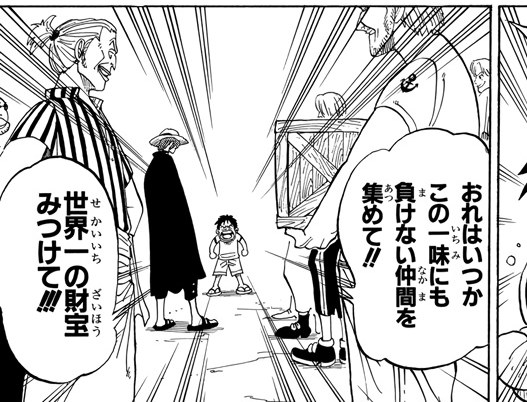 ONE PIECE 第1巻 p.49 ©尾田栄一郎/集英社
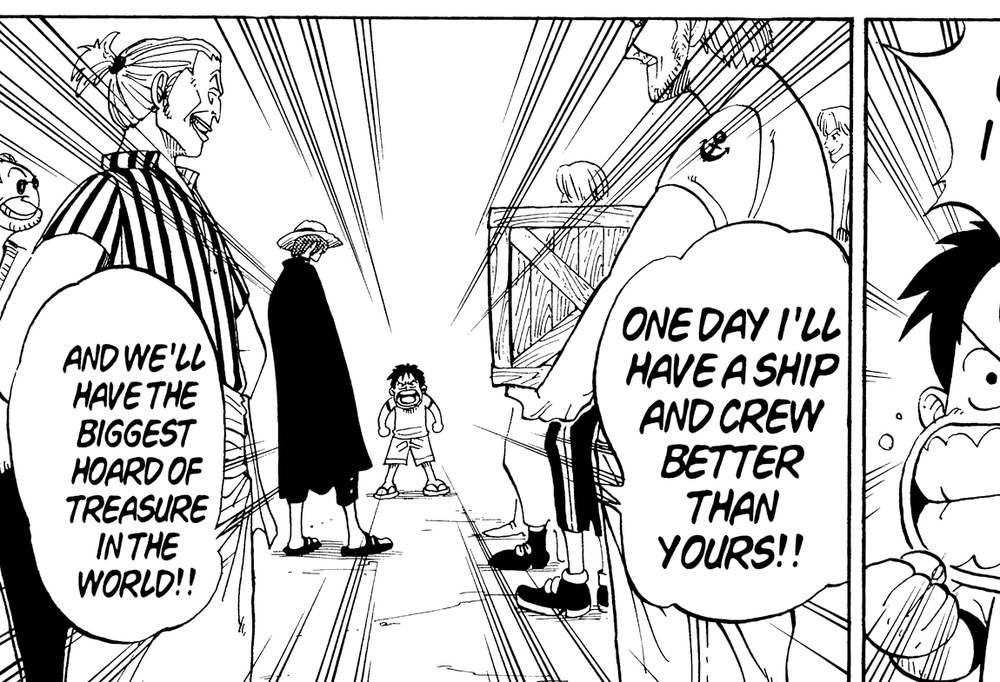 One Piece Vol. 1 (VIZ Media), p.49 ©Eiichiro Oda / Shueisha · VIZ Media
Young Luffy has just been told, one more time, that he is too small to be a pirate. He plants his feet on the dock, glares up at Shanks, and fires off the sentence that will drive the next thousand chapters: ore wa itsuka kono ichimi ni mo makenai nakama o atsumete (おれはいつかこの一味にも負けない仲間を集めて!!, "one day I'll gather nakama who won't lose even to this ichimi of yours"), sekaiichi no zaihō mitsukete (世界一の財宝みつけて!!!, "and I'll find the greatest treasure in the world"). Two different Japanese words for "people who sail together" sit inside that one boast, each doing a different job. VIZ folds them into one: "ONE DAY I'LL HAVE A SHIP AND CREW BETTER THAN YOURS!! AND WE'LL HAVE THE BIGGEST HOARD OF TREASURE IN THE WORLD!!" The swagger survives intact. The two words do not, and the two words are the subject of this entry.
One flavor
Ichimi (一味, furigana いちみ in the panel) is 一 (ichi, "one") on top of 味 (mi, "taste, flavor"). Read it literally and it says "one flavor": a set of people who share a single taste, a single inclination, and therefore move as one body. The image is old — it runs back through tea and Buddhism, where 一味 meant "of one and the same savor," undivided. That neutral, almost warm sense still survives in the set phrase 一味同心 (ichimi dōshin, "one taste, one heart," people united in purpose).
But listen to where the word actually lives in modern Japanese and you hear something cooler. 一味 is the word a newspaper reaches for when it means a ring: 強盗の一味 (gōtō no ichimi, "a member of the robbery gang"), 悪の一味 ("the villain's band"), 一味に加わる ("to join the gang"). The related 一味徒党 (ichimi totō) names a conspiracy. Somewhere between the tea ceremony and the police blotter, "of one flavor" picked up a whiff of the illicit. It is not a slur — a 一味 can be perfectly innocent — but the default modern coloring is a band bound by a shared aim that the law might not approve of. For a story about pirates, that is exactly the right amount of tint.
The word for everyone else's crew
Open the first ten volumes and 一味 is nearly everywhere, and nearly always attached to the other guys. It is Buggy's band (バギー一味), Krieg's band (クリーク一味), Arlong's band (アーロン一味, which VIZ variously renders "Arlong's crew," "Arlong's pirates," and, once, "cutthroats"). When Zoro's old acquaintance warns that "right now, Arlong is out to kill Roronoa Zolo and his crew," the Japanese underneath is sono ichimi (その一味) — "that band of his." The word is how minor characters point at a pirate outfit they fear or despise. It carries the speaker's wariness with it.
Two slots: 一味 and 海賊団
There is a second, more formal word doing parallel duty: kaizokudan (海賊団, かいぞくだん), where 団 is the "-corps, -troupe, -group" suffix of 楽団 (gakudan, "orchestra") and 軍団 (gundan, "army corps"). This is the word that belongs on a title card. When Buggy's arc opens, the chapter banner reads バギー海賊団, "the Buggy Pirates," as an official designation; in dialogue a page later, the same men are just バギー一味, "Buggy's gang." Usopp's playground outfit is grandly billed as ウソップ海賊団, "Usopp's Pirate Crew," on its own banner. The pattern is consistent: 海賊団 is the letterhead, 一味 is what people call you in the street. Most rival crews own both — a formal name and an informal one — the way a company has a registered title and a nickname.
The crew that never got a 海賊団
Here is the thing you find only by searching for a word that is not there. Comb the corpus from the first volume to well past the hundredth and the string 麦わら海賊団, "the Straw Hat Pirates" in its formal -dan form, never appears. Not once. Luffy's crew is named, over and over, as Mugiwara no Ichimi (麦わらの一味) — "the Straw Hat band" — and it is the only major crew in the early series whose standing collective name uses the informal, faintly outlaw 一味 rather than the letterhead 海賊団. They have a nickname where the others have a nickname and a title. It reads as characterization by omission: this is a crew that never files the paperwork, never institutionalizes, stays a band held together by taste rather than a corporation held together by rank.
The name itself debuts late and from an unfriendly mouth. 麦わらの一味 is first spoken by the assassins of Baroque Works during the Alabasta arc, when a hooded agent asks whether "Princess Vivi and the Straw Hats" have been eliminated. A few volumes on, a Marine puts the term inside Japanese quotation marks — 〝麦わらの一味〟を追うんですね!?, "so I'm to go after the 'Straw Hat gang'?!" — the typographic signal that the phrase has hardened into a proper name. The people who coin the crew's name are the people hunting it. That, too, is fitting for a 一味.
What VIZ does with the word
Because English has no single term that carries "band + one shared aim + a hint of the outlaw," VIZ picks a different register every time 麦わらの一味 appears, and the choices are worth watching. Sometimes it is the bare nickname, "the Straw Hats." Sometimes it formalizes to "the Straw Hat Pirates." And in the mouths of the villains and Marines who most often say it, VIZ reaches for "the Straw Hat gang" — the rendering that recovers the 一味 tinge most exactly. One Japanese word, spread across three English ones according to who is speaking.
This is a real loss and a real gain in the same breath. Japanese readers get a single word that quietly holds all three shades at once; the outlaw coloring is always faintly present, even when a friend uses it. English readers lose that constancy — but they gain a translator's editorial read on each line, "gang" when the speaker sneers, "Pirates" when a report needs to sound official. VIZ's "Pirates" is not a flattening error, either: when a Marine files a bureaucratic sighting, the formal English register is the honest match for the formal situation, even though the Japanese kept the informal word. The translation trades one word's steady undertone for a running commentary on tone. Neither edition has the whole thing; they have different halves of it.
一味 is not 仲間
Which returns us to Luffy's dockside boast, where 一味 stands one word away from nakama (仲間) and means something pointedly different. 一味 describes a structure — a band, seen from outside, defined by its shared aim. 仲間 describes a bond — the felt tie between the people inside it. You can be counted in someone's 一味 without any warmth passing between you; Arlong's officers are unmistakably his 一味. You cannot be someone's 仲間 without the relationship being the point. The distance between those two words, and why Luffy keeps collapsing it, is its own long story told in the nakama pitfall — worth reading beside this one, because his whole project is to run a 一味 that is nothing but 仲間.
That is the inflection he puts on the word. A 一味 conventionally assumes a boss and his followers, held together by a shared taste for treasure or terror. Luffy keeps the label — the world calls his people the 麦わらの一味 and he never objects — while gutting its usual internals. No follower ever signs on to a debt or an oath; the crew that will chase the treasure at the end of the Grand Line is a band by the world's naming and a family by its own. The outlaw word stays. What it contains is quietly swapped out underneath.
First appearance
Vol. 1, p.49 of the Japanese edition (ONE PIECE 第1巻), where young Luffy tells Shanks he will gather 仲間 who won’t lose to "this 一味"; the same panel falls on p.49 of VIZ’s One Piece Vol. 1. The crew’s own name 麦わらの一味 first appears later, in Vol. 15 (Baroque Works), and wears Japanese quotation marks as a fixed proper name by Vol. 20.
Related terms
Sources
- ONE PIECE 第1巻 p.49(集英社・日本語版)
- One Piece Vol. 1 (VIZ Media, English edition), p.49
- ONE PIECE 第15巻 p.16・p.33(集英社・日本語版)
- One Piece Vol. 15 (VIZ Media, English edition), p.16, p.33
- ONE PIECE 第20巻 p.56(集英社・日本語版)
- One Piece Vol. 20 (VIZ Media, English edition), p.56
- デジタル大辞泉「一味」(小学館)