The Compound Japan Flipped
Japanese already had a four-character verdict on people who keep their word. The older one is 不言実行 (fugen jikkō): 不 "without" + 言 "words" + 実行 "carrying out." Do the work; skip the announcement. It names a virtue with deep roots in how Japanese business books, school principals, and eulogies praise the quiet doer.
有言実行 (yūgen jikkō) is the flipped version, and Japanese dictionaries typically flag it as the junior coinage, patterned on the older compound by swapping a single character: 不 "without" becomes 有 (yū, "having, being present"). Words present, execution present. Say it out loud first, then do exactly what you said. The structure is two everyday two-character compounds stacked together: 有言 "having spoken" plus 実行 "execution." Jikkō is the same word your computer performs when it runs a program (実行する, "to execute"). Read it in eight morae: ゆ・う・げ・ん・じ・っ・こ・う.
The inversion matters. In the traditional ranking, 不言実行 is the senior virtue: announcing your goals reads as self-promotion, and silence is proof of seriousness. 有言実行 rehabilitates the announcement. It says the declaration is not noise; it is a bond you post in public. Once you have said it, quitting costs you your name.
That is why the word belongs to Naruto. He is the say-it-first ninja in a genre full of quiet geniuses, and the entire series is the long, expensive process of paying off what he announces. To be honest about the record: 有言実行 never appears in our bilingual page database for the series, and neither does 不言実行. It is the label Japanese readers reach for when they describe him, not a line he speaks. What the manga gives us instead is the creed — a sentence that means 有言実行 without using it.
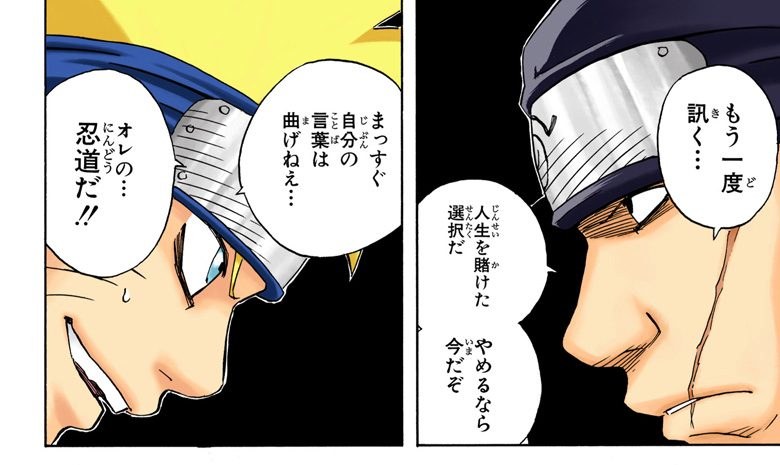
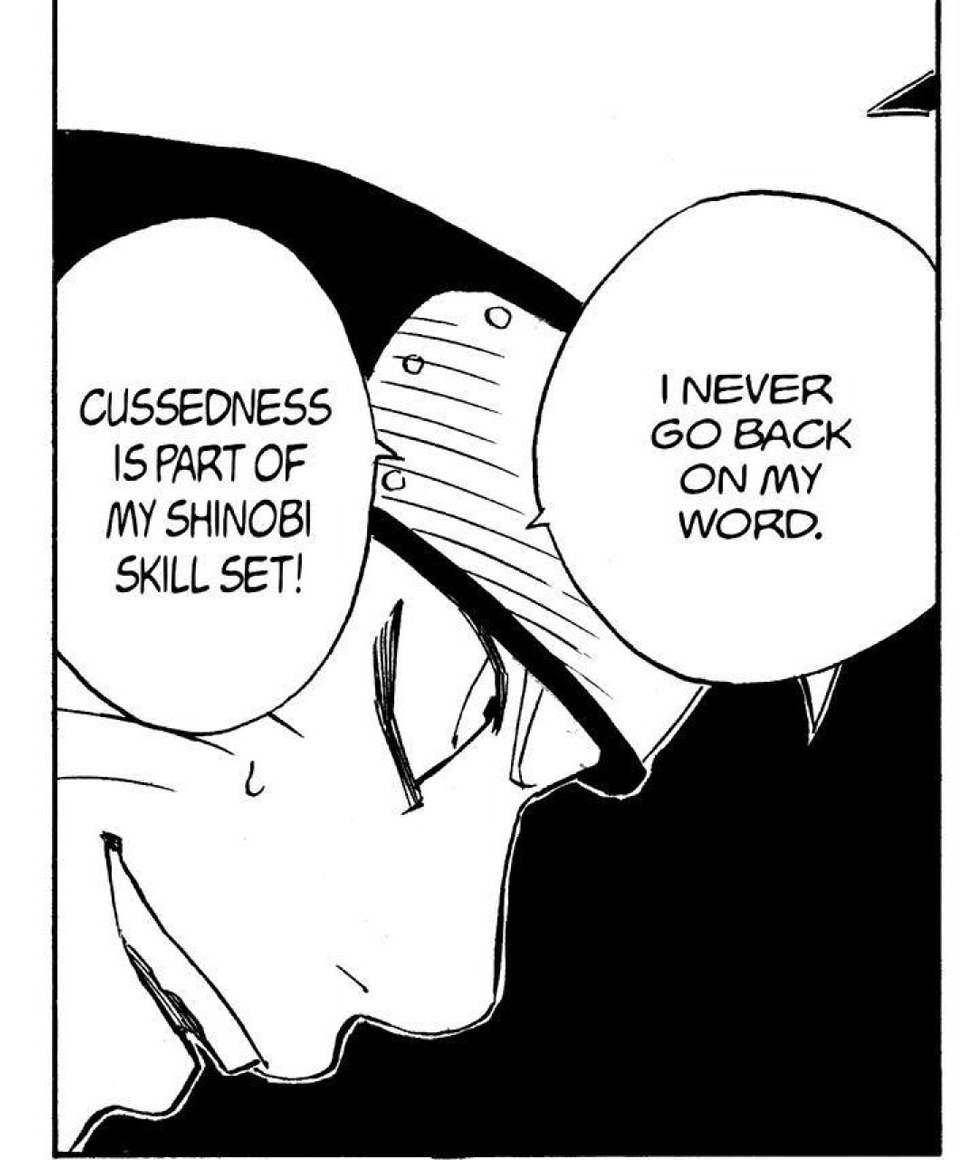
Volume 5, Page 140: The Creed
The written Chunin exam. Proctor Ibiki offers one last exit before the final question: answer wrong and stay a genin forever, or walk out now. Naruto stays, and coins the sentence he will spend the rest of the series honoring:
「まっすぐ自分の言葉は曲げねえ...」 — Massugu jibun no kotoba wa magenē — "I won't bend my own words; I keep them straight." 「オレの...忍道だ!!」 — "It's my... ninja way!!"
VIZ's page renders the first balloon as "I NEVER GO BACK ON MY WORD." and the second, memorably, as "CUSSEDNESS IS PART OF MY SHINOBI SKILL SET!" The noun 忍道 took VIZ several volumes to standardize (the Pitfall on 忍道 tracks that whole journey), but the half that mattered was locked from day one: I never go back on my word survived, verbatim or within a breath of it, from Vol. 5 through Vol. 33 on our checked record, and the Gem next door tells that consistency story. Not a wrong call anywhere in this balloon; the creed's engine came through intact.
Look at what the creed actually claims, though. It is not "I keep promises." It is a statement about speech: my own words (自分の言葉) are the thing I refuse to bend. The sentence presupposes that the words come first — that there is always an utterance on record to be bent or kept. That is 有言実行 stated as a personal law: the 有言 half is assumed, the 実行 half is sworn. The wisdom page on the creed walks through the scene itself; what concerns us here is that Naruto's core principle is grammatically about talking.
Saying It First, Everywhere
Once you see the pattern, it is the shape of his whole story. He announces before he can deliver, and the announcement is the mechanism that forces the delivery.
He opens the series declaring he will surpass every previous Hokage while he is the least promising student in his class; the hokage ambition is broadcast to anyone in earshot years before he can throw a decent punch. In Vol. 18, told the Rasengan is beyond him, he shouts 「三日もありゃこんな術マスターして見せらぁ!!」 ("GIVE ME THREE DAYS, AND I'LL MASTER THIS JUTSU FOR YOU!!") and backs it with a set phrase: 男に二言は無いよ (otoko ni nigon wa nai, "a man doesn't say two [contradictory] things" — VIZ: "BUT A MAN DOESN'T BREAK HIS WORD, YOU KNOW!"), then repeats the creed to Tsunade word for word. In Vol. 21, when Sakura begs him to bring Sasuke home, a teammate needles him — "YOU SURE YOU WANT TO MAKE PROMISES LIKE THAT?!" — and his answer is the creed again: 「へっ!自分の言葉は曲げねェ...オレの忍道だ!」 He then upgrades the promise into a promise of a lifetime, the debt that drives the entire Sasuke arc.
Even his verbal tic plays a part. The sentence-final だってばよ marks him as the boy who cannot stop narrating himself; he is loud by grammar, not just by volume. A shinobi is supposed to be the 不言実行 professional — concealment is the job description, and the word 忍 itself carries "endure, conceal." Kishimoto builds a ninja whose superpower is the opposite: public commitment. The talk is not a flaw his training fixes. The talk is the training.
What English Trades It For
English has no praise-word for this. Its idioms in the neighborhood default to suspicion of talk: talk is cheap, put your money where your mouth is, walk the talk — each one frames speech as a debt you had better cover, with the emphasis on the danger of the mouth. 有言実行 frames the same loop from the far side, as a completed virtue: a label you pin on someone who announced the goal and then stood at the finish line. The nearest English equivalents ("a man of his word," "he delivers") drop the crucial first half — that the person chose to speak when silence was safer.
What English readers get in exchange is real. VIZ's "I NEVER GO BACK ON MY WORD" is a native oath-formula, short, legalistic, and endlessly repeatable, and the translation's discipline in repeating it gave English fans the same recognition-jolt Japanese readers get from the recurring creed. Japanese readers hold the bending metaphor and the cultural backdrop of 不言実行 that makes the loudness legible as heresy; English readers hold a harder-edged promise with courtroom overtones. Different halves of the same character.
Using It Yourself
In the wild, 有言実行 works as a noun and as a praise-label: 有言実行の人 (yūgen jikkō no hito, "a say-it-then-do-it person"), or 有言実行タイプ for the personality type. Its failure-mode opposite in daily speech is 口だけ (kuchi dake, "all mouth"). If you want the full contrast set for the series, taiki-bansei names what Naruto's growth curve looks like from the outside, and chototsu-moshin names how he actually fights; 有言実行 names the contract he signs before every one of those fights.
The take-away: when Japanese media calls Naruto a 有言実行の男, it is not saying he is honest. It is saying he weaponizes the announcement — that a dead-last kid made his mouth write checks and then spent 700 chapters cashing them. The older compound praised those who never needed to speak. His story is the argument for the flip.