The Moment
Loguetown — the East Blue's last port before the Grand Line, self-consciously "the town of the beginning and the end," where the Pirate King was born and executed. Zoro, killing time before his crew ships out, wanders into a weapons shop and fixes on a long blade racked in the back. The dealer doesn't want to sell it, and explains why unprompted, arms crossed, staring past his customer at nothing in particular:
「名だたる剣豪達がその"鬼徹"を腰にしたことで悲運の死を遂げた」「今となっちゃこの世に"鬼徹"を使ってる剣士は一人もいねェ」
Nadataru kengō-tachi ga sono "Kitetsu" o koshi ni shita koto de hiun no shi o togeta. Ima to nacchā kono yo ni "Kitetsu" o tsukatteru kenshi wa hitori mo inē.
"FAMOUS SWORDSMEN HAVE DIED TRAGIC DEATHS BECAUSE THEY WIELDED THE KITETSU SWORDS... THESE DAYS, NO SWORDSMAN IN THE WORLD USES A KITETSU..."
He'd get rid of the sword himself, he admits, if he weren't afraid of what it might do to him for trying:
「おれだってそんなもんさっさと処分してェが...呪われそうでよ...」
Ore datte sonna mon sassa to shobun shitē ga… norowaresō de yo…
"I'D LIKE TO GET RID OF THAT SWORD MYSELF... BUT I MIGHT BE CURSED FOR IT." (Vol. 11, p.138.)
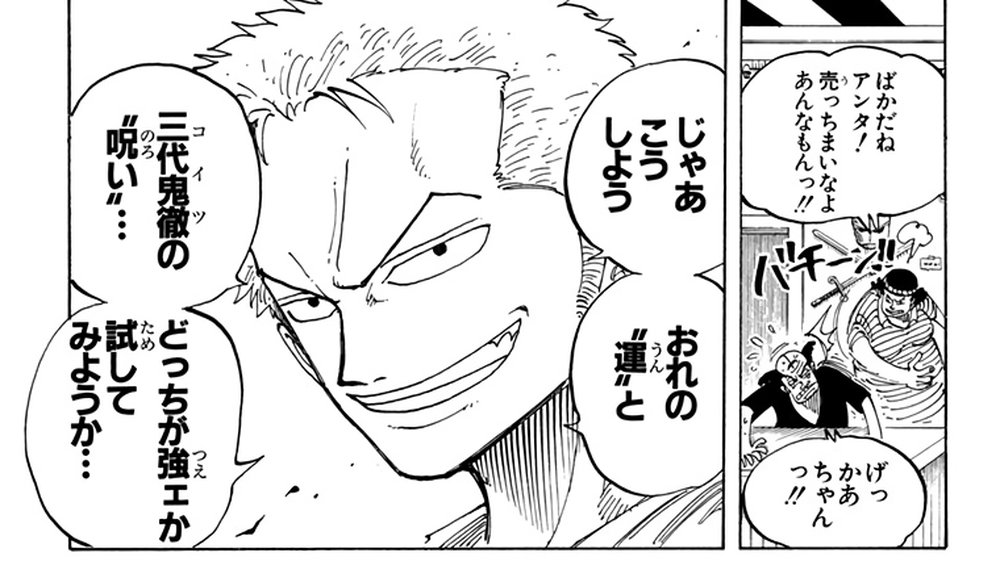
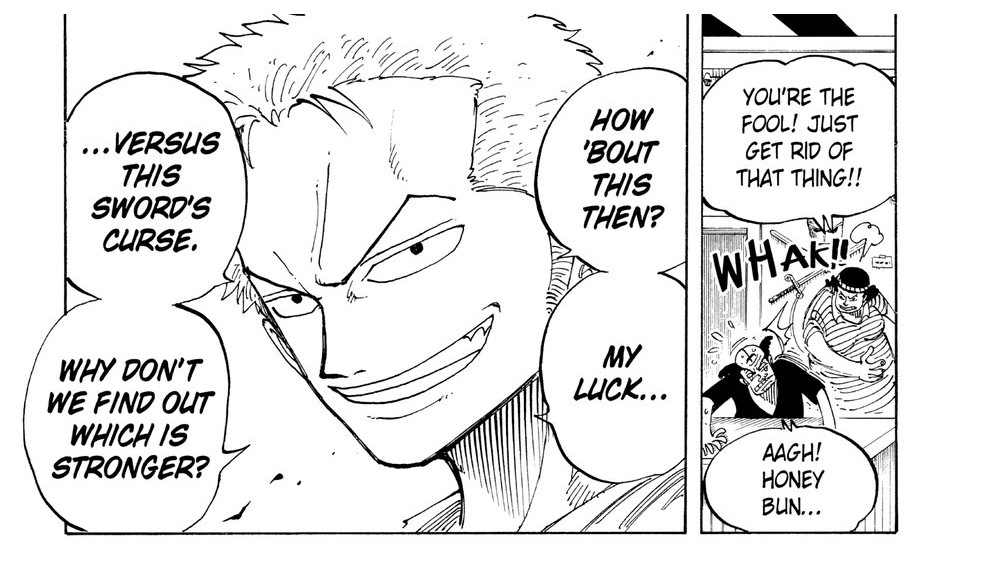
A shop clerk, having mistaken the blade for a toy a moment earlier, is still apologizing — 「そんな恐ろしいものだとは知らなくて!!」, "I DIDN'T KNOW IT WAS SO DANGEROUS!!" Into that fear, Zoro grins: 「気に入った!!」— "I LIKE THIS SWORD!!" He tries to buy it outright; the dealer refuses — 「バ...バカ売らねェぞ!!...それでお前が死んだらまるでおれが殺したみてェじゃねェか!!」, "ARE YOU A FOOL? I CAN'T SELL YOU THAT SWORD!! IF YOU DIED, IT'D BE LIKE I KILLED YOU MYSELF!!" So Zoro proposes terms instead, in four bubbles read in order:
「じゃあこうしよう」「おれの"運"と」「三代鬼徹の"呪い"…」「どっちが強ェか試してみようか…」
Jā kō shiyō. Ore no "un" to sandai Kitetsu no "noroi"… Dotchi ga tsuyoe ka tameshite miyō ka…
VIZ, same order: "HOW 'BOUT THIS THEN?" / "MY LUCK..." / "...VERSUS THIS SWORD'S CURSE." / "WHY DON'T WE FIND OUT WHICH IS STRONGER?" (Vol. 11, p.139.)
Grant the rendering its due before anything else: this is clean work. Four bubbles, four English sentences, none padded or truncated to fit — "curse" lands in exactly the bubble the Japanese puts it in, and the swagger of 試してみようか (the light, almost cheerful "shall we find out" of a man enjoying himself) survives intact as "why don't we find out." Then Zoro holds his bare fist an inch from the standing blade. ヒュッ…ヒュン…ヒュッ… — the sound of air, not flesh. His knuckles come away whole. 「え……!!!!」「斬れ味は本物だぞ!!!」— "OH!!!! THAT BLADE'S RAZOR SHARP!!!" His luck won the bet, this time, against a blade sharp enough to have meant it.
The Original
呪い (noroi) is the noun built from 呪う (norou), "to curse." Break the kanji apart: 呪 is 口 (kuchi, "mouth") over 兄 — and many kanji dictionaries trace that 兄-element back to an old pictograph of a kneeling figure with an open mouth, a reciter of ritual words. The same 兄 sits inside 祝 (shuku), "to bless, to celebrate." Blessing and cursing, on that reading, share a graphic ancestor: both are ritually loaded speech aimed at someone, and the only variable is which way the speaker means it.
That ritual charge never leaves the word family:
- 呪術 (jujutsu) — "sorcery, spellcraft," the general practice — the same word Jujutsu Kaisen borrowed for its title.
- 呪文 (jumon) — "an incantation," the specific words spoken to work it.
- 呪縛 (jubaku) — "a binding spell," paralysis by curse — still the word Japanese reaches for when fear, a promise, or a memory has someone frozen in place, spell or no spell.
- 呪詛 (juso) — the formal, almost legal register for "a curse laid," a word for court records and sutras rather than kids' ghost stories.
呪い itself is the everyday, all-purpose member of that family — common enough in fiction, folklore, and horror media, rare enough in daily conversation, that it sits comfortably in N1-band territory for a learner.
The line's other proper noun rewards the same treatment. 三代鬼徹 (Sandai Kitetsu) is 三代, "third generation" — a smith's lineage name, handed down like a family trade — plus 鬼徹, the smith's own name: 鬼 ("demon, ogre") + 徹 ("to pierce, to go all the way through"). Demon-Piercer, three generations deep. And the grammar carrying the actual threat is almost insultingly plain: [SWORD] の呪い — "[sword]'s curse," a bare possessive. No verb of casting anywhere in the sentence. Nobody in this scene ever says who cursed the blade, or when, or how. The curse is presented as something the sword simply has — the way it has a name.
VIZ's Choice
呪い/呪われる shows up six times across the volumes we have on file. Unlike the scattering we've tracked in sister articles, this word converges — hard:
| Vol. / p. | Speaker | Japanese | VIZ English |
|---|---|---|---|
| 11 / 138 | The Loguetown weapons dealer | ...呪われそうでよ... | ...BUT I MIGHT BE CURSED FOR IT. |
| 11 / 139 | Roronoa Zoro | 三代鬼徹の呪い... | ...VERSUS THIS SWORD'S CURSE. |
| 31 / 49 | A villager, in the crowd | 村人全員呪われるぞ | WE'LL ALL BE CURSED!! |
| 31 / 63 | A villager, in the earthquake | 悪霊の呪いの上に... | WE WERE ALREADY CURSED BY THE SPIRIT, AND NOW... |
| 31 / 82 | The village's elder | 村は果たして"呪い"で死ぬのか!! | IS THE VILLAGE DYING FROM A CURSE?! |
| 31 / 85 | The village's elder | 戦士や村人を殺す。呪い"を | YOU SAY THE CURSE KILLING THE WARRIORS AND VILLAGERS... |
(A seventh instance turned up in Vol. 33, but the corpus's paired English line belongs to a different scene entirely — a stray alignment error our sanity-check caught against the page scans — so we've left it out rather than build a claim on it. Also worth flagging for the record: the corpus OCR renders row four's 悪霊 [akuryō, "evil spirit"] as 悪愛; the printed page, confirmed against the scan, reads 悪霊, and VIZ's own "CURSED BY THE SPIRIT" is the tell.)
Six for six, "curse(d)." Compare that to 因縁, which we've tracked scattering into five different English words across five appearances, or 悪運, which came out as "the devil's own luck," "cursed," and plain "luck" in three straight tries. 呪い gets none of that treatment — every English reader who meets it meets the same word every time.
That convergence is genuinely rare, and it isn't an accident: unlike 因縁 or 悪運, 呪い has an obvious, load-bearing, one-word English cognate. It should be the easy case, and on a panel-by-panel basis, it is — none of the six renderings above is wrong, or even debatable. But the scenes aren't all doing the same thing with the word. Vol. 11 is a weapon with its own inherited malice. Vol. 31 is a village diagnosing a plague as divine punishment. English's one word can't tell you that from the outside; Japanese, if you know where to look, can.
The Gap
"Curse" imports a caster nobody supplies. English "curse" defaults to a spoken malediction — someone says the words, and the curse exists because they said them. Zoro's sword was never cursed by anyone on-page; the dealer never mentions a sorcerer, a ritual, an origin story. The blade simply has 呪い, the way it has an edge — 妖刀 logic, where the malice belongs to the object itself. "This sword's curse" is accurate as a gloss and silently smuggles in a caster the Japanese never names.
One English word is covering a whole native family — and moonlighting for a stranger. 呪い shares its 呪 root with 呪術, 呪文, 呪縛, and 呪詛, four more words for four more shades of the same ritual idea, none of which ever needs the English word "curse" in these particular pages. Meanwhile, in our sister piece on 悪運, we caught VIZ reaching for "CURSED, NO-GOOD RUBBER BOY!!" to translate 悪運野郎 — an unrelated word about karmic luck with no 呪 in it anywhere. English's "curse" is standing in for a five-word Japanese family on these pages and moonlighting for a completely different word on others; a reader tracking only the English text would never know the difference.
"Curse" can't hold the village's specific mistake. 呪い implies intent; its cousin 祟り (tatari) is a kami's or nature's affliction following a broken taboo — consequence without necessarily needing malice. The Vol. 31 villagers reach for 呪い, not 祟り: they believe the plague was set loose on purpose, by an angered god they've just watched die at a stranger's hand. English "cursed" carries their fear intact but can't carry the specific theological claim they're making — or the specific way the story goes on to prove them wrong.
What If
For Zoro's line, the menu and its prices:
- "...against this blade's ill will." — keeps the malice inside the object, no outside caster implied. Cost: "ill will" undersells the menace; it reads more like a grudge than a death sentence.
- "...against Kitetsu's death-mark." — "death-mark" gestures at a doom the blade itself carries, closer to 妖刀 logic than a cast spell. Cost: not idiomatic English; readers will stumble on the compound.
- "...against this sword's bad blood." — keeps VIZ's pun-adjacent snap, and "blood" nods at what the blade has already drawn. Cost: "bad blood" already means an interpersonal grudge in English — a false friend planted right where a true one should be.
- Keep "curse," repair the setup: let the dealer's Vol. 11 p.138 line make explicit that the blade curses on its own, no sorcerer required, so that by the time Zoro says "this sword's curse" the reader already knows what kind. Cost: pushes the real fix onto a different panel than the one that needs it.
Take-away
呪い is the rare word in this series that translates perfectly, panel after panel — and still loses something, because "curse" is a container built for a different religion's magic. English's curse is a sentence someone hands down; 呪い can be a sentence, or it can be a sword's disposition, or a village's diagnosis for an epidemic — and only the context, never the word itself, tells you which.
Three rules of thumb to carry off this page:
- When you meet 呪い, ask who's casting it. Sometimes nobody is — Japanese is comfortable with a curse that simply belongs to an object or a place, no spellcaster required. English "curse" always implies one; that implication is a translation artifact, not a fact about the scene.
- Learn the 呪 family together, not word by word: 呪術 (the craft), 呪文 (the words), 呪縛 (the paralysis), 呪詛 (the formal act), 呪い (the everyday result). One root, five jobs — and English has exactly one word standing in for all of them.
- Don't confuse 呪い with 祟り. A curse is meant; a tatari is consequence. The distinction is the whole plot of the Vol. 31 flashback, and it's exactly what "cursed" can't tell you on its own.
呪い runs through three of the series we track here. Naruto answers with 呪印, Orochimaru's cursed seal branded onto Sasuke's neck like a mark of ownership; Demon Slayer answers with Muzan Kibutsuji's own 呪い, the compulsion he plants in every demon who shares his blood so that none of them can ever move against him. Three different mangaka, one Onmyōdō-flavored word for a malice that never needed a spoken spell to work. For the karmic word English splits five different ways instead of one, see 因縁 and the tie English can't hold together; for the word VIZ calls "cursed" that has nothing to do with 呪い at all, see 悪運 and the devil English hired to explain it — or browse the One Piece translation notes index.
Every Japanese and English line quoted above is a byte-exact capture from the cited editions — ONE PIECE Vol. 11 & Vol. 31 (Japanese) and One Piece (VIZ Media) at the corresponding panels — via our bilingual page database; see Sources below.