The Moment
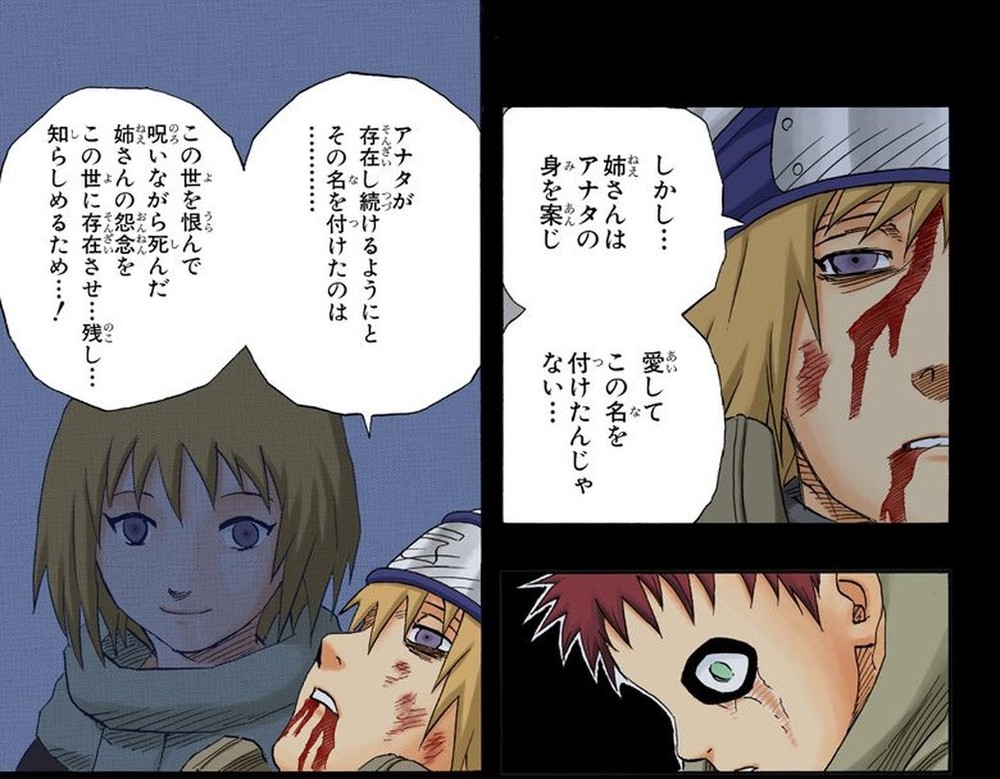
Sunagakure, the night the story has been building toward since Gaara's introduction. An explosive tag has just failed to kill him; the man who planted it, bleeding out against the rubble, is Yashamaru — Gaara's uncle, his lifelong caretaker, the one adult who was ever gentle with him. Two pages earlier he has already told Gaara why: 「姉は里の犠牲になりこの里を呪いながら死んだ......」 — "SHE WAS SACRIFICED FOR THE VILLAGE AND DIED CURSING THIS PLACE..." Gaara's mother, Karura, died giving birth to the son the village had turned into a demon's prison, and died — Yashamaru insists — hating it for what it did to her. Now, cradling a memory of the boy he raised, Yashamaru finishes the story of Gaara's own name:
「この世を恨んで呪いながら死んだ姉さんの怨念をこの世に存在させ…残し…知らしめるため…!」
Kono yo o urande noroinagara shinda nē-san no onnen o kono yo ni sonzai sase… nokoshi… shirashimeru tame…!
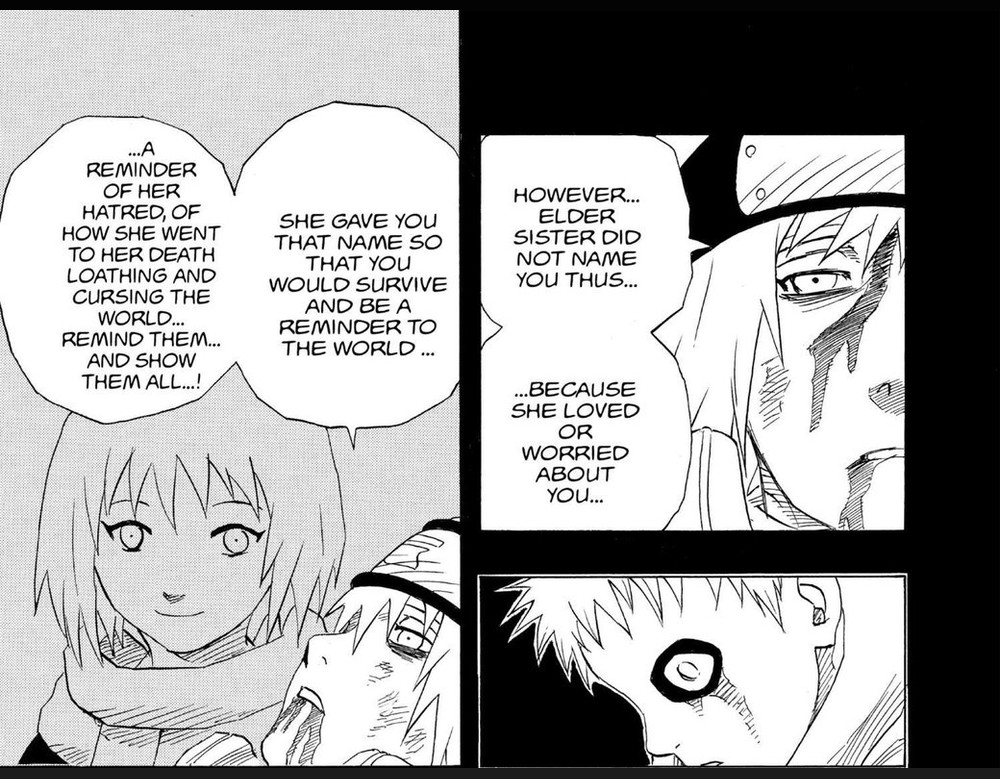
VIZ's English edition prints: "...A REMINDER OF HER HATRED, OF HOW SHE WENT TO HER DEATH LOATHING AND CURSING THE WORLD... REMIND THEM... AND SHOW THEM ALL...!" (Vol. 15, p.95.)
Grant the rendering its due: it is genuinely wrenching, it keeps the sentence's shape almost clause for clause, and "loathing and cursing the world" earns its place next to 恨んで呪いながら. Where it thins out is the one word doing the heaviest lifting in the Japanese — 怨念 (onnen) — which VIZ folds into "hatred," a mood, when the Japanese is naming something closer to a mechanism: the reason, Yashamaru claims, that Gaara exists at all.
The Original
Pull 怨念 apart and both halves resist the easy gloss.
怨 (on/en) is not the everyday word for resentment — that's 恨む (uramu), the verb sitting two clauses earlier in this very sentence (恨んで). 怨 is its heavier, more literary cousin, sharing a reading but not a register: it survives in 怨恨 (enkon), the word Japanese crime reporting reaches for when police cite a "grudge" as motive, and in 怨霊 (onryō), "vengeful spirit" — the noun for a grudge once it has stopped being a feeling and started being an agent.
念 (nen) is the harder half. It doesn't mean "thought" in general; it names a fixed, held unit of mental attention — the same 念 that measures corrupted chakra as 邪念 in our companion piece on Yamato's diagnosis of Naruto, and the same 念 in 一念発起, "a single, gathered resolve." Where 恨み is a feeling that comes and goes, 念 is a feeling that has been set — pinned, held, made durable.
Bolt them together and 怨念 stops being an emotion and becomes cargo: a grudge with enough structural integrity to survive the death of the person who felt it. That is exactly the claim Yashamaru is making about Gaara's own name, revealed two pages earlier: 「この子の名は我愛羅...」「我を愛する修羅...」 — "THIS CHILD'S NAME SHALL BE GAARA... A SHURA, A DEMON, WHO SHALL LOVE ONLY HIMSELF..." 我愛羅 (Gaara) is built to be read 我を愛する羅刹, "a demon who loves only itself" — a name engineered, like the onnen it supposedly carries, to keep existing on its own terms. (Gaara later carves the 愛 out of that name into his own forehead — the same kanji, worn as a scar, long before he understands what it actually cost him.) As vocabulary, 怨 sits outside the standard JLPT kanji lists — rare, mostly literary, encountered in ghost stories and legal reporting rather than conversation; 念 alone is common by N4; the compound 怨念 is advanced N1.
VIZ's Choice
怨念 surfaces exactly once in the pages on file — no scatter across scenes to compare, one sentence and one solution to weigh on its own terms.
And the solution is not a bad one. "Hatred" is punchy, it fits the meter of a manga bubble shouted in a dying breath, and the surrounding clause — "of how she went to her death loathing and cursing the world" — genuinely recovers most of what onnen is pointing at emotionally. Where the choice runs out of road is exactly where the Japanese verbs get to work: 存在させ ("make it exist"), 残し ("leave it behind"), 知らしめる ("make it known") are not verbs you'd use to describe a feeling. They're verbs of installation — the vocabulary of loading something into a container so it persists. "A REMINDER of her hatred" domesticates that into metaphor: Gaara's existence makes people think of her. Nothing in "hatred" tells the English reader that Yashamaru means this closer to literally — that the elders built a vessel, and Gaara was poured into it.
The Gap
Feeling versus force. "Hatred" is a mood; 怨念 is folklore's name for a mood that has outlived its owner and gone looking for a body. English readers get Karura's emotional state. They don't get the metaphysical claim — load-bearing for Gaara's entire backstory — that grudges intense enough don't simply end at death.
No English noun for the raw material. English keeps "vengeful spirit" for the finished onryō but has no everyday word for the onnen that supposedly manufactures one — the ember, not the fire. Something has to be invented or borrowed every time, and "hatred" is the borrow that erases the manufacturing process entirely.
Vessel, not reminder. The very next line makes the stakes explicit: 「アナタは愛されてなどいなかった...!」 — "NO, YOU WERE NEVER LOVED...!" — delivered not as commentary but as the logical conclusion of the onnen claim: if Gaara's whole purpose was to carry his mother's grudge forward, then love was never part of the design. "A reminder," in English, keeps a comfortable distance between Gaara and the thing he supposedly reminds people of. 怨念 collapses that distance to zero.
A repeated death-clause, independently translated twice. 呪いながら死んだ — "died while cursing" — appears verbatim on p.93 about the village and again, escalated to the whole world, on p.95. Japanese is building a crescendo with the exact same words; English, translating each occurrence to fit its own sentence ("died cursing this place" / "went to her death... cursing the world"), never lets the reader hear that it's the same phrase getting bigger.
What If
- "...to give this world a vessel for her grudge — the grudge she carried past her own death — to leave it standing, to make it known..." — keeps the installation verbs and the death-transcending half of onnen. Cost: too long for a bubble, and it loses VIZ's triple-ellipsis momentum.
- "...a living relic of the curse she died cursing this world with..." — "curse" reaches toward the supernatural charge onnen carries. Cost: 呪う ("to curse") is already doing separate work earlier in the same Japanese sentence; English now has one word standing in for two.
- "...so her undying grudge would go on existing in this world..." — "undying" restores exactly the half "hatred" drops. Cost: risks sounding purple in isolation, though the panel around it is already operatic.
- Keep "hatred," add the mechanism it hides: "...A REMINDER OF HER HATRED — A GRUDGE HELD PAST DEATH, GIVEN A BODY TO GO ON HAUNTING THIS WORLD..." — Cost: a footnote's worth of words for a single breathless line; workable as a translator's note, not as lettering.
Take-away
怨念 is what happens when a language treats a grudge as a substance rather than a mood — something with mass, that can be poured into a name, a birth, a body, and left there to keep working after the person who felt it is gone. English's "hatred" tells you how Karura felt. It can't tell you that Yashamaru believes her feeling is still on the job.
Three rules of thumb to carry off this page:
- When 念 is attached to an emotion-kanji, look for permanence, not intensity. 怨念 isn't "very much hatred" — it's hatred that has been fixed in place, the difference between a wave and a tide.
- Watch for verbs of installation around abstract nouns. 存在させる, 残す, 知らしめる treat 怨念 as cargo. When a translation reaches for a verb of feeling ("remind," "remember") instead of a verb of placement, the metaphysics quietly go missing.
- A phrase repeated verbatim is doing arithmetic. 呪いながら死んだ said twice, about a village and then a world, is Japanese showing its work — check whether a repeated clause is escalating before translating each instance as if it were new.
For more of Naruto's Buddhist and folk-religious vocabulary that VIZ has had to compress on the fly, see our companion pieces on 邪念, the same 念 doing duty as a chakra readout, 呪印, the curse-root family hiding inside "curse mark", 娑婆, the sutra word for the world outside a cell, and 修羅場, the asura's battlefield shrunk to fit an exam room — or browse the full Naruto translation notes index. For a Buddhist word about the dead from the other side of our library — the imperative that orders a spirit to move on, rather than describing what it left behind — see 往生しろ・成仏してください, the tombstone pun VIZ reached for on our One Piece site.
Every Japanese and English line quoted above is a byte-exact capture from the cited editions — NARUTO―ナルト― Vol. 15 (Japanese, colored digital edition) and Naruto Vol. 15 (VIZ Media) at the corresponding panels — via our bilingual page database; see Sources below.