The Moment
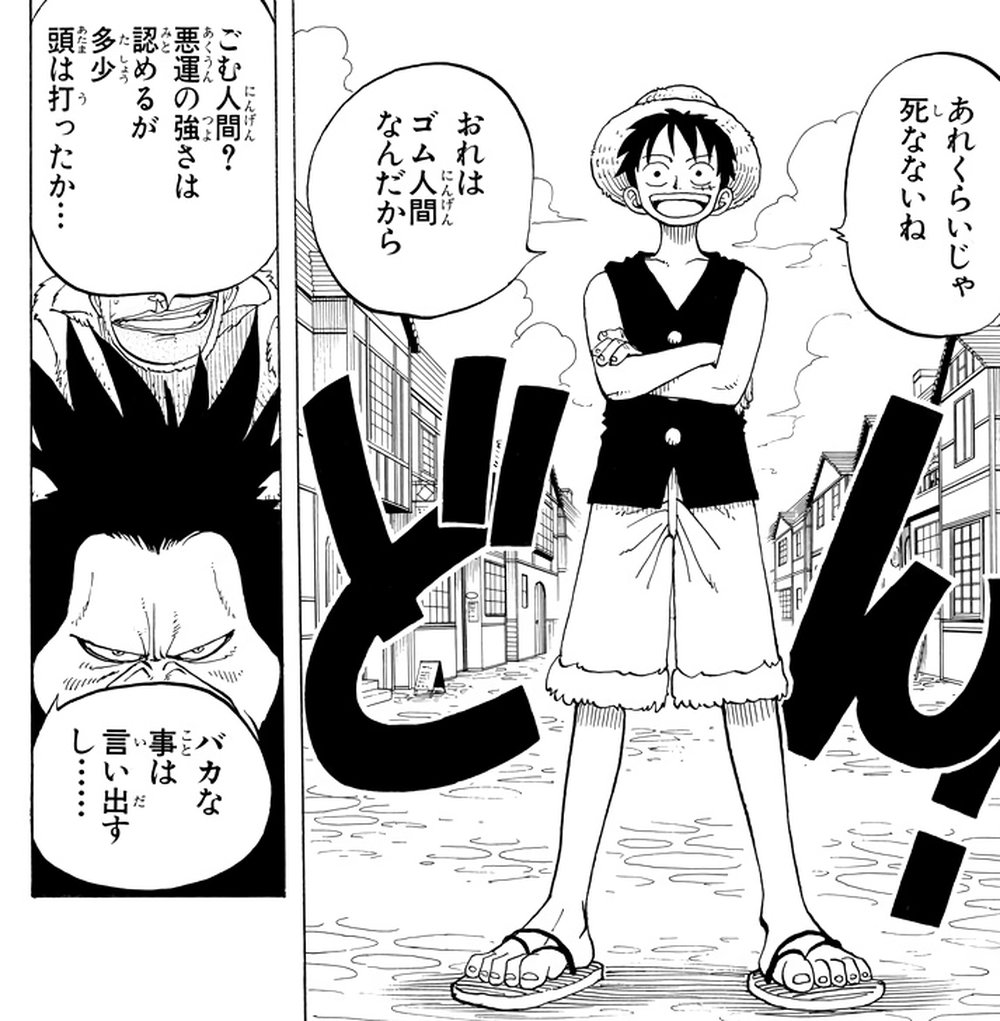
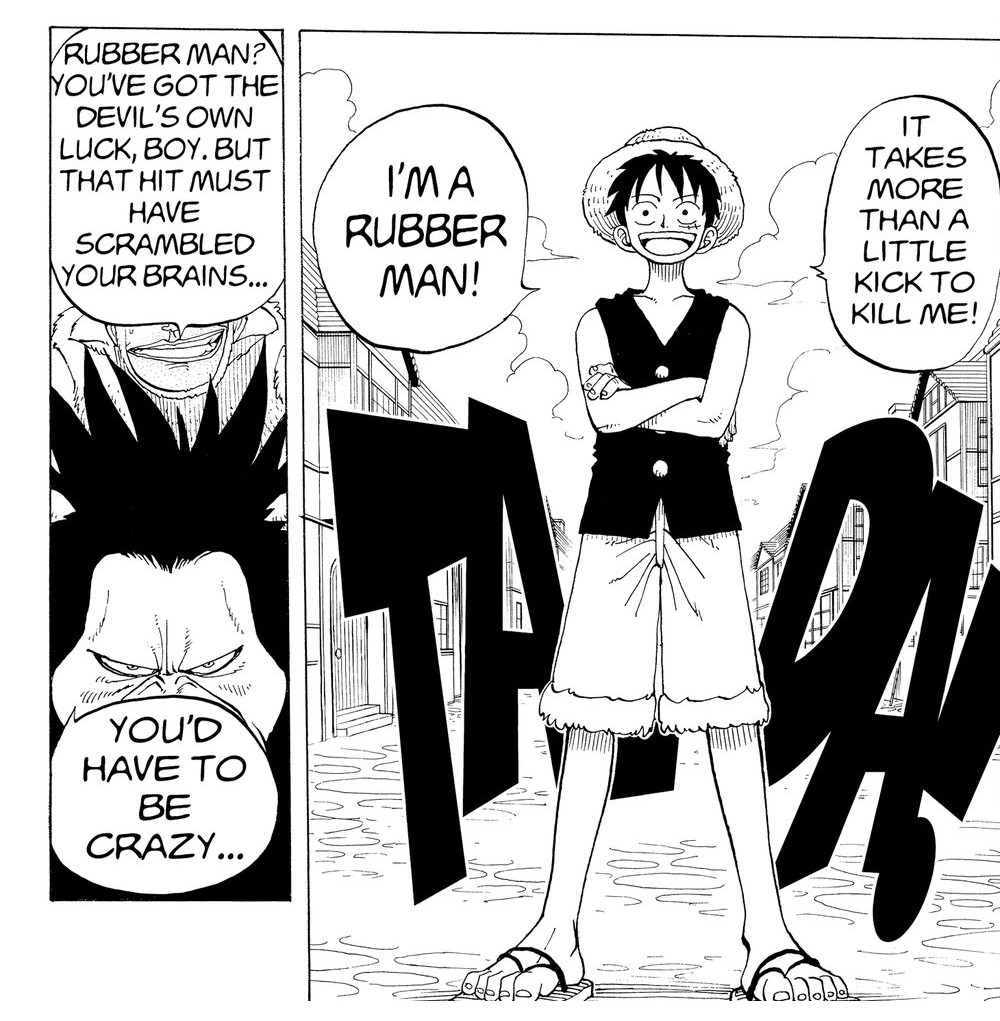
Orange Town, Volume 2 — a ghost town on the Buggy the Clown's itinerary, where the pet-shop dog Chouchou guards his dead master's store. Mohji the Beast Tamer has just let his lion Richie flatten that store, and he has one other item filed under finished business: the strange boy in the straw hat, whom he left for dead. Then the strange boy walks up the street. Mohji sputters — 「殺した筈だろう」 ("YOU SHOULD BE DEAD!!") — and Luffy, arms crossed, offers the world's calmest explanation: 「おれはゴム人間なんだから」 ("I'M A RUBBER MAN!"). Mohji, sweating on top of his lion, concedes the point the only way a villain can:
「ごむ人間?悪運の強さは認めるが多少頭は打ったか…」
Gomu ningen? Akuun no tsuyosa wa mitomeru ga tashō atama wa utta ka…
VIZ's English edition prints: "RUBBER MAN? YOU'VE GOT THE DEVIL'S OWN LUCK, BOY. BUT THAT HIT MUST HAVE SCRAMBLED YOUR BRAINS..." (Vol. 2, p.104).
Grant the rendering its due, because it earns plenty. "The devil's own luck" is a genuine English idiom — luck so outrageous it must have been sponsored downstairs, from the old proverb that the devil looks after his own — and it has exactly the salt-and-gunpowder flavor a pirate comic wants. It even keeps the luck morally suspicious, which most English luck-words don't. And the little touches survive: Mohji repeats Luffy's proud ゴム人間 back at him in dismissive hiragana — ごむ人間? — the orthographic equivalent of scare quotes, and VIZ's incredulous "RUBBER MAN?" catches the tone. One panel later he's back in character: 「またおれの前に現れるってのもバカだ!!頭を噛み砕いてやれっ!!!」 — "TO TANGLE WITH ME AGAIN! RICHIE, BITE HIS HEAD OFF!!"
But the word Mohji concedes with — 悪運 (akuun) — is not "luck," and not the Devil's either. It's a word with a whole courtroom inside it.
The Original
Take it apart. 悪 (aku) is "evil, bad" — the 悪 of 悪人 (akunin, evildoer), 悪行 (akugyō, misdeed), and, yes, 悪魔 (akuma, devil). 運 (un) is "luck, fortune" — and its kanji means "to carry, to transport" (運ぶ, hakobu). That etymology is worth pausing on: in Japanese, fortune is not a dice roll but a current that carries you — the same 運 sits inside 運命 (unmei, fate) and 運勢 (unsei, one's fortunes). Luck with a direction, not luck with a probability.
So far, "bad luck," and dictionaries do list that as sense one. But the sense that owns the set phrases is the second one, and it is startlingly specific:
悪い事をしてもその報いを受けないで済む運 — the luck that lets you do evil and never receive its recompense.
Not luck that happens to be bad. Luck that lets you be bad — and skip the bill. The word presupposes the Buddhist bookkeeping of 因果応報 (inga-ōhō): good deeds return good, evil deeds return evil, accounts always settle. Inside that frame, a villain who thrives is not fortunate; he is in arrears. 悪運 names the scandal of the ledger running late.
That's why the word lives almost entirely inside a matched pair of idioms — a villain's whole biography in two entries:
- 悪運が強い (akuun ga tsuyoi) — "his wicked luck is strong": the scoundrel keeps walking away from the wreckage. Said with a head-shake, half disgust and half awe.
- 悪運が尽きる (akuun ga tsukiru) — "his wicked luck has run dry": the collections notice. The stock line a period-drama officer delivers as the cornered villain runs out of roof.
One pedantic footnote that will matter in a moment: strictly, 悪運が強い should describe wrongdoers. Applied to a blameless survivor of a shipwreck, usage columns will tell you the proper word is 強運 (kyōun, strong luck) — and modern speakers blur the two constantly. Mohji, in Orange Town, is technically in the loose zone: Luffy hasn't done anything evil except exist at Mohji. But hold the strict sense in your pocket; One Piece is about to use it by the book. As vocabulary, 悪運 sits off the official JLPT lists — call it N1-band, assembled from N4 parts, which is exactly the kind of word learners walk past without seeing the karma inside.
VIZ's Choice
Here is every appearance of 悪運 in the volumes we have on file, side by side with the official English:
| Vol. / p. | Speaker | Japanese | VIZ English |
|---|---|---|---|
| 2 / 104 | Mohji | ごむ人間?悪運の強さは認めるが多少頭は打ったか… | RUBBER MAN? YOU'VE GOT THE DEVIL'S OWN LUCK, BOY. BUT THAT HIT MUST HAVE SCRAMBLED YOUR BRAINS... |
| 12 / 11 | Buggy | コナクソあのハデゴム(ーっ!!!)悪運野郎め!!! | BLAST THAT CURSED, NO-GOOD RUBBER BOY!! |
| 12 / 24 | Smoker | フン悪運尽きたな | HUMPH... LOOK'S LIKE YOUR LUCK RAN OUT, KID. |
Three appearances, three shelves: the Devil, a curse, plain luck.
The Vol. 12 scenes need their stage set, because they are the strict dictionary sense coming home. Loguetown: Luffy — by now a wanted criminal with a thirty-million-berry bounty — is seconds from being executed on the town scaffold by Buggy when a bolt of lightning strikes the platform and burns his executioner crisp. Page 11 is the aftermath: Buggy, smoking, hauls himself up while his crew gawps (「バギー船長生きてたんすね!!?」 — "CAPTAIN BUGGY, YOU'RE ALIVE!?"), and rages at the boy the heavens keep siding with: コナクソ…あのハデゴム…悪運野郎め!!! — "damn it… that flashy rubber… akuun bastard!!" In Japanese the rant sprawls across three connected bubbles; VIZ pours it into one — "BLAST THAT CURSED, NO-GOOD RUBBER BOY!!" — so 悪運野郎 never gets its own landing. The nearest word standing in its slot is "CURSED." File that; we'll come back to it.
Thirteen pages later, the Marine captain Smoker has Luffy pinned to the pavement in the rain, jitte at his neck, and pronounces sentence with the set phrase made for the scene: フン悪運尽きたな — "Humph. Your wicked luck has run dry." VIZ: "HUMPH... LOOK'S LIKE YOUR LUCK RAN OUT, KID." (The stray apostrophe in "LOOK'S" is genuinely on the printed VIZ page — a letterer's slip preserved in our capture.) And then the book itself objects: a hooded stranger — readers will later learn he is Monkey D. Dragon — stays Smoker's hand. The corpus pairs his bubble 「そうでもなさそうだが…」 ("doesn't look that way to me…") with VIZ's "WHOSE LUCK DID YOU SAY!?", and a freak storm tears through Loguetown to make his point. Credit where due: by echoing "luck" back, VIZ actually tightens the retort — while quietly confirming that in English, luck is all this ever was.
The Gap
The unpaid bill disappears. 悪運 is luck with a lien on it. When Smoker says 悪運尽きたな, a Marine is telling a pirate: the retribution you've been dodging has arrived — justice caught up. "YOUR LUCK RAN OUT, KID" says: the dice went cold. Same rain, same jitte, but the Japanese line is a verdict and the English line is a craps table. The hard-boiled tone survives beautifully — "HUMPH," "KID" — it's the jurisprudence that evaporates.
A ledger becomes a patron. Nobody grants 悪運. Karma is impersonal bookkeeping, and akuun is a gap in enforcement — a payment deferred, never a gift. "The devil's own luck" runs on the opposite mechanism: the devil looks after his own — luck as favoritism from a personal sponsor. VIZ didn't secularize Mohji's line; it converted it, karma's ledger traded for the Devil's payroll — the same theology-swap move we caught in the tombstone pun VIZ reached for with 往生しろ. And in this particular series the conversion has a side effect: "devil" is loaded vocabulary in One Piece — 悪魔の実, the Devil Fruits — and Luffy has just said "I'm a rubber man." An English reader can hardly help hearing devil-powers behind "the devil's own luck"; the Japanese keeps 悪運 and 悪魔 on separate circuits, sharing only their first kanji.
"Cursed" points the arrow backwards. Buggy's 悪運野郎 means "that scandalously lucky bastard" — the man he hates is the one the lightning keeps missing (or, this once, hitting on his behalf). "CURSED" claims the opposite: that Luffy is hexed, afflicted, bad-luck-bearing. In Japanese, Buggy accuses the universe of protecting Luffy; in English, he accuses Luffy of being jinxed. The fury reads fine either way — the cosmology is inverted.
The tracked word unthreads. Read the three scenes in Japanese and one word is being followed: Mohji grants the akuun in Vol. 2; Buggy curses it after the scaffold; Smoker declares it spent — and the world instantly overrules him with a hooded stranger and a wall of wind. That last beat only lands if you know 悪運が尽きる is the fixed phrase for the karmic account finally closing: Smoker files the paperwork, and the storm reopens the file. The English reader gets "devil," "cursed," and "luck" — three unrelated notes where the Japanese plays one rising theme.
What If
The menu and its prices, for Mohji's line and for Smoker's:
- "Rubber man? I'll grant you've got more luck than any man deserves. But that hit must have scrambled your brains..." — "more than you deserve" smuggles the moral debt back in. Cost: loses the idiom's snap, and runs long for the bubble.
- "Rubber man? You've got the luck of the damned, boy." — keeps a luck-idiom and adds a standing verdict; the damned are people whose bill is already written. Cost: still Christian machinery — hell's docket instead of karma's ledger.
- "Rubber man? Your reckoning's just running late, boy." — makes the deferred payment explicit, and quietly sets up "your luck ran out" ten volumes early. Cost: no luck-word at all, and it reads more literary than a beast-tamer's taunt.
- Keep VIZ's Vol. 2 line, repair Vol. 12: "HUMPH... THAT WICKED LUCK OF YOURS FINALLY RAN OUT, KID." — one added word restores the debt and reconnects Smoker's verdict to Mohji's concession. Cost: "wicked luck" isn't native English idiom; some readers will stumble.
Notice the shape of the problem: English has morally suspicious luck-idioms — the devil's own luck, the luck of the damned — but they all buy their morality from Christian mythology, because that's the only cosmic courthouse English ever built. The one thing no English phrase can say in four syllables is 悪運's precise accusation: you are lucky instead of punished.
Take-away
悪運 looks like "bad luck" and means, in its sharpest sense, nearly the opposite: the outrageous good luck of someone who has earned bad. It only exists because 因果応報 is assumed — no ledger, no scandal in the ledger running late.
Three rules of thumb to carry off this page:
- 悪運 is luck with a lien on it. When you meet it, don't ask "good luck or bad?" — ask what does the holder owe, and who's waiting to collect?
- Learn it as a matched pair: 悪運が強い (the scoundrel keeps escaping) and 悪運が尽きる (the bill arrives). Between those two idioms sits the entire career arc of every drama villain — and, the Marines would say, of Monkey D. Luffy.
- Keep the luck-words sorted: 不運 is plain misfortune, 強運 is morally neutral strong luck, 悪運 is the scoundrel's reprieve. Modern speech blurs 悪運 into 強運 — a drift the usage columns still protest, and a distinction worth owning anyway.
For the day the ledger does pay out on time — and the four-character verdict VIZ renders "serves you right" — see 自業自得 and karma's payday; for the karmic tie that tangles two lives rather than one account, see 因縁, the word English splits five ways — or browse the One Piece translation notes index.
Every Japanese and English line quoted above is a byte-exact capture from the cited editions — ONE PIECE Vol. 2 & Vol. 12 (Japanese) and One Piece (VIZ Media) at the corresponding panels — via our bilingual page database; see Sources below.