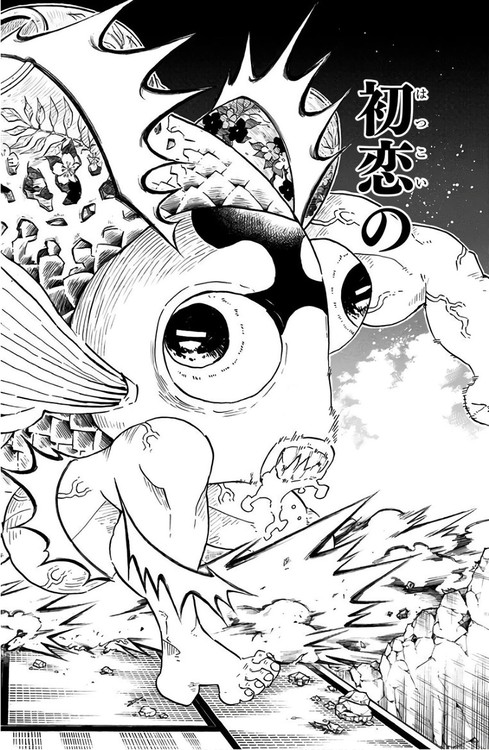
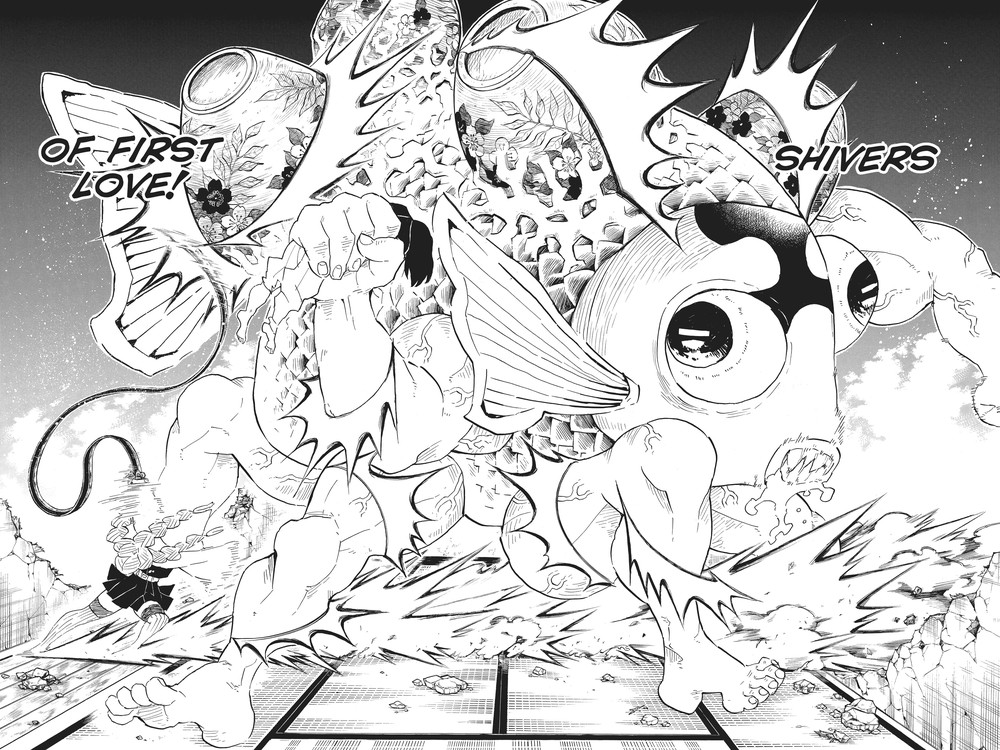
Every other breathing style in this dictionary names its forms after a weapon's motion or a natural force — a slash, a roar, a claw. Love Breathing's First Form names itself after a feeling: not what the blade does, but what happens inside Mitsuri's chest when she thinks of romance. VIZ could easily have softened 初恋のわななき into something punchier and more "attack-shaped" — a title-case action name divorced from the diary-entry register of the Japanese — but instead prints it nearly verbatim as "Shivers of First Love," letting a Hashira's signature opening move read, in English, exactly as unguarded as it does in Japanese. That restraint matters, because Mitsuri is the only character in the series whose fighting style is explicitly, structurally built out of the vocabulary of infatuation rather than metaphor borrowed from it.
わななき is doing quiet double duty. On one level it's simply "trembling" — the shudder of nerves before a blow lands. But it's also the word used for the flutter of a lovesick heartbeat, the almost involuntary shiver of a crush. Mitsuri's own backstory makes this precise: she was rejected by suitor after suitor for looking too strong and eating too much, until the Demon Slayer Corps finally saw those same traits — inverted — as a superhuman asset. A first form titled after the tremor of first love, for a character whose entire emotional arc is about learning that her body's excess strength is not disqualifying but exactly the point, isn't incidental naming; it's a thesis statement.
Structurally this also sets the pattern the rest of Love Breathing follows and this dictionary tracks across every surviving named form: 懊悩巡る恋 ("Love Pangs"), 恋猫しぐれ ("Catlove Shower"), 揺らめく恋情・乱れ爪 ("Swaying Love, Wildclaw"), 猫足恋風 ("Cat-Legged Winds of Love") — none of them are verbs of cutting. They're all full noun phrases lifted from the register of romantic poetry, applied to a woman whose blade is famous for being too flexible, too soft, too pink to be taken seriously as a weapon until it kills an Upper Rank demon. The 型 ("form") numbering system that every other style uses as pure combat taxonomy becomes, in her hands, something closer to a confession told one flourish at a time.