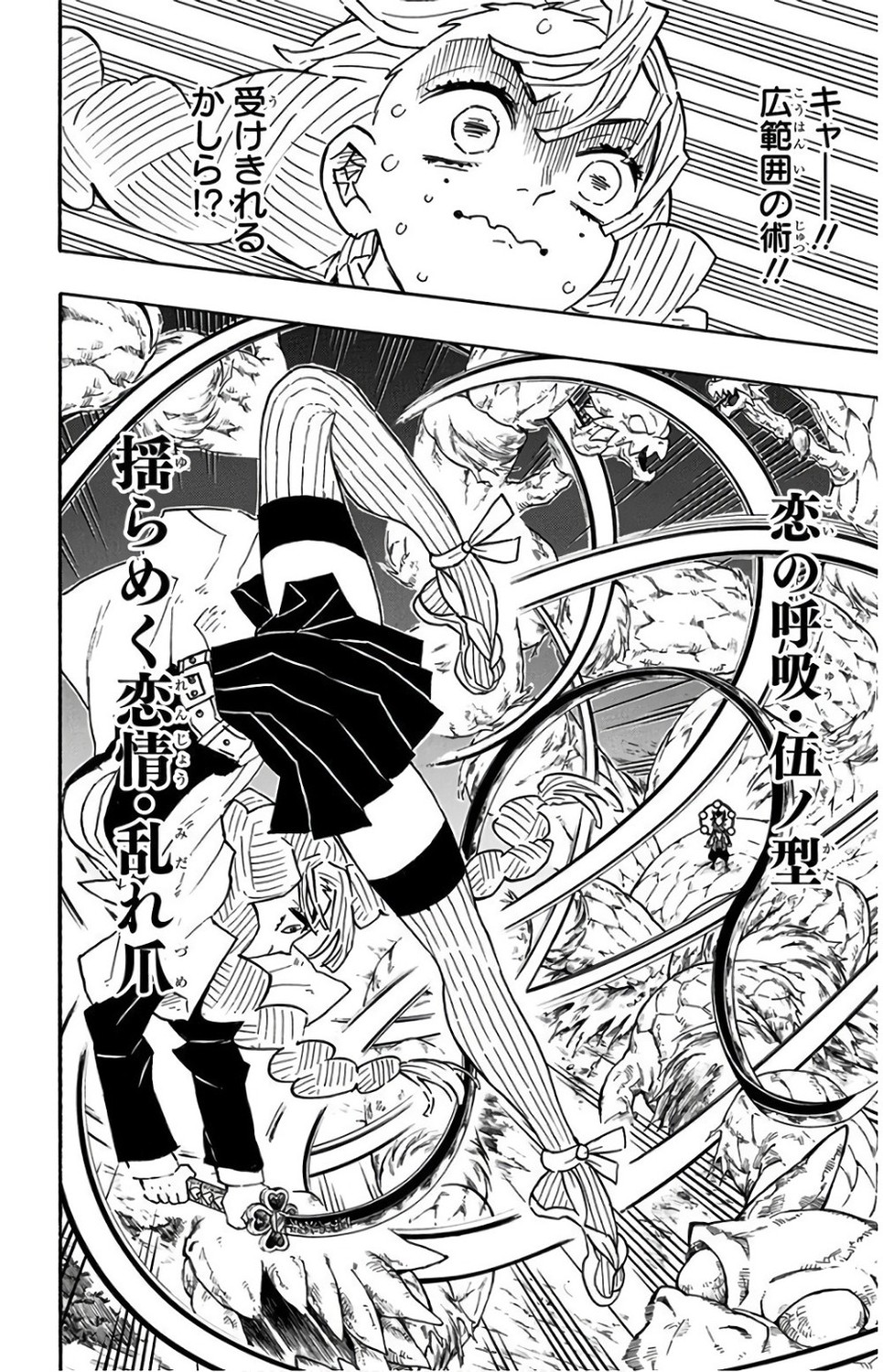
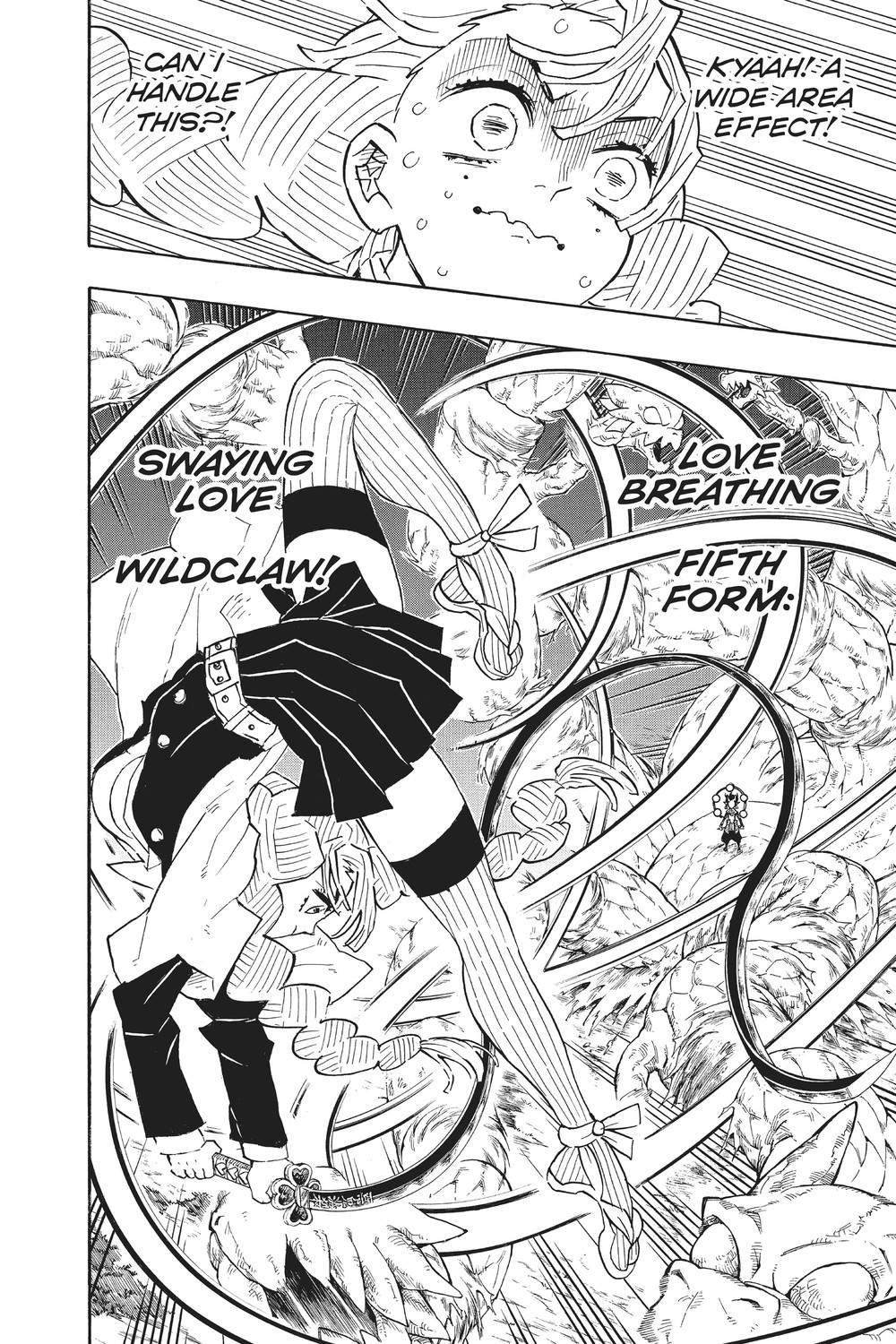
The Japanese name is structurally two separate four-to-five-character units joined by a middle dot (・), a punctuation mark Japanese uses to link parallel items without implying either causation or sequence — closer to a semicolon than to "and." VIZ's "SWAYING LOVE WILDCLAW" erases that seam entirely, reading as one unbroken compound noun. The English name is a defensible choice: it's punchier, and it mirrors the panel's own lettering, which splits "SWAYING LOVE" and "WILDCLAW!" across two separate word-balloons stacked vertically, visually preserving the two-beat rhythm even as the grammar merges them. A reader who only sees the English text would never guess the Japanese name is built from two independently complete phrases rather than one continuous descriptor.
The corpus itself preserves an OCR artifact worth flagging on its own terms: the automated text-extraction pass misreads 恋情 (renjou, "amorous feeling") as 変情 (a non-word substituting the visually similar 変 for 恋) and 乱れ爪 ("disordered claw") as 乱れ瓜 (substituting 瓜, "melon," for the near-identical-looking 爪, "claw") — two separate single-stroke misreads inside one four-character string. Both are exactly the kind of error handwritten-style manga lettering produces: 恋 and 変 differ by roughly one stroke in a stylized brush font, and 爪 and 瓜 are near-indistinguishable at manga print resolution. The confirmed VIZ English translation ("WILDCLAW," not "wild melon") is the tell that resolves which reading is correct.
Mechanically, this is the first Love Breathing form in the corpus explicitly framed by another character's reaction as dangerous even to its own user: the preceding dialogue has an ally gasp "KYAAH! A WIDE AREA EFFECT!" and Mitsuri herself wonder aloud whether she can "handle this." Combined with 揺らめく ("swaying, flickering") in the name — an adjective more commonly applied to candlelight than to a killing blow — the Fifth Form reads as the one moment in her arsenal where Love Breathing's romantic vocabulary brushes up against something genuinely unstable, a feeling large enough that even its owner isn't sure of its edges.