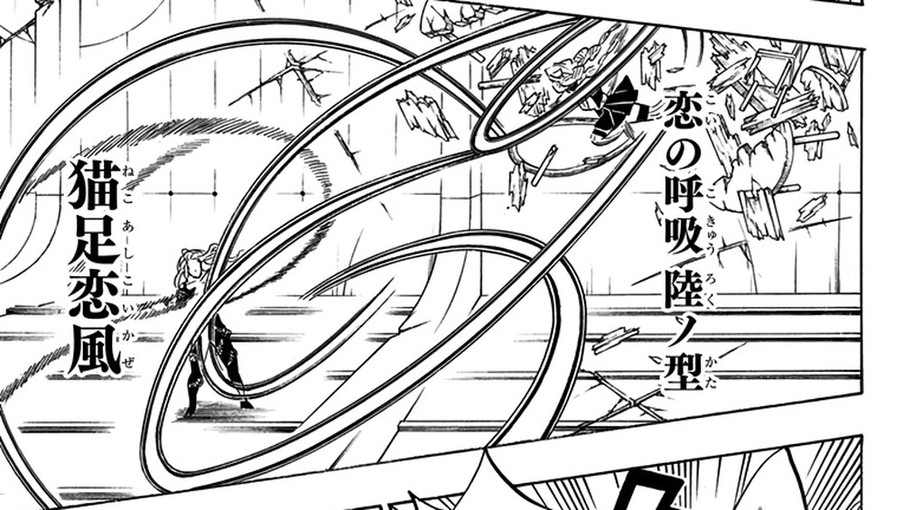
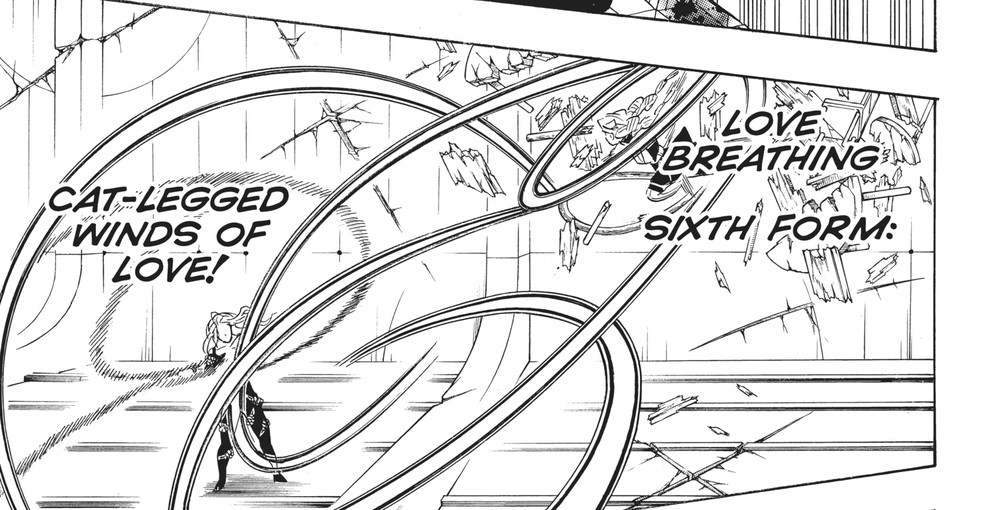
This is one of two Love Breathing forms in the corpus with more than one confirmed appearance, and cross-checking both occurrences turned up a pagination trap of exactly the kind this dictionary's alignment-verification step exists to catch. The underlying bilingual database pairs the Vol. 21 Japanese panel (p.84) with the English string "CATLOVE SHOWER" — the Third Form's name, not the Sixth's. Read at face value, that would suggest VIZ recycled one attack name for two different techniques four volumes apart. It doesn't hold up: Vol. 21 sits in a page range where this series' English edition runs one page behind its Japanese counterpart, and the real printed VIZ page for this panel is p.85, not p.84. Checked directly, p.85 reads "LOVE BREATHING SIXTH FORM: CAT-LEGGED WINDS OF LOVE!" — word-for-word identical to the Vol. 14 rendering. The apparent inconsistency was a database pagination artifact, not a translation one; VIZ was in fact perfectly consistent across both appearances, four volumes apart.
猫足 (nekoashi) is a nice piece of ordinary-vocabulary reuse: it's the standard Japanese word for a bowed, padded furniture leg — the kind you'd see on an old Western-style clawfoot bathtub or a carved wooden table — borrowed from real cats' rounded, silent paws. Mitsuri's fighting style is built entirely on a physical trait the story treats as a hidden asset rather than a flaw: hyper-extendable joints that let her bend and coil in ways a rigid human skeleton can't, the same flexibility that once made her seem too strange for arranged marriage. The Sixth Form has her drop to all fours and spin low, using exactly that joint flexibility the name promises — a technique whose Japanese name is functional anatomy dressed as a love poem.
Of the five confirmed Love Breathing forms in this dictionary, this is also the only one that appears at both the start and the near-end of Mitsuri's corpus appearances — first as one move in a longer combo against Daki, then, alone and repeated, as one of the last things she does in the series before Upper Rank Two Doma overwhelms her. VIZ's decision to keep the translation completely stable between those two moments, rather than vary the phrasing for a "final battle" flourish, means the English edition preserves something the Japanese does too: the same named technique, spoken the same way, book-ending a character's entire arc.