The Moment
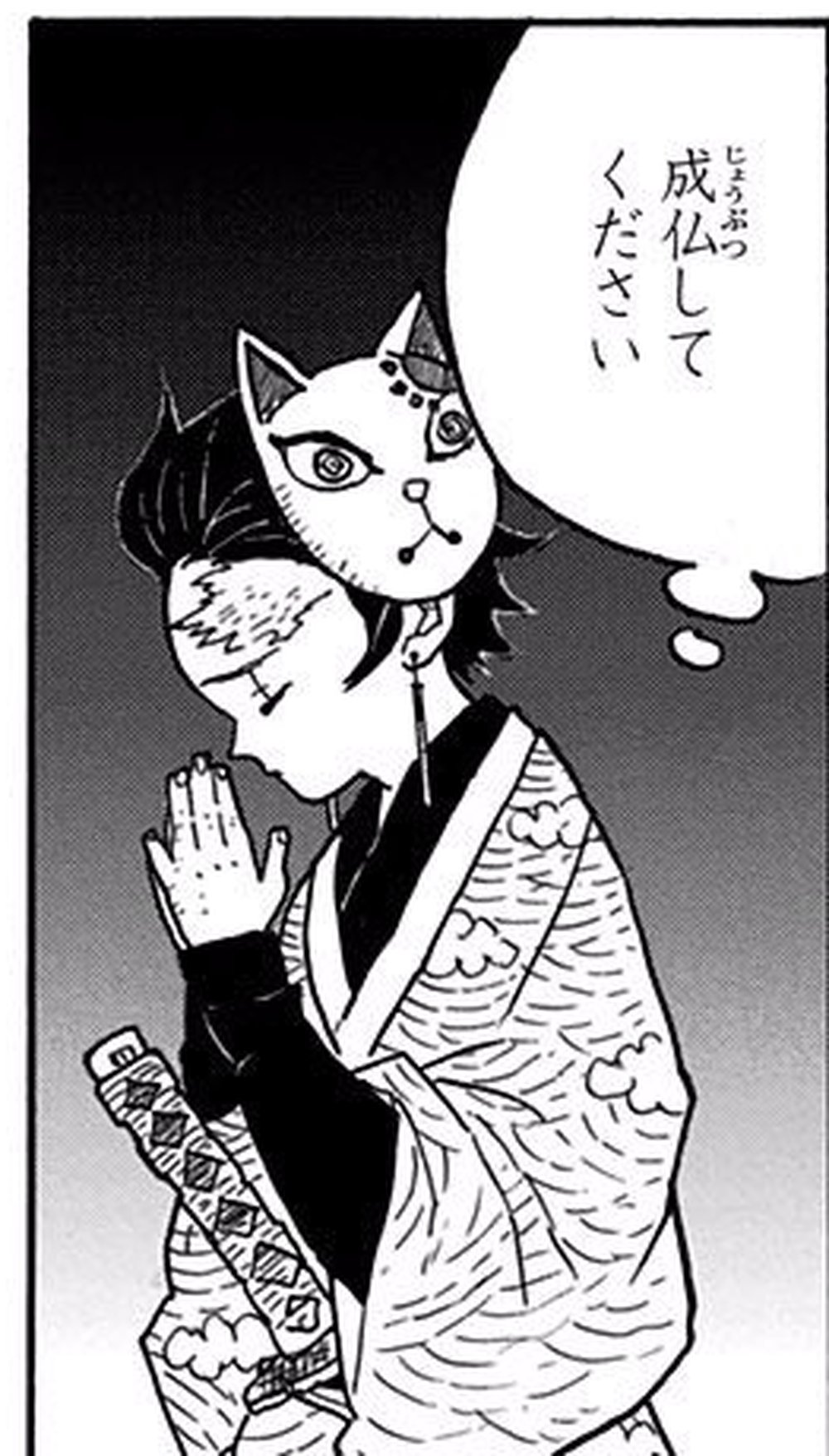
Mount Fujikasane, the Final Selection — the entrance exam where would-be demon slayers survive seven nights among captive demons, or don't. Tanjiro, two years of training behind him and Urokodaki's warding fox mask pushed up on his head, has just done the thing for the first time: beheaded demons with his own sword. His inner monologue is all shaky relief — 「鬼に勝てた」 ("I BEAT TWO DEMONS!") — and then wonder, as the bodies dissolve into nothing before his eyes: 「骨も残らないのか‥」 ("...EVEN THE BONES CRUMBLE!").
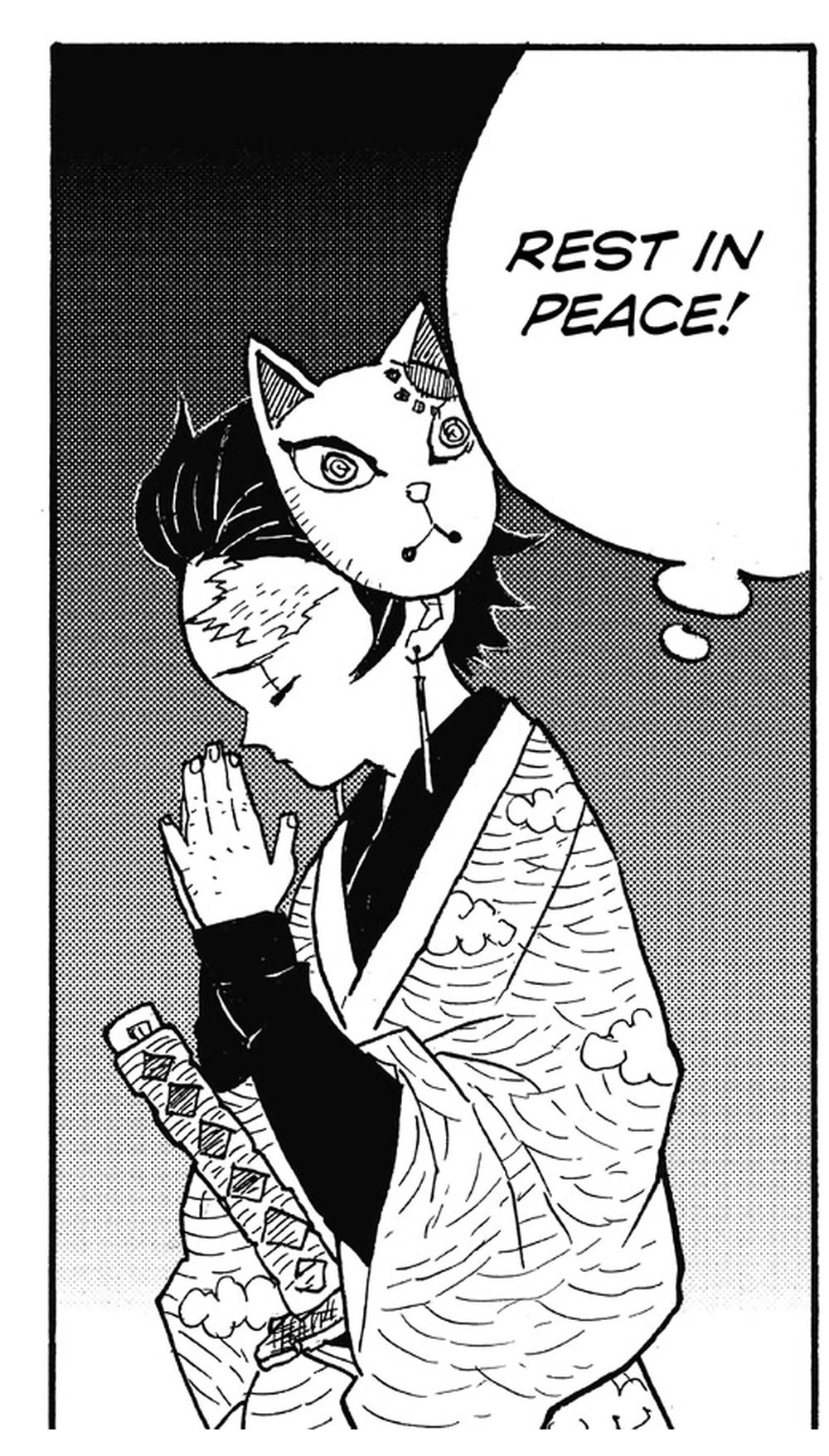
And then he does something no one taught him at swordsmanship school. He presses his palms together over the empty ground and prays:
「成仏してください」
Jōbutsu shite kudasai
VIZ's English edition prints: "REST IN PEACE!" (Vol. 1, p.164).
Grant the rendering its due — twice, actually. First: "rest in peace" is English's only household formula for addressing the dead, instantly legible inside a bubble, and solemn on its face. Second, and rarer: VIZ keeps it. Every time this prayer returns across nineteen volumes, the English reaches for the same three words. Translation scatter — one Japanese phrase dissolving into a different English guess per scene — is the usual fate of culturally loaded expressions, and VIZ's team held the line here. The English reader genuinely feels that Tanjiro has a ritual.
What the English reader never learns is which way the ritual points.
The Original
成仏 (jōbutsu) is two kanji of pure theology: 成 (jō) "to become; to accomplish" + 仏 (butsu) "Buddha." To jōbutsu is literally to become a Buddha — what a soul does when it dies well: it releases every attachment to this world and moves on.
Even the pronunciation is a fossil. 成 is read jō here — the old go-on reading that Buddhist vocabulary preserves (compare 成就, jōju, "fulfillment of a vow") — not the everyday sei of 成功 (seikō, "success"). Say the word aloud and you are already in the temple.
And 仏 leads a double life that tells you everything about the Japanese picture of death: butsu / hotoke means Buddha, and it is also the ordinary respectful word for a dead person. A body at a funeral is a hotoke-sama. The dead and the Buddha share a noun because, if all goes well, the one becomes the other — 成仏 is the verb for that trip, and a soul that fails to make it lingers as the restless ghost of every Japanese ghost story (the everyday word for that state: 浮かばれない, ukabarenai, "the soul cannot rise").
So 成仏してください is not a mood and not an epitaph. It is an instruction with a direction: please let go; please move on; please become. The grammar carrying it is week-one politeness — 〜してください, the JLPT N5 request form, the same shape as "please write your name here." That everyday courtesy, aimed at a beheaded demon's soul, is the characterization: Tanjiro extends to a monster the politeness everyone else reserves for the living. The word 成仏 itself sits off the JLPT lists — its kanji are early-grade, its concept is practical N1-plus, temple vocabulary that never stopped being street vocabulary.
One more detail from the page: in both Vol. 1 and Vol. 3 the line sits in a soft-edged prayer bubble, palms together in gasshō — he isn't announcing it to anyone. It is a funeral rite, performed silently, for a creature that leaves no bones to bury. The prayer is the only funeral a demon gets.
VIZ's Choice
Every appearance of 成仏 in the volumes we have on file, side by side with the official English:
| Vol. / p. | Speaker | Japanese | VIZ English |
|---|---|---|---|
| 1 / 164 | Tanjiro, over his first kills | 成仏してください | REST IN PEACE! |
| 3 / 182 | Tanjiro, over Kyogai | 成仏してください | REST IN PEACE, SPIRIT... |
| 3 / 182 | Tanjiro, over Kyogai (again) | 成仏してください | REST IN PEACE. |
| 19 / 55 (VIZ p.56) | Shinobu's spirit, of herself | これで私も安心して成仏できます | NOW I TOO CAN REST IN PEACE. |
Where our One Piece pieces usually diagnose scatter, this is the opposite finding: total convergence. Four appearances, three speakers' worth of context, one English formula. English has exactly one thing it says to the dead, and everything Japanese says over a body gets pulled toward it like water to a drain — we caught VIZ's One Piece team doing the very same thing with the very same phrase, playing a drunk's 成仏してくださいよォ as a straight "REST IN PEACE." and punning 往生しろ into "REST IN PIECES!!"
The Vol. 3 row deserves a pause, because it is the series' heart. The drum demon Kyogai — a failed writer as a human, his manuscript pages once ground under someone's foot — lies dying, and his last thoughts are of the boy who would not step on those pages during their whole rotating-room battle: 「……認められた……」 ("HE ADMIRED THEM... AND ME."). And Tanjiro, kneeling on the wrecked floor, prays the same seven characters twice in a row — 成仏してください, 成仏してください — identical words repeated like a chanted sutra. VIZ renders them differently: "REST IN PEACE, SPIRIT..." then "REST IN PEACE." Two small choices hide in there: the repetition-as-liturgy becomes varied dialogue, and that added "SPIRIT" quietly renames the addressee — the Japanese doesn't call Kyogai a spirit; it doesn't need to name him at all, because 成仏 already says exactly what he is: a soul at a doorway.
The Vol. 19 row shows the formula under maximum strain. Shinobu — dead at the Upper Rank demon Doma's hands two volumes earlier — appears to him as he dies, smiling sweetly: 「あ やっと死にました?」「良かった」 ("OH... DID YOU FINALLY DIE?" "GOOD.") — これで私も安心して成仏できます: now, with my mind at ease, I too can jōbutsu. Here 成仏 is doing its native grammatical work: it is a verb, in first person, about the future — something the dead do. VIZ writes "NOW I TOO CAN REST IN PEACE." and you can hear the idiom creak: in English the dead rest from burial onward; they don't finally win the right to begin.
The Gap
Stay versus go. "Rest in peace" is requiescat in pace, the Christian epitaph: may the dead lie quietly — the grave as a bed, the sleeper undisturbed. 成仏 points the opposite way: the dead must leave — the grave as a doorway, and lingering as failure. Tanjiro is ushering souls onward; the English tucks them in. Same graveyard, opposite instructions — and it happens in all four rows of the table.
The salvation is deleted. 成仏 names a destination: Buddhahood. Demon Slayer's demons are damned humans — devoured, deceived, broken people — and the series' moral spine is Tanjiro's insistence on seeing the human inside the monster. Spoken to a freshly slain demon, 成仏してください is therefore a theological claim: even you can still be saved; even you can still become a Buddha. "Rest in peace" offers comfort where the Japanese offers redemption. The kindness survives translation; the radicalism doesn't.
A funeral becomes a valediction. Palms in gasshō, the N5-polite ください, a silent prayer bubble: the Japanese line is a boy performing last rites for a creature nobody mourns. "REST IN PEACE**!**" — with an exclamation point, over a kill you just made — sits one register away from an action hero's one-liner. And in Vol. 3, the twice-repeated identical prayer (liturgy) becomes two different English sentences (dialogue). The words are close; the ceremony is gone.
The ghost's verb has no English seat. これで私も安心して成仏できます is potential form, first person: I can finally pass on. Japanese gives the dead a verb for their own departure; English gives the living a wish to say over them. Forced into Shinobu's mouth, the borrowed epitaph turns her exit line into a small paradox — a ghost announcing she can now begin resting — where the Japanese simply opens the door and lets her through it.
What If
The menu and its prices:
- "Please pass on." — keeps the direction and the plain politeness of ください; "pass on" is English's one everyday death verb with a vector. Cost: no destination — the Buddhahood, and with it the promise of salvation, is gone.
- "May you become a Buddha." — the literal prayer; direction, destination, and liturgical sound all intact. Cost: reads as foreign doctrine to a bookstore audience, and mainstream localization has always flinched from naming the Buddha in a children's-section book.
- "Be at peace — and move on." — splices English's comfort formula onto the Japanese vector; every word is idiomatic. Cost: two beats where the bubble has one; it solves the theology by writing a longer line than the artist drew room for.
- Keep "Rest in peace," drop the exclamation: "Rest in peace..." — Cost: still points the wrong way, but at least the Vol. 1 line reads as a prayer over the dead instead of a flourish over a kill. Sometimes the cheapest fix is punctuation.
Every option pays the same tax: English's entire vocabulary for addressing the dead assumes they should stay put. The moment a story's ghosts are supposed to leave, the translator must build the doorway by hand — or borrow the bed and hope nobody checks which way it faces.
Take-away
成仏してください is four syllables of Buddhist theology worn smooth into an everyday kindness — please pass on; please become a Buddha — and it is the closest thing Demon Slayer has to a thesis statement, prayed by Tanjiro over the creatures he kills from his very first night as a slayer. VIZ's unwavering "REST IN PEACE" preserves the ritual and reverses its direction: the dead are told to lie down in a story that is begging them to move along.
Three rules of thumb to carry off this page:
- 成仏 is a verb with a destination. Japanese talks to its dead in directions — go, cross, become. When an English translation lays a soul down, check whether the original was showing it the door.
- 仏 does double duty. Buddha and the deceased share a word (hotoke), because every corpse is a Buddha-in-waiting. Spot 仏 in a death scene and the theology is already on the page.
- Politeness in a violent scene is characterization. 〜してください over a beheaded enemy is not stiffness — it is Tanjiro. Watch what register a character spends on the dead; translation often spends it elsewhere.
For the same departure snarled instead of prayed — Inosuke's 往生しやがれ and what VIZ did with it — read the sister piece on the rudest way to say "pass on"; for another two-kanji compound VIZ had to unpack, see 一刀両断 and the clean-cut idiom, or browse the Demon Slayer translation notes index. And for this exact phrase meeting this exact epitaph one ocean over, the One Piece hub has the tombstone pun VIZ reached for and the Buddhist death buried in 往生際が悪い.
Every Japanese and English line quoted above is a byte-exact capture from the cited editions — 鬼滅の刃 Vol. 1, 3 & 19 (Japanese) and Demon Slayer: Kimetsu no Yaiba (VIZ Media) at the corresponding panels — via our bilingual page database; see Sources below. One pagination note: the Vol. 19 English lines sit on VIZ p.56, one page behind the Japanese edition's p.55, and were confirmed against the printed VIZ page.