The Moment
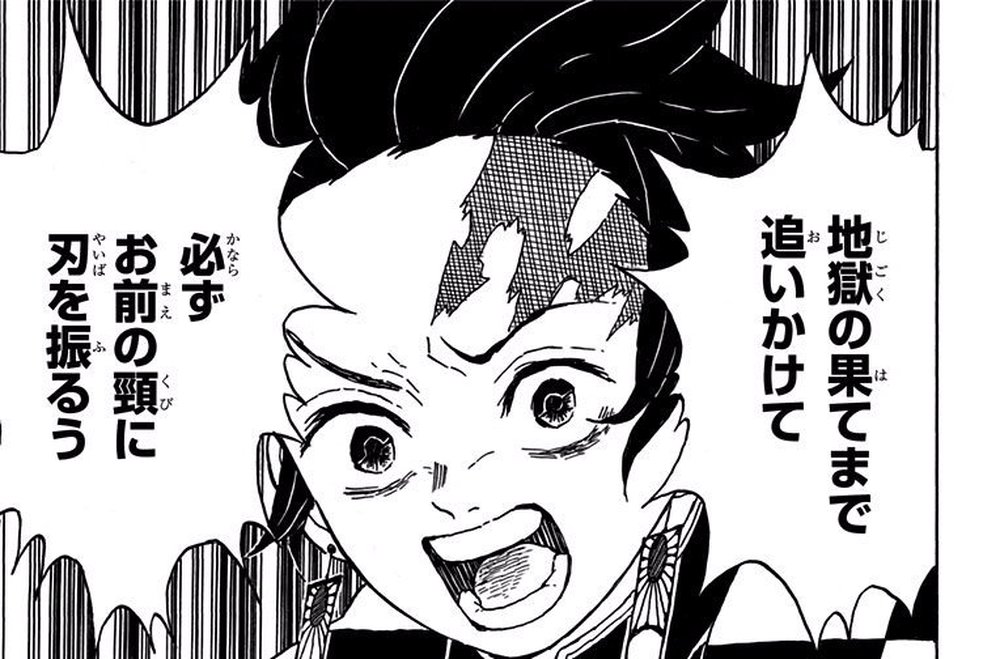
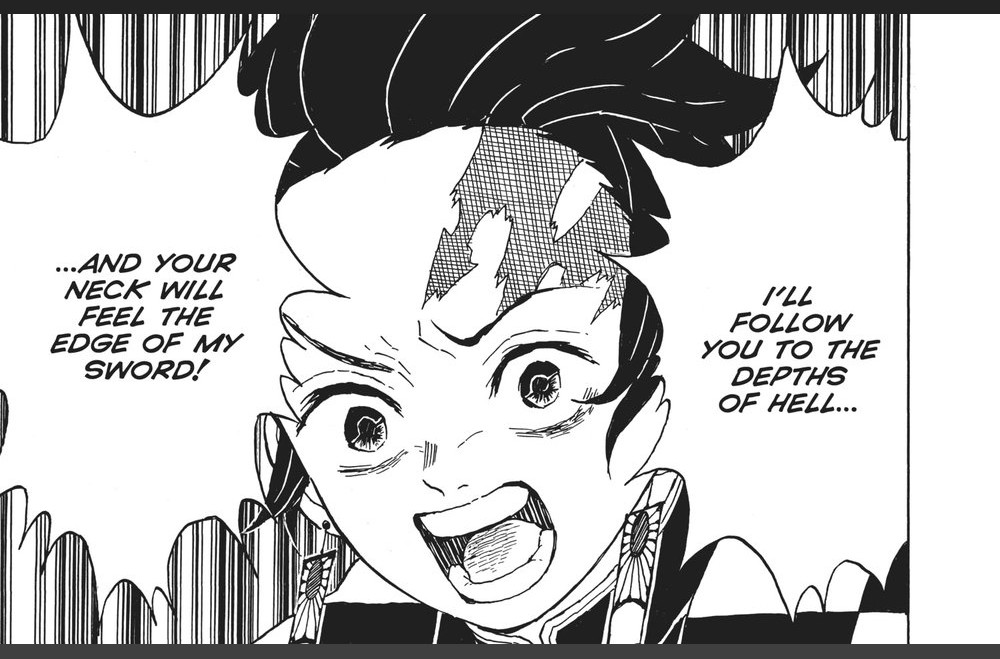
Mount Fujikasane, the morning after the Final Selection. Tanjiro has survived seven nights among real demons, and one of them — the one that killed Sabito, the boy whose fox mask Tanjiro now wears — is in front of him again. Two years of grief and training come out as a scream, broken across four separate bubbles:
「地獄の果てまで追いかけて…必ずお前の頸に刃を振るう…絶対に…お前を…許さない」
Jigoku no hate made oikakete… kanarazu omae no kubi ni yaiba o furuu… zettai ni… omae o… yurusanai
VIZ's English edition prints: "I'LL FOLLOW YOU TO THE DEPTHS OF HELL... AND YOUR NECK WILL FEEL THE EDGE OF MY SWORD! I WILL NEVER... FORGIVE YOU!" (Vol. 2, p.131).
Grant the rendering its due: it's a genuinely strong panel of English. "The depths of hell" keeps the vertical, spatial menace of the Japanese, the exclamation points land where the fragments break, and "I will never... forgive you" nails the trailing rage of 絶対に…許さない. Nobody reading this page in English feels shortchanged.
What they can't feel is that this is also the first of roughly forty times this series says the word 地獄 — and that VIZ is about to answer nearly all of them with the same three words: HELL, singular, undifferentiated, borrowed wholesale from a different religion's afterlife.
The Original
地獄 (jigoku) splits into 地 (chi/ji), "earth, ground" — the same 地 as 地面 (jimen, "ground") — and 獄 (goku), "prison" — the same 獄 as 監獄 (kangoku, "prison"). Together: an earth-prison. That's the standard Sino-Japanese rendering of Naraka, the underground hell-realms of Buddhist cosmology — and Buddhist doctrine doesn't give you one hell. It gives you eight: 八大地獄 (hachidai jigoku, "the Eight Great Hells"), stacked in tiers of escalating torment, from 等活地獄 (Tōkatsu, "Reviving Hell," where the dead are hacked apart and revived only to be hacked apart again) down to 阿鼻地獄 (Abi — Sanskrit Avīci, "Hell Without Interval"), reserved for the deadliest sins on the list: killing a parent, murdering an arhat, slandering the dharma. Each of the eight branches into sixteen further sub-hells, each matched to a specific torment for a specific sin — a mountain of blades for one crime, a river of fire for another, the source of both temple hell-scroll paintings (地獄絵図) and the everyday idiom 針の山 ("mountain of needles").
And every soul in every one of those hells is doing time, not eternity. Once the karma that sent them there is spent, they're reborn — animal, hungry ghost, human, even a god — back onto the wheel of the six realms. There is even a rescue worker: Jizo Bosatsu (地蔵菩薩), the bodhisattva who vowed to walk into every realm, hell included, comforting and freeing suffering beings — especially children — for as long as any realm holds anyone. A hell with an exit, and a Buddha who goes looking for you inside it, is not the same kind of object as a hell defined by the impossibility of leaving.
Even the headline phrase encodes this. 果て (hate) means "the far reaches, the very edge of" — the word for a coastline, a desert, a border you could in principle walk to. "地獄の果てまで" doesn't just mean "very deep into hell"; it presupposes hell has reaches, a terrain, an edge — a place with geography. Christian hell, by contrast, is rarely drawn as a place with an edge; it's a line you cross once, in one direction, permanently. Grammatically the line is simple — 果てまで追いかけて is just "chase [someone] all the way to [place]" — but the cosmology riding underneath the grammar is the whole reason this vow has teeth.
VIZ's Choice
Six representative appearances of 地獄 across the series, sampled from roughly forty occurrences in our corpus, Japanese beside the English VIZ actually printed:
| Vol. / p. (JP) | Speaker → context | Japanese | VIZ English |
|---|---|---|---|
| 2 / 131 | Tanjiro, vowing revenge at the Final Selection | 地獄の果てまで追いかけて | I'LL FOLLOW YOU TO THE DEPTHS OF HELL... |
| 15 / 22 | Zohakuten (Hantengu's hatred-clone), hunting the Kamado group | 地獄の果てまで逃げても追いかけて | YOU CAN RUN TO THE DEPTHS OF HELL, BUT I'LL FOLLOW YOU! |
| 5 / 178 (VIZ p.179)* | Rui, dying, to a memory of his real parents | 山ほど人を殺した僕は…地獄に行くよね… | (confirmed print) I'VE KILLED MOUNTAINS OF PEOPLE, SO I'M GOING TO HELL. |
| 16 / 124 | An unnamed demon, taunting Tanjiro inside Muzan's Infinity Fortress | 貴様らがこれから行くのは地獄だ!! | YOU'RE ALL GOING TO HELL!! |
| 16 / 125 | Tanjiro, retort — naming Muzan directly | 地獄に行くのはお前だ無惨 | YOU'RE THE ONE WHO'S GOING TO HELL, MUZAN! |
| 19 / 8 (VIZ p.9)* | Upper Rank Two Doma, mocking Inosuke's faith in an afterlife | 悪人は死後地獄に行くって | (confirmed print) WICKED PEOPLE GOING TO HELL AFTER DEATH? |
| 23 / 83 | Sanemi Shinazugawa, reunited with his mother's spirit | お袋背負って地獄を歩くよ | I WILL CARRY YOU TO HELL ON MY BACK. |
*Two pagination notes, both on volumes our production brief flagged in advance for a known VIZ/JP page drift. Vol. 5: our bilingual database pairs the Rui line to JP p.178 with an English string of "I'VE KILLED SO MANY PEOPLE... I'M GOING TO HELL, AREN'T I?" recorded against the same page number. Reading both printed editions directly shows VIZ's actual page for this dialogue is p.179, one page later than the database's own page field claims, and the wording VIZ actually printed there is "I'VE KILLED MOUNTAINS OF PEOPLE, SO I'M GOING TO HELL." — close in meaning, not identical in wording. Vol. 19: the same pattern repeats one panel over: the database pairs the Doma line to JP p.8 with an English string of "...THEY WANT TO BELIEVE THAT EVIL PEOPLE GO TO HELL AFTER THEY DIE." recorded against p.8; the confirmed printed VIZ page is p.9, and the line VIZ actually set there reads "WICKED PEOPLE GOING TO HELL AFTER DEATH?" We've used the confirmed printed wording and page in the table above, and kept the corpus strings, byte-for-byte, in this article's Sources/References for traceability — see the note at the foot of this article.
Read down the table and the finding is the same one this site keeps documenting for Demon Slayer's Buddhist vocabulary: not scatter, but convergence. Six different speakers, six different scenes, one English word every time. And the speaker list does real work here. Row two is the cruelest: Zohakuten, one of the demons split from Upper Rank Four Hantengu, hunts the fleeing Kamado group with almost the identical vow Tanjiro made three volumes earlier — 地獄の果てまで逃げても追いかけて mirrors 地獄の果てまで追いかけて nearly word for word. A demon has learned to threaten in the hero's own cadence, and in English the echo survives ("depths of hell" answers "depths of hell"), but the doctrinal question the echo should raise — does a demon's threat and a slayer's vow draw on the same karmic ledger, or a different one? — never surfaces, because "hell" carries no ledger to begin with.
Rows four and five are a duel fought entirely in this one word: a demon inside Muzan's fortress tells Tanjiro you're going to hell, and Tanjiro — mid-swing — tells Muzan he is. Two demon-slayer-manga combatants trading the identical noun back at each other is exactly the kind of exchange "HELL" was built for in English action writing; the taunt-and-comeback rhythm works. What's invisible is that both speakers, inside the story's own cosmology, are making a specific claim about whose accumulated karma has earned which of the eight hells — not swapping a stock insult.
The Gap
One word swallows an entire graded architecture. 地獄 is shorthand for eight major hells, each keyed to a specific sin, each carrying its own matched torment. VIZ's "HELL," repeated across nearly every appearance in this series, forces that felt gradation into English's one undifferentiated pit — Tanjiro's "depths of hell" and Doma's dismissed "hell" name, grammatically, the identical place, even though Buddhist cosmology gives the two speakers room to mean very different addresses.
The sentence is finite in Japanese, open-ended in English. A soul in 地獄 is serving out karma, not eternity — the word itself implies an exit "hell" doesn't carry. That's the only way Rui's parents' answer to his dying confession makes full doctrinal sense: 一緒に行くよ、地獄でも — "we'll go with you, even to hell" — is a real offer only if hell is a place you can enter, endure, and be accompanied through, not a one-way exile from grace. Sanemi's identical gesture at the very end of the manga, carrying his mother's spirit "through hell" on his back, only lands as tender rather than absurd if the reader already knows hell has a floor you can walk on.
A moral verdict reads as a stock insult. When a demon snarls "you're all going to hell" and Tanjiro answers "you're the one going to hell, Muzan," both lines are, inside the story's own rules, actual claims about accumulated karma — not just heat-of-battle trash talk. VIZ's "HELL" traded by both sides reads as an action-movie taunt-and-comeback precisely because English's hell is generic enough to be swung as an insult with no doctrine underneath it.
The corpus itself proves the point. Two of this article's six citations sit on volumes (5 and 19) where even the underlying bilingual database — built to automate exactly this kind of citation — recorded the wrong VIZ page number and a paraphrased English line instead of the one VIZ actually printed. If a word this common can drift that far from its own source record, it's a small demonstration of how easily "just say HELL" starts to feel like a safe, low-friction default — right up until you check the page.
What If
For the headline line, the menu and its prices:
- "I'LL FOLLOW YOU TO THE LOWEST HELL THERE IS..." — gestures at a tiered structure (a "lowest" implies rungs above it) while keeping the pursuit-vow intact. Cost: reads as an intensifier, not a citation of doctrine, to a reader who doesn't already know Naraka has eight levels.
- "I'LL CHASE YOU THROUGH EVERY HELL THERE IS..." — pluralizes hell outright, hinting at the eight-fold cosmology in the grammar itself. Cost: unusual phrasing that risks reading as an editing slip rather than a deliberate choice.
- "I'LL FOLLOW YOU TO NARAKA ITSELF..." — transliterates the doctrinal term directly, the way VIZ leaves other Buddhist vocabulary untranslated elsewhere in this series (南無阿弥陀仏 stays NAMU AMIDA BUTSU). Cost: "Naraka" means nothing on first encounter, and manga localization rarely footnotes a single word buried inside a mid-fight scream.
- Keep "HELL," spend the next line instead: "I'LL FOLLOW YOU DOWN THROUGH EVERY LEVEL OF HELL..." — Cost: adds syllables a breathless, furious vow shouldn't have room for, and over-explains a line built to land in one breath.
Take-away
地獄 looks like the easiest word in this series to translate — everyone already knows what "hell" means — and that familiarity is exactly the trap. Demon Slayer's hell is graded, plural, and temporary: eight named realms, sixteen sub-hells apiece, matched torments for matched sins, and an exit built into the doctrine from the start. English's hell is none of those things, and translating jigoku as "hell" isn't wrong so much as it's answering a different theological question than the one the Japanese is asking.
Three rules of thumb to carry off this page:
- 地獄 always has a number attached, even when it isn't spoken. Whichever of the eight a character means, the cosmology assumes gradation; "hell" in English assumes there's only one address to mean.
- Ask whether the hell in front of you has an exit. If a soul can serve out karma and leave, or a bodhisattva can walk in and rescue them, you're reading Naraka wearing English's clothes, not the other way around.
- When translation converges — everyone getting the same word — check what doctrine that convergence is quietly erasing. Here, it's an entire tiered afterlife collapsing into a single four-letter noun, forty times over.
For more of this series' Buddhist vocabulary hiding in plain sight: the funeral prayer rendered as an epitaph in 成仏してください and the Epitaph That Points the Wrong Way, the hungry-ghost realm behind every playground insult in 餓鬼 and the Hungry-Ghost Hell Behind Every "Brat", the specific Pure Land flattened to a generic afterlife in 極楽 and the Footnote VIZ Used When the Kanji Wouldn't Move, the impersonal cosmic law English keeps personifying in 天罰 and the Impersonal Heaven English Keeps Personifying, the three-crossing river rounded down to one in 三途の川 and the Three Crossings English Rounds Down to One, and the one prayer VIZ chose to translate in 南無三 and the One Prayer VIZ Chose to Translate — or browse the full Demon Slayer translation notes index. For the same word, a different demon-slaying franchise, and a very different English pun built on the same Christian afterlife, see the One Piece piece on 往生しろ and the tombstone pun VIZ reached for, whose similarExpressions entry on 地獄で仏 first flagged this word for us.
Every Japanese and English line quoted above is a byte-exact capture from the cited editions — 鬼滅の刃 Vol. 2, 5, 15, 16, 19 & 23 (Japanese) and Demon Slayer: Kimetsu no Yaiba (VIZ Media) at the corresponding panels — via our bilingual page database; see Sources below. Two lines carry a correction: the Vol. 5 and Vol. 19 English dialogue are recorded in our database against pages 178 and 8 respectively, but print on VIZ pages 179 and 9 — one page later in each case — with wording that paraphrases rather than matches the database's stored string; both editions' page images were checked directly, and the printed wording used above is the confirmed one.