The Moment
Page 15 of the entire series. Taishō-era Japan, a mountain path at dusk. A boy in a checkered haori — baskets strapped to his back, a scarf against the cold — has spent the day selling charcoal in town, and an old man who lives along the road is not letting him walk home in the dark. 「うちに泊めてやる」 — "YOU CAN STAY HERE." — and then, glaring over his shoulder: 「鬼が出るぞ」 — "YOU DON'T WANT TO RUN INTO ANY DEMONS."
Tanjiro, embarrassed by the fuss, offers the only credential he has:
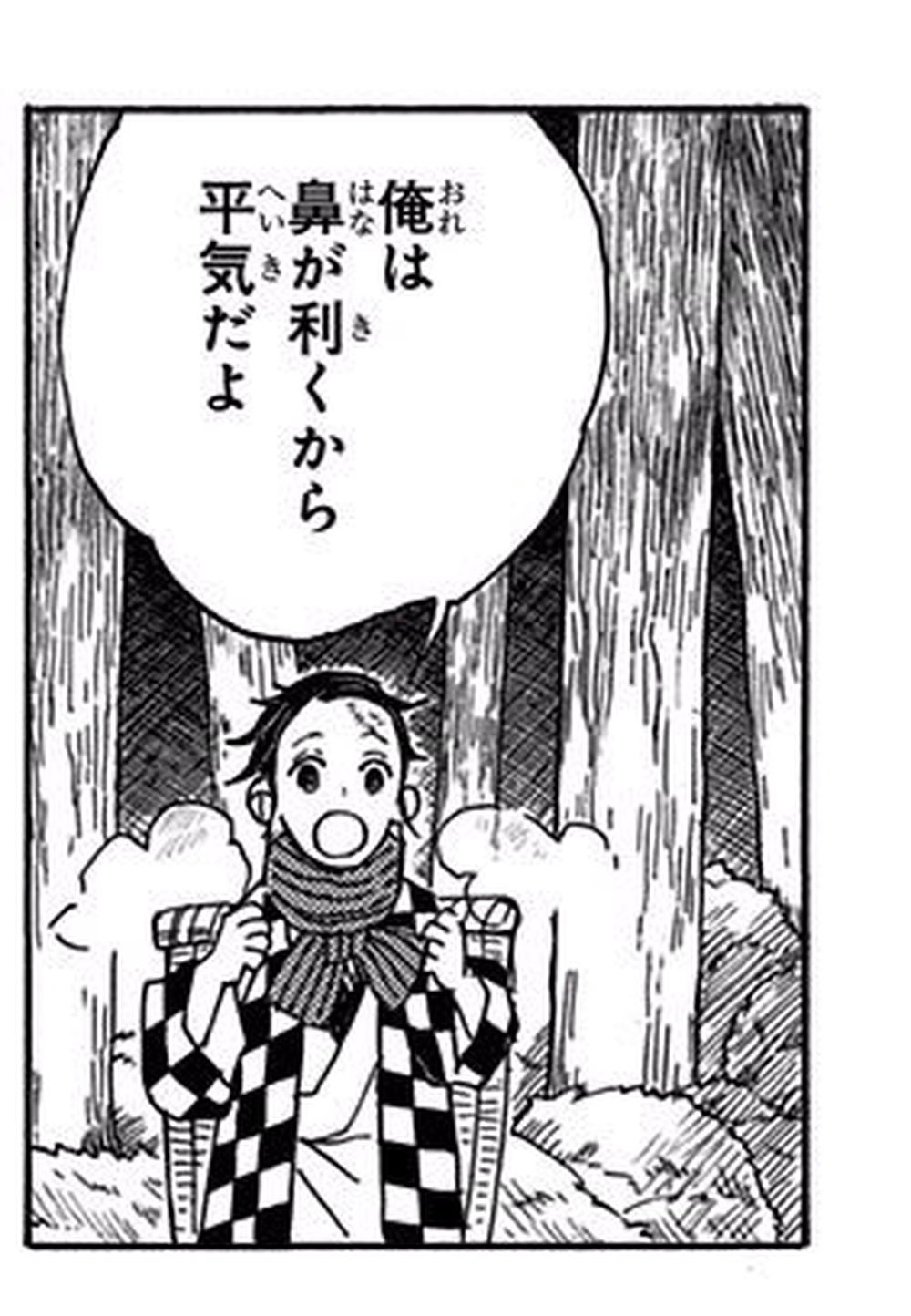
「俺は鼻が利くから平気だよ」
Ore wa hana ga kiku kara heiki da yo
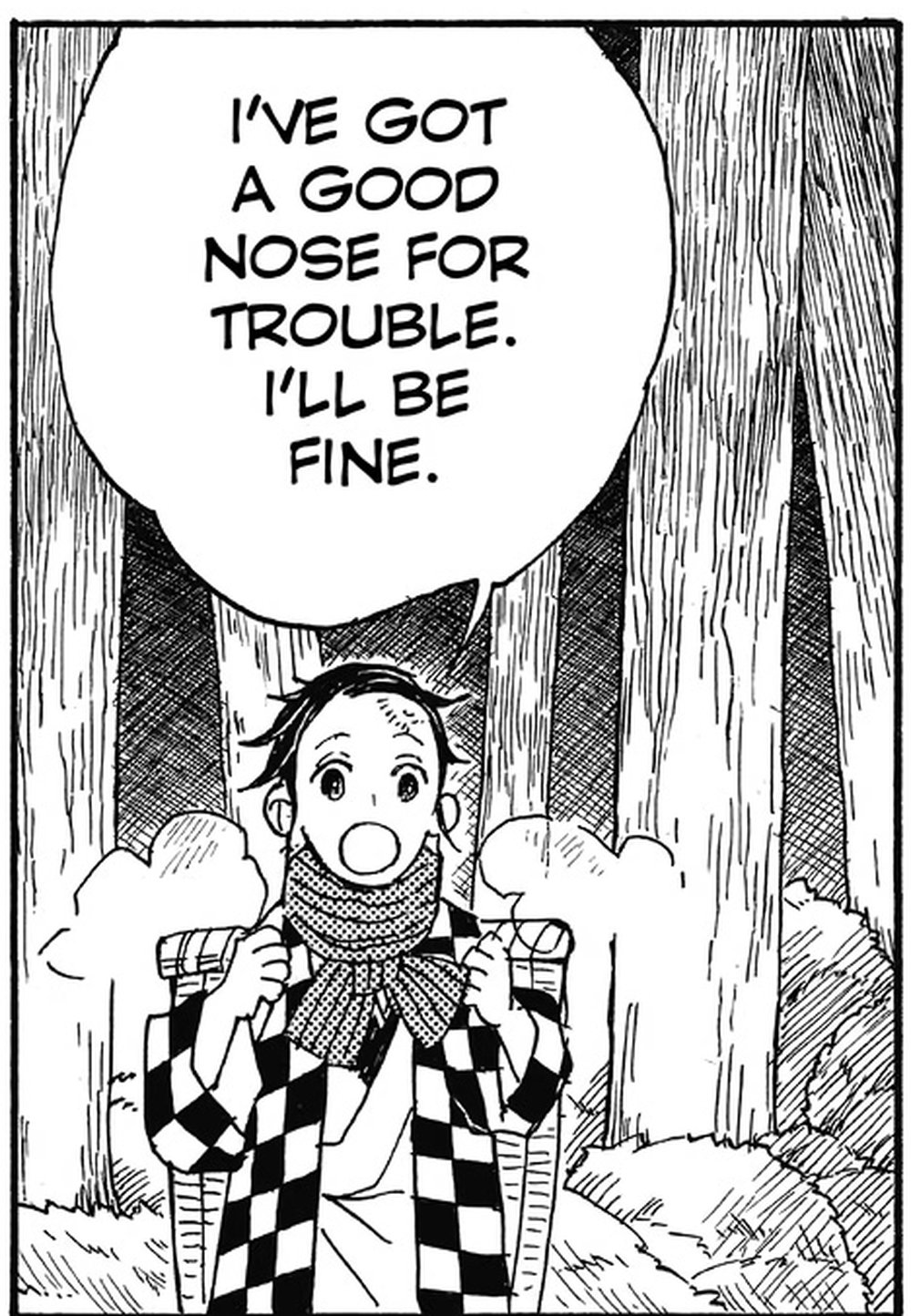
VIZ's English edition prints: "I'VE GOT A GOOD NOSE FOR TROUBLE. I'LL BE FINE." (Vol. 1, p.15).
Grant the rendering its due. It keeps the nose. It sounds like a real boy talking. "I've got a good nose for—" is exactly the shape English small talk uses for a minor talent, and the beat stays gently comic: a kid politely declining a rescue he doesn't think he needs. As a single bubble on a single page, it's a perfectly professional line.
But readers who know the series know what happens while he sleeps under that borrowed roof: this is the night his family is killed — the night that turns the charcoal seller into a demon slayer. The little boast on page 15 is not small talk. It is the first appearance of the faculty his whole future runs on, phrased in Japanese as a fact about equipment: my nose works. And "a good nose for trouble" is the one way of putting it in English that makes the equipment disappear.
The Original
The idiom is three words, and the verb is the whole story.
鼻 (hana) is "nose." 利く (kiku) is "to work, to function, to be effective" — the 利 of 便利 (benri, "handy"), 有利 (yūri, "advantageous"), 左利き (hidari-kiki, "left-handed" — literally "the left one works"). Japanese splits this verb from its homophone in writing: 利く for faculties and instruments that function, 効く for medicines and remedies that take effect. A nose 利くs the way brakes do (ブレーキが利く) — it's machinery doing its job.
So 鼻が利く says, at the letter, the nose works. Dictionaries stack two senses on that: (1) the sense of smell is sharp; (2) the owner is quick to sniff things out — bargains, danger, stories, whatever is hidden. Said of a detective or a journalist, it's the second sense; said of a hunting dog, the first. Said of Tanjiro on page 15, it is deliciously, unknowably both — and the phrase never has to choose, because nothing in it names what the nose is for. It is intransitive, objectless, aimed at the world in general.
The pattern [BODY PART + が利く] is a productive little family, and owning it pays off across the whole language:
- 目が利く — the eye works: a connoisseur's discernment.
- 気が利く — the attention works: attentive, considerate, quick on the uptake.
- 顔が利く — the face works: pull, connections, influence.
- 腕が利く — the arm works: professional skill.
Grammar: N4. The verb 利く as "function": solid N2. The set idiom 鼻が利く: N1 idiom-drill territory. And the register of the sentence around it is pure country boy — 俺, plain form, and the soft landing of 平気だよ, "I'll be fine, really," which hands the credit to the nose and keeps the boy modest.
VIZ's Choice
Here is every appearance of 鼻が利く in the volumes we have on file — nine of them, spoken by five different people about the same nose:
| Vol. / p. | Speaker | Japanese | VIZ English |
|---|---|---|---|
| 1 / 15 | Tanjiro | 俺は鼻が利くから平気だよ | I'VE GOT A GOOD NOSE FOR TROUBLE. I'LL BE FINE. |
| 1 / 89 | Giyu's letter | 少年の方は貴方と同じく鼻が利くようです | LIKE YOU, THE BOY HAS A STRONG SENSE OF SMELL. |
| 1 / 102 | Tanjiro | 簡単!!俺は鼻が利く | THAT'S EASY! I HAVE A SHARP NOSE! |
| 1 / 176 | Urokodaki | お前ももっと鼻が利くようになれば…鬼が何人喰ったかわかるだろう | IF YOUR NOSE GETS STRONGER YOU'LL BE ABLE TO TELL... HOW MANY PEOPLE A DEMON HAS EATEN. |
| 4 / 40 | Tanjiro | 俺は鼻が利くんだ | I HAVE A KEEN SENSE OF SMELL. |
| 4 / 141 | Zenitsu | 鼻が利く炭治郎なら死んでるわ! | WITH HIS SENSITIVE NOSE, TANJIRO MUST BE DEAD! |
| 12 / 63 | a Kakushi escort | さらに鼻が利くというあなたには鼻栓を | ALSO, SINCE YOU HAVE A GOOD SENSE OF SMELL—NOSE PLUGS! |
| 12 / 86 | Tanjiro | うーん体力が万全じゃないのも鼻が利きにくい原因だ。 | HMM... AND NOT BEING COMPLETELY HEALTHY IS HAMPERING MY NOSE. |
| 12 / 117 | Tanjiro | 見つけるよ俺は鼻が利くから | I'LL FIND YOU! I'VE GOT A GOOD NOSE! |
Read down the right-hand column and the pattern is the opposite of the usual translation scatter. Eight of the nine are literal noses — "sense of smell," "sharp nose," "sensitive nose," "my nose" — every one of them correct, because by Vol. 1's own midpoint the story has made the smell real: Giyu's letter certifies the boy to master Urokodaki by his nose; Urokodaki teaches him to read a demon's kill count with it; the Corps hands him nose plugs before a secret journey, precisely because his nose works too well.
The single exception — the only time VIZ reaches for the English idiom — is the very first line, the introduction, the one a Japanese reader will hear echoed eight more times. And look at the last row: 見つけるよ、俺は鼻が利くから — practically the same sentence as page 15, eleven volumes later. VIZ's rendering there, "I'VE GOT A GOOD NOSE!", is objectless, double-readable, and would have been a near-perfect page 15. The translation found the right answer eventually. It just found it in Vol. 12.
The Gap
"For trouble" points the nose at its owner. English's "a nose for X" idiom demands a target, and trouble is a loaded one: "a nose for trouble," said of a person, hovers between detecting trouble and attracting it — as often as not it means trouble finds THEM. The Japanese line is a reassurance (平気だよ — "I'll be fine"); half the English readings turn it into a self-deprecating joke about being a trouble magnet. On this of all nights — the family slaughtered by morning — the "attracts trouble" reading becomes accidentally prophetic in a way the Japanese never is. The original plants a shield; the translation can be heard planting a curse.
The superpower gets filed under figure of speech. Chapter 1 uses this line the way a mystery plants a clue: state the talent plainly, cash it in later. 鼻が利く is literal equipment — a nose that works — and seventy pages on, the series' most reserved swordsman stakes a recommendation on it: "LIKE YOU, THE BOY HAS A STRONG SENSE OF SMELL." An English reader who met page 15 as an idiom about knack has no reason to remember it as a physical fact, so the certification arrives without its setup. The plant is uprooted at the moment of planting.
Nine echoes, no echo. In Japanese, 鼻が利く is close to a catchphrase: the same four morae from Tanjiro, his teacher, his rival, the support staff — vol. 1, vol. 4, vol. 12. In English the nine lines share no wording at all: good nose for trouble, strong sense of smell, sharp nose, nose gets stronger, keen sense of smell, sensitive nose, good sense of smell, hampering my nose, good nose. Each is fine; together they dissolve a running motif into nine unrelated remarks. The scatter isn't a lexical failure — it deletes a rhythm the Japanese reader gets for free.
What If
The menu for page 15, and what each item costs:
- "I'VE GOT A GOOD NOSE. I'LL BE FINE." — VIZ's own Vol. 12 solution, retrofitted to Vol. 1. Objectless like the Japanese; literal and figurative both survive; the catchphrase gets its English form. Cost: "a good nose" alone is faintly odd English — the ear waits a beat for the "for."
- "MY NOSE IS SHARP. I'LL BE FINE." — plants the literal talent exactly where the Japanese does. Cost: no idiom at all; it reads like a spec sheet, and the folksy warmth thins.
- "I CAN SMELL TROUBLE COMING. I'LL BE FINE." — keeps VIZ's trouble, but as something detected, not attracted; the reassurance logic is safe. Cost: still names an object the Japanese leaves open, and brags a shade harder than 平気だよ.
- "MY NOSE NEVER LETS ME DOWN." — the closest to what 利く actually asserts: an instrument that reliably works. Cost: a road-tested adult phrase in a thirteen-year-old's mouth; the modesty evaporates.
Notice the shared bill: English keeps making the line say what the nose is for or how good the boy is. The Japanese says neither. It says the nose functions — and lets twelve volumes decide what that's for.
Take-away
鼻が利く is an easy idiom hiding a hard translation problem: an objectless verb of functioning, in a language whose matching idiom demands a target. When the translator supplies one — trouble — the line changes owners: the talent stops being about the world's smells and starts being about the boy's luck.
Three rules of thumb to carry off this page:
- Wherever you meet [body part] + が利く, read 利く as "works." The whole family unlocks at once — 気が利く, 目が利く, 顔が利く — and you'll stop mistaking them for metaphors about effort or luck.
- When an English idiom needs an object and the Japanese one doesn't, ask what the object smuggles in. "A nose for trouble" imported a fate; "a nose for news" would have imported a profession. The Japanese imported nothing.
- Track repeated self-descriptions in the original. When the same four morae surface in Vol. 1 and Vol. 12, that's a leitmotif — and translation scatter will hide it unless you're reading with the Japanese in one hand.
For another idiom where a Japanese body part does something English body parts can't, see the ringing arms of 腕が鳴る — or browse the Demon Slayer translation notes index.
Every Japanese and English line quoted above is a byte-exact capture from the cited editions — 鬼滅の刃 Vol. 1–12 (Japanese) and Demon Slayer: Kimetsu no Yaiba (VIZ Media) at the corresponding panels — via our bilingual page database; see Sources below.