弟 (otōto), never サスケくん: an intimacy that never softens into affection-speak
Itachi never once calls Sasuke by an affectionate diminutive — no くん, no nickname, nothing. He calls him by name, サスケ, flat, or by the kinship term 弟 ("younger brother") stripped of any warmth-signaling suffix at all: 「愚かなる弟よ...」 ("BROTHER, YOU'RE PATHETIC..."), spoken to a genjutsu-trapped Sasuke on massacre night, uses the classical vocative よ instead of anything softer. It's a register that reads almost archaic even in Japanese — よ as a vocative particle is more at home in period drama than shōnen dialogue — and it never appears anywhere else in the cast. Every other character who addresses a sibling or student uses some marker of closeness; Itachi's closest approach to tenderness is grammatically identical to his most brutal command.
「許せサスケ...また今度だ」 — a catchphrase that means the opposite thing twice
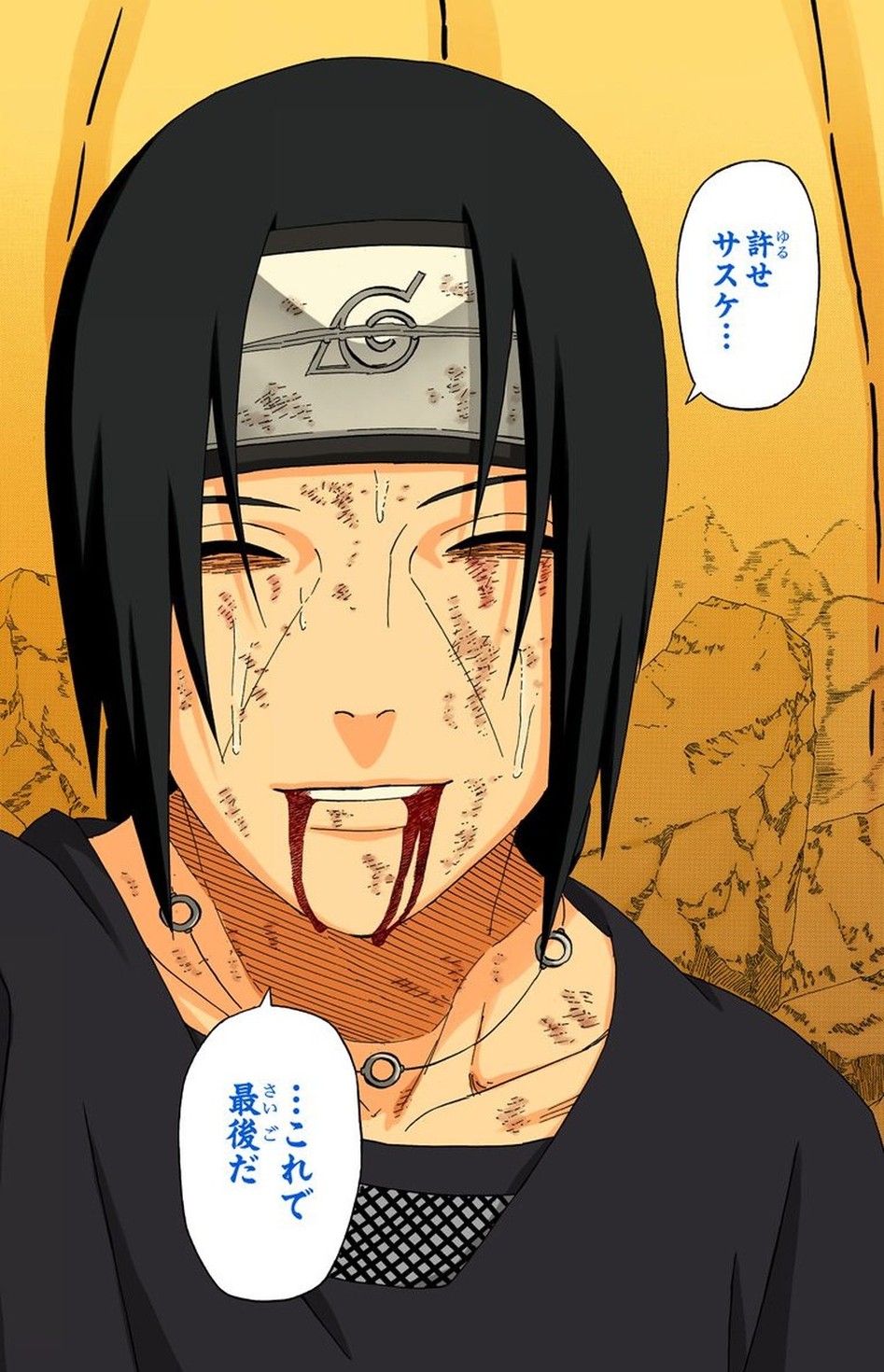
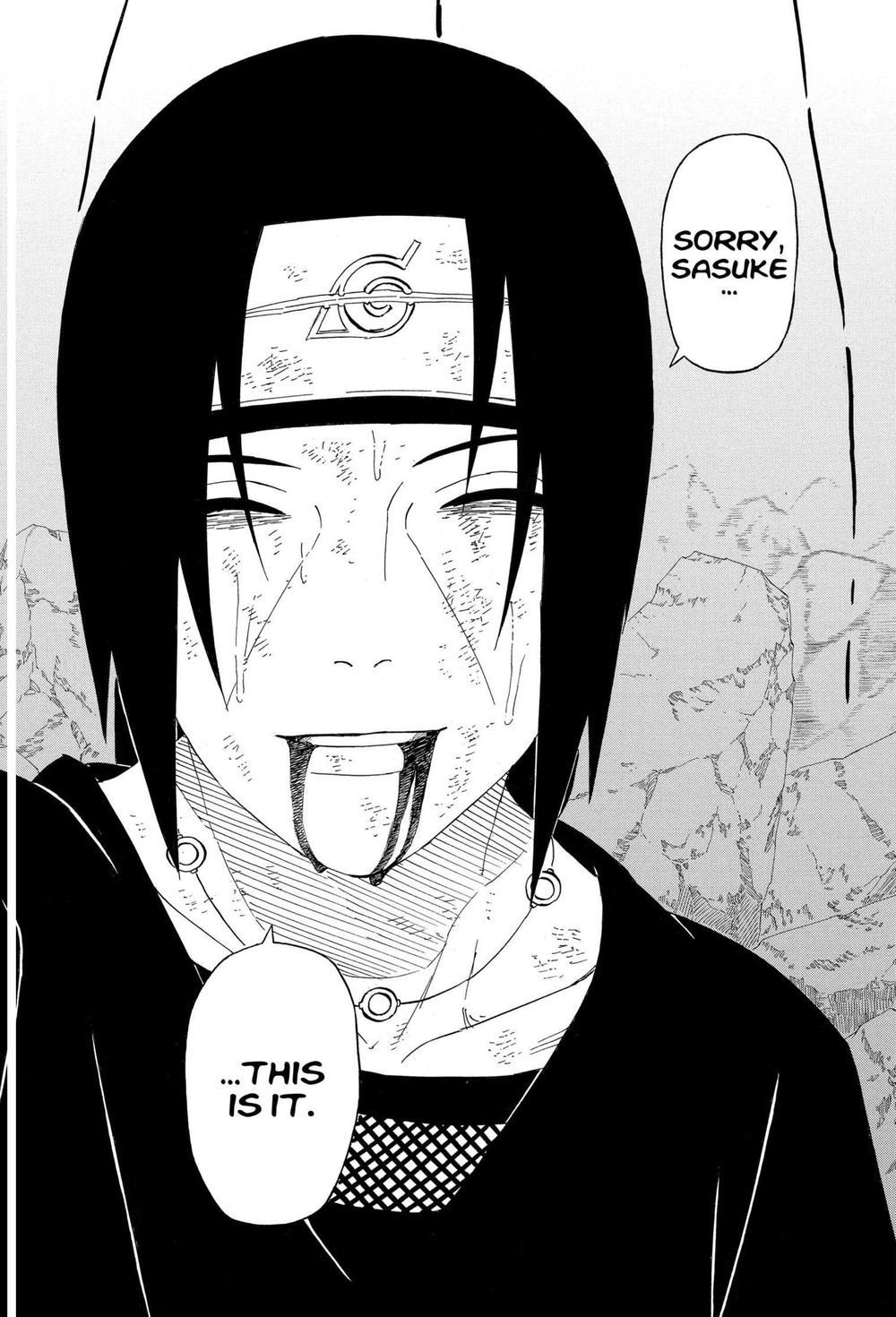
Itachi's signature line first appears in a flashback of ordinary sibling life: young Sasuke begs for shuriken practice, and Itachi brushes him off with 「許せサスケ...また今度だ」 ("SORRY, SASUKE... MAYBE NEXT TIME"), followed immediately by a light forehead poke — 「いっもいつも“許せサスケ”って額こずくばっかりで..」 ("YOU ALWAYS SAY SORRY, SASUKE AND JAB ME IN THE FOREHEAD"), Sasuke complains, establishing the gesture as an affectionate running joke between them. Fifteen years and one massacre later, the same phrase returns, edited by one word, as Itachi's literal last words while performing the same poke: 「許せサスケ...これで最後だ」 ("SORRY, SASUKE... THIS IS IT") — また今度だ ("another time") has become これで最後だ ("this is the last time"), the childhood placeholder finally, fatally, kept.
Massacre-night imperatives: command forms with nothing to soften them
The genjutsu Itachi shows Sasuke of the massacre reveals his cruelest register: a string of bare imperatives with no politeness marker anywhere in them. 「恨め!憎め!」 ("HATE ME AND LIVE...") and 「そしてみにくく生きのびるがいい...」 ("...SETTLE FOR HATING ME...") use the plain command form (恨め, 憎め) that a teacher might use scolding a child, aimed instead at ordering an eight-year-old to survive by hating him specifically. 「..愚かなる弟よ...このオレを殺したくは生にしがみつくがいい」 ("...BROTHER, YOU'RE PATHETIC. IF YOU WANT TO KILL ME... CLINGING TO LIFE WITHOUT HONOR!") closes the speech on the same よ-vocative that opens it — the massacre-night Itachi and the sibling-teasing Itachi are, grammatically, running the exact same register in opposite directions.
The wall metaphor, and "even if it means being hated"
Itachi's dying words to Sasuke, delivered as a final memory-gift rather than genjutsu cruelty, restate his life's stated purpose almost verbatim from years earlier: 「お前とオレは唯一無二の兄弟だ...お前の越えるべき壁としてオレはー...それが兄貴ってもんだ...オレはお前と共に在り続けるさ...たとえ憎まれようともな...」 ("IT'S JUST THE TWO OF US... I'LL ALWAYS BE THERE... THAT'S WHAT BIG BROTHERS ARE FOR... ...LIKE A WALL YOU NEED TO CLIMB OVER... EVEN IF IT MEANS BEING HATED..."). VIZ's line breaks scatter this across four separate bubbles in a way that obscures how the Japanese runs as one continuous, grammatically complete thought — a rare moment where Itachi's control cracks just enough to say, once, plainly, why he let his brother hate him for fifteen years. Sasuke's own voice, on the receiving end of both the tenderness and the cruelty, is covered on the companion page: Sasuke Uchiha's quotes. The Sharingan and its awakened forms — 万華鏡写輪眼, Amaterasu, Tsukuyomi, and Susanoo — that make Itachi's genjutsu possible in the first place are covered individually in 写輪眼, 天照, 月読, and 須佐能乎.