オレ, not 俺 — the pronoun everyone assumes is different
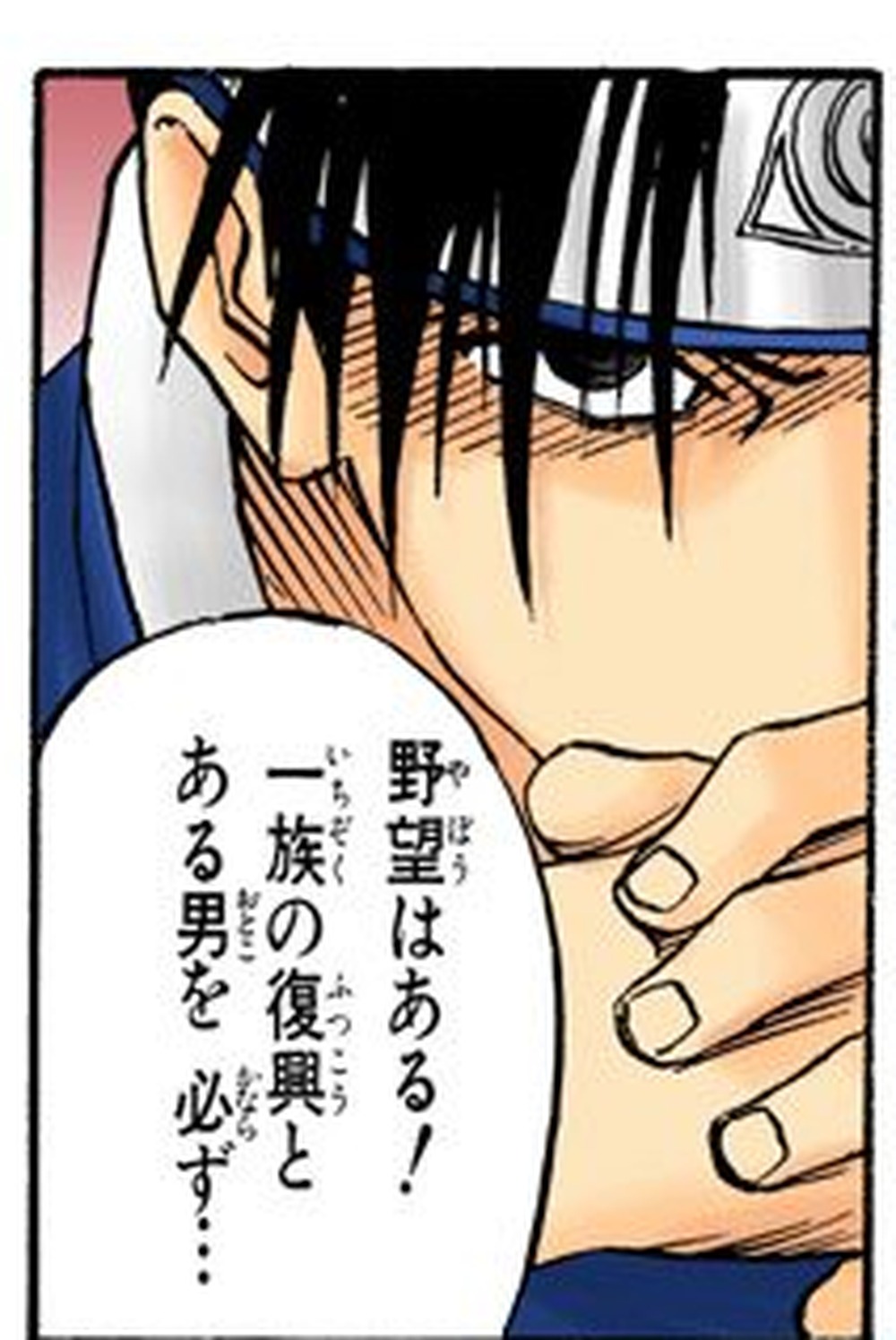
Fan shorthand loves to claim Sasuke speaks in the "cold" kanji 俺 while Naruto speaks in the "loud" katakana オレ — a tidy contrast that the actual page images don't support. Check every line on this page against the source art and not one of them spells his first person in kanji. 「オレは復讐者だ」, 「オレは火影になる…」-style declarations, even his coldest Itachi vow — all オレ, katakana, identical to the script Naruto himself uses. Kishimoto renders nearly his entire genin cast this way; the kanji 俺 barely appears in these volumes at all. So the coldness fans hear isn't coming from the pronoun. It's coming from everything Naruto stacks after his オレ that Sasuke refuses to: no だってばよ, no んだ explaining-himself tic, no run-on qualifiers. Same word, opposite grammar built around it.
Sentences that end and don't explain
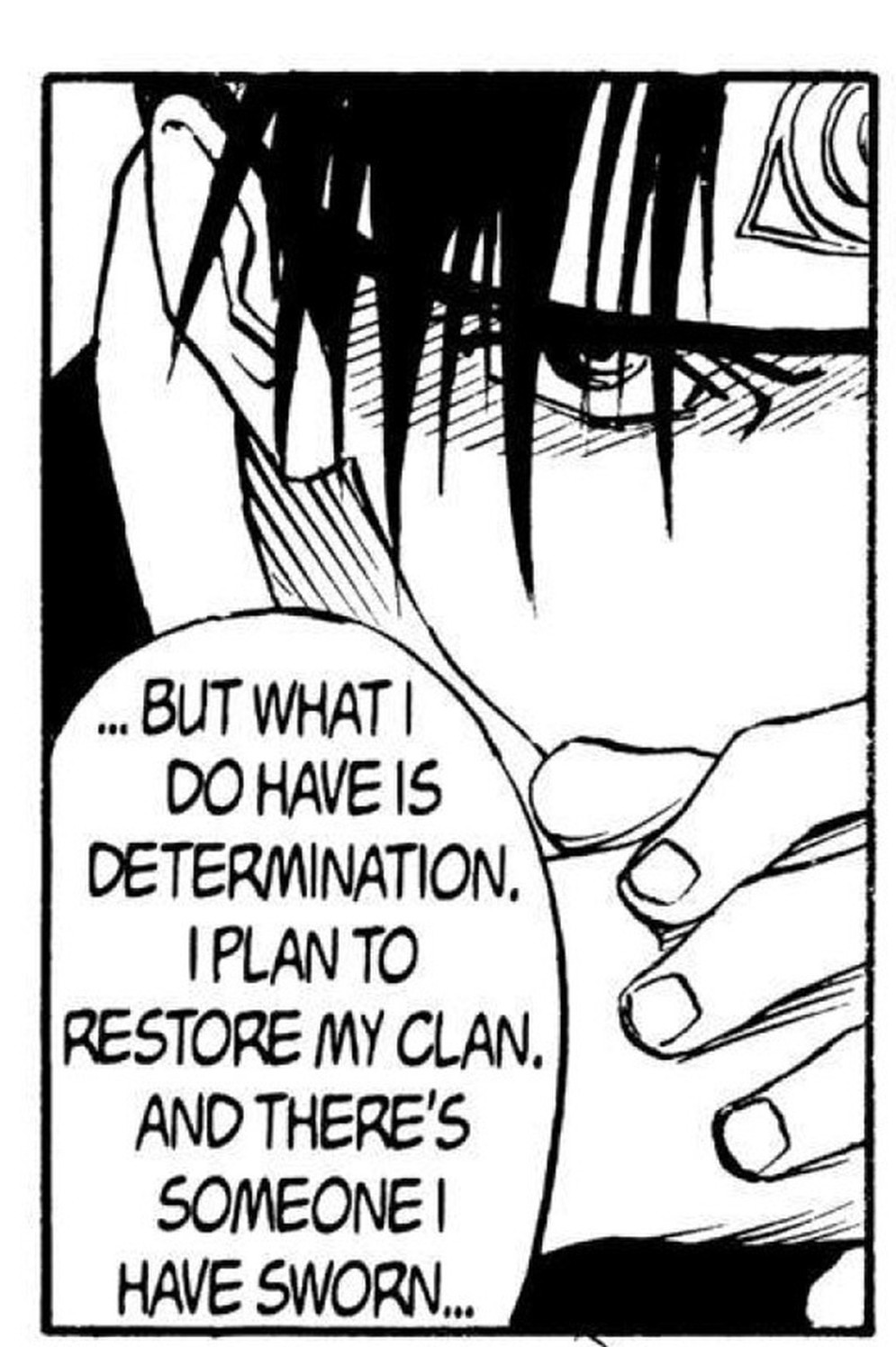
Sasuke's signature move is the flat declarative with nothing appended. 「オレは復讐者だ」 — "I am an avenger" — is the whole sentence; no reason, no target named, no softening. 「図に乗るな!!」 to Zaku in the Forest of Death is two words and an imperative, thrown a beat before his own trap springs (full breakdown: 図に乗る and the nine faces English gives to getting cocky). Even his most famous vow, 「殺すことだ」 — the flat "...to kill" that closes his Team 7 self-introduction — arrives as a single clause after Kakashi tries to interrupt with 「次!」 ("next!"). VIZ has to work to keep that flatness: English wants a subject and a verb tense doing more work than one bare noun phrase, so "...BUT WHAT I DO HAVE IS DETERMINATION" and "...TO KILL" spread across two panels what the Japanese lands in about four words total.
フン, and the flattest insult in his vocabulary
Where Naruto has だってばよ, Sasuke's verbal tic is closer to silence with a sound attached: フン (fun), a dismissive exhale that VIZ almost always prints as "HMPH!" It shows up on this page closing out a childhood needling match with Naruto — Naruto taunts, Sasuke snaps back, Naruto shrugs it off, and Sasuke's only reply is フン!, full stop. No comeback, no last word in actual language. The sound itself is the last word.
うすらとんかち — the one insult that's almost affection
The same childhood exchange gives up Sasuke's other verbal fingerprint: 「何だと!このうすらトンカチ」 — "WHAT?! YOU'RE THE IDIOT!" in VIZ's English — where うすらとんかち (usura-tonkachi, roughly "you thin hammer," a blockhead insult built from a carpenter's tool) is aimed at Naruto and, on the corpus pages we have on file, at no one else. It's a strange insult to reserve for exactly one person across a whole manga, and that exclusivity is the point: everyone Sasuke actually dismisses gets フン; only Naruto gets a whole invented compound. Later arcs of the saga (and the sequel series that follows it) keep returning to うすらとんかち as shorthand for Sasuke's single working channel of fondness — we're building a dedicated page tracking every occurrence of the word across the English editions; for now this is the one verified instance in our corpus, tagged for that future piece.
From 殺すことだ to 一生の約束 — a companion arc, and the thaw VIZ has to voice
Read this page's quotes in story order and the register barely moves — Sasuke's Volume 26 Valley of the End line, 「オレはお前以上に特別だ」 ("I'M STILL MORE SPECIAL THAN YOU!"), is exactly as clipped as his Volume 1 self-introduction. What changes is the addressee, not the grammar: the same flat declarative that once dismissed an entire village now answers Naruto by name. The Valley of the End sequence sits inside a wider translation puzzle this hub has already mapped — his cursed-seal vow, 「この力に手を染めちまったら最後…」, is the headline line of 手を染める and the hands English gets backward, and the same volume's parasitic double-talk from Ukon — a villain quoting the language of marriage mid-battle — gets its own treatment in 一心同体 and the bond VIZ flattens into "assimilated", a useful companion read for how this arc's Japanese keeps reaching for intimacy vocabulary in combat. For the bridge scene where a shaking Sasuke renames his own fear before it ever reaches Naruto, see 武者震い and the idiom VIZ explained instead of translated. Track all of it front to back and the throughline isn't warmth arriving late — it's the same terse, unexplained オレ, pointed at someone worth keeping.