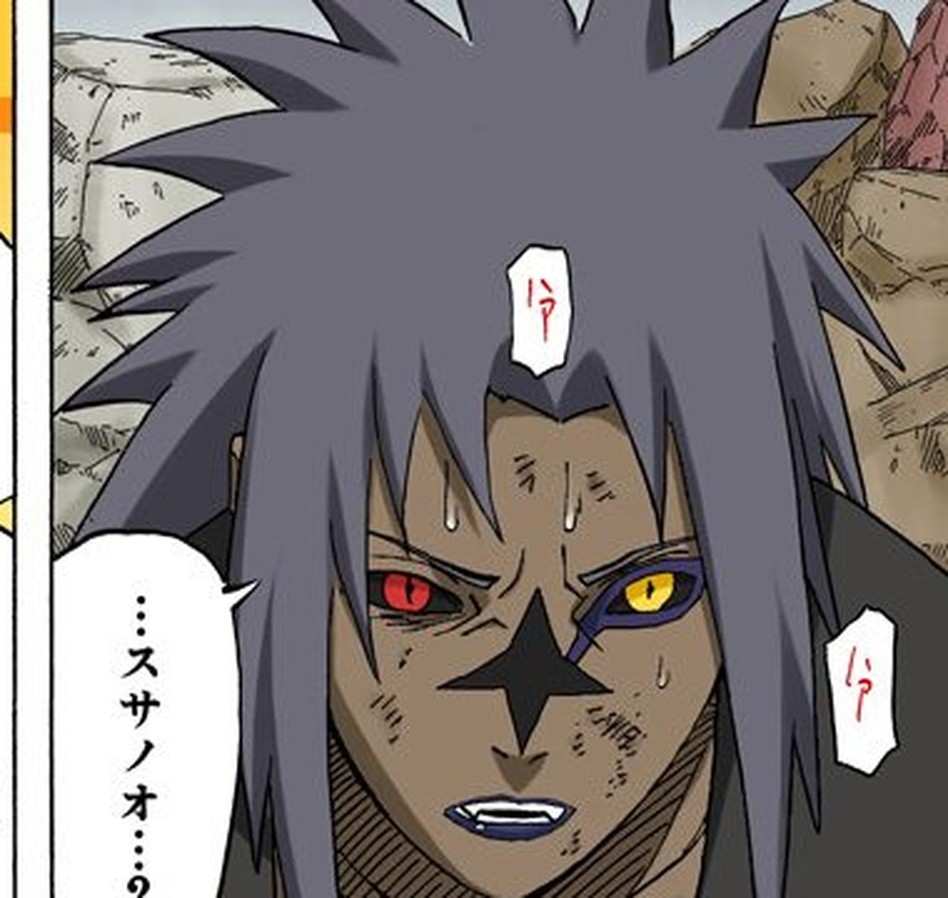
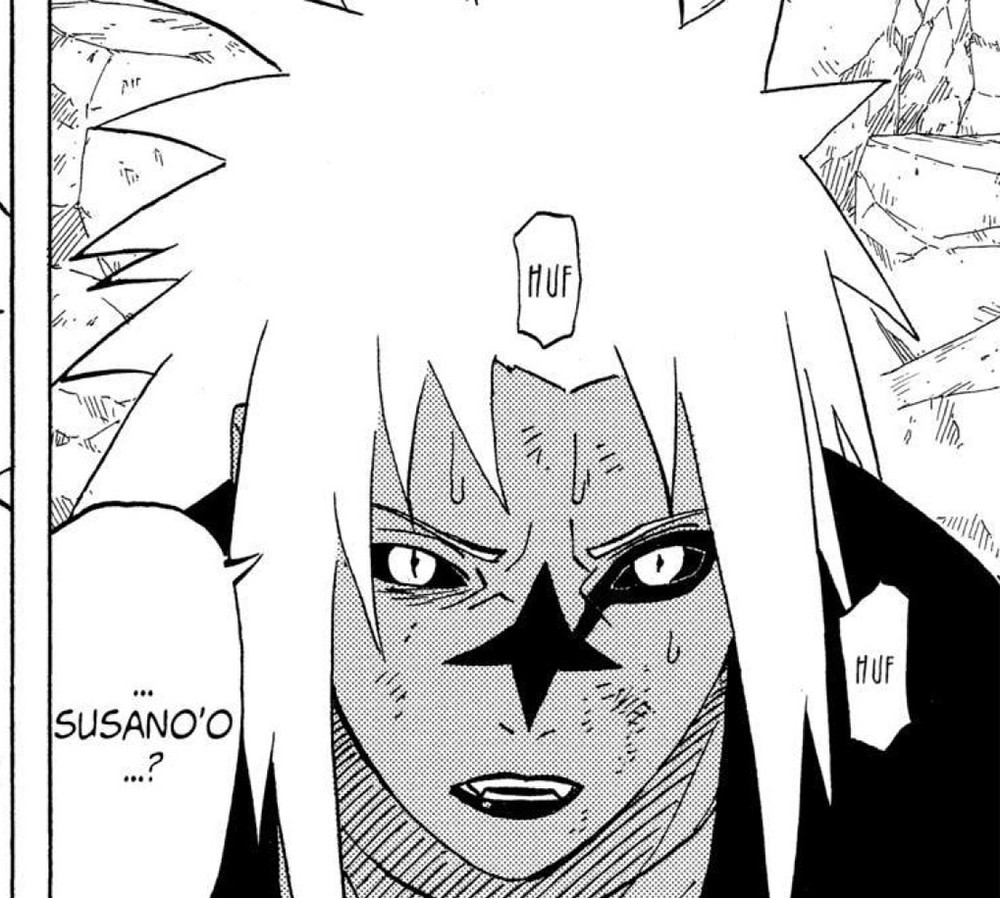
Susanoo closes out the trio this dictionary's Amaterasu and Tsukuyomi entries build toward, and the corpus states the causal relationship between all three in a single panel: Itachi tells Sasuke, mid-fight, that Susanoo is "THE ONE OTHER JUTSU THAT TOOK ROOT IN MY EYES... ONCE BOTH THE TSUKUYOMI AND AMATERASU WERE AWAKENED" (Vol. 43 p.044) — the same page where Itachi manifests it for the first time, murmuring "…スサノオ…?" ("...SUSANO'O...?") almost as a question, as if surprised by his own power. That's the technique's true first appearance in the manga; Sasuke's own first use comes later, at the Five Kage Summit (Vol. 50 p.025), and is worth distinguishing from Itachi's debut for anyone tracking "first use" claims elsewhere.
Susanoo-no-Mikoto is, in the actual Kojiki, the wildest and most disruptive of Izanagi's three children — a storm god exiled from heaven for his destructive behavior, who later goes on to slay the eight-headed serpent Yamata-no-Orochi. Giving the manga's single most destructive, army-scale Mangekyo technique that god's name tracks the mythology unusually closely: Amaterasu (fire, precision, the sun) and Tsukuyomi (mind, illusion, the moon) are comparatively contained, single-target techniques, while Susanoo is a giant armored combat avatar capable of leveling terrain — the storm god's outsized, uncontainable energy made literal.
The corpus shows Kishimoto isn't done drawing on Shinto myth even after naming the base technique. Itachi's own Susanoo variant, used during his Edo Tensei revival to control his own black flames without burning himself, is named 須佐能乎加具土命 (Vol. 66 p.128, "INFERNO STYLE, SUSANO'O FLAME CONTROL!!!") — invoking Kagutsuchi (加具土命), the Shinto god of fire whose birth burned his mother Izanami fatally, according to the Kojiki. That's a second mythological citation stacked on top of the first: not just "Susanoo," but a specific named variant of Susanoo bearing a second god's name for a fire-focused subset of its power, showing the same layered-mythology instinct at work twice in one technique family.
VIZ's spelling is the least stable of any term in this dictionary. "Susano'o" (with the apostrophe marking the vowel break, closer to the actual Japanese pronunciation su-sa-no-o) appears at the technique's chapter-title debut (Vol. 43, "Number 392: Susano'o...!!") and dominates the early corpus, but later volumes (Vol. 58, Vol. 70) switch to plain "SUSANOO" without explanation — an inconsistency that likely reflects different translators handling different volumes over the run's later years, rather than any deliberate in-story shift.