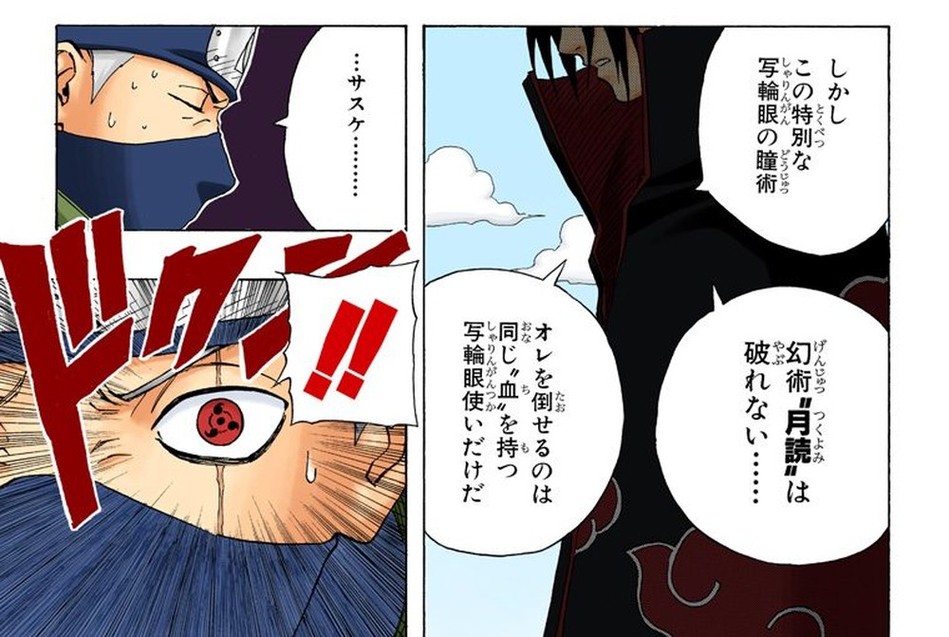
Tsukuyomi completes the naming triangle this dictionary's Amaterasu entry lays out: three ultimate Uchiha techniques, three siblings from the Kojiki's founding myth, mapped almost one-to-one onto the manga's Mangekyo Sharingan progression. Where Amaterasu governs unstoppable fire and Susanoo manifests as a giant armored avatar, Tsukuyomi governs the mind itself — a fitting technique for the god most associated in real Shinto tradition with night, the unseen, and (via the near-homophone 黄泉, yomi, "the underworld") the boundary between life and death. Kishimoto didn't need Tsukuyomi to mean anything about illusions or mental time-distortion for the borrowing to work dramatically; he needed a genuinely three-way mythological trio to draw from, and the Kojiki conveniently supplies exactly three siblings born from one purification ritual, cleanly matching his three-technique structure.
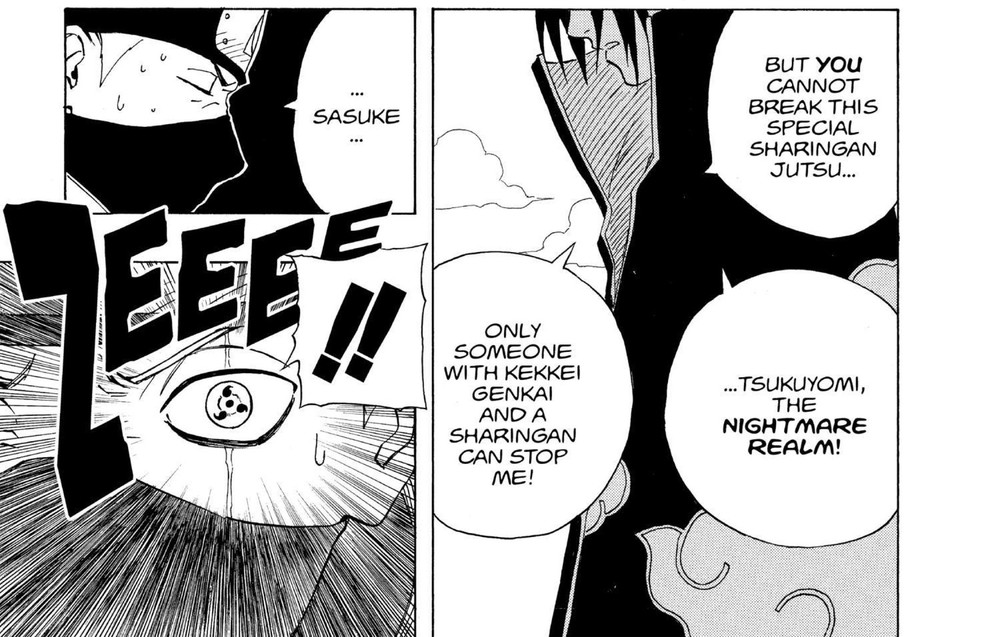
The corpus's first Tsukuyomi occurrence (Vol. 16 p.145) is one of the more heavily glossed technique reveals in this whole dictionary: "幻術"月読"は破れない..." becomes "...TSUKUYOMI, THE NIGHTMARE REALM!" — VIZ pairing the bare romanization with an invented English subtitle that appears nowhere in the Japanese line (幻術 here just means "illusion technique/genjutsu"; "Nightmare Realm" is VIZ's own coinage, not a translation of 月読 itself). That subtitle recurs once more at Vol. 29 p.074 ("YOU'VE LEARNED FROM EXPERIENCING TSUKUYOMI, THE NIGHTMARE REALM, ONLY ONCE") and then disappears from the sampled corpus entirely — by Vol. 43 onward the term stands alone as plain "TSUKUYOMI," the same trajectory this dictionary's Rasengan and Sharingan entries show for their own early explanatory glosses.
A related but structurally distinct technique appears later in the corpus under a modified version of the same name: 無限月読 (Mugen Tsukuyomi, "Infinite Tsukuyomi"), Madara and later Kaguya's civilization-scale genjutsu cast on the moon itself to trap the entire world's population in a shared dream. VIZ renders this consistently as "INFINITE TSUKUYOMI" from its first sampled appearance (Vol. 50 p.077) onward — the 無限 ("infinite/boundless") prefix is translated rather than romanized, unlike the base term, which is worth noting as a small but real difference: VIZ treats the original Itachi-era Tsukuyomi as an untranslatable proper noun but is comfortable modifying it with an English adjective once the jutsu scales up to a different order of magnitude. The choice to cast this apocalyptic version specifically on the moon is itself the tightest mythological callback in the set — Tsukuyomi is the moon god, and the technique that bears his name is ultimately performed using the actual moon as its casting medium.
The corpus's OCR shows unusual strain on this particular term compared to others in this dictionary, worth flagging for anyone cross-checking sources: variant misreadings like "TSUKYOMI" (Vol. 42 p.166, Vol. 70 p.193), "SUKUYOMI" (Vol. 71 p.038), and "TSUKUYOIM" (Vol. 72 p.044) recur across the War-arc volumes, alongside at least one panel (Vol. 43 p.044) where VIZ's own lettering has a genuine in-print typo, "TSUKIYOMI." None of these affect the technique's core romanization, but they make this one of the least byte-stable terms in the whole dictionary.