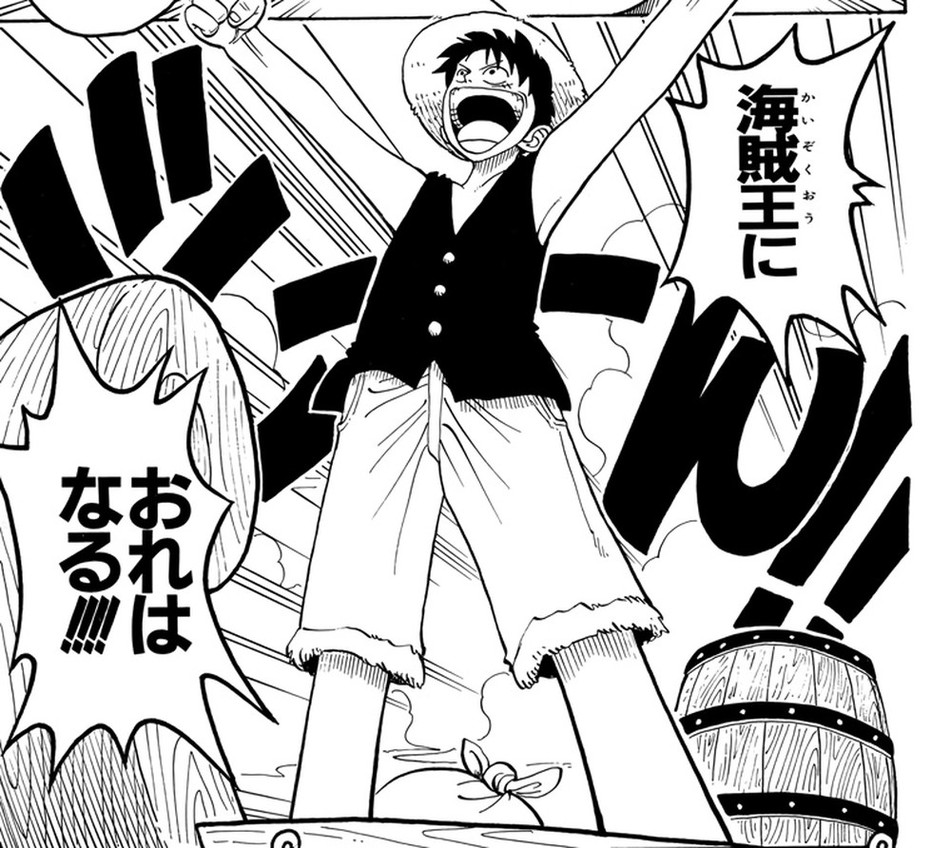
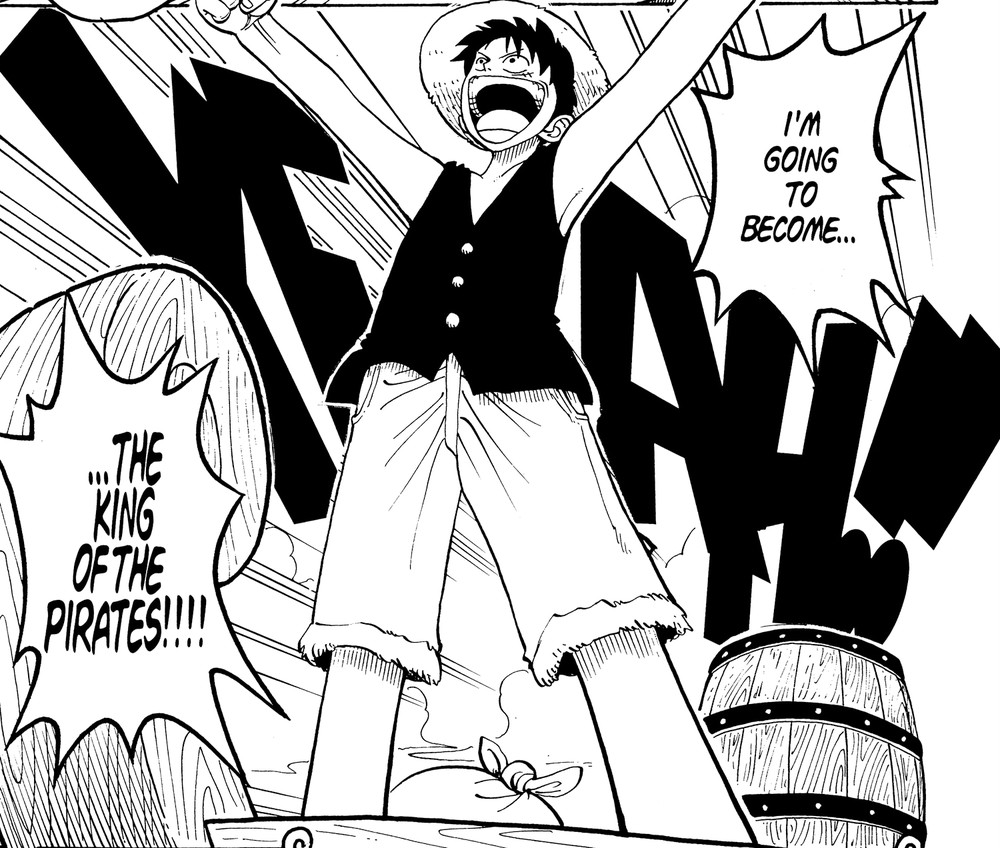
Luffy's Japanese is built from a small set of blunt parts, used the same way whether he's happy, furious, or dying. The pronoun is always おれ — the plain, boyish "I" that never softens into the humble 私 (watashi) even when he's talking to marines, royalty, or his own crew. The verb endings are bare: だ, だぞ, んだ — no です/ます, no hedging, no のではないか. When a textbook would soften a claim ("I intend to become...", "perhaps I could..."), Luffy states it as settled fact: 海賊王になる男だ, "I'm the man who's going to become King of the Pirates." Compare that to Coby, two pages earlier in Volume 1, answering in reflexive polite form — 称号ですよ!? — and the class distance between them is audible before either boy says anything about pirates.
The recruiting lines on this page are the clearest place to watch the pattern hold under completely different emotional weather. To Zoro it's a transaction dressed as a boast (おれは海賊王になる男だ!!!, backed by an offer to steal back his swords). To Nami it's a shouted claim of ownership after a fight — お前はおれの仲間だ!!! — no hedging, no "if you want." To a terrified, half-feral Chopper it's a chase and an order: おれ達の仲間になれェ!!!, the imperative form なれ used exactly like you'd order someone to sit down. To Vivi, mid-sob, it curdles into a rebuke — 仲間だろうが!!! — where だろうが stops being a question and becomes "you already know this, so stop arguing." Four totally different registers of feeling, and the grammar barely moves: おれ, a bare copula, and a command. For the same directness turned into an actual order rather than a claim, see how Luffy tells Morgan's son to give it up outright in 諦めろ — the imperative that ends an argument: a single verb, no cushioning, is close to Luffy's whole grammar in miniature.
What's notably absent is the hostile pronoun system this site tracks elsewhere in early One Piece — 貴様 and てめェ, the two words a small-time bandit and a tyrant marine captain reach for the moment they want to threaten someone (see 貴様, from "your esteemed self" to a slur and てめェ, the register English flattens into "you"). Luffy has てめェ available — he uses it, rarely, at Arlong and a handful of other genuine enemies — but it isn't his default weapon the way it is for Morgan or Higuma. His aggression runs through imperatives and flat declaratives, not through pronoun choice; he doesn't need a rude "you" because he was never being polite to begin with.
VIZ's English tracks the content of every line above with real skill — "YOU'RE ONE OF US NOW!!!!", "OKAY!!!!!", "IT'S ALL OVER BETWEEN YOU AND ME!" all land the emotional beat. What the crossing can't carry is the flatness of the grammar underneath: English "I'm gonna be" and "I'm the guy who's gonna be" both sound like ordinary boy-talk, where Japanese おれは〜だ is doing something closer to pronouncement. The gap is the same one this site documents for his written laugh, ししし — hissing, closed-teeth, unmistakably his in Japanese, printed as generic "HA HA HA!" and "HEE HEE" across the English volumes. (There's a second layer buried in that laugh worth a dedicated piece of its own: しし is also an old word for meat, and a boy whose every non-fighting thought runs toward 肉 laughing in a string that echoes it is exactly the kind of small, deniable joke Oda likes — more on that another time.)
Read in sequence, the eleven lines trace a single boy's grammar holding steady from a rowboat in Volume 1 to a duel he loses in Volume 35: the same おれ, the same bare だ, the same refusal to ask when he could just declare.