The Moment
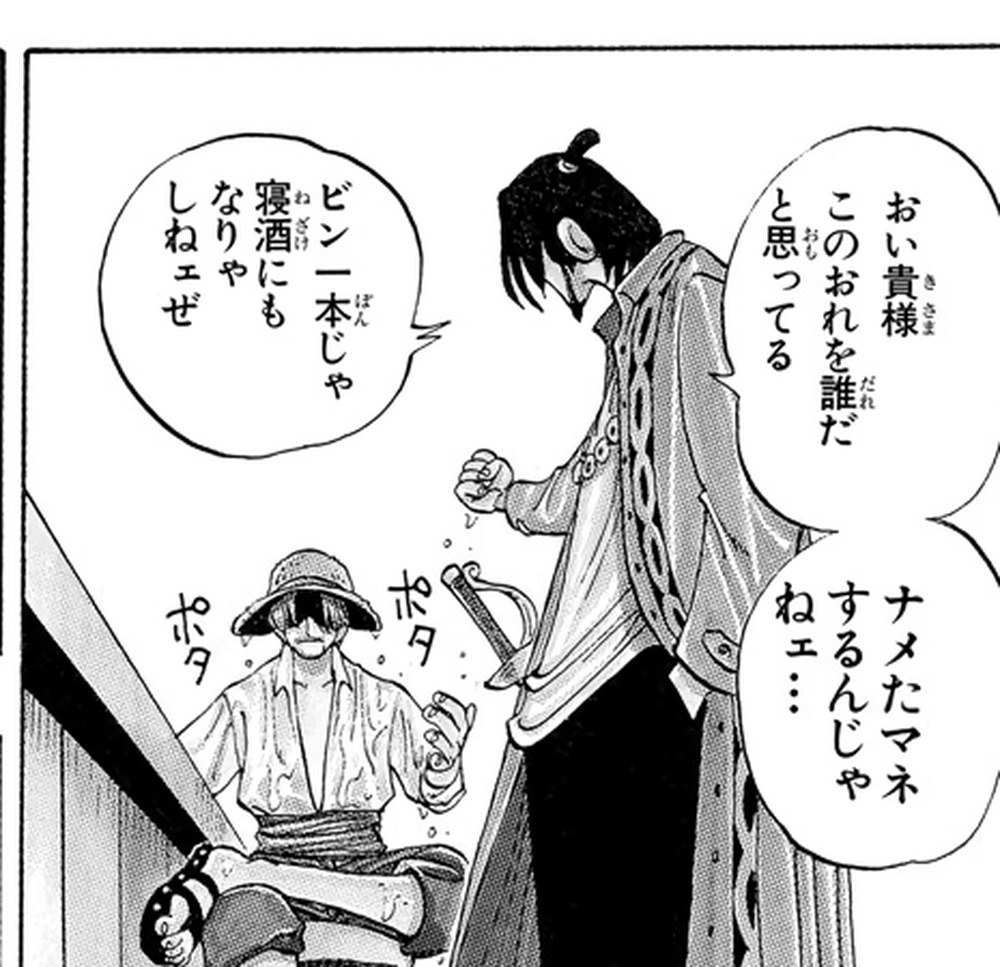
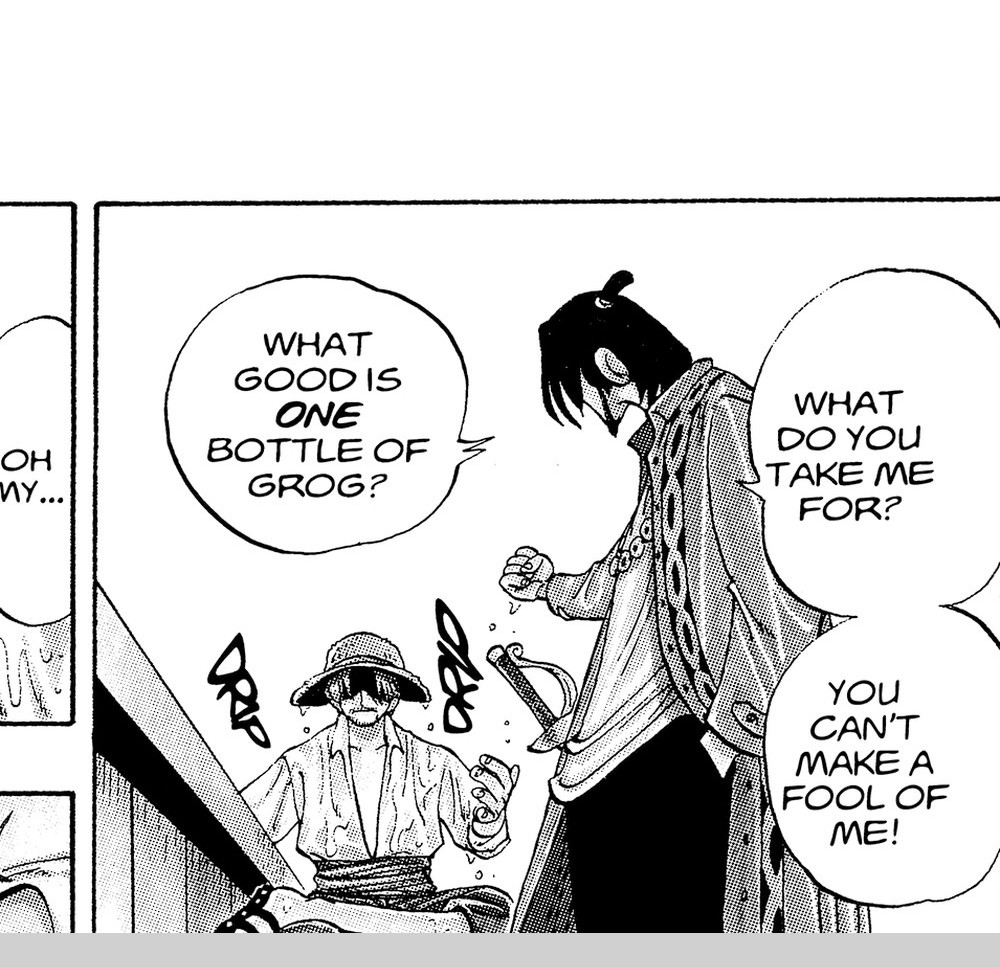
Two pages earlier, a caption sizes up the newcomers plainly: 「山賊棟梁ヒグマ」 — "HIGUMA THE BEAR LEADER OF THE MOUNTAIN BANDITS." He and his crew have already barged into a hillside tavern run by a young pirate captain, drunk it dry, and been told — apologetically, by the captain himself, mop in hand — that there's nothing left to sell. Higuma looms over him anyway:
「おい貴様このおれを誰だと思ってる」
Oi, kisama, kono ore o dare da to omotteru.
VIZ's English edition prints: "WHAT DO YOU TAKE ME FOR?" (Vol. 1, p.20.)
Grant the rendering its due: it's punchy, natural, playground-ready English — exactly the line a small-time thug barks in a bar he thinks he owns. No complaint about the tone.
But sit with what's actually happening here for a second. This is chapter one. Before Luffy has eaten a Devil Fruit, before a single named villain, before the reader has learned a word of this world's vocabulary, Eiichiro Oda reaches for 貴様 (kisama) to establish "this is how a One Piece tough guy talks." It is — by page count — the earliest of the roughly 181 times the word appears across the volumes in our corpus. Whatever 貴様 is doing here, it is doing it as the series' founding gesture of menace. And the man saying it is literally named after a brown bear — ヒグマ (higuma) is the ordinary Japanese word for the species. He is not using an honorific. Except, etymologically, he absolutely is.
The Original
Take the two characters apart, because the joke is entirely in the kanji.
貴 (ki) means "noble, precious, esteemed" — the same 貴 in 貴族 (kizoku, "nobility"), 貴重 (kichō, "precious, valuable"), and 貴社 (kisha, "your esteemed company," standard business-letter vocabulary to this day).
様 (sama) is the highest-register honorific suffix Japanese owns — the one that turns a customer into お客様, a respectful address to an audience into 皆様, and a deity into 神様.
Put them together and 貴様 parses, character for character, as something like "your noble self" or "your esteemed lordship." That is not folk etymology; that is what the kanji say, plainly, to any reader who stops to look at them — which is exactly what almost nobody does, because by the time you're old enough to read manga, 貴様 has already finished its journey. It's commonly traced back to genuinely respectful address in earlier centuries of Japanese — a register cousin of 貴殿 (kiden), still in polite use today in letters and period drama. Somewhere between then and now, 貴様 wore all the way down. Say an elevated word to someone often enough, at close enough range, without enough sincerity, and eventually the elevation itself starts to sound like sarcasm — that's more or less the physics of it. By the modern era 貴様 had landed at the opposite end of the register scale entirely: a blunt, confrontational "you," used almost exclusively toward rivals and enemies, overwhelmingly by male speakers, and disproportionately by manga villains and tough guys picking a fight. It slots easily into the roughest available grammar and can even stand alone, with no verb at all, as a pure interjection of rage — 貴様!! — which is exactly what happens twice in the table below.
貴様 didn't do this alone. Japanese pronoun history is full of the same downhill slide. お前 (omae) started as 御前, "before the honorable presence" — still used with reverence toward Buddhist and Shinto figures in fixed phrases — and today ranges from friendly-among-close-friends to flatly rude, depending entirely on who's speaking to whom. てめえ (temee) started as 手前, a humble first-person "the one before your esteemed hands" — i.e., "your humble servant" — and became a slur the moment someone pointed that self-effacement at the person they were yelling at instead of themselves. You'll meet the plural of exactly this word elsewhere in this corpus: Usopp opens a death threat with てめェら in our sister piece on 往生しろ. 貴様 belongs to that family tree. It just wore nicer clothes at the root.
None of this is on a JLPT vocabulary list — pronoun register is sociolinguistics, not grammar, and tests don't examine it directly — but functionally it sits at N2–N1: the kind of fluency where a learner stops translating words and starts hearing who is allowed to say what to whom.
VIZ's Choice
貴様 appears roughly 181 times in the One Piece volumes we have on file — far too many to table in full, and that isn't really the point anyway. What matters is the range. Below are five occurrences chosen to span wildly different speakers and situations — not an exhaustive list, a representative sample, each one verified against the official VIZ page art:
| Vol. / p. | Speaker → Addressee | Japanese | VIZ English |
|---|---|---|---|
| 1 / 20 | Higuma, mountain bandit → Shanks | おい貴様このおれを誰だと思ってる | WHAT DO YOU TAKE ME FOR? |
| 6 / 157 | Dracule Mihawk → Luffy | 小僧貴様は何を目指す | LAD, WHAT IS YOUR GOAL? |
| 10 / 12 | one of Arlong's fish-men → Luffy | 貴様 | HUMAN SCUM! |
| 17 / 68 | King Wapol → Chopper | 3分!?ちがかかった!!!3分どころか貴様ごときがおれに勝てるか!!! | THREE MINUTES!? WA HA HA HA!! AS IF YOU COULD DEFEAT ME!!! |
| 22 / 11 | Pell, royal guard → Mr. 1 | おのれ貴様ァ!!! | YOU FIEND !!! |
(One housekeeping note on that last row: the Alabasta-arc chapters carry extra pages in the Japanese tankōbon that don't exist in the same place in the English collection, so VIZ's page numbers drift out of lockstep with the Japanese ones by this point in the series — the panel above sits on Japanese p.11 and English p.16 of the same volume. We checked the actual VIZ page art directly rather than trust the page number alone, and the line lines up exactly as tabled.)
Five wildly different people say this word — a common thug, an aristocratic swordsman treated with narrative reverence, a member of a species that considers humans vermin, an actual reigning monarch, and a loyal knight defending his mentor's life — and VIZ answers with five different solutions, only three of which even keep the bare word "you" on the page. "Human scum" throws the pronoun away entirely and substitutes a slur about species. "Lad" throws the pronoun away and substitutes an address term that, interestingly, is the one rendering here that gestures at the status difference 貴様 sometimes carries — Mihawk is condescending, not merely furious. "Fiend" keeps "you" but bolts on a noun the Japanese never supplied (おのれ貴様 is two rude pronouns stacked for emphasis, not a pronoun-plus-epithet). And Wapol's boast keeps "you" the plainest of all five — even though his Japanese specifically says 貴様ごとき, "someone as lowly as you," a diminutive tacked onto an already-hostile pronoun; the contempt-within-contempt collapses into a bare pronoun, rescued only by the surrounding exclamation marks.
That last point is the real finding. It isn't only that 貴様 scatters into five different English outputs — 因縁 does that too, in our sister piece. It's that the scatter runs both directions: the same word lands differently depending on the scene, and different words (貴様, てめえ, おのれ, お前) can just as easily land on the identical output. English isn't failing to translate 貴様 badly; English is structurally incapable of giving 貴様 a stable address, because it has nothing built into "you" itself for hostility, formality, or status to attach to. Every fix has to be improvised fresh, panel by panel, by whichever epithet fits the artwork.
The Gap
The whole pronoun system funnels through one word. Japanese distributes the job "you" across a real paradigm: 貴様 and てめえ (hostile, blunt), おのれ (archaic-reflexive turned snarl), お前 (rough-to-neutral depending on company), 君 (kimi, warm or condescending depending on age gap), あなた (anata, textbook-neutral, faintly distant in real speech). Each carries its own coordinates of formality, hostility, gender, and era. English has one lever for all of it — "you" — with no dial. A reader of the Japanese instantly clocks the difference between an enemy spitting 貴様 and an enemy grunting お前; a reader of the English cannot, because both arrive as the identical word.
The compensation is real but untraceable. Translators aren't asleep at the wheel — "HUMAN SCUM," "FIEND," "LAD" all correctly import some hostility or distance into the English line. But none of it is tied to 貴様 specifically. The same epithets could just as easily have been reached for to translate てめえ or おのれ in a different panel, and in this very corpus, plenty of 貴様 lines get nothing added at all — just a bare "you." A learner who wants to build an ear for 貴様, the way they might learn to recognize -san or -chan from context, has no equivalent foothold in the English text. The word never leaves a consistent fingerprint.
The kanji joke disappears structurally, not just lexically. Every time a Japanese reader meets 貴様 hurled as an insult, there is a small, mostly unconscious irony sitting underneath it: a word for "your esteemed lordship" being used to threaten someone. "You," "fiend," "scum," and "lad" were never elevated in English, so none of them can be ironically degraded — the joke has no floor to fall from. It isn't that the translation loses the joke through carelessness; the joke requires machinery — an honorific system with a visible history of decay — that the target language doesn't own.
What If
For Higuma's line specifically, the menu and its prices:
- "Hey, YOU — who do you think you're talking to?" — capitalizing YOU is the closest English typography gets to marking a pronoun as loaded. Cost: the emphasis lives in the type treatment, not the word choice, and vanishes the moment someone reads the line aloud.
- "You've got some nerve. Know who I am?" — natural, energetic bar-fight English. Cost: 貴様 disappears into idiom entirely; nothing in the sentence marks that a specific, escalating pronoun was chosen over the neutral alternative.
- "Watch your mouth, boy — do you know who you're addressing?" — "boy" borrows some of the status-conscious condescension that "LAD" captures for Mihawk elsewhere in this piece. Cost: invents a status gap between Higuma and Shanks that the Japanese doesn't actually assert.
- Keep VIZ's "WHAT DO YOU TAKE ME FOR?" — Cost: it's the honest answer. No English sentence carries 貴様's register on its own; the loss has to be explained in prose, which is the entire purpose of an article like this one.
Take-away
貴様 is not hard to translate because it's rare — it's everywhere, roughly 181 times over in this series alone. It's hard because English built its pronoun system without a formality-and-hostility dial, and Japanese built its pronoun system with almost nothing but one. When a translation gives you "lad" here and "human scum" there for the identical word, the pattern is real; English just has to reinvent it from scratch every single time.
Three rules of thumb to carry off this page:
- When "you" feels flat in an English translation, ask what Japanese pronoun might be underneath it. 貴様, てめえ, お前, 君, and あなた are not stylistic synonyms — they are close to six different relationships compressed into "you," and a translator has already made an invisible decision on your behalf.
- Watch for the honorific-to-insult pattern elsewhere. 貴様 (from "esteemed self"), お前 (from "before the honorable presence"), and てめえ (from "your humble servant, addressed at you") are not exceptions — pejoration is closer to the default fate of any Japanese address term used often enough. The pattern also runs in reverse: 拙者 (sessha, "this humble one"), the archaic first-person pronoun samurai and ninja characters use — most famously in Naruto — has stayed humble instead of turning hostile, because nobody weaponizes self-effacement the way they weaponize a pointed "you." And elsewhere in Japanese status-vocabulary, 無礼者 (bureimono, "rude, insolent person") takes a third approach entirely — instead of loading hostility into a pronoun, it names the accusation outright as a noun, "you discourteous person," a blunter cousin of 貴様's disguised insult.
- A bare pronoun can be the whole sentence. 貴様! needs no verb, no object, nothing — the word alone is a complete threat. English "YOU!" can almost do this, but only with punctuation and panel context doing the work that the Japanese word does by itself.
For the other hostile pronoun already hiding in this corpus — てめェ, thrown by Usopp at the enemies he's about to threaten with a Buddhist death sentence — see the tombstone pun VIZ built out of 往生しろ. For the word-scatter pattern this article shares with a very different vocabulary item, see 因縁 and the five ways VIZ split one karmic tie. And for more places where a single Japanese word carries more social information than English can hold, browse the One Piece translation notes index.
Every Japanese and English line quoted above is a byte-exact capture from the cited editions — ONE PIECE Vol. 1–22 (Japanese) and One Piece (VIZ Media) at the corresponding panels — via our bilingual page database; see Sources below.