The Moment
Chapter 5. Shells Town's marine base has just watched its own commanding officer's authority crumble in front of everyone: Luffy, freshly escaped, has smashed his way through the garrison to reclaim Zoro's stolen swords, and the base's own soldiers are starting to wonder whether Captain Morgan — the man who governs this town by fear, a jut-jawed martial-law tyrant obsessed with his own greatness — is still worth serving. Morgan has just watched Luffy, Zoro, and the young marine recruit Coby humiliate his men, and demanded the three of them be executed on the spot for what he calls 反逆 ("rebellion") — his word for children who wouldn't bow. Now he turns on Zoro directly, still tied to the execution stake, and reaches for two different weapons in the same breath. First the fancier one:
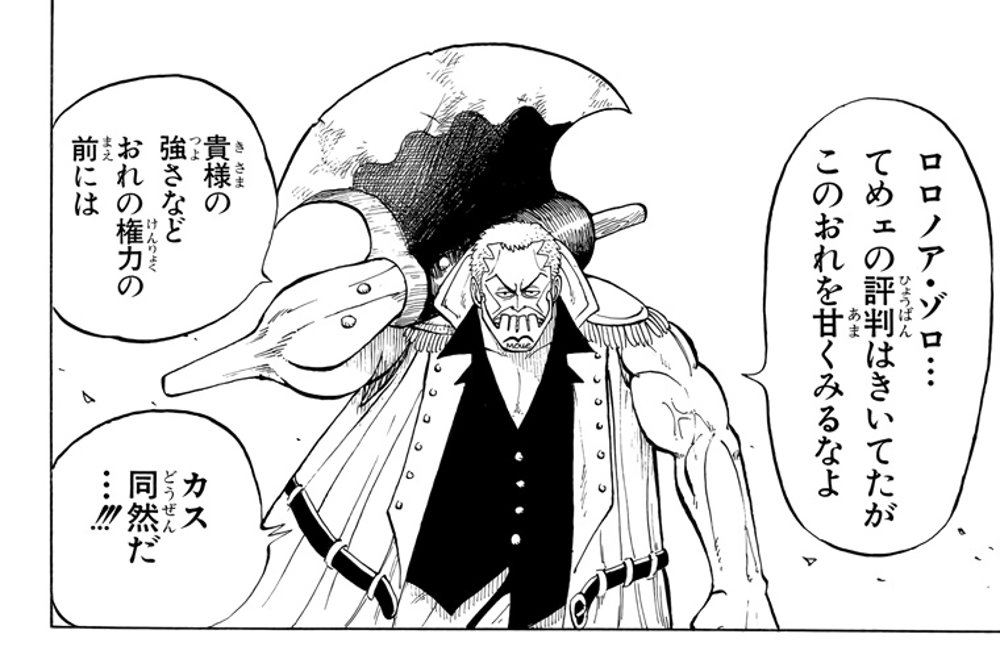
「貴様の強さなどおれの権力の前には…カス同然だ...!!」
Kisama no tsuyosa nado ore no kenryoku no mae ni wa… kasu dōzen da…!!
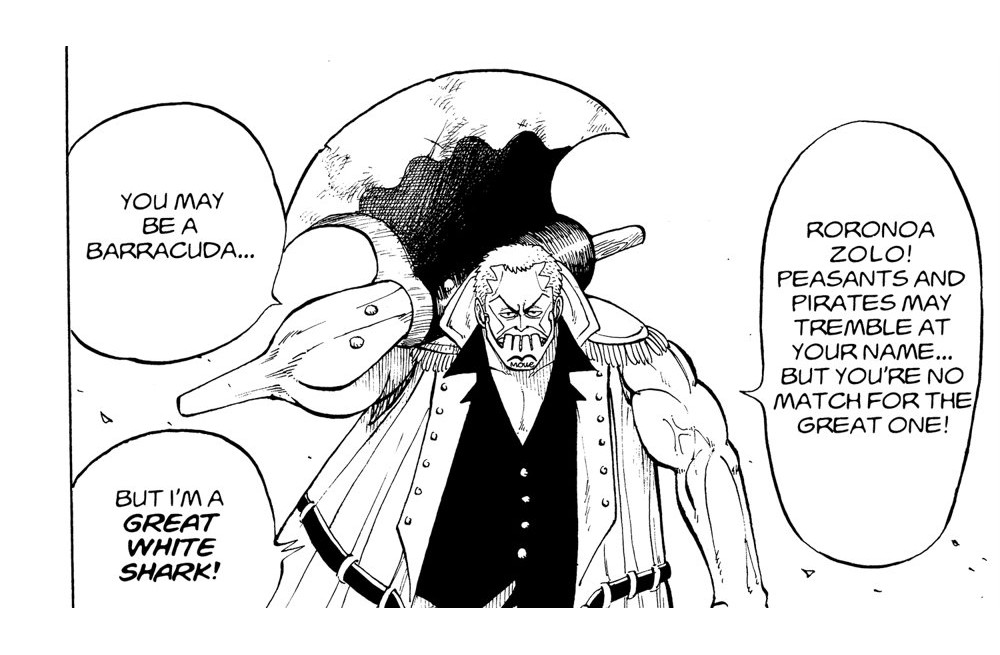
VIZ: "YOU MAY BE A BARRACUDA... BUT I'M A GREAT WHITE SHARK!" — a whole invented shark metaphor standing in for a much plainer boast: your strength is nothing next to my authority… practically garbage. Then, one breath later, the cruder word:
「ロロノア・ゾロ...てめェの評判はきいてたが、このおれを甘くみるなよ」
Roronoa Zoro… temē no hyōban wa kiiteta ga, kono ore o amaku miru na yo.
VIZ's English edition prints: "RORONOA ZOLO! PEASANTS AND PIRATES MAY TREMBLE AT YOUR NAME... BUT YOU'RE NO MATCH FOR THE GREAT ONE!" (Vol. 1, p.132.)
Grant the rendering its due: "the Great One" is a nice touch for a character whose entire arc is megalomania about his own rank, and the line lands with real menace. But notice what happened to the two Japanese pronouns in the crossing. 貴様 — the fancier, more theatrical insult — was translated as nothing: no pronoun survives in "YOU MAY BE A BARRACUDA... BUT I'M A GREAT WHITE SHARK!" at all, only an invented animal metaphor. てめェ — the cruder, blunter word — got the only "you" in the whole exchange. A reader of the Japanese hears Morgan escalate, mid-speech, from an elevated insult to a guttural one; a reader of the English can't hear that escalation at all, because the fancier word vanished and the plainer one kept the sentence's only pronoun.
The Original
Take てめェ apart, and there's irony in the spelling before you even reach the meaning: as printed, it has no kanji at all. The small katakana ェ is manga orthography for a clipped, growled vowel — the same trick this corpus's companion piece on 貴様 flags in てめェら, the plural form. But trace the word back one step and the kanji original is perfectly legible: 手前 (temae) — 手 (te), "hand," plus 前 (mae), "front, before." Literally, the space before one's hands.
That spatial sense is still alive in ordinary Japanese today: 駅の手前 (eki no temae, "just before the station"), and famously in 手前味噌 (temae-miso, "one's own homemade miso") — the idiom for tooting your own horn, because bragging about your own miso is exactly the kind of thing you're not supposed to do out loud.
From that spatial "the space before me" sense grew a genuinely humble first-person pronoun: 手前ども (temae-domo), "we, your humble servants," the kind of self-reference a shopkeeper or tradesman still uses today, especially in rakugo and period drama — this modest one, standing here before you. てめェ is what happened when a speaker took that same humility and, instead of aiming it at themselves, aimed it outward: not "this humble self before you," but "you, right there, within reach of my hands" — spoken with maximum contempt. The vowel coarsened along the way, temae to temē, and the politeness didn't survive the trip.
Compare that journey to お前 (omae), 貴様's rougher cousin covered in this corpus's companion article: お前 began as 御前, "before the honorable presence," an honorific pointed AT the listener from the start, which degraded the ordinary way — overuse wearing the respect off. てめェ took the harder road: it began as a term for the SPEAKER, not the listener, and had to be redirected before it could insult anyone. Two completely different roads — one an eroded compliment, the other a hijacked apology — arriving at the identical destination: the crudest "you" the language owns.
Grammatically, the headline sentence is unremarkable: てめェ takes a possessive の exactly the way any polite pronoun would (てめェの評判, "your reputation"), and sits opposite このおれ, "THIS me" — an emphatic, swaggering self-reference that mirrors てめェ's contempt with an equal and opposite arrogance. Pronoun register doesn't appear on JLPT vocabulary lists — this is sociolinguistics, not grammar — but functionally, reliably parsing てめェ as one notch below 貴様, rather than as a rough synonym for it, is N2–N1-level fluency: the point where a learner stops just recognizing rude words and starts hearing exactly how rude.
VIZ's Choice
てめェ (and its plural, てめェら) appears roughly 578 times in the One Piece volumes we have on file — far too many to table, and the count itself is the finding: this is not a rare word reaching for a rare solution, it is the default snarl of the entire cast. Below are six occurrences chosen to span wildly different speakers, relationships, and stakes — not an exhaustive list, a representative sample, each one verified against the official VIZ page art:
| Vol. / p. | Speaker → Addressee | Japanese | VIZ English |
|---|---|---|---|
| 1 / 132 | Captain Morgan → Roronoa Zoro | ロロノア・ゾロ...てめェの評判はきいてたが、このおれを甘くみるなよ | RORONOA ZOLO! PEASANTS AND PIRATES MAY TREMBLE AT YOUR NAME... BUT YOU'RE NO MATCH FOR THE GREAT ONE! |
| 1 / 131 | Captain Morgan → Luffy, Zoro & Coby (plural) | てめェら三人でクーデターでも起こそうってのか? | YOU'RE TRYING TO OVERTHROW ME!! |
| 1 / 111 | Zoro → Luffy | たち悪ィそてめェ!! | YOU LITTLE RAT! |
| 5 / 179 | Zeff → Luffy | てめェのせいだい!小僧!! | THAT'S YOUR FAULT, BRAT!! |
| 7 / 126 | Don Krieg → Gin | ギンてめェ!! | GIN, YOU SWINE !! |
| 22 / 154 | Crocodile → King Cobra | クハハハてめェは犬死さコブラ!! | HA HA... YOU WILL DIE LIKE A DOG, COBRA!! |
(One housekeeping note on the last row: the Alabasta-arc chapters carry extra pages in the Japanese tankōbon that don't exist in the same place in the English collection, so VIZ's page numbers drift out of lockstep with the Japanese ones by this point in the series — the panel above sits on Japanese p.154 and English p.159 of the same volume. We checked the actual VIZ page art directly rather than trust the page number alone, and the line lines up exactly as tabled.)
Six rows, five distinct speaker identities — Morgan appears twice, singular then plural, one page apart — and the results scatter exactly the way 貴様 scatters in this corpus's companion piece, but across an even wider social range. Notice who's using this word: not just criminals. Captain Morgan is a Marine officer, law and government incarnate in Shells Town, and he reaches for the identical crude pronoun a pirate captain does two rows down. てめェ doesn't respect the line between outlaw and authority; it only tracks who currently feels entitled to intimidate whom. Zoro — the story's hero — uses it on Luffy in the middle of an ordinary conversation, no violence involved, just genuine annoyance at a dirty trick. Zeff scolds a clumsy teenager with it, half a parent's exasperation and half a threat. Only Krieg and Crocodile use it the way a phrasebook would predict: pure, murderous contempt.
And VIZ answers with a different animal, insult, or nothing at all every time: "rat," "brat," "swine," "dog," a bare "you" wrapped in an invented boast about "the Great One," and — in the plural row — no pronoun at all, just "YOU'RE TRYING TO OVERTHROW ME!!" with the crude group address dissolved entirely into the verb. None of these choices is wrong on its own page. But stack them and no throughline survives: a Japanese reader hears the exact same word tighten Morgan's menace, sour Zoro's irritation, and detonate Krieg's rage, and recognizes it every time. An English reader meets five or six unrelated words and has no way to know they were ever the same pronoun.
The Gap
The whole cluster funnels through one word — and so does the escalation inside a single speech. Morgan proves it by using both hostile pronouns back-to-back: 貴様 for the grandiose boast, てめェ for the direct, personal jab. A Japanese reader feels the register tighten mid-monologue — the villain getting more dangerous as he gets more specific. English cannot tighten "you." Worse, in this exact case, VIZ's chosen fixes run backwards: 貴様, the fancier insult, disappears into an invented shark metaphor with no pronoun at all, while てめェ, the crude one, keeps the only "you" in the passage — so if anything, the English suggests the opposite escalation from the one Oda wrote.
The irony has two different engines, and neither survives. 貴様 degrades from honor — "your esteemed self" worn down into an insult. てめえ degrades from humility pointed the wrong direction — "your humble servant" aimed outward instead of inward. English "you" was never elevated and never lowered, so it can't carry either joke, and because these are opposite mechanisms landing on the same word, the loss isn't one missing nuance — it's two, cancelling into silence.
The plural erases the crowd. てめェら, aimed at Luffy, Zoro, and Coby together on p.131, marks a specific kind of menace: all of you, together, are my enemies now. VIZ's "YOU'RE TRYING TO OVERTHROW ME!!" keeps the accusation but drops the pronoun that made it collective and personal at once — the English sentence could just as easily be aimed at one person, or at an abstract "they."
Status inversion goes quiet. When Crocodile calls a reigning king てめェ, the crudeness is doing real work: a supposed subject openly refusing every honorific a king would be owed. VIZ's "YOU WILL DIE LIKE A DOG, COBRA!!" delivers the menace through the dog simile and the bare name, not through the pronoun — which means the specific insult of addressing royalty like gutter trash has to be inferred from context rather than heard in the word itself.
What If
For Morgan's line specifically, the menu and its prices:
- "Roronoa Zolo... I've heard the talk about you. Don't get cocky." — keeps the blunt threat shape and drops VIZ's invented "Great One" bravado. Cost: loses the quotable swagger, even though that swagger isn't in the Japanese.
- "Zolo — heard your name plenty. Don't think you're better than me." — plain, natural bar-fight English; keeps てめェ's contempt readable in tone rather than word choice. Cost: "me" undersells このおれ's boastful "THIS me" emphasis.
- "Zolo. Big reputation. Doesn't scare ME." — clipped, tough-guy fragments mimic てめェ's bluntness better than a full sentence does. Cost: drops the two-clause, warning-then-threat shape of the original.
- Keep VIZ's "BUT YOU'RE NO MATCH FOR THE GREAT ONE!" — Cost: "the Great One" is manufactured swagger with no Japanese behind it, and "you're" carries none of てめェ's specific crudeness — any English pronoun would fit the sentence exactly as well.
Every option pays a different price, but notice what none of them can do: mark, inside the word itself, that this is the second, cruder pronoun Morgan has reached for in the same breath. That distinction has nowhere to live in English except in the surrounding prose — which is the entire purpose of an article like this one.
Take-away
てめェ is not hard to translate because it's obscure — with roughly 578 appearances in this corpus alone, it's one of the most common words in the book. It's hard because it arrived at the bottom of Japanese's pronoun ladder by the opposite route English speakers would guess: not an insult that stayed an insult, but an apology that got pointed at someone else and never recovered.
Three rules of thumb to carry off this page:
- When "you" feels flat, ask which of the six pronouns is underneath — and whether the speaker is escalating between two of them in the same breath, the way Morgan does with 貴様 then てめェ. That escalation is information the English has already thrown away by the time you're reading it.
- Watch pejoration run in both directions. 貴様 and お前 wear down FROM honor; てめえ wears down from HUMILITY pointed the wrong way. Same destination, opposite roads — and collecting examples of both is the fastest way to actually feel the difference between them.
- てめェら is not just "you guys." It's the crude singular plus a real plural marker, aimed at a group the speaker has decided to treat as one collective threat.
For 貴様, てめェ's fancier, more theatrical cousin — and its own five-scene sample, spanning a bandit to a king — see the pronoun system English flattens into "you". For a death threat built entirely around this word's plural form, see the tombstone pun VIZ built out of 往生しろ. And for more places where a single Japanese word carries more social information than English can hold, browse the One Piece translation notes index.
Every Japanese and English line quoted above is a byte-exact capture from the cited editions — ONE PIECE Vol. 1–22 (Japanese) and One Piece (VIZ Media) at the corresponding panels — via our bilingual page database; see Sources below.