Usopp is the Straw Hats' sniper — a village boy who can't stop lying about himself while telling the truth about everything else. His Japanese runs on grandiose self-titling ("I am Usopp, ruler of this village, leading a great pirate crew!!"), invented weapon names in battle-cry grammar, and a masked alter-ego, そげキング (Sogeking), whose formal 私 replaces his usual おれ. Underneath the boasting sits a real pattern: fear stated plainly, then a vow to act anyway. This page collects nine signature lines — his Syrup Village debut, a pun nickname VIZ couldn't keep, a Buddhist death threat, his duel over the Going Merry, and the Sogeking reveal — verified against the tankōbon and paired with VIZ's official English.
Usopp's quotes — Japanese vs official English
おれはこの村に君臨する大海賊団を率いるウソップ!!!
Ore wa kono mura ni kunrin suru dai-kaizokudan o hikiiru Usoppu!!!
“I AM THE NOTORIOUS CAPTAIN USOPP!!!”
Literally: I am Usopp, who reigns over this village, leading a great pirate crew!!!
Vol. 3, p.130 — Confronting the newly landed Straw Hats on the beach — his invented rank announced before anyone's even asked his name
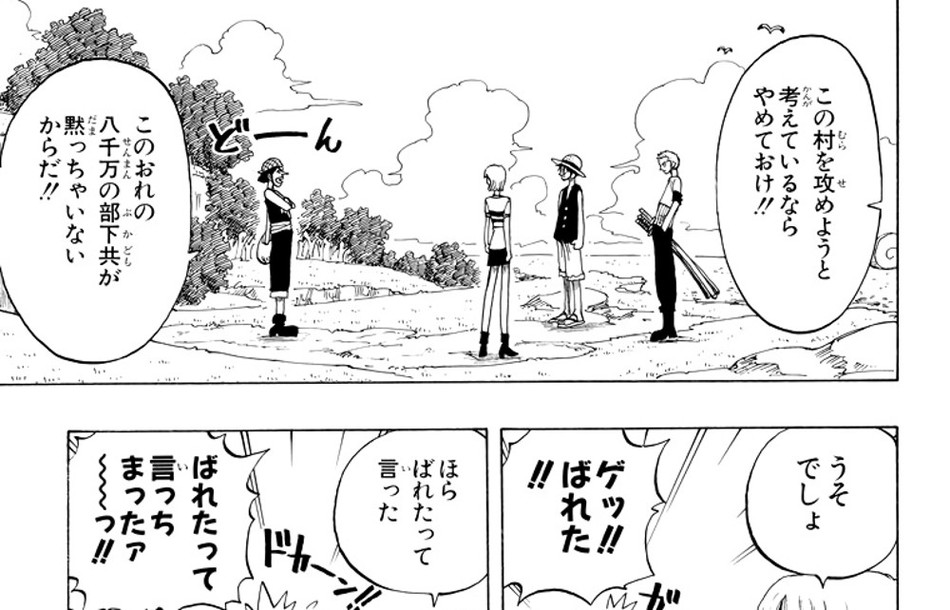
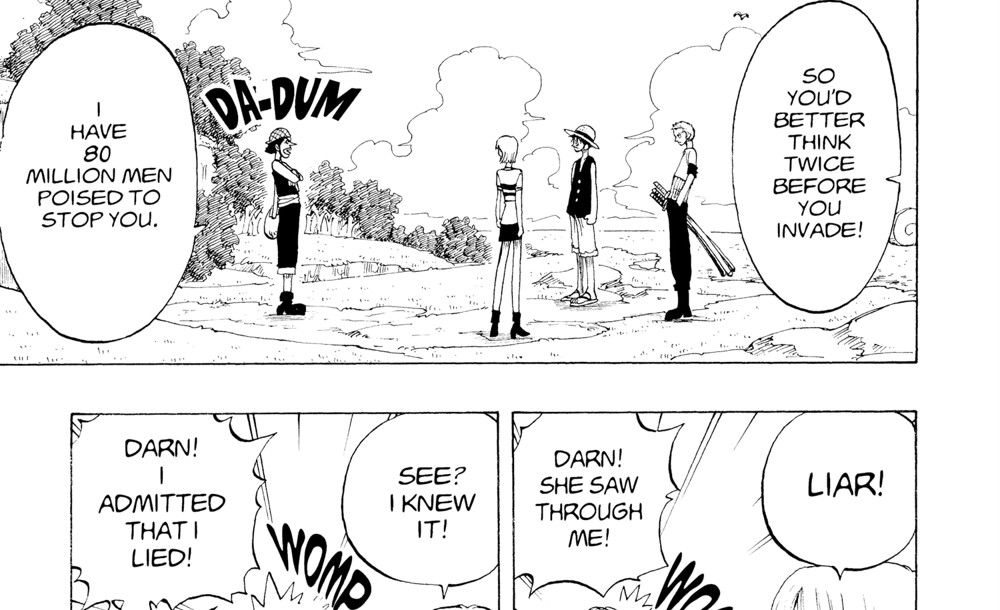
このおれの八千万の部下共が黙っちゃいないからだ!!
Kono ore no hassenman no buka-domo ga damacchainai kara da!!
“I HAVE 80 MILLION MEN POISED TO STOP YOU.”
Literally: Because these 80 million subordinates of mine won't stay quiet!!
Vol. 3, p.131 — Warning the Straw Hats not to invade the village — the boast that collapses one panel later under Nami's single-word うそでしょ, "LIAR!"
おれは誇り高き男なんだ!!!その誇りの高さゆえ人がおれを“ホコリのウソップ”と呼ぶ程にな!!
Ore wa hokori-takaki otoko nan da!!! Sono hokori no takasa yue hito ga ore o "Hokori no Usoppu" to yobu hodo ni na!!
“I'M A PROUD MAN! WHICH IS WHY THEY CALL ME "PROUD CAPTAIN USOPP"!”
Literally: I'm a man of high pride!!! So much so that people call me 'Hokori no Usoppu' — 誇り (pride) is a perfect homophone of 埃 (dust), spelled in katakana
Vol. 3, p.131 — Christening himself with the nickname he can't hear is a homophone joke at his own expense — see the site's hokori-usopp pitfall article
てめェらは少々やりすぎた...!!往生しろよ!!
Temēra wa shōshō yarisugita…!! Ōjō shiro yo!!
“YOU WENT TOO FAR!! NOW REST IN PIECES!!”
Literally: You lot went a little too far... meet your end, now! — 往生しろ is the bare imperative of the Buddhist verb for departing this life
Vol. 14, p.111 — Covering an unconscious Luffy at Little Garden — the rare beat where Usopp's fear is entirely on someone else's behalf
この船は確かに船長であるお前のもんだ...だからおれと戦え!!おれが勝ったらメリー号は貰って行く!!!
Kono fune wa tashika ni senchō de aru omae no mon da... Dakara ore to tatakae!! Ore ga kattara Merī-gō wa moratte iku!!!
“YOU'RE THE CAPTAIN, AND THIS SHIP BELONGS TO YOU... SO FIGHT ME FOR HER!! IF I WIN, I'M TAKING MERRY GO!”
Literally: This ship is certainly yours, the captain's... so fight me!! If I win, I'm taking the Merry Go with me!!!
Vol. 35, p.82 — Challenging Luffy to a duel over the Going Merry's fate — see the Luffy quotes page for his answering line from the same scene
これが!!おれの戦闘だ!!!ばかばかしいか!?大マジだぞルフィ...!!
Kore ga!! Ore no sentō da!!! Bakabakashii ka!? Daimaji da zo Rufi...!!
“THIS...IS HOW I FIGHT!! YOU THINK I'M FOOLING AROUND?! I'M DEADLY SERIOUS, LUFFY!”
Literally: This is!! My style of combat!!! Does it look stupid? I'm dead serious, Luffy...!!
Vol. 35, p.96 — Defending his trap-and-trick fighting style mid-duel against Luffy's brute strength — his weapons are jokes, his commitment to them isn't
“必殺”タバスコ星!!!
Hissatsu Tabasuko Boshi!!!
“DELUXE PEPPER SAUCE STAR!!!”
Literally: "Certain-kill" Tabasco Star!!! — 必殺 is the same battle-cry prefix shonen heroes use for their real signature attacks
Vol. 35, p.96 — One of his invented joke-weapon names mid-duel — the straight-faced hissatsu grammar is the whole gag
初めまして私は狙撃の王様"そげキング"だ!!
Hajimemashite, watashi wa sogeki no ōsama "Sogekingu" da!!
“IT'S A PLEASURE TO MEET YOU. I AM THE KING OF SNIPING, THE SNIPER KING!!”
Literally: How do you do — I am the King of Sniping, "Sogeking"!! — 初めまして and 私 (watashi) replace his usual おれ, a formal register for a mask he built himself
Vol. 39, p.53 — The Sogeking debut — introducing himself to a bound Robin as though they'd never met
おーい!!喜べ!!おれだそー!!
Ōi!! Yorokobe!! Ore da sō!!
“HEY!! REJOICE!! I'M BACK!!”
Literally: Hey!! Rejoice!! It's me!! — shouted between the huffs of exhaustion the page prints as their own line
Vol. 45, p.157 — Sprinting back to the crew after leaving over the Merry duel, breathless and in tears, still performing the confident-captain voice
All lines are byte-exact captures from a bilingual corpus of the Japanese tankōbon and the official VIZ Media edition.
Usopp's first-person pronoun is おれ, the standard rough-and-tumble "I" of shonen boyhood — the same pronoun Luffy and Zoro use — but he deploys it for a purpose neither of them shares: narrating himself in the third person from inside his own sentences. 人々はおれを称えさらに称え"わが船長"キャプテンウソップと呼ぶ!!! ("people praise me, praise me further, and call me 'my captain,' Captain Usopp!!!") isn't a boast about something he did; it's a boast about what people supposedly call him, cited as evidence of a reputation that exists nowhere but in the sentence itself. The grammar of his lies is always secondhand — 人が〜と呼ぶ ("people call me"), 称える ("they praise") — because a claim about your own reputation, unlike a claim about your own strength, can't be immediately punched in the face to disprove it. It takes exactly one word, Nami's うそでしょ ("LIAR!"), to collapse the whole architecture.
The boasting has a documented internal logic worth tracking across volumes: scale as proof. このおれの八千万の部下共が黙っちゃいないからだ!! ("my 80 million subordinates won't stand for it!!") and, decades later during the Enies Lobby arc, おれには!!!8千人の部下がいる!!! ("I have 8,000 subordinates!!!") — the numbers change, the sentence structure doesn't: cite an army nobody can see as the reason you should be afraid of me. It's the same move as ホコリのウソップ, the nickname he gives himself in the same breath as his debut boast — 誇り (hokori, "pride") and 埃 (hokori, "dust") are perfect homophones, and printing the nickname in katakana lets the page mock a boast its speaker can't hear being mocked (see this site's full breakdown of the pun VIZ swept for a "CAPTAIN"). Usopp's Japanese voice is built almost entirely out of unfalsifiable citations of his own greatness — which is what makes the moments the mask actually drops so loud.
The brave-coward pattern is real vocabulary, not just fan shorthand for his arc. It shows up structurally rather than in one quotable line: Usopp is consistently the character whose dialogue names the danger out loud — ヤベェな今のがたい?大量に飛んで来るぞ!! ("this is bad, are they going to fly in in large numbers?!") — one beat before he's the one standing in the impact zone. The clearest single performance of it is his return to the crew after the Merry duel: おーい!!喜べ!!おれだそー!! ("Hey!! Rejoice!! I'm back!!") — shouted between the huffs of ハァ...ハァ...that the page prints as its own dialogue line, a boy running toward people he isn't sure will take him back, doing the confident-captain voice with no breath left to support it. The bravado in his Japanese was never evidence that he wasn't scared; it was always the thing he says instead of admitting it, which is a more interesting translation problem than a plain 怖い ("I'm scared") would be, because English has to render swagger and exhaustion in the same breath VIZ gives him.
The そげキング (Sogeking) mask changes the pronoun, and that shift is the whole joke of the alter ego: 初めまして私は狙撃の王様"そげキング"だ!! ("It's a pleasure to meet you, I am the King of Sniping, 'Sogeking'!!") swaps おれ for 私 (watashi) and opens with 初めまして, the formal "nice to meet you" of a first introduction — impeccable manners bolted onto a home-made mask, introducing himself to a crewmate he's known for years as though they'd never met. It's the same self-mythologizing engine as the Syrup Village boast, just run through a more dignified register, because a superhero, unlike a village liar, has to sound like one.
VIZ's translators earn their keep on the invented vocabulary. His joke weapon names keep the 必殺 (hissatsu, "certain-kill") prefix that every shonen hero's real special attacks use — “必殺タバスコ星!!! ("hissatsu Tabasco Star!!!") rendered as "DELUXE PEPPER SAUCE STAR!!!" — and the gag only works if the reader recognizes the battle-cry grammar being wasted on a condiment; VIZ's "DELUXE" does real work standing in for a straight-faced hissatsu the joke needs kept straight. And where the site's 往生しろ pitfall tracks a rare moment Usopp sounds genuinely dangerous rather than funny — てめェらは少々やりすぎた...!!往生しろよ!!, the bare-imperative Buddhist death sentence VIZ turns into the tombstone pun "NOW REST IN PIECES!!" — the target of that line is enemies who've hurt an unconscious Luffy, which is the other half of the brave-coward equation: the fear is always about himself, the fury never is. For the scene from the other side of the same duel over the Going Merry, see the Luffy quotes page, where his おれとお前達との縁も、それで終わりだ!!! answers Usopp's だからおれと戦え!! line for line.