The Moment
Volume 3. Luffy, Zoro and Nami have just dropped anchor off a quiet village, and the reception committee is one long-nosed boy up on the bluff, announcing to the horizon that eighty million men stand ready to repel them. Nami needs exactly one word: 「うそでしょ」 — "LIAR!" The army evaporates on the spot. The boy yelps that he's been found out, then yelps that he just admitted he's been found out, and collapses into staged despair. Luffy roars 「はっはっ、はっはっはッはお前面白ェなーっ!!」 — "HA HA HA HA HA!! YOU'RE FUNNY!!" — which turns out to be the wrong thing to say. 「おいてめェおれをコケにするな!!」 — "HEY! ARE YOU LAUGHING AT ME!?" — and the boy draws himself up to his full, quivering height:
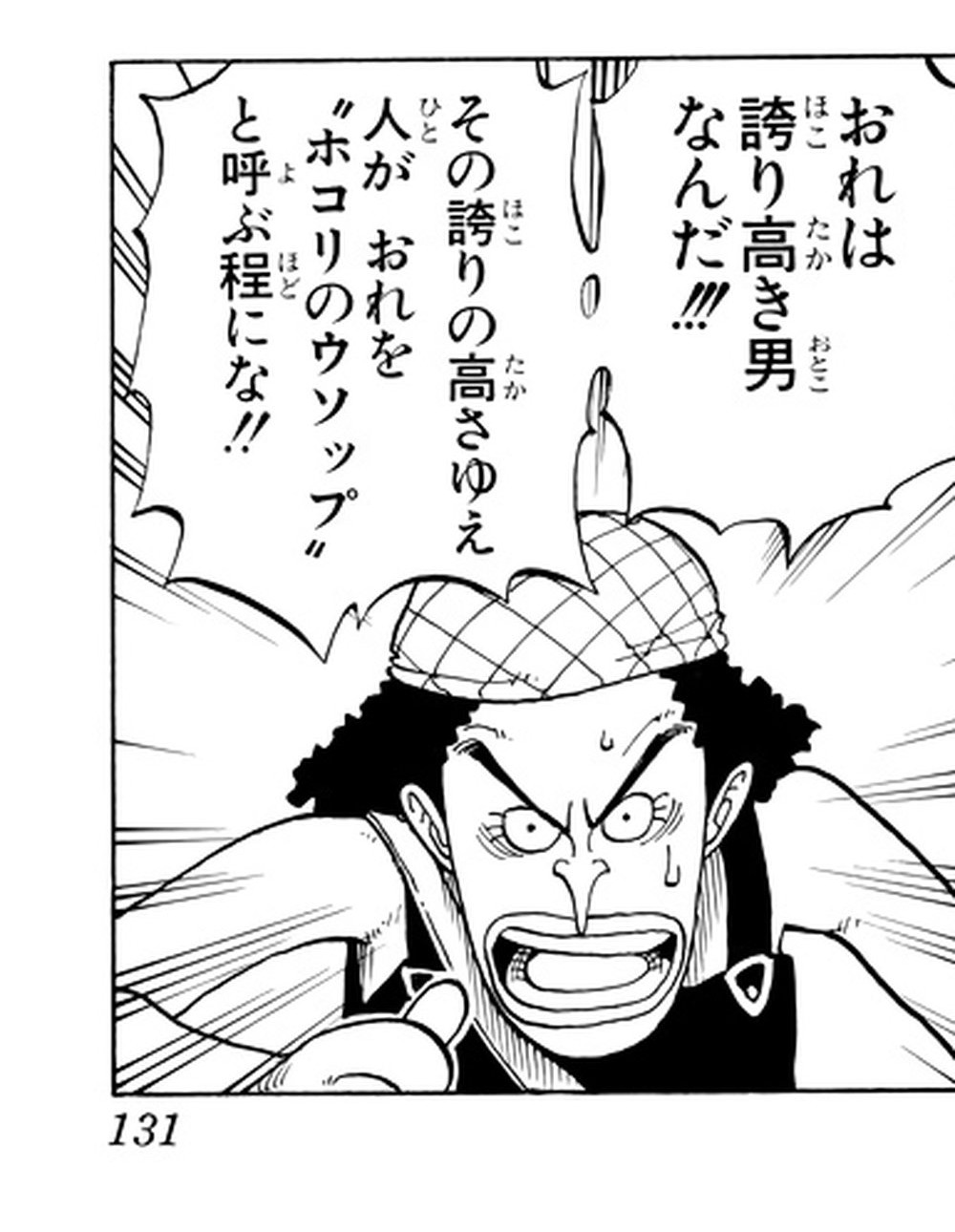
「おれは誇り高き男なんだ!!!その誇りの高さゆえ人がおれを“ホコリのウソップ”と呼ぶ程にな!!」
Ore wa hokori-takaki otoko nan da!!! Sono hokori no takasa yue hito ga ore o "Hokori no Usoppu" to yobu hodo ni na!!
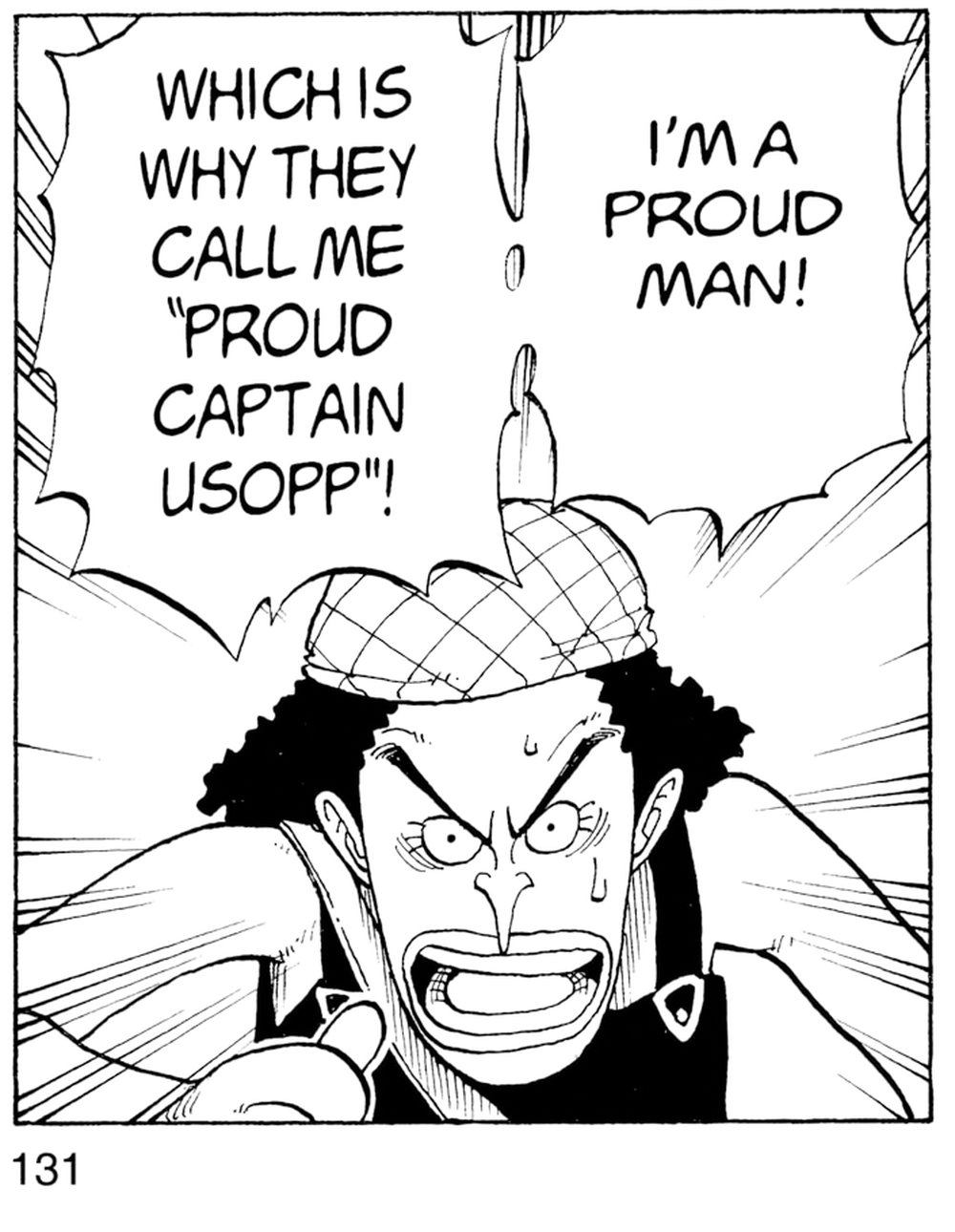
VIZ's English edition prints: "I'M A PROUD MAN!" — "WHICH IS WHY THEY CALL ME "PROUD CAPTAIN USOPP"!" (Vol. 3, p.131).
Grant the rendering its due. It's bouncy, it's boast-shaped, "they call me" keeps the liar's trick of citing the world as his own witness, and "CAPTAIN" — a rank found nowhere in this bubble — is exactly the kind of promotion Usopp habitually awards himself. As characterization, it sings. What it can't do is contain the joke, because the joke isn't in the words. It's in the spelling.
The Original
Say the line aloud and you hear hokori twice. Read it off the page and you see two different words.
The first is 誇り (hokori), "pride" — the noun of 誇る (hokoru, to boast, to take pride). Its kanji is honest about the family business: 誇 puts the speech radical 言 next to 夸, "to talk big." Pride, etymologically, as big talk. And Usopp gives it the full costume drama: 誇り高き男 uses 高き, the classical attributive of 高い — the き of storybook epithets like 気高き ("noble") and 名高き ("renowned") — and the connector ゆえ (故), a literary "by reason of." This is a boy narrating himself as a legend: a man of high pride, such that…
The second is 埃 (hokori), "dust" — the soft grey stuff on shelves, a perfect homophone of pride. And here Japanese orthography does something English orthography cannot. 埃 sits outside the Jōyō list of everyday kanji, so real-world print overwhelmingly writes dust in kana — on cleaning-product labels, in newspapers, in manga — as ホコリ. Katakana is dust's everyday written face.
Now watch the panel. First bubble: 誇り in kanji, furigana ほこ politely supplied. Second bubble: the nickname arrives as “ホコリのウソップ” — in katakana. The eye has just been shown the kanji, so the switch is deliberate and audible: spoken, the nickname is "Usopp the Proud"; spelled, it defaults to "Usopp the Dust." Usopp pronounces a medal and the page prints a mop. He can't hear the difference — that's what homophones are — and that is the whole engine: the mockery travels on a channel Usopp doesn't have access to, from author to reader, straight over the speaker's head.
There's a thousand-year pedigree here. Classical poetry built a formal device — 掛詞 (kakekotoba), the pivot word — on one sound carrying two words at once: 松 "pine" / 待つ "to wait," 秋 "autumn" / 飽き "weariness." Manga inherited the trick and added a tool the poets never had: three scripts, so the spelling itself can take sides.
And clock the grammar, because it's the anatomy of a proper tall tale: その誇りの高さゆえ…と呼ぶ程にな!! — "to such a degree (程) that people call me…" Inflate a virtue, then cite the world's reaction as evidence of scale. The nickname is fabricated corroboration — a second lie shoring up the first — and Oda has spelled the debunking directly into the fabrication. As vocabulary, 誇り is roughly JLPT N3 and 埃 roughly N2; the working mechanism — kana choice as a tone of voice — appears on no JLPT level at all.
VIZ's Choice
The nickname is not a one-panel gag. Oda liked it enough to make it canon: from Volume 8 on, the dramatis personae at the front of the Japanese volumes stamps it into Usopp's one-line bio, and it is still there deep into the thirties. Side by side:
| Vol. / p. | Japanese | VIZ English |
|---|---|---|
| 3 / 131 (scene) | その誇りの高さゆえ人がおれを“ホコリのウソップ”と呼ぶ程にな!! | WHICH IS WHY THEY CALL ME "PROUD CAPTAIN USOPP"! |
| 8 / 5 (character page) | 自称“ホコリのウソップ”。シャンクスの部下ヤソップを父に持つ。 | The newest addition to Luffy's crew, Usopp's known for his tall tales, but he has a way with a slingshot and a heart of gold. |
| 18 / 5 (character page) | 自称“ホコリのウソップ”。シャンクスの部下ヤソップを父に持つ。 | A village boy with a talent for telling tall tales. His father, Yasopp, is a member of Shanks's crew. |
| 27 / 6 (character page) | 自称“ホコリのウソップ”シャンクスの部下ヤソップを父に持つ。 | A village boy with a talent for telling tall tales. His father, Yasopp, is a member of Shanks's crew. |
(In our corpus window the epithet recurs on the character pages of Vols. 8, 9, 12, 18, 26, 27, 29, 32, 33, 34 and 35 — practically every volume that carries the feature. The English column for those rows is VIZ's entire replacement blurb: the epithet itself has no English rendering anywhere.)
Two different fates for one pun. In the scene: substitution. Pride is kept, dust is swept, and a "CAPTAIN" is imported to cover the swagger deficit. In the paratext: deletion. VIZ can hardly keep quoting a nickname it never coined, so every English character page swaps the lie for a description of lying — "known for his tall tales," "a talent for telling tall tales." Accurate, efficient, and joke-free.
And notice the sly extra word on the Japanese character pages: 自称 (jishō), "self-styled." In the scene, Usopp claims 人がおれを…と呼ぶ — people call him this. The dramatis personae, with one bureaucratic stamp, calls that claim what it is: nobody calls him this; he calls himself this. The author's own front matter is fact-checking his character's boast, volume after volume, for decades. That wink needs the nickname to exist — and in English it doesn't.
The Gap
The reader loses a joke Usopp never got. The pun is dramatic irony delivered through spelling: speech says pride, print says dust, and only the reader sees both. English can't split those channels — its spelling is its sound — so "PROUD CAPTAIN USOPP" collapses the two hokori into the one Usopp intended. The English reader stands with Usopp inside the boast; the Japanese reader stands with Oda outside it.
A mocking name becomes a flattering one. Read as dust, the nickname is the world's verdict on Usopp's pride: insubstantial grey fluff, one sneeze from gone. Read as VIZ prints it, the nickname is a salute. This is the scene where the reader first learns what kind of liar Usopp is — and the two editions file opposite reports: the Japanese page shows you what his pride is worth; the English page shows you what he thinks it's worth.
The tall tale loses its self-destruct. The line's structure — so proud that people call me… — is fabricated evidence, a second lie propping up the first, and the Japanese spelling detonates it mid-sentence: the "proof" of his pride literally reads as dust. In English the evidence merely inflates further (a CAPTAIN appears from nowhere). The boast survives its own punchline.
A thirty-volume running gag flattens into a character note. 自称“ホコリのウソップ” on page 5 of volume after volume is Oda re-telling the joke to returning readers like a handshake. VIZ's character pages tell you Usopp tells tall tales; the Japanese ones show you one — twelve characters long, with the debunking spelled in.
What If
No rendering gets this for free; here is the menu and the prices.
- "SO PROUD THEY CALL ME 'USOPP THE PROUD'! ...PRETTY SURE THEY'RE SAYING 'PROUD.'" — rebuilds a self-own inside the bubble by letting doubt flicker. Cost: makes Usopp half-aware of the mockery; the original needs him serenely oblivious.
- "MY PRIDE LEAVES 'EM ALL IN THE DUST!! THAT'S WHY THEY CALL ME 'DUSTY USOPP'!!" — keeps pride, keeps dust, and builds a boast-shaped bridge between them. Cost: invents logic the Japanese never states; a silent spelling-joke becomes an explained one.
- "THEY CALL ME 'PROUD USOPP THE DUST-DEVIL'!!" — smuggles dust back in as bravado (a dust devil at least moves fast). Cost: dust turns from verdict into decoration; the insult softens into flair.
- Keep "PROUD CAPTAIN USOPP" and footnote the pun (hokori: "pride" — also "dust"). — the only route that preserves the actual mechanism. Cost: VIZ's early volumes barely footnote, and a pun explained in the gutter is a pun that died in the bubble.
The impossible part isn't vocabulary — English owns "pride" and "dust" outright. It's that English spelling can't quietly disagree with English speech. This pun lives in the gap between a language's ears and its eyes, and English doesn't have one.
Take-away
Three rules of thumb to carry off this page:
- Kana choice is a tone of voice. When a word that owns a perfectly good kanji suddenly shows up in katakana — especially right after the kanji version — the spelling is talking to you. Ask what it's saying: it's usually the joke, the sneer, or the alarm.
- Homophones are load-bearing. From classical 掛詞 (松/待つ, 秋/飽き) to schoolyard ダジャレ, Japanese comedy routinely hangs real weight on identical sounds. Collect pairs like 誇り/埃 — manga will play them silently, via script, without ever flagging that a pun occurred.
- Read the paratext. Japanese volumes hide jokes in their furniture: a dramatis personae that stamps 自称 ("self-styled") on a character's own nickname is characterization you will never meet inside the chapters. Compare front matter across editions when you can — it's where translation quietly triages.
For Usopp's other collision with the English shelf — the Buddhist death-threat VIZ turned into a tombstone pun — see 往生しろ and "rest in pieces". For another pun English had to rebuild from spare parts, see the wordplay buried in the "Pound Phoenix" — or browse the One Piece translation notes index.
Every Japanese and English line quoted above is a byte-exact capture from the cited editions — ONE PIECE Vol. 3–35 (Japanese) and One Piece (VIZ Media) at the corresponding pages — via our bilingual page database (where OCR stumbled on a dramatis-personae line, the display text above was normalized against the printed page; Sources keep the raw captures); see Sources below.