The Moment
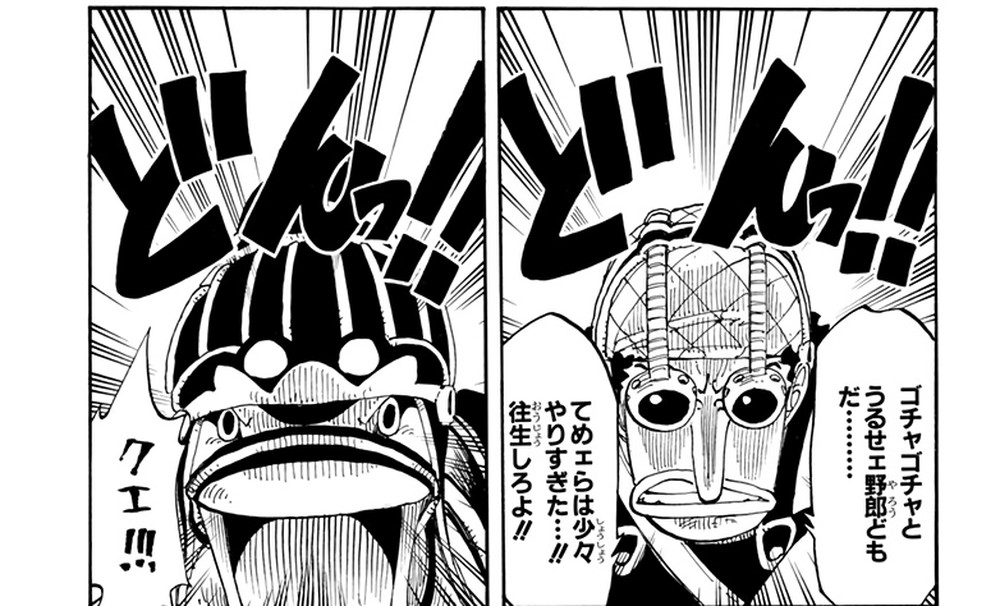
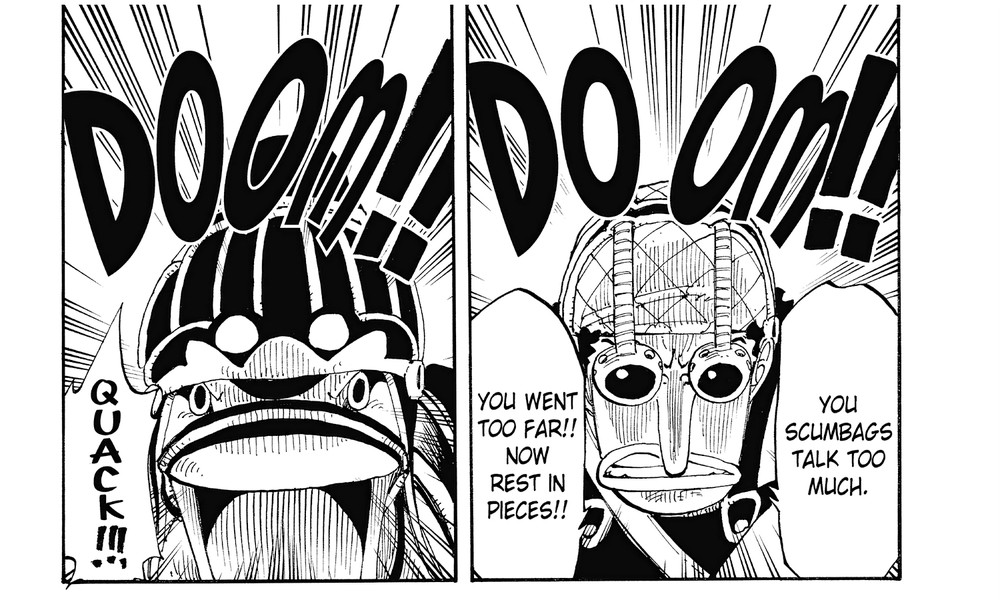
Volume 14. A fight has stopped being fun. Insults are already flying — 「ゴチャゴチャとうるせェ野郎どもだ......」 ("YOU SCUMBAGS TALK TOO MUCH.") — allies are shouting 「さァ!援護は任せろ!!ルフィ!!」 ("OKAY! WE'LL BACK YOU UP, LUFFY!!"), and then Usopp — of all people the crew's designated coward, sniper's goggles down, Karoo the duck flapping beside him — draws a line under the whole exchange:
「てめェらは少々やりすぎた...!!往生しろよ!!」
Temēra wa shōshō yarisugita…!! Ōjō shiro yo!!
VIZ's English edition prints: "YOU WENT TOO FAR!! NOW REST IN PIECES!!" (Vol. 14, p.111).
Grant the rendering its due first, because this one earns it. "Rest in pieces" is the classic English tombstone pun — take the epitaph everyone knows, crack it open, and it becomes a threat of dismemberment. It's funny, it's menacing, it fits in a speech bubble, and it lands. Ask ten letterers for a death-threat one-liner and half will reach for it.
Eleven volumes later, the same shelf gets raided from the opposite end of the emotional register. A drunken voice — the neighboring bubbles are a hiccup, 「ヒック」 ("HIC"), and a cackle, 「ウヒャヒャヒャッ!!!」 — addresses someone bound for the next world:
「成仏してくださいよォ」
Jōbutsu shite kudasai yo-ō
VIZ: "REST IN PEACE." (Vol. 25, p.103.)
Two different Japanese verbs, both Buddhist to the bone. One English formula for both, straight off the Christian shelf — punned the first time, played straight the second. That swap is the whole article.
The Original
Start with 往生 (ōjō), because if you've read our sister piece on the Buddhist death buried in 往生際が悪い, you already own this word. 往 "to go" + 生 "to be born": to go and be born — to depart this life for rebirth in the Pure Land (極楽往生, gokuraku-ōjō), worn down over centuries into a solemn everyday word for dying. In that article the word hid inside a noun, 往生際, "the brink of one's passing." Here it stands naked as a verb, in the bluntest form Japanese owns:
往生しろ = 往生 + しろ, the bare imperative of する (N4 grammar, zero politeness). Meet your end. As an order.
しろ is the form of drill sergeants and death threats — 黙れ, やめろ territory. Bolting it onto a dignified Buddhist verb produces something deliciously cold: not the schoolyard's 死ね ("die!") but a formal, faintly liturgical verb delivered like a sentence from the bench — proceed to your rebirth. The final よ gives the order a shove. And the addressee is てめェら: てめえ, the most hostile everyday "you" in the language, plus the plural ら — with the small-katakana ェ spelling doing what manga orthography does best, writing a snarl.
Now 成仏 (jōbutsu): 成 "become" + 仏 "Buddha." In the Japanese Buddhist folk picture, to die properly is to become a Buddha — to release every attachment to this world and move on. This is the load-bearing idea behind virtually every Japanese ghost story you have ever read: a spirit that lingers — out of grudge, love, or unfinished business — has failed to jōbutsu, and the story ends when someone finally helps it pass. So 成仏してください, said to the dead or dying, is not a mood. It is an instruction with a direction: please pass on properly. Don't stay.
The grammar around it does the characterization. 〜してください is the polite request form every learner meets in week one (N5). The final よォ — a small-katakana ォ stretching the vowel — is pure spoken texture: pleading, wheedling, a little slurred. Politeness melting into a drunken drawl: a tipsy, oddly tender prayer at somebody's send-off.
VIZ's Choice
Both occurrences in the volumes we have on file, side by side:
| Vol. / p. | Japanese | VIZ English |
|---|---|---|
| 14 / 111 | てめェらは少々やりすぎた...!!往生しろよ!! | YOU WENT TOO FAR!! NOW REST IN PIECES!! |
| 25 / 103 | 成仏してくださいよォ | REST IN PEACE. |
In the sister article the finding was scatter: one Japanese phrase, a fresh English guess every time. Here it is the mirror image — convergence. Two different Japanese words, from two different scenes, in two opposite registers, funnel into a single English formula. That is just as diagnostic. English has exactly one household phrase for speaking to the dead, and it is rest in peace; whatever Japanese says over a body gets pulled toward it like water to a drain. The translator's one degree of freedom was whether to pun.
And credit where due: choosing the pun for the threat was right. 往生しろよ!! needs to menace, and "NOW REST IN PIECES!!" menaces with a grin. The problem is not the joke. The problem is what the formula underneath the joke believes.
The Gap
Stay versus go. "Rest in peace" is requiescat in pace — a Christian wish, carved over graves for centuries, that the dead lie quietly: the grave as a bed, the body asleep until resurrection. 成仏 points the opposite way: the dead must leave — the grave as a doorway, and lingering as failure. One tradition asks the dead to stay put; the other begs them to move along. So "REST IN PEACE." for 成仏してくださいよォ is not a loose paraphrase; it is directionally backwards. The drunk is saying go. The English says stay.
One theology swapped for another. Notice what VIZ did not do: it didn't secularize. English's death-threat shelf is religious through and through — "say your prayers," "meet your maker," "rest in pieces" (a pun on an epitaph). So 往生しろよ!! came out of translation exactly as pious as it went in — just converted. A Buddhist order to proceed to your rebirth became a Christian joke about a headstone. The closest cousin on that shelf was "meet your maker": imperative-shaped, openly religious, and — crucially — pointed onward, at a destination. Still the wrong religion, but at least facing the same direction.
The tone channel. 往生しろよ is cold formality snapped like a whip — a solemn verb in a brutal form. "NOW REST IN PIECES!!" trades that chill for swagger; the menace survives, the solemnity doesn't. And 成仏してくださいよォ — polite ください dissolving into a drunken よォ — is wheedling, warm, half a lullaby, while "REST IN PEACE." with its full stop is a headstone: correct, flat, and stone sober. The theology is one loss; the voice is a second, separate one.
What If
No rendering is free; here is the menu and its prices.
- "NOW MEET YOUR END!!" — keeps the imperative-of-death structure and the cold formality of 往生しろ. Cost: no religion, no joke.
- "MEET YOUR MAKER!!" — the closest English cousin: religious, imperative, and pointed onward rather than downward. Cost: swaps the Pure Land for a Creator — still a conversion, just a smaller one.
- "TIME YOU PASSED ON!!" — "pass on" is English's one everyday death verb that keeps a direction. Cost: gentle where the Japanese is judicial; the punch is gone.
- "GO ON TO THE NEXT WORLD, OKAAAY?" (for 成仏してくださいよォ) — keeps the instruction, the direction, and the drunken drawl. Cost: long, and English has no ritual formula here, so it sounds improvised — which, to be fair, a drunk would.
The deeper point for a learner: every option pays because English's entire vocabulary for addressing the dead assumes they should rest. The moment a language's ghosts are supposed to leave, the translator has to build the doorway from scratch — or borrow a bed and hope nobody checks the theology.
Take-away
When One Piece characters tell each other to die, they often do it in Buddhist: 往生しろ orders an enemy to meet his end properly, and 成仏してください begs the departed to move along and not linger. English hears both through its one graveside formula, so the dead get told to lie down in a language where they were being told to get going. Same graveyard, opposite instructions.
Three rules of thumb to carry off this page:
- 往生 and 成仏 are verbs with a destination. Japanese talks to the dead in directions — go, cross, become. English lays them down. Watch for that reversed vector whenever religion brushes a translation.
- しろ is the bluntest tool in the box. The bare imperative of する turns any する-verb — however holy — into an order or a threat. 往生しろ is "die," wearing vestments.
- A stretched vowel is characterization. One small-katakana ォ (くださいよォ) carries drunkenness, pleading, and affection that English needs a whole stage direction to reproduce.
For the noun this verb hides inside — and the villain's taunt VIZ turned into "sore losers" — read the sister piece on the Buddhist death buried in 往生際が悪い. And for more lines where the words survive and the fingerprint doesn't, see the One Piece translation notes index.
Every Japanese and English line quoted above is a byte-exact capture from the cited editions — ONE PIECE Vol. 14–25 (Japanese) and One Piece (VIZ Media) at the corresponding panels — via our bilingual page database; see Sources below.