Zoro's おれ sounds nothing like Luffy's, even though it's the same word. Luffy's おれ declares; Zoro's おれ withholds. Where Luffy states his dream in full sentences to strangers within minutes of meeting them, Zoro answers questions about himself in fragments — おれは三刀流なんでね..., "I use the three-sword style, you see..." — trailing off on なんでね the way someone does when they'd rather be doing anything but explaining themselves. The grammar underneath is almost entirely negative-contraction: 敗けねェ (makenē, "won't lose"), 動くな (ugoku na, "don't move"), 知らねェ (shiranē, "dunno") — the roughest possible reduction of 〜ない, spoken by a man who has never once reached for です or ます, not even when addressing Dracule Mihawk, the strongest swordsman alive, mid-duel.
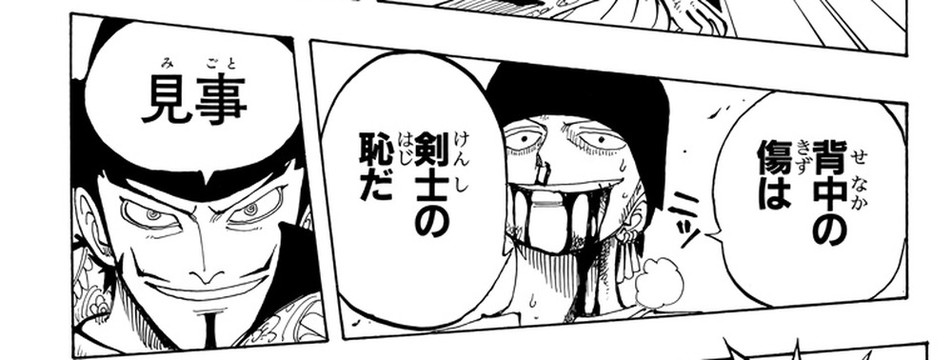
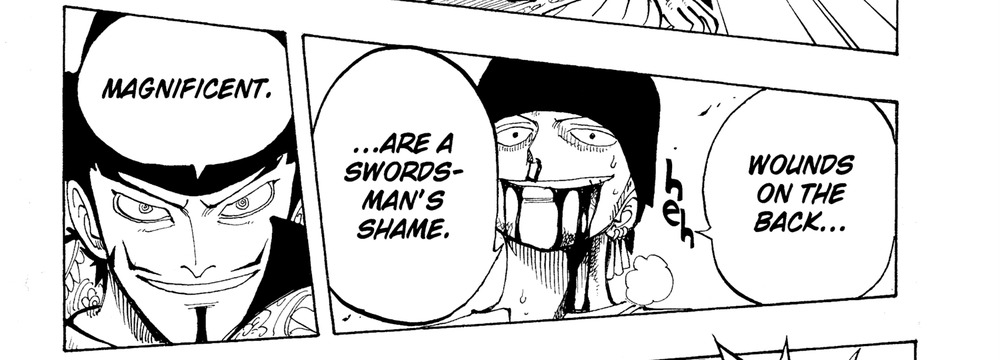
That duel is where Zoro's whole ethic surfaces in seven syllables: 背中の傷は剣士の恥だ, "wounds on the back are a swordsman's shame." He says it to Mihawk's face while deliberately turning to take a killing blow on his chest rather than his spine — a flat declarative with no hedge, no です, nothing that could be mistaken for a request. 恥 (haji, "shame") and 背中 (senaka, "back") are ordinary words; what makes the line land is that Zoro delivers a complete code of conduct as a bare noun-plus-copula sentence, the same grammatical shape he'd use to state the weather. Two pages earlier, losing for the first time in his life, he doesn't soften that either: 敗けた, "I've lost," no explanation, no excuse — and two pages later, bleeding out on the Baratie's deck, he upgrades the same verb into a vow to Luffy: 二度と敗けねェから!!, "I will never lose again!!" One verb, 敗ける, carries him from admission to promise inside four pages, and the grammar barely moves.
The vocabulary swings wider than the grammar does. In Skypiea, ambushed by two strangers screaming for his death, Zoro's first instinct is a Buddhist shrug — 何の因果か知らねェが, "dunno what twist of karma this is, but..." — 因果 being the doctrinal word for cause-and-effect itself, not slang (see 何の因果か and the bewildered shrug VIZ turns into a question of motive). Two pages later in the same volume, his finishing move against a gunman turns out to be a counting ladder through the 108 earthly desires of Buddhist cosmology, disguised as an artillery pun — 煩悩鳳!!!, landing in VIZ as "...POUND PHOENIX!!!!" (see 108 Desires, 108 Pounds). A swordsman who talks like he dropped out of school in the second grade keeps reaching for JLPT N1 sutra vocabulary mid-fight, and the joke — Oda's joke, not Zoro's — is that he never notices he's doing it. His refusal of Luffy's first recruitment offer runs the same trick backward: 誰が好んで海賊なんて外道になるか, "who'd willingly become a gedō — an outsider from the Path — just because it's piracy," using a word for heretic to explain why he won't break the law (see 外道 and the Buddhist heretic English turns into "stinking," "brute," and "fiend"). Three pages later he takes the offer anyway, on one condition delivered as a joke with a completely straight face: その時は腹切っておれにわびろ!! — "if I ever have to abandon my ambition, apologize to me by committing hara-kiri." He is threatening his own captain with seppuku, as a bit, thirty seconds after meeting him.
One more thing colors every quote on this page and deserves its own article rather than a paragraph here: VIZ's English tankōbon do not print his name as "Zoro." They print "Zolo" — visible in three different quotes above, from "RORONOA ZOLO!!!" in Volume 1 to "ZOLO IS STRONG" in Volume 26 — a substitution that has followed the character through the entire VIZ print run for reasons that have never been officially confirmed. It is the strangest gap on this whole site: a swordsman whose defining trait, in Japanese, is that he never once hedges what he says, renamed in English by a single vowel he never agreed to. A full comparison of ロロノア・ゾロ against "Roronoa Zolo" — what changes, what doesn't, and what a doubled-l or a swapped vowel actually does to a reader's first impression of a character — is coming as its own piece on this hub.
And then there's the joke Zoro makes at his own expense, the one line on this page that isn't about honor or violence at all: told to stay put and hold their position, he answers 言うだろ「道に迷ったらそこを動くな」, "they say it, don't they — 'if you get lost, don't move from that spot.'" He is citing a folk saying as though it settles the matter, completely deadpan, seconds before Nami reminds him that he is the one who gets lost. The same flat, unhedged grammar that makes his vows land makes his one running joke land too — Zoro doesn't do self-deprecation with a wink; he does it with the identical straight face he uses for swordsman's-honor speeches, and that is exactly why it's funny.