The Moment
Skypiea's Upper Yard, and Zoro is on his own — no crew in sight, sword already answering for him. Out of nowhere, two winged strangers dive at him with a blade raised, shrieking:
「死ね!!!」
Shine!!!
VIZ: "DIE !!!"
Steel meets steel — ガキィン!!! — and Zoro parries without so much as blinking. His first word is almost bored:
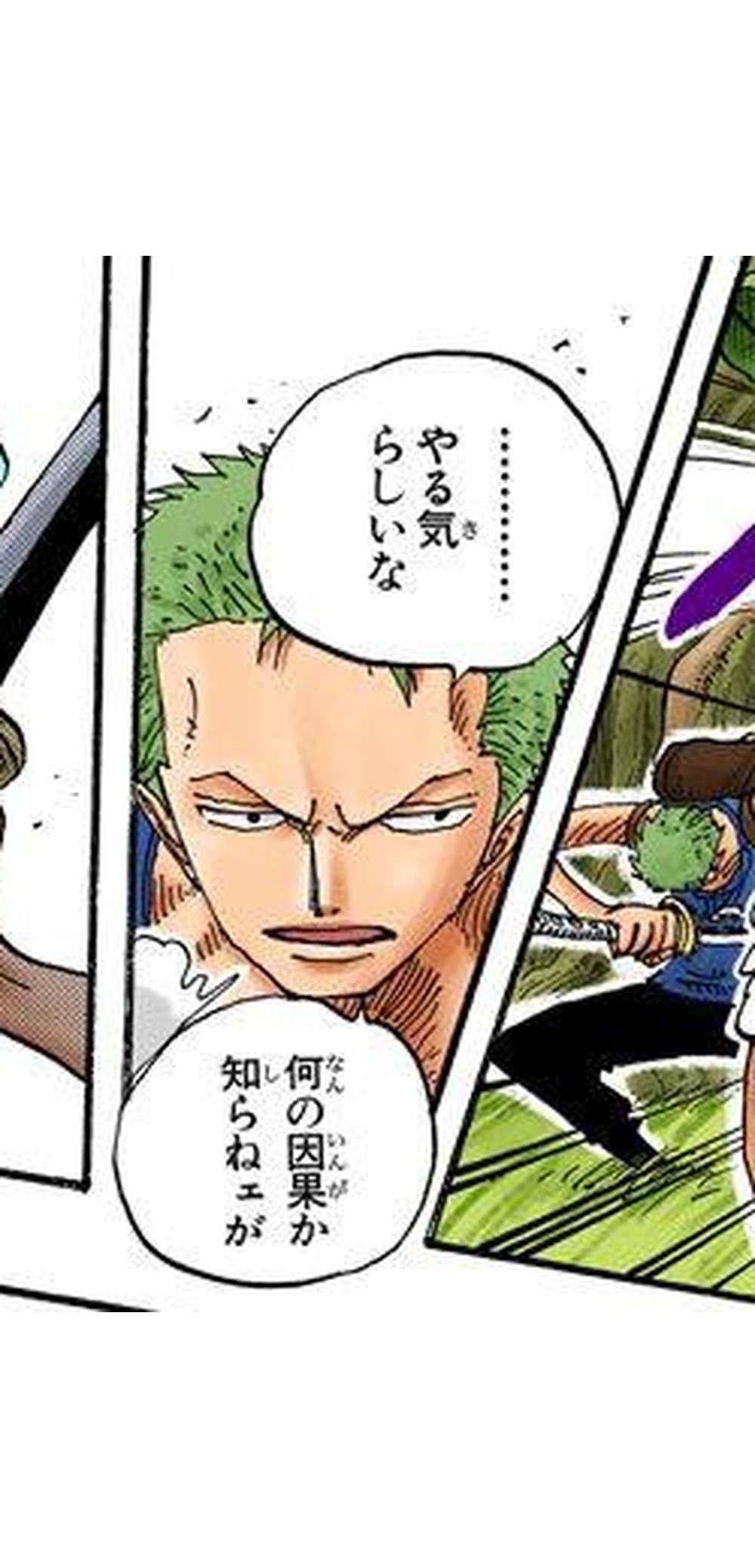
「やる気らしいな」
Yaruki rashii na.
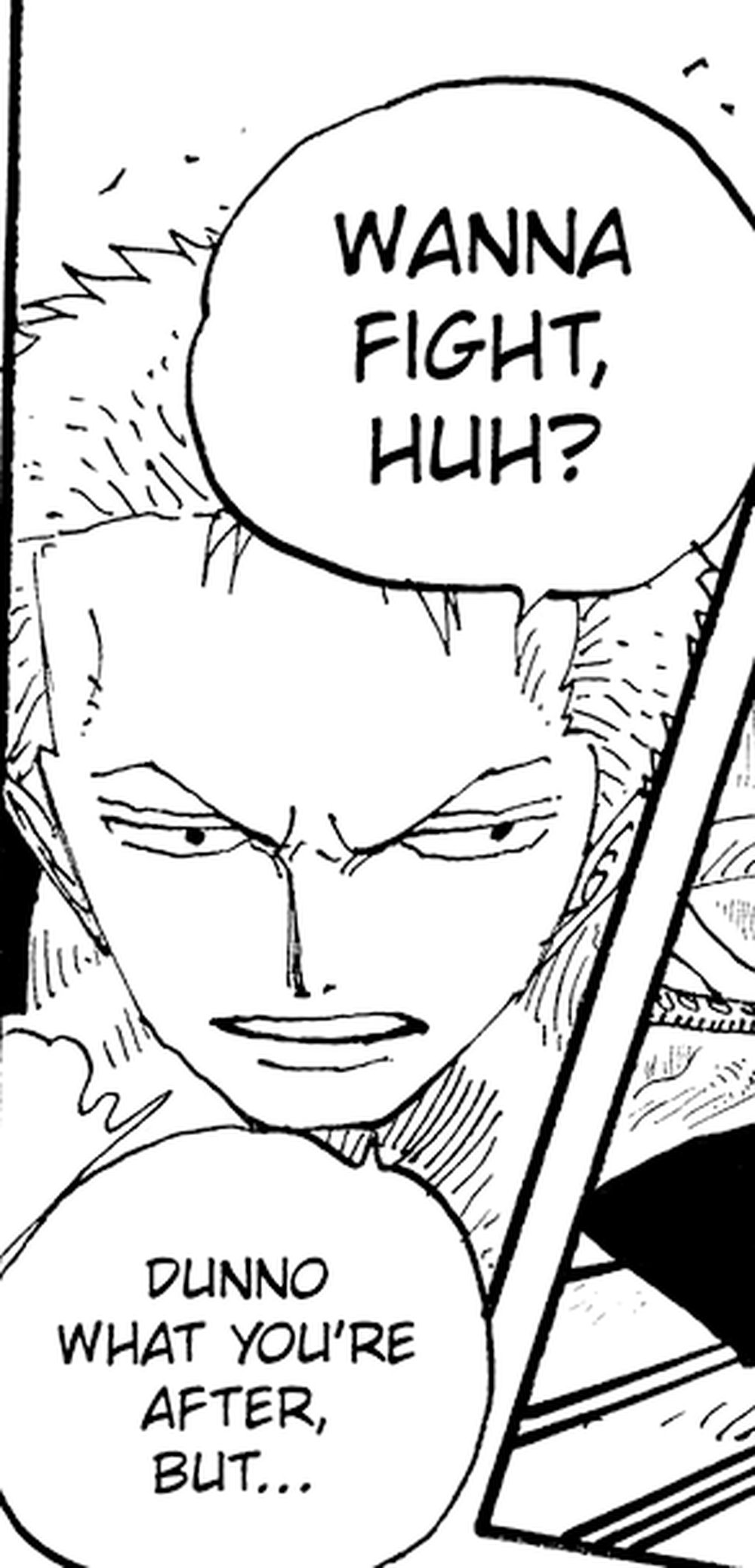
VIZ: "WANNA FIGHT, HUH?"
Then, still holding the block, still not having asked who these people are or why they want him dead, he adds:
「何の因果か知らねェが」
Nan no inga ka shiranē ga
VIZ's English edition prints: "DUNNO WHAT YOU'RE AFTER, BUT..." (Vol. 28, p.54; VIZ p.59).
Grant the line its due: it reads fine. It's terse, tough-guy, and sets up the beatdown that follows — ブリキィッ!! / SLASH!!! — as the two attackers go down screaming, ウあァ!!! / RAAH !!! and ぐあっ!! / GRAAH!! But listen to what the Japanese is actually doing at that moment, blade still crossed, before a single blow has landed. Zoro isn't asking them anything. He's musing — half amused, half resigned — on the sheer pointlessness of the ambush, using a word that has nothing to do with wanting anything at all: 因果, cause-and-effect itself, the Buddhist machinery of karma. And when the strangers are on the ground and it's over — ドサ...!! / FWUMP !! — he finally asks the question that actually is a question:
「何なんだおめェらはよ!!?」
Nan nanda omēra wa yo!!?
VIZ: "WHO ARE YOU GUYS, ANYWAY?!"
Two different kinds of not-knowing, four panels apart. The mistranslation quietly collapses them into one.
The Original
Start with the frame, because it's a fossil: 何の〜か (nan no ~ ka) turns any noun into a bewildered indirect question — "[by] what kind of ~," the shape behind everyday complaints like 何の騒ぎだ ("what's all this fuss") or 何の用だ ("what business is this"). Drop 因果 into that slot and the whole phrase calcifies into a set idiom: 何の因果か — "by what twist of karma," "for what inexplicable reason" — the stock opener for marveling, usually a little bitterly, at a coincidence too pointed to be random and too senseless to explain.
Now the word doing the real work. 因果 (inga) splits exactly the way its sister word 因縁 (innen) does — half matching, half not:
- 因 (in) — "direct cause." Identical to the 因 in 因縁; you know it from 原因 (gen'in, "cause").
- 果 (ka) — "fruit, result." The same 果 in 結果 (kekka, "result, outcome") and 果物 (kudamono, "fruit").
Where 因縁 pairs cause with 縁 (en, "condition") — the doctrine that an effect needs both a seed and the soil around it, and the word that ends up meaning a tangled relationship between two people — 因果 pairs cause directly with its 果, its fruit. It is the doctrine of hetu-phala: every effect has a cause, full stop, mechanism rather than entanglement. 因縁 is the story of how two lives got knotted together; 因果 is the law that guarantees a story exists at all, even when nobody on stage can read it. That's the difference Zoro's line is built on: he isn't wondering about a relationship to these two strangers. He's shrugging at the fact that something must have caused this, and he has no idea what.
The grammar around 因果 is nothing exotic — 知らねェ is just the tough, dialectal contraction of 知らない, and the trailing が is the same pivot-to-action "but" that shows up constantly in shōnen dialogue, the hinge between a thought and a sword swing. As vocabulary, 因果 sits around JLPT N1; the sentence that carries it is N4–N5 grammar a first-year student already owns. The difficulty, as usual with this family of words, is entirely conceptual.
VIZ's Choice
This is the only appearance of 何の因果 in the volumes we have on file — no scatter to chart, no table of five renderings pulling in five directions. Just one translator, one panel, one roll of the dice.
And it's an understandable roll. "DUNNO WHAT YOU'RE AFTER, BUT..." is a real, well-worn line from the action-hero phrasebook — the kind of thing a gunslinger says before a shootout in any number of English-language stories. It fits the panel, it fits the tempo, and "AFTER" isn't a wild leap from 因果 the way some mistranslations are; asking about a stranger's motive is a perfectly natural thing to wonder mid-ambush. The problem isn't that the guess is unreasonable. It's that the Japanese specifically isn't guessing about motive — Zoro never wonders what these two want. He wonders why the universe arranged for them to be here at all, which is a bigger, vaguer, more resigned question than "what's your angle." The translator reached for the nearest stock phrase that fit the panel's energy, and 因果's actual referent — cause-and-effect as a cosmic law, not a personal agenda — didn't survive the reach.
The Gap
Cause becomes goal. "WHAT YOU'RE AFTER" is motive-language: it says these two people are pursuing something, and Zoro is curious what. 因果 is the opposite kind of word — it names an unknown cause, not an unknown desire. "I don't know why fate did this to me" and "I don't know what you want from me" sound similar in a speech bubble and mean different things: one is philosophical bewilderment, the other is tactical assessment.
The aside becomes an address. 何の因果か…が is Zoro talking to himself, the way とは… lets a Baratie cook trail off in awed silence elsewhere in this series (see the causal tie hiding inside 因縁). "DUNNO WHAT YOU'RE AFTER, BUT..." reads as spoken at the attackers — a question that expects, or at least invites, an answer. None comes, because none was ever wanted.
The real question gets pre-empted. This is the sharpest loss, and it's visible right there on the page. Four panels later, standing over the two men he's just put down, Zoro asks the question he actually has: 「何なんだおめェらはよ!!?」 — "WHO ARE YOU GUYS, ANYWAY?!" In Japanese, that's new information — the first time he wonders about their identity, because 何の因果か was never about identity or motive to begin with. In English, "DUNNO WHAT YOU'RE AFTER" has already gestured at not knowing something about them, so "WHO ARE YOU GUYS" lands as a repeat of the same confusion instead of a distinct, almost funny admission that he went into the fight with zero theory whatsoever — not about their goals, not about their identity, nothing. English gives Zoro one flavor of cluelessness twice. Japanese gives him two: bewilderment at fate, then, only after the fight, plain not-knowing who he just fought.
What If
No rendering is free; here is the menu and its prices.
- "Dunno what twist of fate this is, but..." — keeps the karmic shrug and the self-directed, musing register. Cost: "twist of fate" reads more fortune-cookie than Buddhist mechanism, but at least the direction is right — fate is acting on Zoro, not the reverse.
- "Don't know what karma brought this on, but..." — keeps "karma" audible on the page. Cost: "brought this on" can still tip toward being about the attackers specifically, rather than circumstance in general.
- "No idea what I did to deserve this, but..." — a natural colloquial "why me," and it keeps Zoro talking to himself rather than to them. Cost: "deserve" sneaks in a moral judgment — that he earned this — which the flat, impersonal 因果 never makes.
- "Dunno what cosmic joke this is, but..." — matches the aside-not-question shape of VIZ's actual line. Cost: "cosmic joke" implies amusement; Zoro's delivery, blade already crossed, reads more bewildered than wry.
Take-away
何の因果か is what a Japanese speaker reaches for when a cause exists but is invisible to them — not "what do you want," but "why is this even happening." It is 因縁's plainer, more mechanical cousin: 因縁 is the tangled bond two lives end up sharing; 因果 is just the law of cause-and-effect that makes bonds, grudges, and ambushes alike possible in the first place.
Two rules of thumb to carry off this page:
- 因果 asks about causes, never about wants. When you see it, resist any translation that turns it into motive, purpose, or agenda — that's a different word's job entirely.
- Watch for trailing が. A clause that ends on "but..." and pivots straight into action, rather than into a reply, is almost always a character musing to themselves, not interrogating someone else — the grammar of an aside, not a question.
For the entangled, relationship-flavored half of this same doctrine, see the karmic tie hiding inside 因縁 — and for another moment in this very volume where Zoro's blunt speech turns out to be carrying Buddhist vocabulary mid-swing, see the bilingual pun inside 煩悩鳳. For more lines where the words survive and the fingerprint doesn't, browse the One Piece translation notes index.
Every Japanese and English line quoted above is a byte-exact capture from the cited editions — ONE PIECE Vol. 28 (Japanese) and One Piece Vol. 28 (VIZ Media) at the corresponding panels — via our bilingual page database; see Sources below.