The Moment
Skypiea, the sky island — and for once the loudest thing on the page is not Enel's thunder but gunfire. Zoro is squared off against a gunman, and a boast hangs in the air between them:
「間合いも威力もおれの武器が勝ってる」
Maai mo iryoku mo ore no buki ga katteru.
VIZ: "IN TIMING AND POWER, MY WEAPON WILL WIN." (Vol. 28, p.73)
Zoro's reply is not a counter-boast. It is a Buddhist maxim:
「一世三十六煩悩」
Isse sanjūroku bonnō.
VIZ: "IN A LIFETIME, THERE ARE 36 EARTHLY DESIRES."
Then he sorts the two of them into calibers — 「お前は銃おれは大砲」, "YOU ARE A PISTOL. I AM A CANNON." — and two pages later the sermon becomes the attack:
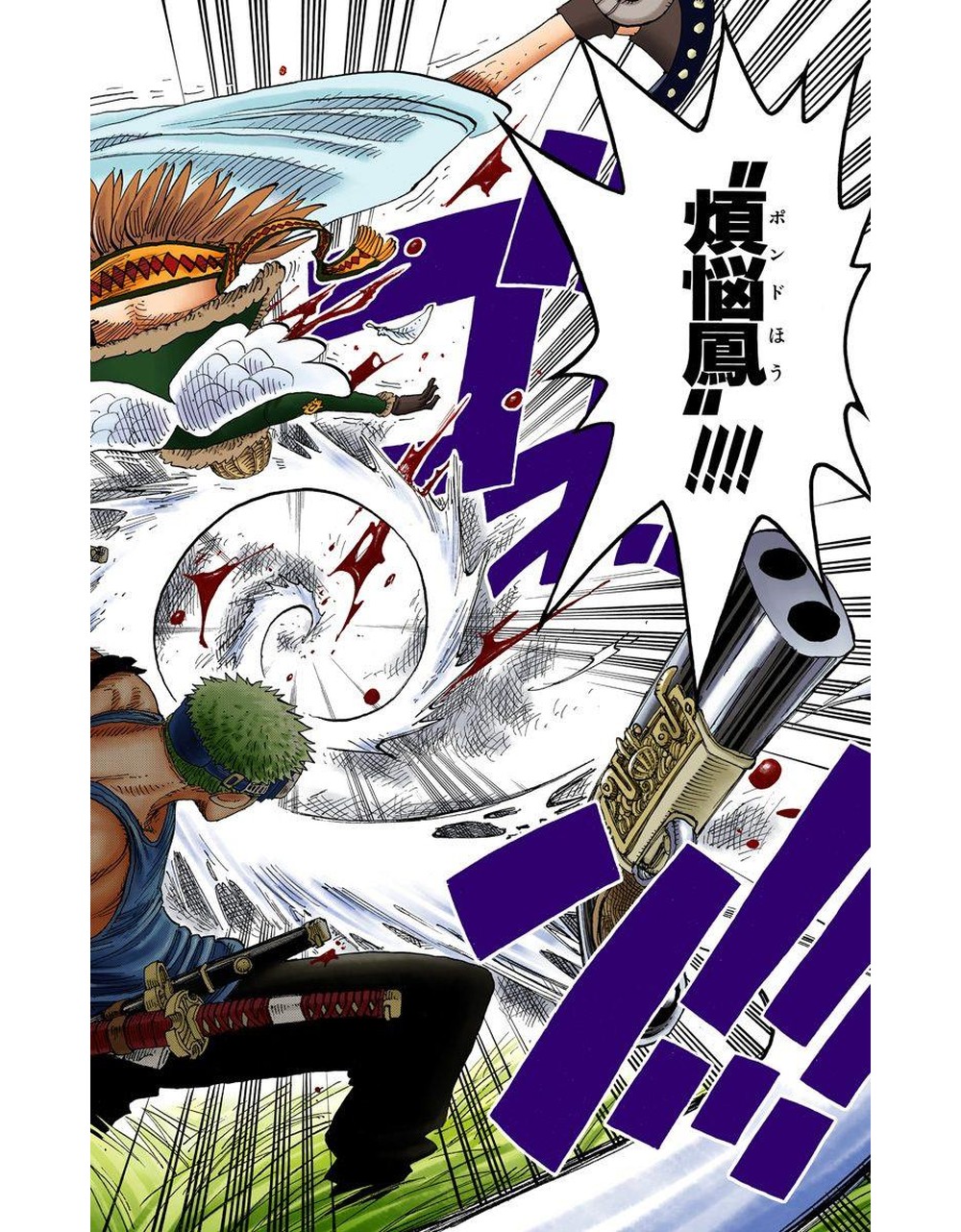
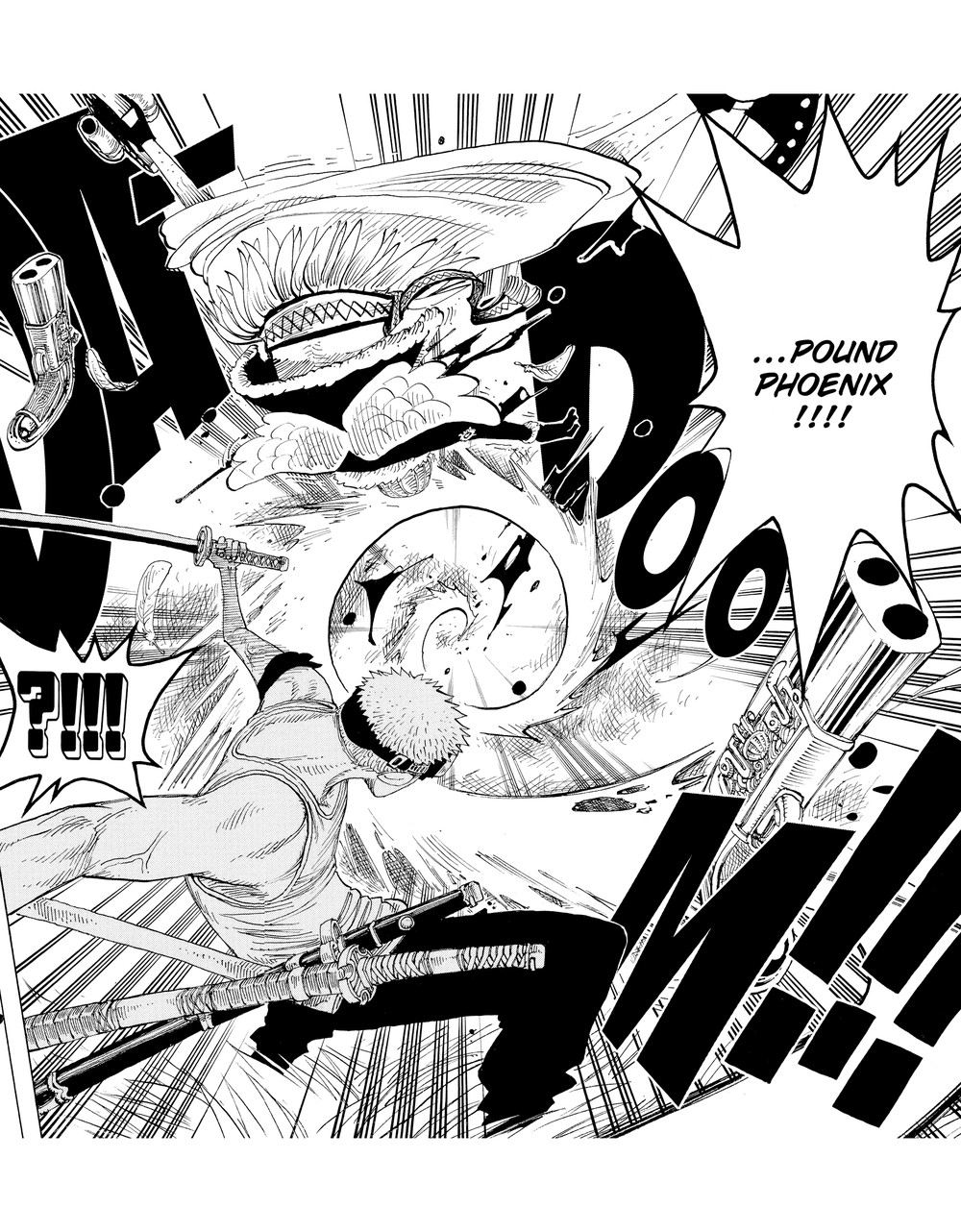
「煩悩鳳!!!」
Bonnō hō!!!
VIZ: "...POUND PHOENIX !!!!" (Vol. 28, p.75)
Hold those two VIZ lines side by side. On one page, 煩悩 is "EARTHLY DESIRES" — printed in full, correctly, beautifully. Two pages later, the very same word is "POUND." That is not a translator losing the thread. That is a translator who understood the whole joke — and could only fit half of it through the door.
The Original
Start with the word doing the heavy lifting. 煩悩 (bonnō) is the everyday Japanese name for the Buddhist kleshas — the worldly desires and afflictions that chain a person to suffering. The kanji tell you how it feels: 煩 is "to vex, to trouble" (you meet it in 煩わしい, wazurawashii, "bothersome") and 悩 is "to anguish" (悩む, nayamu, "to agonize over"). Two characters, both itchy.
Canonically there are 108 of them. That number is one of the fixed constants of Japanese culture: on New Year's Eve, every temple in the country rings its bell exactly 108 times — 除夜の鐘 (joya no kane) — one toll per desire, to clear the old year's afflictions; a full Buddhist rosary carries 108 beads for the same reason. The derivations of the number vary, but a popular one multiplies a base count of desires across the 三世 (sanze) — the three temporal worlds of past, present and future. Keep that word in your pocket; it comes back.
Now watch what Oda builds with it. Zoro's flying-slash series climbs a ladder:
- 一世三十六煩悩 — one world, 36 desires
- 二世七十二煩悩 — two worlds, 72 desires
- 百八煩悩 — the full 108
36 and 72 are the factors; 108 is the complete set. The finishing move is not merely the biggest slash — it is the entire tally of human desire, delivered at once. Oda has turned Buddhist arithmetic into a power level.
And the last character? 鳳 (hō) is the male hō-ō phoenix of Chinese myth (its mate is 凰). So 煩悩鳳 reads, on its face, as "phoenix of earthly desires."
But say it aloud. Bonnō hō sits one breath away from pondo-hō — ポンド砲, a "pounder": the old way of rating a naval cannon by the weight of the ball it throws. A 36-pounder was a real gun on a real ship of the line — and One Piece is nothing if not a world of broadsides. Better still, 砲 (hō, "cannon") is a perfect homophone of 鳳 (hō, "phoenix"). The name is a double exposure by design: "108 Earthly Desires Phoenix" and "108-pound cannon," in the same four characters. Zoro even says the quiet part out loud — "YOU ARE A PISTOL. I AM A CANNON." — right before firing it.
And if the pun ever felt like an analyst's stretch, the page itself settles it. On the Volume 28 splash where the attack lands, the furigana printed beside the kanji read ポンドほう (pondo hō): Oda rubies 煩悩鳳 with the cannon reading, right there in the original edition. The kanji carry the 108 desires; the ruby carries the pound. A Japanese reader takes in both in one glance — and no English page can print a word and its second reading in the same spot.
Grammar corner, briefly: the name is an all-kanji block with no particles and no okurigana, numerals welded straight onto nouns (三十六煩悩) in the pre-modern style of sutra titles and temple plaques. The syntax costs you nothing; the vocabulary is the toll booth. 煩悩 is JLPT N1 territory, and 鳳 lives beyond the jōyō list entirely.
VIZ's Choice
Here is every appearance in the volumes on file, side by side with the official English:
| Vol. / p. | Japanese | VIZ English |
|---|---|---|
| 28 / 73 | 一世三十六煩悩 | IN A LIFETIME, THERE ARE 36 EARTHLY DESIRES. |
| 28 / 75 | 煩悩鳳!!! | ...POUND PHOENIX !!!! |
| 29 / 147 | 二世七十二煩悩 | SECOND 72 POUND... |
| 29 / 147 | 百八煩悩 | 108 POUND... |
Grant the rendering its due first — and this time, grant it everything. This is the fairest "VIZ's choice" in this series, because VIZ did not mishear anything. Look at the table: the same translator who wrote "POUND" printed "36 EARTHLY DESIRES" one explanation beat earlier. They saw both faces of the coin and made a deliberate call:
- An attack name has to be shoutable. "108 POUND PHOENIX" detonates in a speech bubble. "108 EARTHLY DESIRES PHOENIX" files a report.
- The scene itself argues for artillery. Zoro has just declared himself a cannon against a pistol. The pound-rating reading is the one the panels are already dramatizing.
- The Buddhist half got paid where the page could afford it. The maxim beat — dialogue, not a shout — carries "EARTHLY DESIRES" in full.
So the usual scatter argument runs backwards here. When we charted 往生際が悪い, the same phrase drew a new improvised English every time — the sign of an idiom with no seat in English. Here the two renderings of 煩悩 are systematic: explanation beats get the temple, attack calls get the artillery. The translator split one bilingual pun into its two halves and printed each where it fit. The pitfall is not a wrong choice. It is that English has no way to print both halves in the same place — which is the entire trick of the original.
The Gap
The ladder of desire disappears. In English the series reads 36 POUND → 72 POUND → 108 POUND: escalating firepower, a bigger gun each time — a perfectly good shonen shape. In Japanese it reads 36 → 72 → 108 bonnō: a swordsman counting his way up to the complete census of human affliction, landing his finisher on the number every reader hears tolled on New Year's Eve. One is a heavier cannonball. The other is the whole bell.
The double exposure collapses. The pleasure of 煩悩鳳 is hearing the sermon and the broadside in the same breath — solemn and silly at once, liturgy with a gag sealed inside. VIZ's reader receives one clean image and no evidence a second ever existed. You cannot enjoy a pun you were never told about; the English page doesn't wink, because the wink was in the sound.
三世 flattens to "THIRD." The stage-counters 一世・二世・三世 (isse, nise, sanze) double as the Buddhist three worlds — past, present, future — the very multiplication that produces 108. VIZ's "SECOND 72 POUND... / THIRD..." can only read them as combo levels: second stage, third stage. Reasonable, unavoidable — and the doctrinal arithmetic quietly leaves the page.
What If
No rendering is free; here is the menu and its prices.
- "108 EARTHLY DESIRES PHOENIX" — keeps the temple bell and matches VIZ's own maxim beat. Cost: unshoutable, and it contradicts the pistol-versus-cannon staging the scene runs on.
- "108 CALIBER PHOENIX" — stays inside gun-measurement and even smuggles in English's own double reading, since "caliber" also means a person's stature. Cost: the specifically Buddhist 108 still evaporates, and caliber measures the bore, not the shot weight the pun runs on.
- "108 PASSIONS PHOENIX" — "the 108 passions" is a real, older English rendering of the kleshas, and "passions" flickers nicely against a phoenix. Cost: modern ears hear romance, not affliction; the cannon is gone.
- Keep "108 POUND PHOENIX" and bridge it in the dialogue — let the maxim beat read "36 desires... 36 pounds" so the reader glimpses that the two halves are one coin. Cost: a visible seam in a line Oda kept seamless.
The honest conclusion: this pun is untranslatable in one position. The best available strategy is exactly the one VIZ used — spend each half of the pun where the page can carry it — plus, ideally, a wink so the reader knows a trade was made.
Take-away
When an official English attack name looks oddly literal, oddly arbitrary, or oddly physical — why would a phoenix be measured in pounds? — treat it as an archaeological clue. Attack names in shonen are dense, layered puns more often than not, and the English name is frequently the fossil of just one layer.
Three rules of thumb to carry off this page:
- When an English attack name feels arbitrary, hunt the homophone. "POUND" made no sense until you heard bonnō / pondo and hō / hō. The strangeness of the translation is the shape of the missing pun.
- When you meet 煩悩, the number 108 comes with it — and with 108 come the New Year's bell (除夜の鐘), the 108-bead rosary, and factor-numbers like 36 and 72 doing doctrinal work.
- Set-numbers are vocabulary. 三十六, 百八, 三世 — classical counting frames still run underneath modern Japanese naming. When a number in a name looks specific, it usually is.
Want another line from the same sky — where a self-styled god's Buddhist put-down became "sore losers"? See the One Piece translation notes index.
Every Japanese and English line quoted above is a byte-exact capture from the cited editions — ONE PIECE Vol. 28–29 (Japanese) and One Piece (VIZ Media) at the corresponding panels — via our bilingual page database; see Sources below.