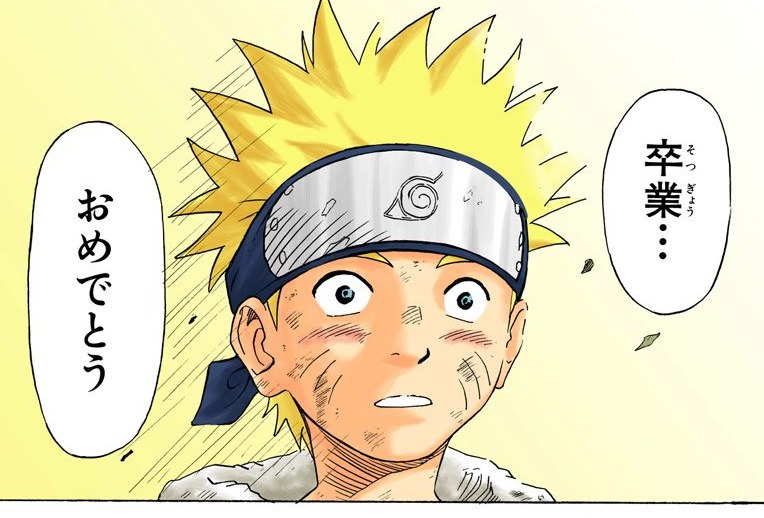
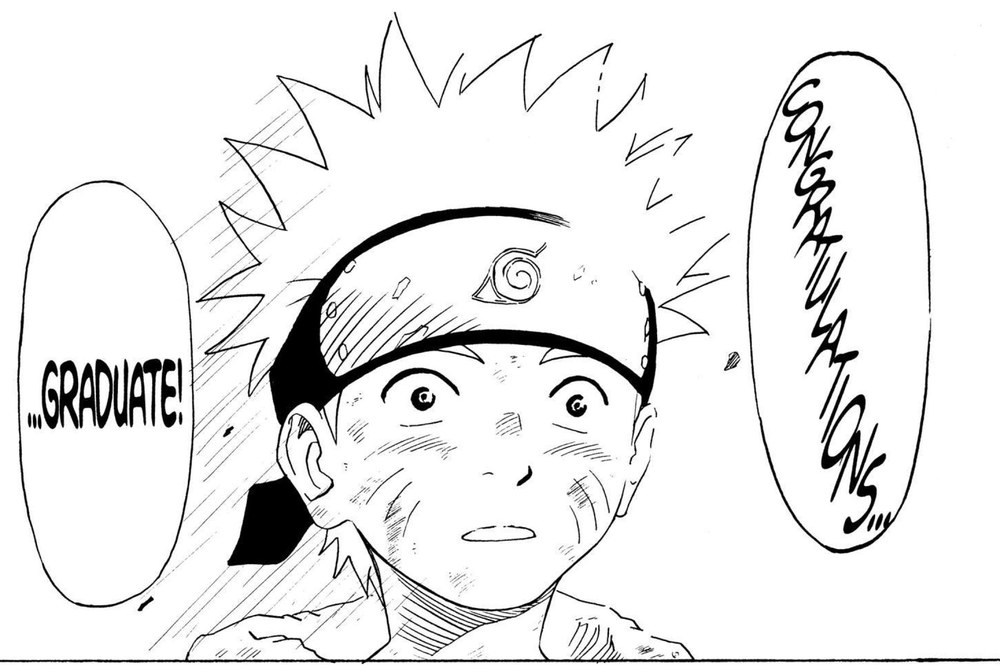
Iruka takes off his own headband, ties it across the forehead of the boy who just flunked out, and gets exactly two words out before his voice goes: 「卒業...おめでとう」 (sotsugyō... omedetō, "graduate... congratulations"). VIZ splits it across two balloons the same way: "...GRADUATE!" and "CONGRATULATIONS..." A page earlier this same kid was the classroom washout who couldn't pass the exit exam. Now the vessel is, at last, finished.
Japanese has a four-character compound (yojijukugo) for precisely this shape of life: taiki bansei (大器晩成).
Four kanji: a great vessel, late to set
The compound is two two-kanji halves:
- 大器 (taiki) — 大 (dai/ō, "great, large") plus 器 (ki, native reading utsuwa, "vessel, bowl, container"). A big vessel. Figuratively, a person of large capacity — English "he has the makings of something" lives near here.
- 晩成 (bansei) — 晩 (ban, "late; evening," the same kanji as in 今晩 konban, "tonight") plus 成 (sei, native reading naru, "to become, to be completed," as in 完成 kansei, "completion"). Late to be completed.
Put together: a great vessel is completed late. The big pot takes the longest to fire. Applied to people, it is the label for the late bloomer — the one who is slow, unremarkable, even written off in youth, and only comes into their powers well after everyone else.
The line is older than you think — and it originally cut the other way
Taiki bansei comes from the Laozi (老子, the classical Chinese text also called the Dào Dé Jīng / 道徳経). Chapter 41 runs a series of paradoxes: 大方無隅、大器晩成、大音希声、大象無形 — "the greatest square has no corners; the greatest vessel is [bansei]; the greatest sound is barely audible; the greatest form has no shape."
Here is the wrinkle worth carrying. In its original context the phrase is arguably not the encouragement it later became. Read alongside its neighbors — a square so large it has no corners, a shape so large it has no shape — 大器晩成 reads as "a vessel so great it is never completed." The warm, motivational sense we use today ("greatness just takes time") is a later settling of the meaning, popularized through the centuries and through histories like the Records of the Three Kingdoms, where it gets attached to men who succeeded late. So when you deploy it, you are using a phrase whose comforting modern face grew over a stranger, more austere original. Not a reason to avoid it. A reason to know what is under it.
The compound never appears in Naruto — and it is exactly the word for him
Full disclosure: 大器晩成 does not appear anywhere in the Japanese text of the manga; a search of the colored digital edition turns up nothing. It is not a phrase the series speaks. It is the phrase Japanese readers reach for about the series' premise, because the premise is the dictionary illustration of it.
The engine of the setup is a single word the villagers keep pinning on Naruto: 落ちこぼれ (ochikobore, "dropout, dead-last, the one who fell out"). His tutor-to-be Ebisu spits it in the second chapter — 私の大嫌いな落ちこぼれだ (watashi no daikirai na ochikobore da, "the washout I can't stand"). It follows him for years; deep into the Chūnin Exam arc an opponent is still using it as a taunt, and the chapter where Naruto finally overturns that opponent is literally titled 「落ちこぼれ!」 ("The Failure!"). The word is the "great vessel, seen early, mistaken for an empty one."
The graduation panel above is taiki bansei in miniature. Naruto has just failed the exit exam — his weakest technique is the very clone jutsu the test hinges on — and he does not pass by suddenly acing it. He passes sideways and late, by staying up all night to learn a forbidden technique and stumbling into stopping a traitor. The vessel finishes on its own clock and by its own odd route, which is the whole point of the compound: not "fast," not "on schedule," but complete in the end. The dream he attaches to that late finish — inheriting the hokage name — is a fifty-year vessel, not a graduation-day one.
What each language gets
A Japanese reader gets the payoff for free the moment the arc's shape becomes clear: they already own a four-character word that files Naruto under a recognized, even honorable, human type — the late bloomer with the classical pedigree of the Laozi behind him. The washout is not just a washout; he is a 大器, a great vessel not yet fired.
English has no compact idiom that carries the same freight. "Late bloomer" is close and VIZ-style plain, but it is botanical and gentle where 大器晩成 is architectural and a little grand. VIZ, sensibly, does not try to import the phrase; it lets the story say what the compound would say, and trusts "...GRADUATE! CONGRATULATIONS..." over a battered, disbelieving face to land the beat. What the English reader loses is only the dictionary click — the small satisfaction of watching a boy grow into a phrase that was waiting on the shelf. What the English reader gains is the beat delivered raw, without a label doing the work for it.
Using it yourself
Taiki bansei is warm and complimentary in modern use — you can say it of a colleague who found their stride at forty, or hope it of yourself. Because it points at a finish that has not happened yet, it works best as faith rather than verdict: 彼は大器晩成型だ (kare wa taiki-bansei-gata da, "he's the late-blooming type") is a bet on someone, not a summary of them. It pairs naturally with the boar-charge energy of chototsu-moshin and with the fall-down-get-up rhythm of shichiten-hakki: the vessel finishes late precisely because it keeps getting knocked over on the way. And if you want the fuller texture of the code that keeps Naruto reaching for the Hokage name, that is his nindō — the shinobi's-way article picks it up.