The Moment
Volume 53, p.70 in the Japanese edition; VIZ Volume 53 at the corresponding panel. Naruto is standing inside his own mindscape, face to face with a woman he met for the first time minutes ago and has already, somehow, cried in front of — his mother, Kushina, a chakra remnant sealed away since the night of his birth.
The scene has earned its comedy the hard way. Three pages earlier (p.62), a disguised Kushina — still unidentified, still read by Naruto as a hostile Nine-Tails apparition — snaps at him mid-fight: 「違うってばね!!」, "YOU'RE WRONG, YA KNOW?!!" Naruto freezes. 「...てばね...?」, "...YA KNOW...?" — something about the fragment catches on him, though he can't say what. Three pages after that (p.65), the fight is over, the truth is out, and Naruto — sobbing, nose bleeding, twelve years of an unmet mother arriving all at once — says the thing his own mouth has said thousands of times without him ever noticing it was inherited: 「ずっと...会いたかったってばよ...母ちゃん...!」, "...I'VE... WANTED TO MEET YOU FOR SO LONG, MA... YA KNOW!?" Kushina goes quiet, then: 「...やっぱり私の子ね...」, "...YOU REALLY ARE MY CHILD..." — the tic itself standing in as proof of blood, before either of them has said the word "tic" out loud.
Which brings us to p.70. Naruto, curious about how his parents met, asks the question; Kushina goes silent, embarrassed, and it slips out again: 「な...何か...恥ずかしいってはね...!」, "I-IT'S... A BIT EMBARRASSING, YA KNOW...?!" And Naruto — delighted, pointing — says the headline line:
「あ〝てばね〟って言った!」
A, "tebane" tte itta!
VIZ's English edition prints: "YOU SAID YA KNOW!" (Vol. 53, p.70).
Grant it its due: "YOU SAID YA KNOW!" is bright, natural, perfectly-timed English, and it lands the joke's shape exactly — a son catching his mother's speech habit red-handed. What it can't reproduce is the typography. 〝てばね〟 sits inside its own quotation marks in the Japanese line — the only place in this entire record where だってばよ's family of tics gets typeset as a nameable word rather than absorbed into the surrounding sentence. Naruto isn't just saying "you said some words like mine" — he's saying, with his own hand-drawn air-quotes on the page, you said the word "tebane." Flustered, Kushina digs the hole deeper: 「こういう場合は動揺って言うんだってばね!」, "YEP, I'M GETTING MY THOUGHTS WOUND UP, YA KNOW!" — using the tic to explain away the tic. Naruto: "YOU SAID IT AGAIN, A-HA HA HA!"
The Original
Start with the grammar everyone actually uses, because だってばよ is not a nonsense word — it's real Japanese wearing a costume.
ってば is ordinary, everyday colloquial grammar, historically descended from something like と言えば or と言うのに ("if I say / even though I say") worn down through casual speech into a single fused particle. Its job is insistence: you use ってば when you feel unheard, when the first attempt didn't land — ちゃんと聞いてってば!, "I SAID listen!" Any Japanese speaker uses it; it costs nothing at a conversation table and shows up around N3–N4 in most textbooks.
Onto that real particle, Naruto's line stacks the assertive よ — the ordinary sentence-final push that means, roughly, ", you hear me" — giving だってばよ its full shape: だ (copula) + ってば (insistence) + よ (assertion). Kushina's variant swaps that final よ for ね, the confirmation-seeking particle — ", right? / ~, you know?" — grammar that reaches for agreement instead of asserting a fact outright. Same insistence engine under the hood; different final gesture on top. A Japanese reader parses the difference instantly and unconsciously: the son's tic pushes outward at the world, daring it to disagree; the mother's tic reaches for reassurance that someone's still listening. Same accent, different personality riding it — which is exactly the kind of detail a family resemblance is made of.
The headline sentence performs a small grammar lesson on itself. あ〝てばね〟って言った! breaks into あ (interjection, "oh—"), 〝てばね〟 (the tic itself, pulled out of ordinary use and set inside quotation marks as a direct-quote noun — grammatically, an object being pointed at rather than a particle being spoken through), って (the quotative marking what was said), and 言った (past tense of 言う, "to say"). Literally: "Oh — [you] said 'tebane'!" Kishimoto has built one sentence that both uses the family tic and, uniquely in this record, comments on it from outside — treating だってばよ's whole idiolect family as an object with a name, not just a noise a character makes.
VIZ's Choice
Here is the shape of the translation across the corpus, sampled from an 820-occurrence record of だってばよ/ってばよ spanning Volumes 1–58, plus a dedicated search for Kushina's ってばね:
| Vol. / p. | Speaker | Japanese | VIZ English |
|---|---|---|---|
| 2 / 11 | Naruto | あーーーもーー!だから答えって何なんだってばよォ!? | AW, COME ON, ALREADY! TELL US!!! |
| 53 / 62 | Kushina | 違うってばね!! | YOU'RE WRONG, YA KNOW?!! |
| 53 / 62 | Naruto | ...てばね...? | ...YA KNOW...? |
| 53 / 65 | Naruto | ずっと...会いたかったってばよ...母ちゃん...! | ...I'VE... WANTED TO MEET YOU FOR SO LONG, MA... YA KNOW!? |
| 53 / 70 | Kushina | な...何か...恥ずかしいってはね...! | I-IT'S... A BIT EMBARRASSING, YA KNOW...?! |
| 53 / 70 | Naruto | あ〝てばね〟って言った! | YOU SAID YA KNOW! |
| 53 / 70 | Kushina | こういう場合は動揺って言うんだってばね! | YEP, I'M GETTING MY THOUGHTS WOUND UP, YA KNOW! |
| 53 / 183 | Kushina | 自来也先生には...気をつけなさいってばね...! | BE WARY OF... MASTER JIRAIYA. YA KNOW...! |
| 58 / 83 | Naruto | チャクラモードってやつだってばよ! | I'M IN CHAKRA MODE, YA KNOW! |
The pattern is not subtle. Volume 2's line is a clean example of VIZ's standing rule for fifty-two volumes running: absorb the tic into whatever emphasis the local sentence can hold, no marker, no held phrase — "AW, COME ON, ALREADY! TELL US!!!" carries real energy and zero だってばよ. That rule holds, by our count, for roughly 810 of the 820 occurrences on file. Then Volume 53 arrives — the volume that resurrects Kushina — and "ya know" appears, and keeps appearing, for both speakers, all the way out to Volume 58's war-arc line, six volumes and at least one full story arc later.
A note on rigor, since this is exactly the kind of pattern that invites overclaiming: the raw corpus also threw up a couple of tempting hits containing the words "believe" — one in Volume 35, one apparently in Volume 37, one apparently in Volume 54. We checked each against the actual printed English page. The Volume 37 and Volume 54 "believe" hits did not survive contact with the real page — one pointed at a page containing an unrelated fight scene, the other at a page whose real printed line ("...FOR A TEACHER LIKE GUY-SENSEI WHO'S ALL ABOUT 'REFRESHING YOUTH,' THAT'S A PRETTY LAME NAME FOR JUTSU...") contains no "believe" at all — both are alignment artifacts of the automatic pairing, not real VIZ renderings, and neither is used anywhere in this article. That leaves this record with zero verified instances of "Believe It!" in the manga, exactly matching Mari Morimoto's account (see Cultural Context) that the phrase is a dub-only invention.
The Gap
The よ/ね distinction is flattened into one tag. Both characters' tics become "ya know" — a fair reading of either particle in isolation, but not of the difference between them. English's tag can't hold assertive よ and agreement-seeking ね apart, so the one grammatical detail that told a Japanese reader whose sentence they were reading, on sound alone, disappears.
The quotation marks vanish. 〝てばね〟 is the single moment in this record where the manga typographically treats its own tic as a namable word rather than background speech texture. "YOU SAID YA KNOW!" is true to the event — someone said a tic-word — but silent on the metalinguistic wink of watching a character quote his own mother's idiolect back at her.
Fifty-two silent volumes make the joke's premise shakier in English. A Japanese reader arrives at Volume 53 having silently absorbed ってばよ across 600-plus prior panels; Kushina's ってばね plays as recognition, a half-step variation on a sound the reader already owns. An English reader meets "ya know" for the first time in the whole series right here — VIZ having offered no marker at all since Volume 1 — so the scene reads as a fresh joke about a stranger's quirk instead of the payoff of a forty-volume setup.
The tic's emotional cost is easy to miss entirely. ってば's root sense is a plea to be heard — and that plea is literally, structurally true of Kushina's last conversation with her son (Vol. 53, p.183): a chakra remnant with minutes left before the seal closes over her voice forever, rushing through a lifetime of parenting advice to a newborn who cannot understand her yet, and closing one sentence — 「自来也先生には...気をつけなさいってばね...!」, "BE WARY OF... MASTER JIRAIYA. YA KNOW...!" — with the same insistence marker her son will spend the next sixteen years using without knowing where he got it. "Ya know" reads as chatter. On its own, it doesn't carry a dying woman's insistence on being heard just once more.
What If
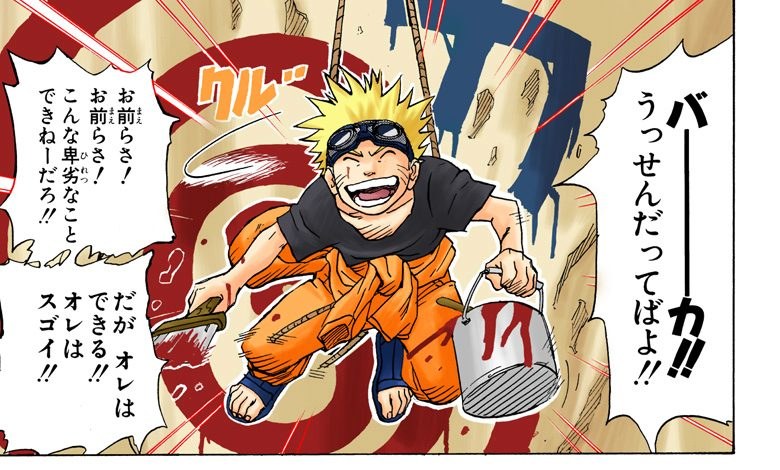
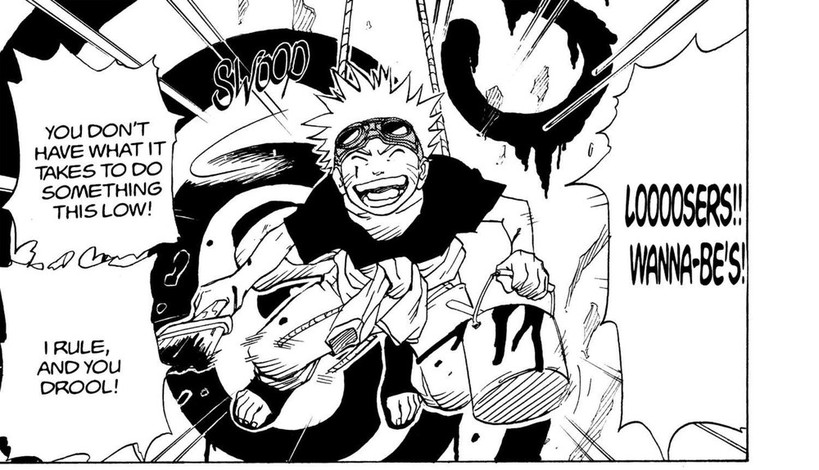
- "Ya know" from Volume 1 onward — unifies the 72-volume voiceprint and makes the Volume 53 family echo audible in English the way it's audible in Japanese. Cost: roughly 820 repetitions of one tag would exhaust readers long before the payoff, and Volume 1's punchiest lines ("LOOOOSERS!! WANNA-BE'S!") would drag under it.
- "Believe It!" for both of them — instantly recognizable, needs no introduction for anyone who's seen the show. Cost: imports a truth-claim ("believe") neither ってばよ nor ってばね makes, and per this record, was never printed on a single manga page.
- Differentiate them: "...you know?" (Kushina) vs. "...I swear!" (Naruto) — preserves the ね/よ distance between agreement-seeking and assertion. Cost: two different tags make the shared trait — the entire point of the Volume 53 scene — harder for an English-only reader to notice at all.
- Absorption everywhere, VIZ's own Volume 1–52 default — the fewest awkward repetitions, the most natural prose panel to panel. Cost: with the tic gone, the recognition scene has nothing to recognize; "...ya know...?" as a moment of dawning realization becomes a realization about nothing in particular.
Take-away
だってばよ is the rare untranslatable tic that gets to prove its own point inside the story: a manga about a boy whose defining wound is going unheard builds him a verbal tic that means, structurally, listen to me — and then reveals, fifty-some volumes in, that his dead mother had it first, in her own key.
Three rules of thumb to carry off this page:
- When a verbal tic reappears on a second character, check whether the grammar marks who is speaking through a shared root with a different final gesture — English rarely has a resource that keeps both signals audible in one tag.
- A long series's "never translate this" rule can quietly change partway through — and the change, when you can date it, is often more interesting than the rule itself.
- ってば is real, ordinary Japanese, safe to use in your own speech (ちゃんと聞いてってば!); だってばよ and ってばね are Kishimoto's personal, fictional extensions of that real grammar into character signature — don't mistake the costume for the particle underneath it, or the particle for the costume.
For the pronoun and copula wing of this same idiolect problem, see ござる and the samurai copula Kakashi almost spoke, 拙者 and Pakkun's borrowed samurai "I", and わし, the old-sage pronoun. For だってばよ in Naruto's own voice, alongside his other sentence-enders and the pronoun オレ he never softens, see our collected Naruto quotes page — or browse the full Naruto translation notes index.
Every Japanese and English line quoted above is a byte-exact capture from the cited editions — NARUTO Vol. 2, 53, and 58 (Japanese) and Naruto (VIZ Media) at the corresponding panels — via our bilingual page database; see Sources below. Two automatic "believe"-adjacent matches elsewhere in the raw corpus (Vol. 37, Vol. 54) were checked against the printed page, found not to hold up, and are not used anywhere in this article.