The Moment
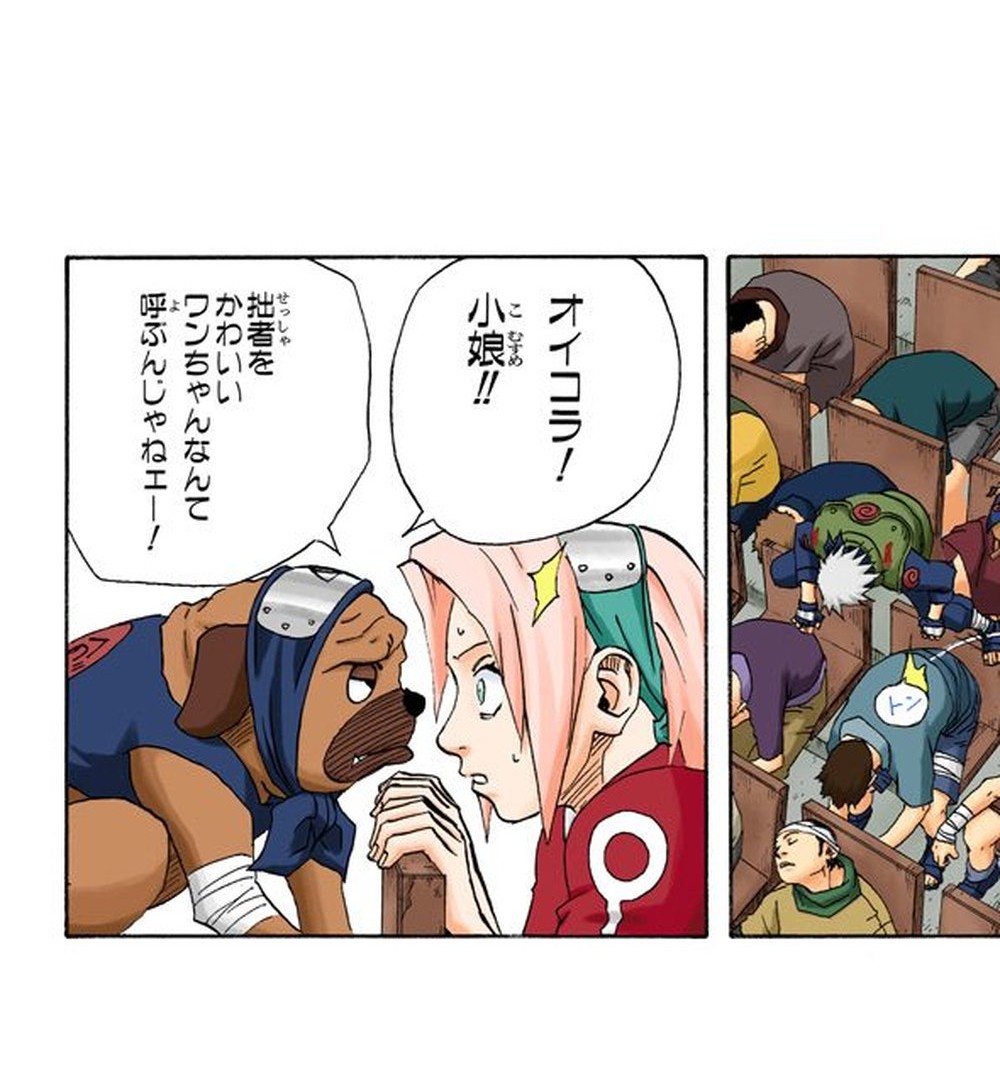
Sakura and Naruto are trapped in a genjutsu; Kakashi's ninja dogs have been summoned to help break it. In the confusion, Sakura says something — the panel before ours shows her insisting かわいいは…言ってない…, "I DIDN'T… SAY 'CUTE'…" — but it's too late. Whatever she said, the pug in the headband, jabbing a paw-claw at her face, has already decided he was insulted:
「拙者をかわいいワンちゃんなんて呼ぶんじゃねエー!」
Sessha o kawaii wanchan nante yobun ja nē!
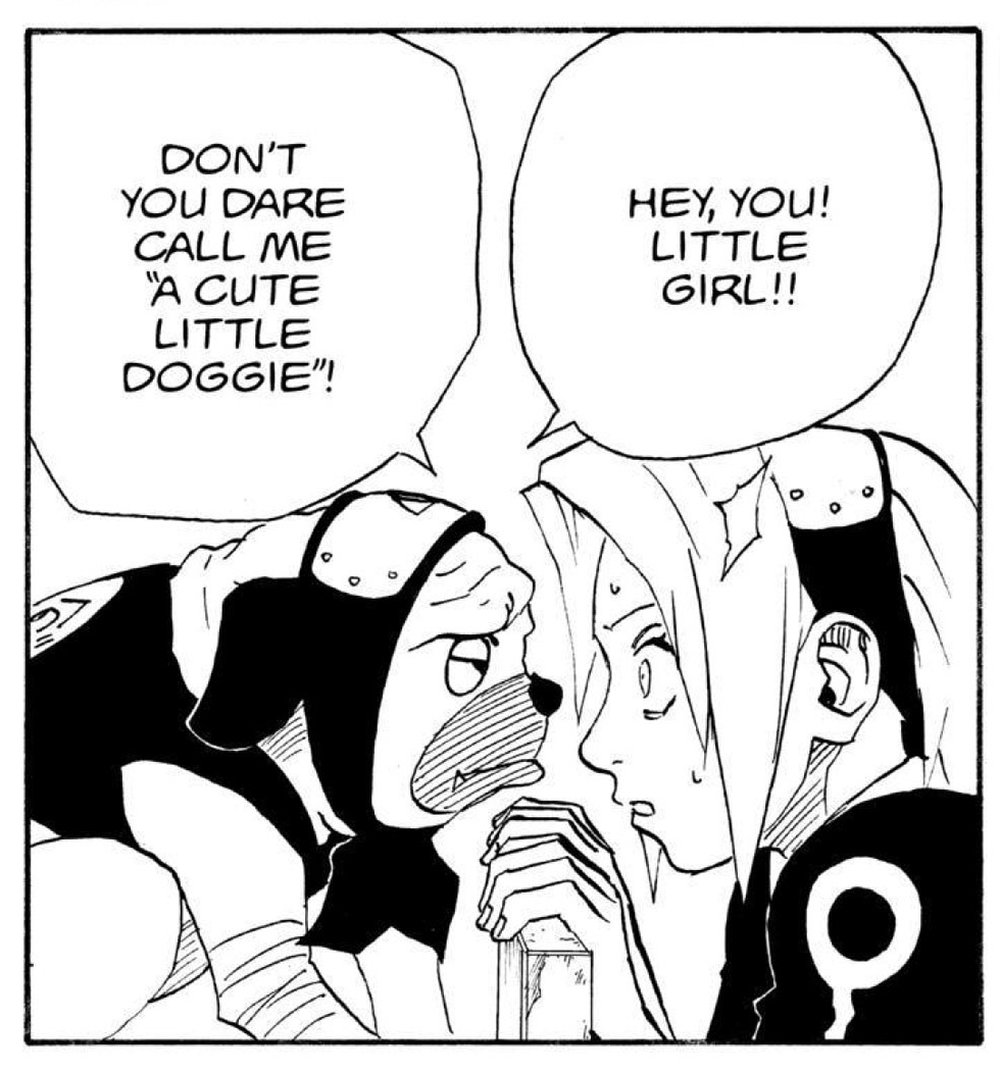
VIZ's English edition prints: "DON'T YOU DARE CALL ME 'A CUTE LITTLE DOGGIE'!" (Vol. 13, p.169).
Grant the rendering its due: the sentence is punchy, it's funny, it lands the outrage, and "a cute little doggie" nails the mocking diminutive of ワンちゃん (wanchan, baby-talk for "doggie"). Read purely as a joke about a small dog being called cute, VIZ's line works perfectly. The problem is that the manga's joke isn't really about being called cute — Naruto readers already know Pakkun hates that — it's about how he says he hates it. He doesn't growl わりゃ me や おれ; he reaches all the way back to 拙者, the humble, self-effacing first person of Edo-period samurai. A little bulldog snapping at a preteen girl, and doing it with the pronoun of a warrior addressing his lord. That collision never makes it into English at all.
The Original
拙者 (sessha) breaks into two pieces worth sitting with. 拙 (setsu) means "clumsy, unskilled, poor at" — the same root as 拙い (tsutanai, "clumsy, unskillful") and 拙速 (sessoku, "hasty and crude [but fast]"). 者 (sha), read the same as 者 in 医者 or 忍者, simply means "person." Put together, 拙者 literally says: this unskilled person — a pronoun that performs humility in its very syllables, formally lowering the speaker even as he confidently uses it to mean, unambiguously, himself.
Grammatically, 拙者 is a perfectly ordinary noun-pronoun — it takes を, は, が exactly like わたし or 僕 (拙者を, as in our line). There's nothing exotic in the sentence structure. All of the word's power is in its register: 拙者 was bushi (warrior-class) speech, the humble first person a samurai or ninja used in formal address, centuries before manga existed. Today it survives almost nowhere in ordinary conversation — you will not hear a modern Japanese office worker say 拙者 unless he's doing a bit. Where it does survive, robustly, is fiction: this is 役割語 (yakuwarigo), "role language" — speech patterns that exist to signal a character archetype (linguist Satoshi Kinsui's term for the phenomenon), independent of whether anyone alive actually talks that way. The instant a character says 拙者, the audience hears "samurai," "ninja," or "dignified old warrior" — even, as here, if the character in question is a bulldog with a Konoha headband.
Notice too what surrounds the pronoun: 呼ぶんじゃねエー — a contraction of 呼ぶんじゃない ("don't call [me]"), spoken in blunt, masculine, modern-rough grammar, with the elongated ねエー spelling a snarl. That's the real texture of the line: an archaic, self-lowering "I" fused onto street-tough modern grammar in the same breath. Dignity and gutter attitude, one sentence, one dog.
VIZ's Choice
拙者 appears six times across the ninken pack's dialogue in the volumes on file — always spoken by Pakkun or by the pack as a whole. Here is every occurrence, side by side with VIZ's English:
| Vol. / p. | Japanese | VIZ English |
|---|---|---|
| 13 / 169 | 拙者をかわいいワンちゃんなんて呼ぶんじゃねエー! | DON'T YOU DARE CALL ME "A CUTE LITTLE DOGGIE"! |
| 14 / 134 | 拙者たち以外にもサスケを追っている者がおる! | COMRADES, THERE ARE OTHERS PURSUING SASUKE ALSO! |
| 15 / 50 | 拙者は戦闘タイプじゃねーからあしからす!! | I'M NOT A BATTLE TYPE NINJA DOG, SO DON'T COUNT ON ME!! |
| 30 / 11 | じゃそろそろ拙者は消えるか居ても邪魔にはなっても | I GUESS IT'S TIME I GO. I'LL BE NO MORE USE HERE. |
| 37 / 158 | 拙者達も行くぞ! | LET'S GO! (see note below) |
| 39 / 102 | 拙者たちの声は無線よりも遠くこだまし | OUR VOICES REACH FARTHER THAN ANY COMMS UNIT. |
Six appearances, six different solutions: "me," a restructured vocative "comrades," "I'm," "I," a flat imperative with no pronoun at all, and "our." Every single one is a reasonable, idiomatic English sentence in isolation — and not one of them signals archaic or samurai or self-lowering. English simply doesn't keep a spare, register-marked first-person pronoun in the drawer for occasions like this, so the translator's only real choice, every time, is which ordinary English pronoun to use — never whether to also flag the register.
The Vol. 14 line is the most telling: 拙者たち以外にも…追っている者がおる ("besides us, there are others pursuing [Sasuke]") uses 拙者たち as the ordinary subject of "besides." VIZ's "COMRADES, THERE ARE OTHERS…" turns that same word into a vocative — something Pakkun calls Naruto and Sakura, not something he calls himself. The pronoun isn't just translated loosely here; its grammatical job is swapped entirely, from "we" to "hey, you two." That's a clean, readable English sentence built by discarding the very word this article is about.
Note on Vol. 37, p.158: the bilingual corpus pairs this line with "...I SEE..." — but checking the actual page images shows that pairing is a machine-alignment artifact (the corpus recorded the wrong facing page for this pair). The real VIZ rendering, confirmed on the correct English p.158, is the plain command "LET'S GO!" spoken by Pakkun as the ninken pack races after Naruto. It's its own small case study: when 拙者 carries no other content the translator needs to preserve, it can vanish completely, pronoun and register both, without leaving so much as a placeholder.
The Gap
English has no register-marked "I." This is the whole story in one sentence. Japanese can signal "this speaker belongs to an archaic warrior-class register" purely through pronoun choice; English pronouns are register-neutral. "I," "me," and "we" are used identically by a child, a general, and — apparently — a talking pug. The entire joke of Pakkun's dialogue, that he sounds like a character escaped from a samurai epic, has nowhere to land in the pronoun system and must be reconstructed, if at all, from art and characterization alone.
Grammar gets repurposed, and the pronoun disappears without a trace. The Vol. 14 "COMRADES" isn't a mistranslation — 拙者たち genuinely can be paraphrased that way in context — but it demonstrates how thoroughly the pronoun can be absorbed into English sentence architecture that no longer needs a first-person word at all. A reader has no way to know a pronoun, let alone an archaic one, was ever there.
Total collapse is possible, and it can look identical to normal English. "LET'S GO!" for 拙者達も行くぞ! is grammatically fine and tonally appropriate — and contains zero trace of 拙者, archaic or otherwise. Unlike 因縁 or 往生, which at least force a translator to choose a lexical substitute, 拙者's information can sometimes be dropped for free, because English commands don't require a stated subject at all.
What If
No fix is free; here's the menu and what each option costs.
- "Don't you DARE call this unworthy cur a 'cute little doggie'!" — "this unworthy [noun]" is English's nearest gesture at self-lowering formal diction. Cost: reads fussy and slow for a one-beat manga bark; the archaism smothers the anger that makes the line funny.
- "Verily, do NOT call this humble hound a cute little doggie!" — "verily" flags "old speech happening" fast. Cost: it's the wrong old speech — mock-Shakespearean pattern-matches to English costume drama, not samurai drama, so readers get an archaism, just not this one.
- A consistent typographic or lexical tag across the whole ninken pack's dialogue — e.g., giving all eight dogs one shared stiff, old-fashioned diction pattern (extra-formal verb endings, no contractions) that a reader learns to recognize as "the dog voice" over many chapters. Cost: invisible in a single panel; only pays off as a running character choice a translator would need editorial buy-in to sustain for eight background characters across dozens of volumes.
- "Don't you dare call THIS one a cute little doggie!" — "this one" borrows the faint self-distancing of referring to oneself in the third person, without claiming a fake historical register. Cost: reads as quirky-modern, not samurai-old; the depth of 拙者's history still doesn't survive.
Take-away
Pakkun's 拙者 is a small, precise example of a translation problem bigger than any one word: Japanese fiction has an entire wardrobe of first-person pronouns — 拙者, 某, 我輩, 儂, 僕, あたし, 俺様 — each cut to a different character silhouette, and English owns exactly one, general-purpose "I." No amount of translator skill changes that inventory gap; the only real choices are which local costs to pay, panel by panel.
Three rules of thumb to carry off this page:
- When a character's pronoun is doing character work, don't expect it to survive. Register-marked first person is a Japanese-specific tool; English compensates with word choice, syntax, and voice elsewhere in the line — or simply loses the signal.
- Watch for silent grammatical repurposing. A humble "we" can quietly become an English vocative ("comrades") or vanish into a subject-less command — both fluent, both untraceable back to the original word.
- 拙者 and 貴様 are a matched pair. One lowers the speaker, the other (in modern use) lowers the listener; both are bushi-register fossils that outlived the samurai class by centuries, living on now purely as character costume in anime and manga.
For the hub of Naruto translation notes as this collection grows, see the Naruto translation notes index.
Every Japanese and English line quoted above is a byte-exact capture from the cited editions — NARUTO Vol. 13–39 (Japanese) and Naruto (VIZ Media) at the corresponding panels — via our bilingual page database, with one noted correction (Vol. 37, p.158) verified directly against the printed page image; see Sources below.