The Moment
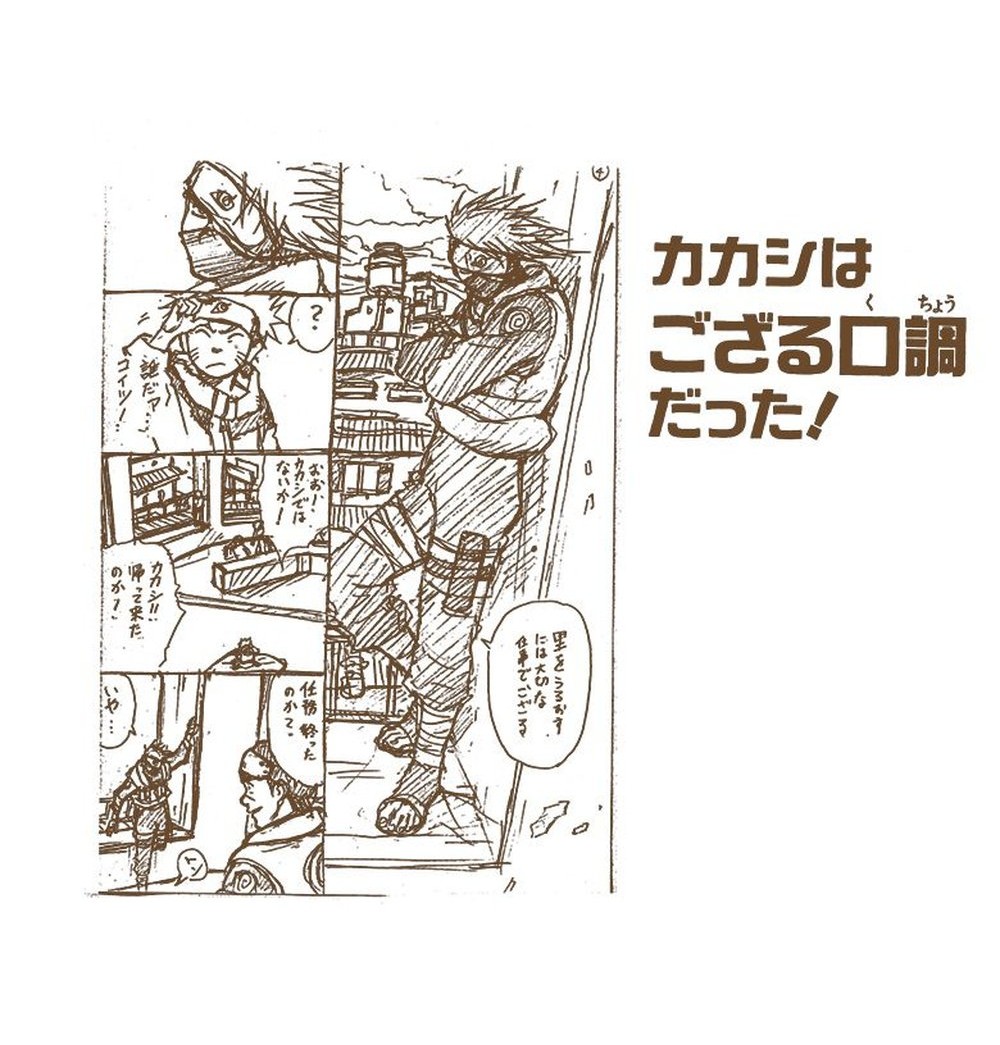
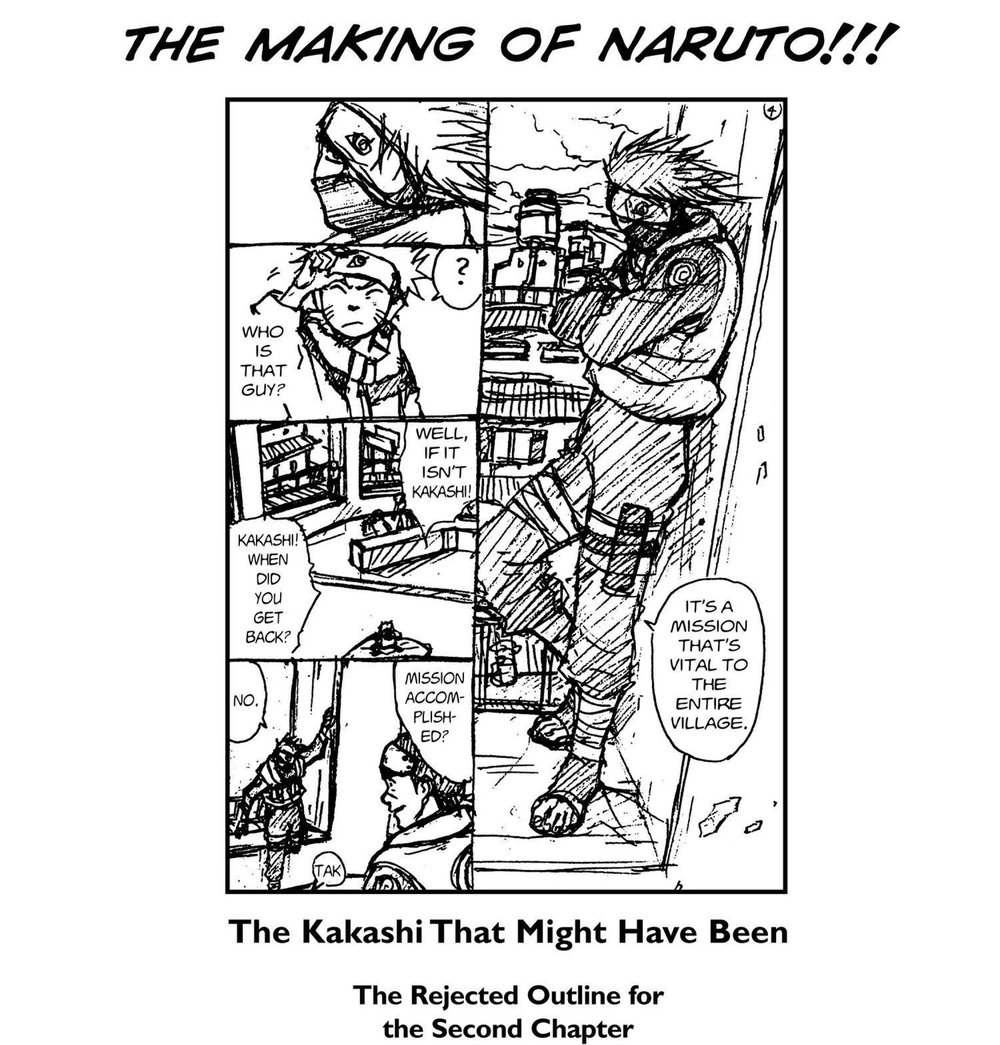
Volume 1 doesn't end with the story. It ends with Kishimoto's own author's-note omake, titled in big block letters "THE MAKING OF NARUTO!!!" — a look back at ideas he tried and threw away. One of them gets a full two-page spread of its own: a hand-drawn mock panel showing what Kakashi's debut almost looked like, headlined with the joke stated outright:
「カカシはござる口調だった!」
Kakashi wa gozaru kuchō datta!
VIZ's English edition prints: "The Kakashi That Might Have Been" (Vol. 1, p.128).
Grant it its due first: it's a lovely, wistful title, and it does real work — "might have been" carries the whole idea that this is a road not taken, and it reads naturally as an omake headline in English. The problem is what got left behind. The Japanese title doesn't just say "there was another Kakashi" — it names, as its entire grammatical subject, the one word that Alternate-Kakashi would have said differently: ござる. カカシは ござる口調 だった, "Kakashi['s speaking-style] WAS gozaru." The word is doing all the work. VIZ's title, elegant as it is, could describe any discarded draft — a grumpier Kakashi, a taller Kakashi, a Kakashi from a different clan. Only the Japanese title tells you it was specifically about how he'd have talked.
Kishimoto proves the point two panels later by drawing the joke out loud. In the mock strip, Alternate-Kakashi appears — same headband, same slouch — and gets exactly one line, delivered after a fellow shinobi asks if his mission is done:
「里をうるおすには大切な仕事でござる。」
Sato o uruosu ni wa taisetsu na shigoto de gozaru.
VIZ: "IT'S A MISSION THAT'S VITAL TO THE ENTIRE VILLAGE."
That's the demonstration panel — the one meant to let readers hear what the joke sounded like — and in English it's the single most ordinary sentence on the page.
The Original
ござる carries no kanji in modern printing, but it has one on record: 御座る. 御 (go) is the honorific prefix that also opens 御飯 and でございます; 座る (here read za) is "to sit, to be seated." Put together, ござる etymologically means something like "to be honorably present" — a polite-and-humble verb of pure existence that once did the job ある and いる do today, just dressed in formal clothes. Attach a noun with で and you get a whole copula: 〜でござる, "it is ~" — the direct ancestor of both である (the literary "to be") and でございます (the modern super-polite "to be" you hear from a shopkeeper). Historically it was ordinary formal Japanese, used across class lines in address to superiors; centuries of drift narrowed it down to almost pure costume.
The headline compresses all of that into one grammatical trick. カカシは[X]口調だった means "Kakashi's speech register WAS [X]" — and X is simply ござる, standing bare as a noun, no modification needed. 口調 (kuchō) itself breaks into 口 (kuchi/ku, "mouth") + 調 (chō, "tune, key, tone") — literally "the tune of the mouth," one's cadence or verbal tic. So the sentence says, almost tautologically: Kakashi's entire manner of speaking was, itself, gozaru. Not "Kakashi spoke formally" or "used old-fashioned words" — his whole register reduces to naming one verb ending.
VIZ's Choice
All three appearances of ござる in the volumes on file sit on a single page — Volume 1, p.128 — because this whole article is one self-contained omake. Side by side:
| Location | Japanese | VIZ English |
|---|---|---|
| Headline | カカシはござる口調だった! | The Kakashi That Might Have Been |
| Mock dialogue | 里をうるおすには大切な仕事でござる。* | IT'S A MISSION THAT'S VITAL TO THE ENTIRE VILLAGE. |
| Author's prose | …クールでキザな「ござる」口調でしゃべる上忍キャラ… | …a cool, affected, upper-level ninja who ended sentences … with the very polite "de gozaru" verb form. |
*Alignment note: the bilingual corpus's raw OCR pass mis-scanned this bubble as 『王どうるん?には大切な仕事でございます — misreading 里 as 王, うるおす as どうるん, and, tellingly, でござる as でございます. We opened the printed JP page directly; the bubble reads plainly across three columns: 里をうるおすには/大切な仕事で/ござる。 — confirmed でござる, not でございます. rawCapture in this article's Sources preserves the corpus's literal (garbled) OCR text, per this project's byte-exact-citation rule; the display quote above and throughout the rest of this piece uses the visually verified reading.
Three occurrences, three different outcomes — and only one of them, the author's-prose paragraph explaining the joke in English narration, actually lets the word gozaru survive, and only because the format allows a translator's aside: "the very polite 'de gozaru' verb form," italicized and glossed, doing in a footnote-like context what a dialogue bubble never could. The headline drops the term for a (lovely) abstraction. The demonstration panel — the one place a reader could have heard the register — drops it for a flatly ordinary English sentence with no trace of formality, era, or genre.
The Gap
English's copula carries no register — and the Japanese title names a copula as its subject. "Is/was" is "is/was" whether a general or a talking pug says it (see also: our companion article on Pakkun and 拙者). Japanese can build a headline whose entire joke is "his mode of speech WAS [a specific archaic copula]"; English has no equivalent copula-name to drop into the same sentence, so the title has to describe the situation (an alternate character) rather than the mechanism (a swapped verb ending).
The one demonstration panel proves nothing in English. Kishimoto didn't just tell readers Kakashi almost talked like a samurai — he drew a mock strip and gave Alternate-Kakashi a line ending in でござる, so readers could hear it for themselves. "IT'S A MISSION THAT'S VITAL TO THE ENTIRE VILLAGE." is accurate, fluent, and completely silent on register. An English-only reader gets the setup (there was another Kakashi) and the punchline (it didn't happen), with the actual joke — what he would have sounded like — missing from the one panel built to deliver it.
Naruto is being self-aware about its own genre furniture, and that self-awareness doesn't cross over. This isn't a random line of dialogue; it's the author explicitly naming yakuwarigo as a design choice he considered and rejected. That kind of meta-commentary about role-language is rare enough in manga to be worth noticing on its own — and it's exactly the kind of thing that can't survive translation into a language that never built the role-language system in the first place. You can't discuss the rejection of a tool your workshop doesn't stock.
What If
No option is free.
- "Kakashi Used to Talk Like a Samurai!" — states the actual, concrete claim: a speech style, not a swapped personality. Cost: drops the specific verb ending, and loses the "there was a whole rejected draft" implication VIZ's "might have been" carries so well.
- "The Kakashi Who Said 'De Gozaru'!" — keeps the actual romanized tic front and center, giving curious readers something to look up. Cost: reads like a linguistics caption, not an omake punchline, and sacrifices the wistful counterfactual mood entirely.
- "Kakashi's Discarded Samurai-Speak" — names both the register and the rejection in one noun phrase. Cost: flat and expository — no exclamation mark, no surprise, none of the Japanese line's near-tautological snap.
- Keep VIZ's title, add a translator's gloss: "THE KAKASHI THAT MIGHT HAVE BEEN (he would have talked in 'de gozaru')" — preserves VIZ's elegant phrasing while restoring the missing information. Cost: the parenthetical undercuts the headline's punch, and still assumes the reader already knows what "de gozaru" means.
Take-away
ござる is the copula-level version of a problem this hub has already met in 拙者: Japanese fiction owns a whole wardrobe of speech markers — pronouns, sentence endings, whole copulas — that exist to announce a character archetype the instant they're spoken, and English's grammar carries no equivalent slot to put them in. What makes this case remarkable isn't the untranslatability itself; it's that Naruto's own author stages a demonstration of it, on the page, in his own voice, and the demonstration still can't cross the language gap.
Three rules of thumb to carry off this page:
- When a joke's subject is a register, not a fact, expect English to keep the fact and drop the register. "There was an alternate Kakashi" survives; "he would have sounded like a samurai" is the part that has to be rebuilt from context, if it survives at all.
- でござる and 拙者 are copula-and-pronoun twins. One is the archaic "to be," the other the archaic "I" — both flagship yakuwarigo markers for the same bushi/ninja register, and both routinely vanish into ordinary English "is" and "I."
- Watch for the rare cases where a manga discusses its own devices. An author's note naming a rejected linguistic joke is a small window into how deliberately these registers get built — and a reminder that the translation gap applies even when the author is explaining the joke directly.
For the pronoun half of this same samurai-register family — Kakashi's own ninja dogs, who do end up talking this way — see the sister piece on 拙者 and Pakkun's samurai "I". Or browse the Naruto translation notes index.
Every Japanese and English line quoted above is a byte-exact capture from the cited editions — NARUTO Vol. 1 (Japanese) and Naruto Vol. 1 (VIZ Media), p.128 — via our bilingual page database, with one noted OCR correction (the mock-panel dialogue, verified directly against the printed page image); see Sources below.