The Moment
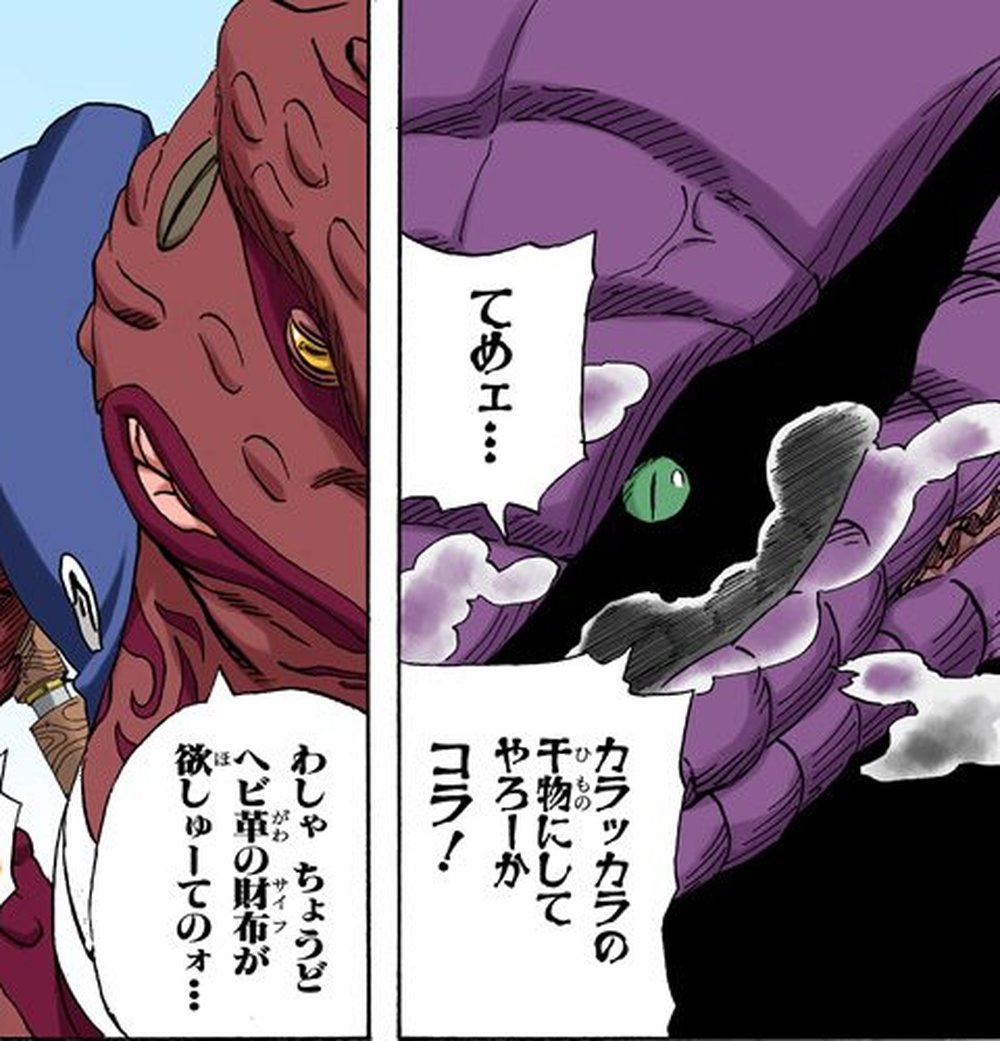
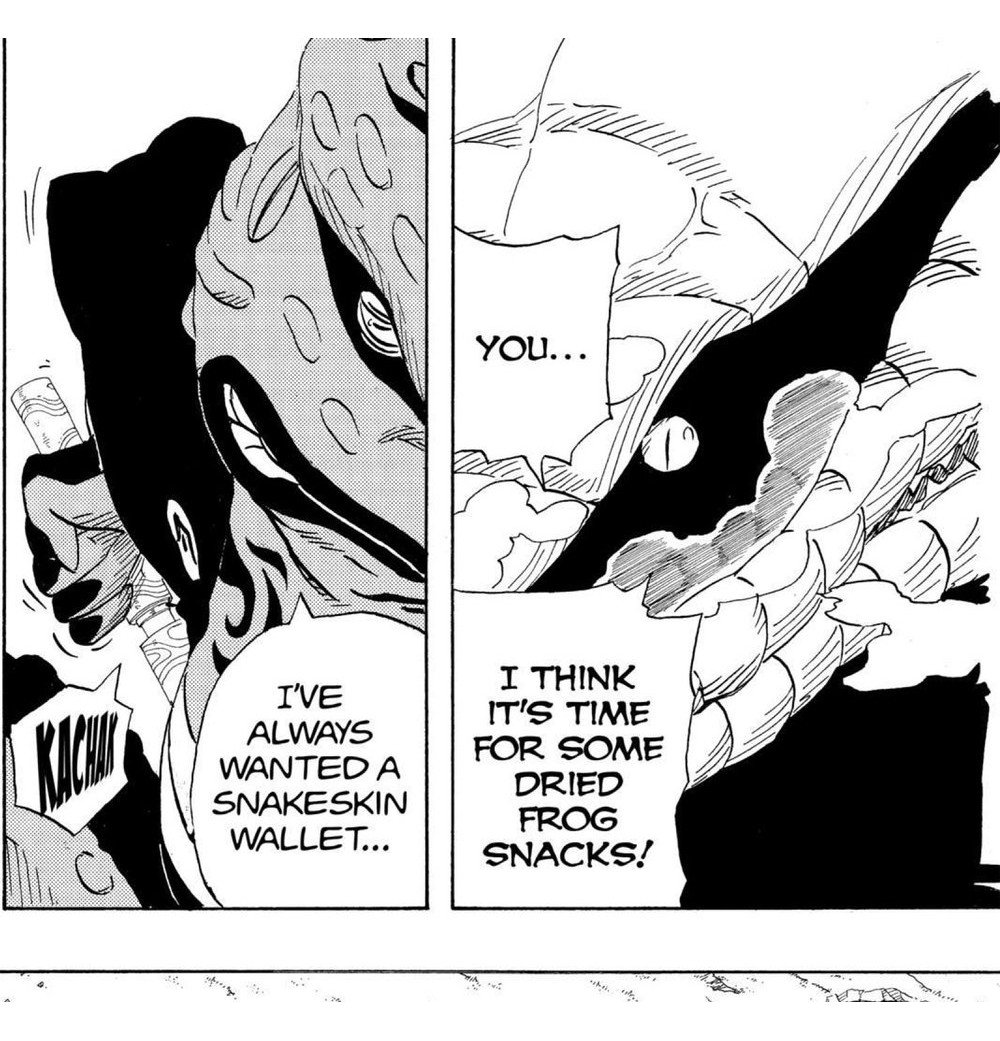
Tenchi Bridge, deep inside Orochimaru's hideout. Three shinobi who once fought side by side as Konoha's "Three Legendary Sannin" — Tsunade, Jiraiya, and the traitor Orochimaru — stand across from each other for the story's first real reunion, and each has already summoned their signature creature: Tsunade's slug Katsuyu, Orochimaru's serpent Manda, and Jiraiya's boss toad, Gamabunta. Manda is already snarling, threatening to turn someone into dried rations, and the someone he's glaring at is the giant toad currently gripping him by the throat. Gamabunta doesn't flinch. He just growls back, almost bored:
「わしゃちょうどへビ革の財布が欲しゅーてのォ…」
Washa chōdo hebigawa no saifu ga hoshūte no ō…
VIZ's English edition prints: "I'VE ALWAYS WANTED A SNAKESKIN WALLET..." (Vol. 19, p.154).
Grant the rendering its due first: it's a terrific line. Deadpan, casually savage, and it lands the exact joke the Japanese is making — a war-toad the size of a building, mid-battle, cracking wise about turning his opponent into leather goods. Nothing about the humor is lost in translation. What's missing is quieter, and it isn't really about this one joke at all: わし, the word doing the growling, isn't just "I." It's the same pronoun a Japanese reader has already heard from an elderly bridge builder several volumes earlier, and will hear again from a masked Kage and, eventually, from a rage-filled fox god speaking from behind a cage inside Naruto's own body. Gamabunta doesn't just sound tough here. He sounds old — old the specific way Japanese marks it — and that's a signal VIZ's flawless "I've" simply has no room to carry.
The Original
わし carries no standard kanji in modern printing. Dictionaries record 儂 — 人 ("person") plus 農 as a phonetic component — as its historical spelling, but almost no manga bothers to typeset anything so obscure; on the page it's always plain hiragana. Grammatically, that hiragana pronoun is entirely unremarkable: わし takes は, が, の, を exactly like わたし or ぼく (わしは, わしが, わしの, わしを), and in fast, contracted speech collapses わし + は into a single breath — わしゃ, exactly as Gamabunta says it above. There is no exotic construction hiding anywhere inside the word. All of its charge is generational, not grammatical: わし is simply an older, worn-down way of saying "I," related to わたくし/わたし by sound-shift rather than by different roots, that the Japanese ear now files under "elderly" the instant it's spoken — the way an English ear files "shan't" or "reckon" as a generation or a region, not a grammar lesson.
That filing system has a name. Linguist Satoshi Kinsui's yakuwarigo (役割語, "role language") research groups わし together with the sentence-final copula じゃ under 老人語 (rōjingo), "old-person language": the default voice of every wizened master, grumbling grandfather, and village elder in Japanese fiction, spoken by characters in contemporary dramas exactly as readily as by characters in feudal fantasy. This is the crucial difference from ござる and 拙者, the samurai-register pair this hub has already covered: those two mark era — say them and a Japanese reader hears "period drama," full stop, however comic the mismatch (a talking pug, an author's discarded draft). わし marks age, which is a much bigger, much more portable category. And unlike ござる, わし isn't purely fossil: it survives as a genuine regional first person among older speakers across western Japan — Kansai down through Chūgoku, Shikoku, and Kyūshū — which is exactly why fiction keeps reaching for it. The trope has a living dialect underneath it, not just a costume-drama memory.
Listen to how thoroughly the headline line commits to that dialect coloring. わし is only the first marker; 欲しゅーて is a dialectal onbin softening of standard 欲しくて ("want," te-form) — the kind of contraction real western-Japan speech makes — and the sentence trails off into a drawled, elongated のォ. Stack an old-person pronoun on top of a regional verb contraction on top of a lazy vowel-drag, and Gamabunta doesn't just sound old. He sounds like he rolled in from somewhere with its own weather. Grammatically, none of this is difficult — わし sits at a plain JLPT N5 slot, no harder than わたし. Recognizing its social meaning isn't tested on any exam at all. It's simply something every Japanese reader already knows long before they can read a manga unassisted.
VIZ's Choice
Here is わし on five very different bodies, sampled from across the corpus:
| Vol. / p. | Speaker | Japanese | VIZ English |
|---|---|---|---|
| 2 / 37 | Tazuna, the elderly bridge builder | わしは橋作りの超名人タズナというもんじゃわい | I AM TAZUNA, A BRIDGE BUILDER OF ULTIMATE RENOWN.. |
| 10 / 152 | The Kazekage, addressing the Chūnin finalists | ...この本選には審査員としてわしを含め | FOR THE FINALS, YOU WILL BE OBSERVED BY MANY JUDGES... NOT ONLY ME, BUT... |
| 11 / 11 | Jiraiya, posturing at Naruto | わしは仙人だ!お前のようなひょっ子に言いくるめられるようなアホではない.. | I'M A POWERFUL SAGE! I'M NO FOOL TO BE TWIRLED ON A STRING AROUND THE FINGER OF A GREENHORN LIKE YOU... |
| 19 / 154 | Gamabunta, gripping Manda by the throat | わしゃちょうどへビ革の財布が欲しゅーてのォ... | I'VE ALWAYS WANTED A SNAKESKIN WALLET... |
| 26 / 82 | The Nine-Tailed Fox, raging behind the seal | このわしに...(な...感謝するんだ) | ...THANK ME... (YOU'D BETTER...) |
Compare this to 因縁 in our One Piece coverage, where one word scattered into five different English words. Here the pattern runs the opposite way: one word converges, without exception, onto the single most generic pronoun English owns. "I am," "not only me," "I'm," "I've," "me" — every single occurrence is grammatically correct, idiomatic, and completely silent on register. That's not a translator missing something; it's the ceiling of what English pronouns can do.
The range of speakers is the real story. A civilian bridge builder, a masked head of state, a boastful toad-summoning ninja, a hundred-plus-year-old war toad, and a fox spirit old enough to have fought the First Hokage all reach for the identical grammatical costume. A Japanese reader's ear does the sorting instantly and for free: old, senior, not to be trifled with — a note that plays across an unnamed elder in an early omake, a bridge builder hiring bodyguards, a proud toad mid-brawl, and an ancient demon in a cage, all in the same key. VIZ's English can't play that note at all; it can only tell you, case by case, what each of these five characters happens to be saying, never that they're all saying it in the same voice.
The Gap
English's "I" carries no age or gender coding whatsoever. A toddler, a company president, and a thousand-year-old fox spirit all say exactly the same word. There is no seat in the pronoun system to put わし's seniority into — not a spare formal "I," not an archaic "I," nothing. Whatever the translator does about Gamabunta's age has to happen somewhere else in the sentence, if it happens at all.
The throughline disappears. Because this corpus shows わし on such a wide range of bodies, its disappearance in English erases a connection a Japanese reader feels on contact: that Tazuna, the Kazekage, Jiraiya, Gamabunta, and the Nine-Tailed Fox are all, despite sharing nothing else, speaking old in the identical register. An English-only reader has no way to sense that a construction worker and an imprisoned demon god are, grammatically, doing the same thing in the same breath.
Compensation is scattered, not systematic. Where VIZ does add texture, it's real: Jiraiya gets a blustery "SHEESH... WHAT A DESPICABLE BRAT!," Gamabunta gets a dismissive "HOW IDIOTIC" in a different scene (Vol. 15, p.161: わしが何でワザワザこんな奴と…あほくせーわい, "AND WHY SHOULD I GO OUT OF MY WAY TO FIGHT THAT CREATURE...? HOW IDIOTIC."). But that flavor rides on word choice and exclamation, never on anything tied to the pronoun itself. Some わし lines get compensating grit; the Nine-Tailed Fox's flat "...THANK ME..." gets none at all. The pattern never becomes something an English reader can learn to recognize the way わし is recognized on sight, every time, in Japanese.
What If
No fix is free; here's the menu for the headline line.
- "This old toad's always wanted himself a snakeskin wallet..." — folds in countrified diction ("wanted himself a") to gesture at age plus dialect grit. Cost: pattern-matches to a specific American-rural voice with nothing to do with Japan — a regional flavor, just the wrong one.
- "Snakeskin wallets. I've always wanted one, you know." — restructures the line to invite an unhurried, rambling "old-timer" cadence into the sentence itself rather than the pronoun. Cost: the slower pacing kills the one-liner's deadpan snap.
- A series-wide typographic convention for every わし-speaking character (dropped g's, extra ellipses, a slower cadence), applied consistently from Tazuna to the Nine-Tailed Fox. Cost: needs buy-in across dozens of characters and 72 volumes — a style budget most manga translations never get, and easy to tip into caricature if pushed too hard.
- "Heh... I've always fancied a snakeskin wallet." — "fancied" nudges toward a mildly old-fashioned, vaguely British-elder register English does have on hand. Cost: British-elder isn't Japanese-elder; it imports an adjacent but wrong flavor, and loses Gamabunta's growl entirely.
The deeper lesson: every option trades the system (a pronoun any Japanese reader recognizes instantly, on any speaker) for a local patch (a word choice that only works in this one sentence). English can approximate わし one line at a time. It cannot reproduce the fact that わし is the same costume every time.
Take-away
わし is Japanese fiction's most portable role-language marker — not tied to a period, a genre, or even a species, just to the claim "I am old, and that matters here." Naruto proves the portability by handing the identical pronoun to a bridge builder, a Kage, a sage, a war toad, and a demon fox, and English proves its own limits by turning every single one of them into the same flat "I."
Three rules of thumb to carry off this page:
- わし marks age, not era. Where ござる and 拙者 announce "samurai drama," わし only announces "senior, and worth deferring to" — which is why it shows up in settings those two never would.
- Watch for わし's dialect entourage. のォ, 〜てのォ, and onbin contractions like 欲しゅーて for 欲しくて often ride alongside it, stacking regional grit on top of the age marker — a whole accent hiding in a handful of vowel drags.
- A pronoun shared across wildly different speakers is a pattern, not a coincidence. When the same grammatical costume turns up on a human, an animal, and a god, the manga is telling you something about status that a translation, working sentence by sentence, has no clean way to relay.
For the companion samurai-register "I" — the century-costume half of this same pronoun wardrobe — see the sister piece on Pakkun, the ninken pack, and 拙者, and for the copula Kishimoto once considered giving Kakashi, see ござる and the Kakashi that might have been. Or browse the Naruto translation notes index.
Every Japanese and English line quoted above is a byte-exact capture from the cited editions — NARUTO Vol. 2, 10, 11, 15, 19, 26 (Japanese, digital colored edition) and Naruto (VIZ Media) at the corresponding panels — via our bilingual page database; see Sources below.