Inosuke's first person is 俺様 (ore-sama) — not the plain 俺 every other shōnen lead in this cast uses, but 俺 with 様 (-sama, the honorific reserved for addressing someone else with respect) welded onto the end of his own name for himself. Volume 10 catches him doing it twice at once: 「大暴れしてやるよ この俺様伊之助様が ド派手にな!!」 — "I'm gonna go wild! ME-LORD INOSUKE! I'm gonna be reeeeeal flashy!!" — 俺様 and 伊之助様, two honorifics stacked on the same boy in one breath, self-worship with no discount. It isn't performance for an audience, either — nobody taught him this grammar exists to be reserved for other people. He was raised by boars in a mountain with no one around to model ordinary Japanese self-reference, so he built his own first person out of the most respectful shape he ever happened to hear, aimed it at himself, and never once heard anyone tell him that was strange.
That same isolation produces his most consistent bit: he cannot be bothered to learn anyone's actual name. Deep in the Tsuzumi Mansion arc he vents to Tanjiro about getting called "stupid pig" — 「クソ猪とか言われたんだぜ紋次郎」, "HE CALLED ME A STUPID PIG, MONJIRO!" — using a name that isn't Tanjiro's at all. Tanjiro's reply is instant and flat: 「炭治郎だ!!」, "IT'S TANJIRO!" VIZ keeps the joke structurally intact by inventing an English name-shaped nonsense word ("Monjiro") that rhymes with the real one, rather than translating the sound of the mistake literally — a small, clever piece of localization that preserves the gag's shape even though no English reader can see that 紋 and 炭 don't share a single syllable in Japanese either; the joke is that Inosuke isn't even trying, not that the names are similar. He does the identical thing to strangers in bulk: recruits on a mission become 「子分その二」「子分その三」, "underling #2," "underling #3" — numbered rather than named, the same indifference applied wholesale.
The word that best captures what teamwork costs him is 「ホワホワ」, a mimetic word that in ordinary Japanese describes something fluffy, soft, warm — the feeling of cotton, or a hug, or a lazy afternoon. Mid-battle at the Tsuzumi Mansion, with Tanjiro jumping in front of him to help, Inosuke snarls 「てめェェ!!これ以上俺をホワホワさすんじゃねええ!!!」 — literally, don't you make me any more fluffy-soft than this. He's turning a cozy, harmless word into a battlefield insult, because to him being protected doesn't feel safe, it feels like losing his edges — like the hard, feral readiness that lets him fight is being smothered in cotton wool. VIZ doesn't attempt the mimetic word at all; it reaches straight past it to the underlying grievance — "YOU SAY 'COOPERATE' BUT YOU JUMP IN FRONT! I WON'T LET YOU EMBARRASS ME ANYMORE!" — a totally reasonable English sentence that quietly discards the one detail that makes the Japanese funny and strange: that the word for his complaint is the same word you'd use for a kitten.
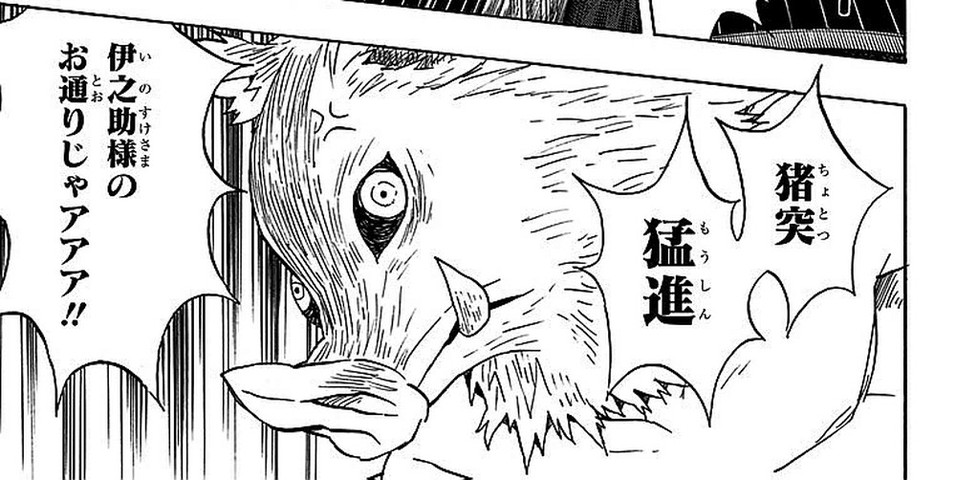
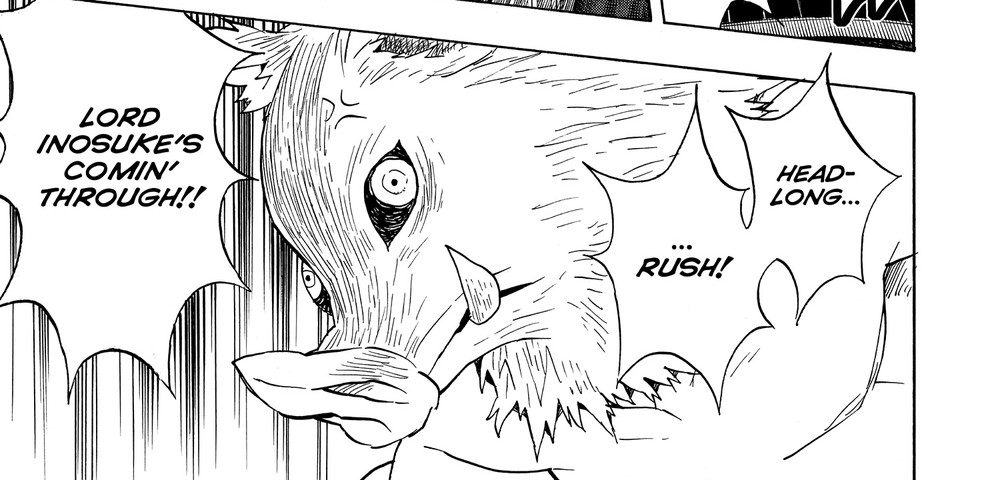
All of this sits on top of a battle cry that predates every relationship he has in the story: 猪突猛進 (chototsu-mōshin), a real four-character idiom — "boar-charge, fierce advance," reckless headlong momentum — that Inosuke doesn't quote so much as detonate, shouted twice in a row, blade first, in nearly every volume he appears in. VIZ translates it a different way almost every time it fires ("COMIN' THROUGH," "BOAR RUSH," "HEADLONG RUSH"), which is its own quiet tell: an idiom this load-bearing to a character's identity should probably read as one fixed phrase, the way 「猪突猛進!!伊之助様のお通りじゃアアア!!」 — "HEADLONG... RUSH! LORD INOSUKE'S COMIN' THROUGH!!" — lands on the Mugen Train, a war cry and a self-introduction fused into one shout. His finishing techniques carry the same self-taught logic into their names: every other breathing style calls its techniques 型 (kata, "form"), the vocabulary of an actual dojo; Inosuke's Beast Breathing calls them 牙 (kiba, "fang") instead, because no one ever taught him the word for "form" — see Beast Breathing, First Fang: Pierce for how far that invented vocabulary goes, right down to an OCR pipeline that garbles his technique callouts more than anyone else's in the corpus.
His most quotable line by far isn't a boast at all. Deep in the Infinity Castle, answering the demon Doma's claim that heaven and hell are human fictions, Inosuke snarls 「往生しやがれド腐れ野郎!!」 — a funeral-liturgy verb (往生, "depart and be reborn") crammed into the filthiest imperative grammar Japanese owns, VIZ's "DIE, YOU ROTTEN BASTARD!!" keeping the snarl and losing the sutra entirely. It's the same pattern as everything else on this page: elevated vocabulary delivered completely feral, a boy who never had a teacher assembling his Japanese out of whatever registers he happened to overhear and mashing them together without apology. The full breakdown of that collision is at 往生しやがれ: Temple Word, Gutter Grammar. Compare his register to Tanjiro's borrowed keigo on Tanjiro's quotes page, or to Zenitsu's panic-driven collapse on his — of the three boys who fight side by side for twenty-three volumes, Inosuke is the only one whose Japanese never had a single lesson behind it, and it never once tries to hide that fact.