The Moment
Volume 19, deep in the Infinity Castle, in a chamber Doma has dressed like a shrine — wooden walkways over a lotus pond, floating candles, the Upper Rank Two smiling behind his war fans. Shinobu is already gone; what remains of her plan is the poison she steeped into her own body, and the two young fighters carrying the rest of it: Kanao, and — crashing into the duel beside her — Inosuke.
Doma, delighted by his guests, offers a compliment and a correction. 「猪に育てられたというのに よく言葉を知ってるね」 — for someone raised by a boar, you know a lot of words — 「だけど間違ったことも覚えたみたいだ」 — but it seems you've picked up some mistaken ideas too. The mistaken ideas in question: 「この世界には天国も地獄も存在しない」 — in this world, there is no heaven and no hell. They are 「人間による空想」「作り話なんだよ」 — human fantasies, made-up stories, comfort for weak hearts in an unfair world.
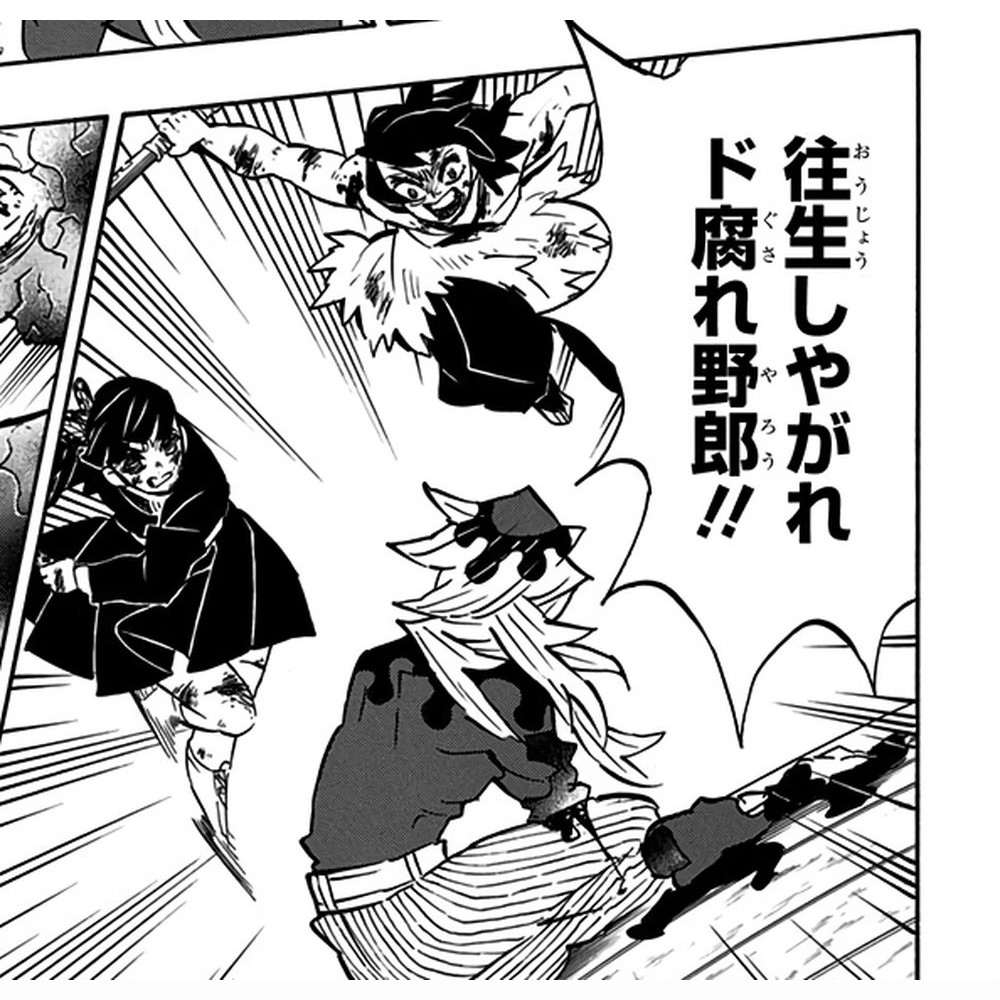
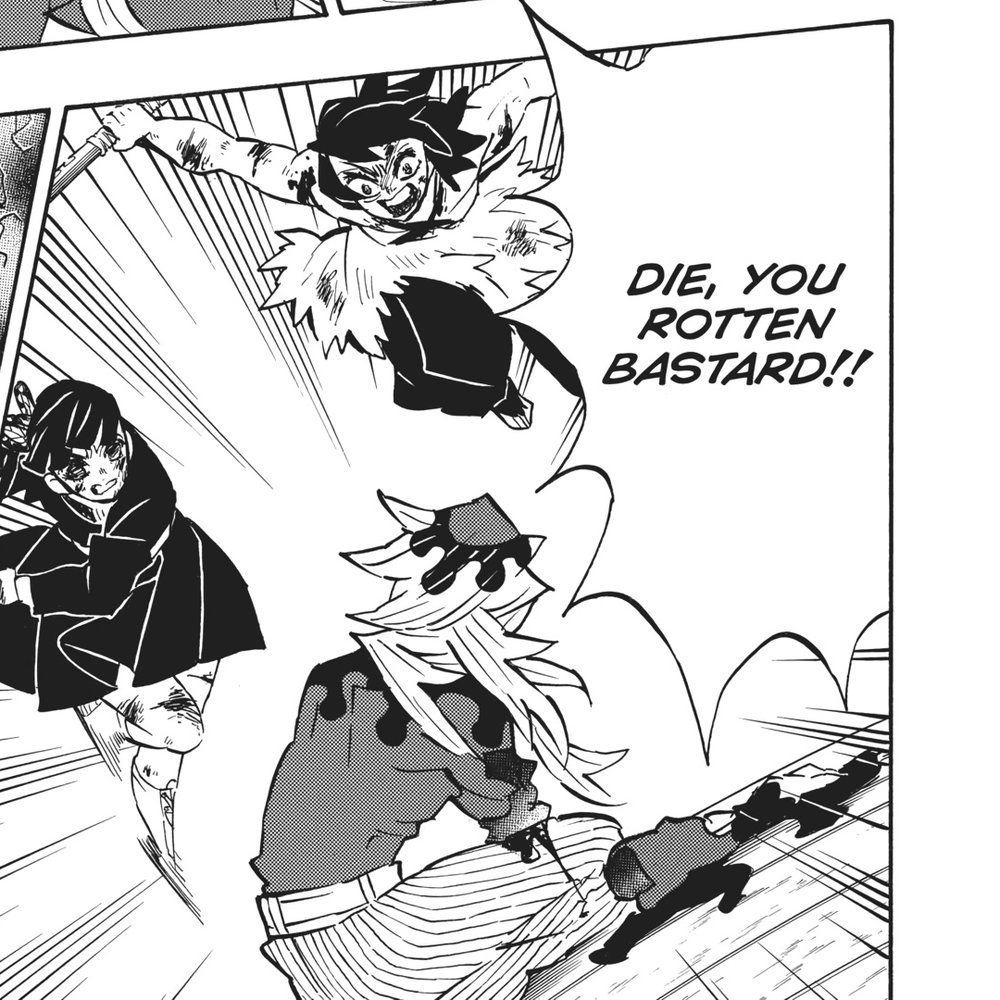
Inosuke's rebuttal comes in two installments. The first, mid-battle, VIZ prints gloriously straight: 「地獄がねぇなら俺が作ってやるァア!!」 — "IF HELL DOESN'T EXIST, I'LL CREATE IT FOR YOU!!" Then, pages later, as Kanao vows 「絶対にしのぶ姉さんの命を無駄にはしない!!」 ("I WON'T LET SHINOBU'S SACRIFICE BE IN VAIN!!") and Inosuke launches himself blade-first at the demon:
「往生しやがれド腐れ野郎!!」
Ōjō shiyagare do-gusare yarō!!
VIZ's English edition prints: "DIE, YOU ROTTEN BASTARD!!" (Vol. 19, p.39).
Grant the rendering its due — most of this line is translated about as well as English allows. ド腐れ野郎 comes out nearly morpheme-for-morpheme: 腐れ is "rotten," 野郎 is "bastard," and only the untranslatable intensifier ド is left on the table. The line is short, brutal, and fits a mid-leap bubble. Exactly one word went missing — the first one. It happens to be the one carrying the theology.
The Original
往生 (ōjō) breaks into 往 (ō), "to go" — the same 往 as 往復 (ōfuku, "round trip") — and 生 (jō), "to be born." To go and be born. This is Pure Land Buddhism's technical term for the good death: departing this life to be reborn in Amida's paradise, 極楽往生 (gokuraku-ōjō). Centuries of funerals wore it down into a solemn everyday verb for dying — and then everyday Japanese kept going and gave it a second, sardonic career: to be stuck, stumped, at the end of one's rope (立ち往生, tachi-ōjō, is what a train does in heavy snow — literally "dying on one's feet," like the warrior monk Benkei). If you've read our One Piece sister pieces, you've met this word twice: hiding inside a noun in 往生際が悪い, and as a bare-imperative threat in 往生しろ.
しやがれ is where the register falls off a cliff. Take する, run it through やがる — the auxiliary whose entire job is to coat another verb in contempt (textbooks file it under N1, mostly out of embarrassment) — and then put that in the imperative. やがれ is the roughest order Japanese can give, a notch below even the drill-sergeant しろ: 黙りやがれ ("shut yer mouth"), くたばりやがれ ("drop dead"). It is the grammar of gangsters, street brawlers — and one boar-raised demon hunter.
ド腐れ野郎 finishes the job: ド, the intensifying prefix of ド根性 and ド阿呆, written in katakana for extra violence; 腐れ, "rotten," from 腐る; 野郎, "bastard."
Put it back together and read it literally: Attain thy rebirth, you rotten bastard. A verb from funeral liturgy, delivered in the filthiest grammatical frame the language owns. That collision is not an accident and not noise — it is Inosuke's entire speech profile compressed into one bubble. Doma just said it himself: for someone raised by boars, this kid knows a lot of words. He does. He just delivers every one of them feral.
VIZ's Choice
Our bilingual database covers all 23 volumes of Demon Slayer, and this is the only 往生 in the series — no scatter to chart, just one word at one hinge. What we can chart is the exchange it caps, because the two halves of Inosuke's rebuttal went through translation very differently:
| Vol. / p. | Speaker | Japanese | VIZ English |
|---|---|---|---|
| 19 / 9 | Inosuke | 地獄がねぇなら俺が作ってやるァア!! | IF HELL DOESN'T EXIST, I'LL CREATE IT FOR YOU!! |
| 19 / 38 | Inosuke | 往生しやがれド腐れ野郎!! | DIE, YOU ROTTEN BASTARD!! |
(The English edition runs one page behind the Japanese in this stretch; the lines sit on EN pp.10 and 39.)
The first line survives intact because its religious keyword is hell — a concept English keeps in stock. The second line's keyword is 往生, and English stocks no verb that means "depart and be reborn," so VIZ reached for the plainest tool on the shelf: die. Compare the same verb's fate across the strait: in One Piece, 往生しろよ became the tombstone pun "NOW REST IN PIECES!!" — wrong theology, but a theology. Here even the pun is gone. The word that started in the sutras ends as three letters.
And to be fair to the letterer: the bubble is small, the leap is fast, and "DIE" detonates on impact. If the word were only a synonym for death, this would be a model translation.
The Gap
"Die" stops; 往生 departs. English's plainest death verb is terminal — a wall, a full stop, no itinerary. 往生 is a journey verb: go (往), be born (生), somewhere specific. Inosuke is not telling Doma to cease functioning; he is ordering him onward — out of this world and into the next, where the accounts get settled. The Japanese threat has a destination. The English threat has an off switch.
A doctrinal counterpunch becomes generic abuse. This fight is a theology debate conducted with swords. Doma's position, stated smiling over a lotus pond: no heaven, no hell, no afterlife — humans made it all up. Inosuke's position: if hell doesn't exist, I'll build it, and then, at swordpoint, 往生しやがれ — go to your next life, the single word asserting the entire cosmology Doma just canceled. It is the perfect comeback: the demon says there's nowhere to send him, and the boy orders him shipped anyway. "DIE, YOU ROTTEN BASTARD!!" surrenders that argument — in English, Inosuke threatens the nihilist in the nihilist's own materialist terms. Doma's worldview wins the translation.
The register collision was the characterization. VIZ's own Doma marvels — on the page — that a boy raised by wild boars is so well-spoken. In Japanese, the payoff arrives thirty pages later: the feral kid produces a priest's verb and snarls it through yakuza grammar. Temple word, gutter delivery — that is Inosuke, the boy who mangles names and memorizes battle vocabulary. English prints the setup and then gives him a one-syllable punchline any thug could have said.
What If
No rendering is free; here is the menu and its prices.
- "PASS ON ALREADY, YOU ROTTEN BASTARD!!" — "pass on" is English's one everyday death verb with a direction, and "already" smuggles in やがれ's impatience. Cost: hospice vocabulary doing a battlefield job; the menace goes soft.
- "OFF TO THE NEXT LIFE WITH YOU, YOU ROTTEN BASTARD!!" — keeps the destination, keeps the shove, and lands the jab at Doma: there is a next life, and you're booked on it. Cost: long for a mid-leap bubble, and faintly storybook.
- "MEET YOUR MAKER, YOU ROTTEN BASTARD!!" — religious, imperative-shaped, pointed onward; the same closest-cousin our One Piece sister article nominated for 往生しろ. Cost: converts the Pure Land into a Creator. A smaller conversion than deletion — but a conversion.
- "DIE PROPERLY, YOU ROTTEN BASTARD!!" — keeps VIZ's punch and adds ōjō's undertone that death is a rite you can perform well or badly. Cost: "properly" reads arch in English; the panel didn't order a laugh.
Every option pays somewhere, because English's death vocabulary splits into two shelves — clinical (die, perish) and Christian (rest in peace, meet your maker) — and neither shelf stocks a verb whose factory setting is depart for rebirth. The translator must borrow a bed, borrow a church, or go plain. VIZ went plain.
Take-away
Three rules of thumb to carry off this page:
- Japanese death verbs have vectors. 往生 goes-and-is-born; 成仏 becomes a Buddha; あの世へ行く crosses to that world. English's "die" is a point, not an arrow. Whenever a character dies — or threatens death — check which way the verb was facing before translation flattened it.
- やがる is a register weapon. Bolted onto any verb, it manufactures contempt; bolted onto a formal verb, the mismatch itself is the message. When you spot elevated vocabulary inside gutter grammar, someone is being characterized — don't let a smooth translation sand it off.
- When a fight argues theology, the verbs are the argument. Doma denies the afterlife; Inosuke's threat asserts it in one word. Track who names an afterlife and who refuses to — in Japanese fantasy combat, cosmology is frequently what the shouting is about.
For the polite face of this same instruction — Tanjiro-adjacent, tearful, and just as Buddhist — see our sister piece on 成仏してください, the send-off that begs the dead to move along. Demon Slayer keeps its swords sharp elsewhere too: the four-kanji cut of 一刀両断 and the itching forearms of 腕が鳴る. And the word 往生 itself has a whole parallel life in One Piece, where VIZ turned it into "sore losers" once and a tombstone pun the next time. Or browse the Demon Slayer translation notes index.
Every Japanese and English line quoted above is a byte-exact capture from the cited editions — 鬼滅の刃 Vol. 19 (Japanese) and Demon Slayer: Kimetsu no Yaiba Vol. 19 (VIZ Media) at the corresponding panels — via our bilingual page database; see Sources below.