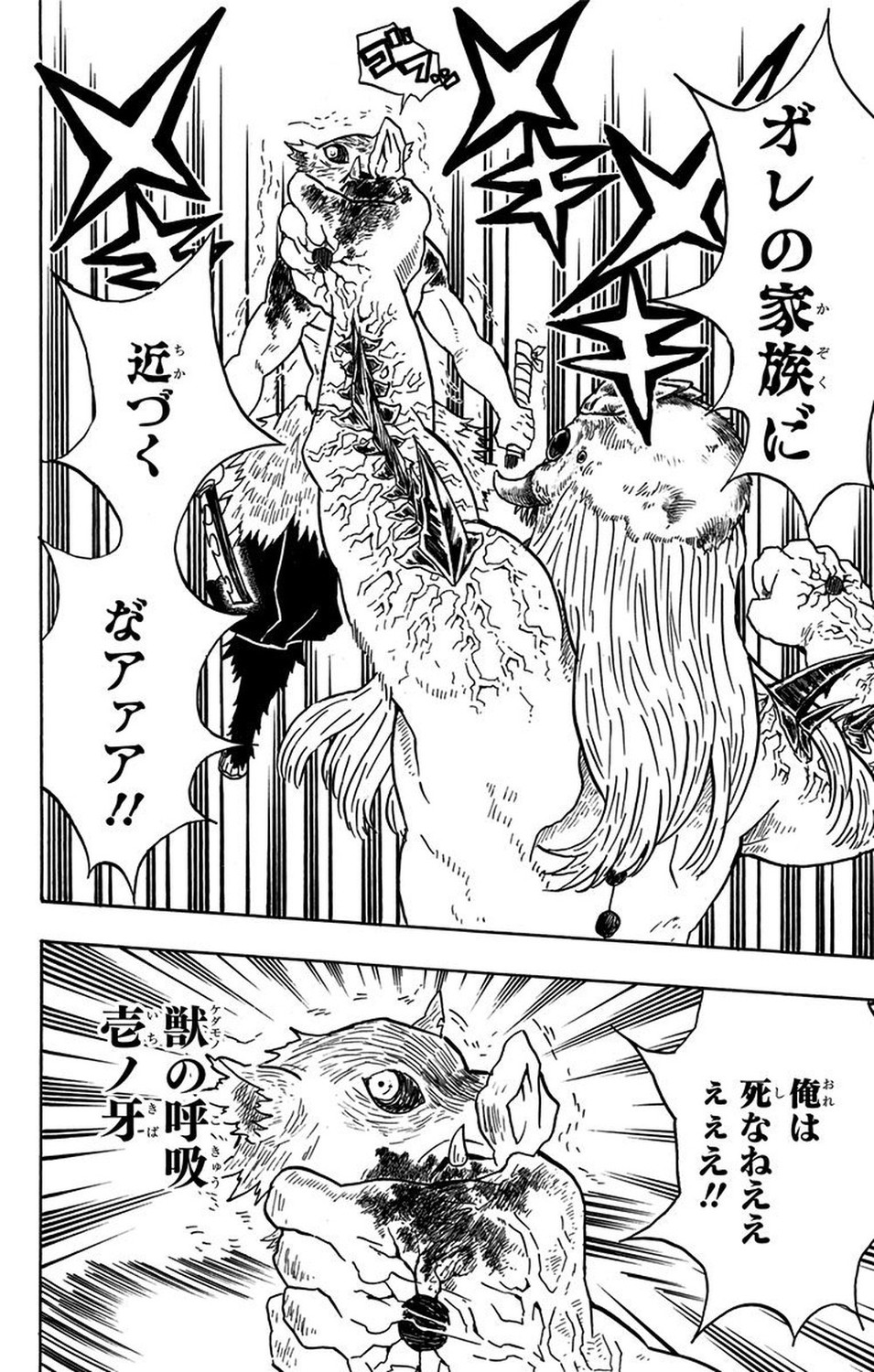
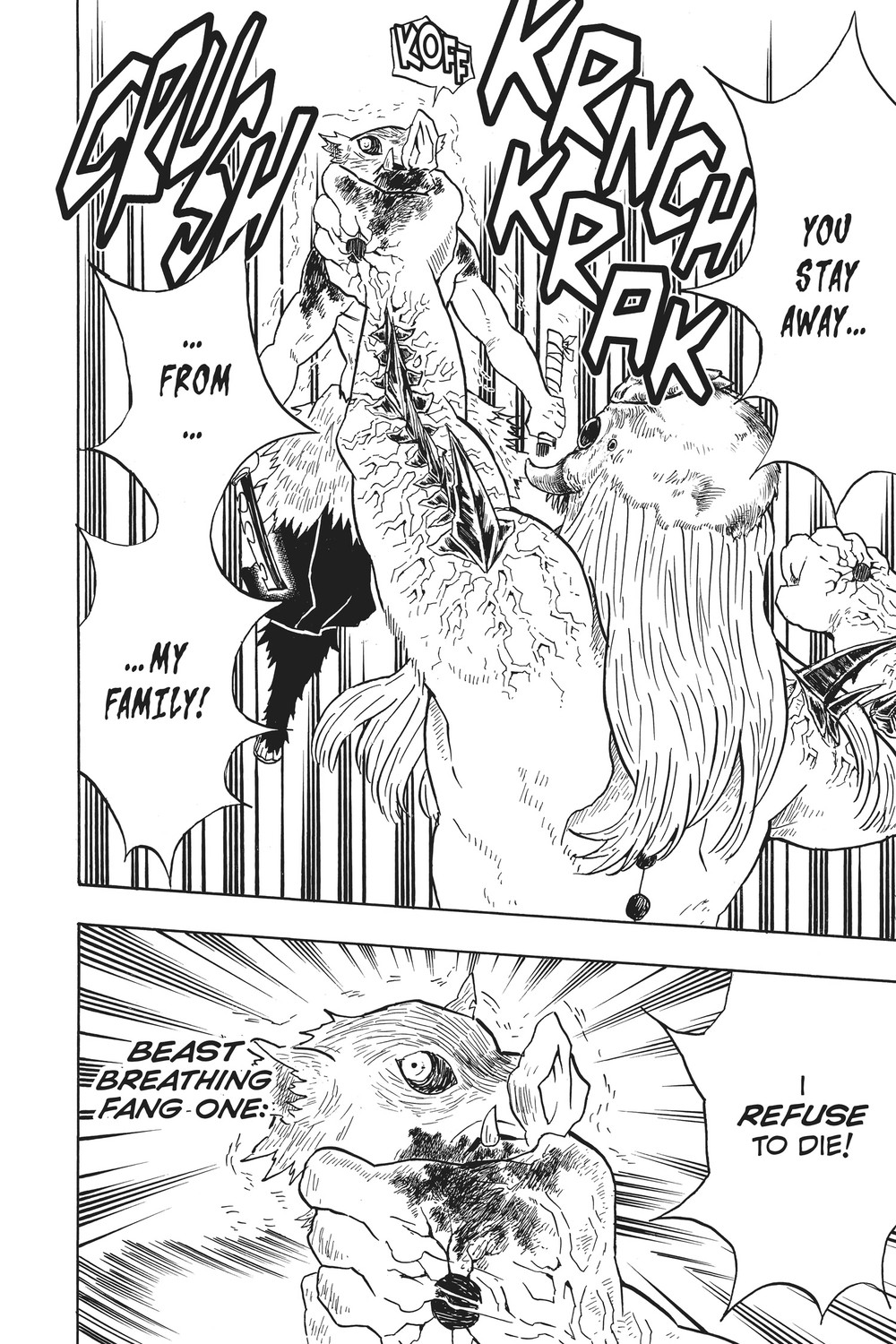
Every other numbered breathing style in this series calls its techniques 型 (kata, "form") — 水の呼吸壱ノ型, 雷の呼吸壱ノ型, and so on — because every other breathing style descends from an actual dojo, with an actual teacher standing behind the word "form" as a term of art. Inosuke Hashibira never had one. He was thrown into a river as an infant, raised by a mother boar in the mountains, and built his entire fighting style from scratch by fighting bears with his bare hands. So when his techniques get a name, they don't get 型 — they get 牙 (kiba), "fang," the word for the tusks jutting out of the boar skull he wears as a mask. First Fang isn't a school's opening form; it's a wild animal's first bite, dressed up in the same formal kanji numeral (壱) real martial traditions use, because Inosuke picked up the convention of numbered forms without ever meeting anyone who could have taught him the word for them.
That borrowed formality gets tested twice more, later in the style: two of Beast Breathing's nine Fangs — the seventh and the eighth — are written in the raw Japanese with 型 instead of 牙, the exact word every trained swordsman uses and Inosuke supposedly never learned. VIZ's own English translation doesn't even agree with itself about what to do with the slip: at the Seventh's one appearance (Vol. 4) it prints "SEVENTH FORM," preserving the anomaly; at the Eighth's only appearance (Vol. 11) it prints "EIGHTH FANG," smoothing it away. Neither choice is wrong, but together they mean an English-only reader can never see that the Japanese itself briefly forgets Inosuke is self-taught — see this hub's Form 7 and Form 8 entries for the full page-by-page comparison.
There's a smaller, funnier tell of the same idea buried in this corpus's raw OCR pass, before any human correction. Nearly every Fang-number callout in Beast Breathing comes out of automatic character recognition as gibberish: 参ノ牙 ("Fang Three") is misread as 参ります ("here I come"); 壱ノ牙 ("Fang One," this very technique) is misread as ビノ牙 in one panel and ゼノオ in another — neither a real word; 弐ノ牙 ("Fang Two") comes out as ルキッチ; even the move name 切り裂き ("Slice") gets hallucinated into 剣丞さん, a fictitious character called "Mr. Kenjou" who does not exist anywhere in Demon Slayer. Every other breathing style's technique names sit in the manga's normal dialogue lettering, and OCR reads them cleanly. Inosuke's get the jagged, spike-edged "feral shout" font reserved for his own voice — and that typographic wildness trips the same automated pipeline, page after page, into inventing words that were never there. The Japanese text is unstable at the level of ink before it's unstable at the level of grammar.