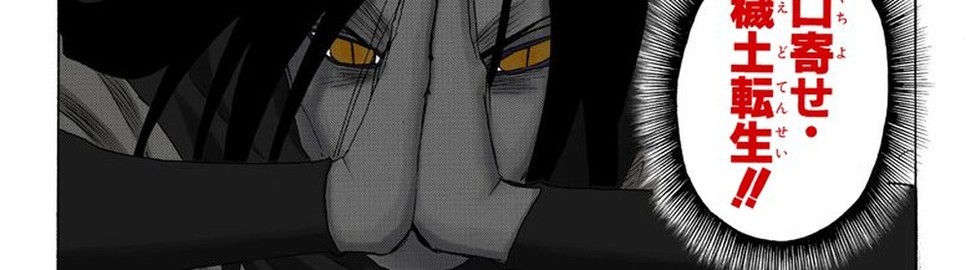
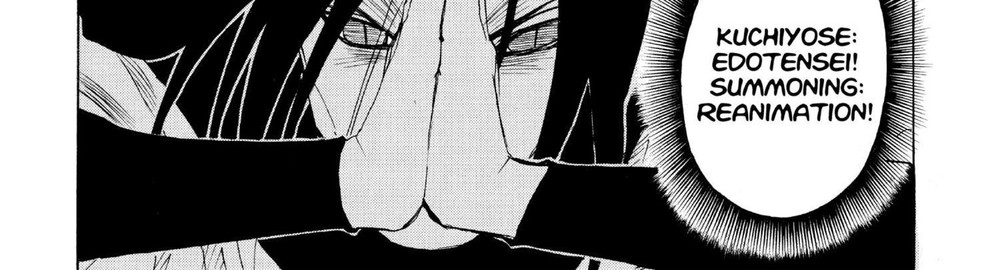
This is the most doctrinally loaded name in the entire Naruto jutsu lexicon. 穢土 isn't generic fantasy vocabulary — it's a specific term from Pure Land Buddhism (浄土教), the tradition that frames the physical world (穢土, "the impure land") as a place of suffering and corruption that the faithful hope to escape by being reborn into Amida Buddha's Pure Land (浄土) after death. Naming a jutsu "穢土転生" — being reborn back into the impure world — casts every reanimated shinobi in the corpus not as some neutral zombie or golem, but as a soul that has been ripped out of whatever peace or Pure Land it reached and forced back into suffering, physical form against its will. That's a much darker framing than English "reanimation" or "resurrection" carries, and it's precisely the nuance VIZ's usual gloss erases.
The corpus doesn't have a character stop to explain this etymology directly, but the connotation leaks through consistently: every appearance of the term is bracketed by 禁術 ("forbidden technique"), and Kabuto himself describes losing control over how many souls he's pulled back (Vol. 55 p.033: "あまりに穢土転生の数が多くてコントロールするには少々大変でね" / "IT IS A BIT DIFFICULT TO CONTROL SO MANY REANIMATED SHINOBI") — framing mass Edo Tensei less as summoning an army and more as an ethical violation piling up faster than its caster can manage. This dictionary's companion entries on 地獄 (jigoku, hell) and 娑婆 (shaba, "this transient world," also from Buddhist cosmology) sit in the same conceptual neighborhood: Naruto repeatedly reaches for real Buddhist vocabulary about death, suffering, and the boundary between worlds, and 穢土転生 is the technique name that leans on that vocabulary hardest.
VIZ's handling is visibly less disciplined than for other signature techniques in this dictionary. Unlike Rasengan or Sharingan, which each settle into one fixed romanization within a few volumes, 穢土転生 never fully stabilizes: the corpus shows "Edotensei" (most common, one word), "Edo Tensei" (two words), and "Edo-Tensei" (hyphenated) used interchangeably by different translators, plus outright substitutions like "REANIMATION JUTSU" (Vol. 58 p.050) and "THIS REANIMATION JUTSU" (Vol. 54 p.159) that drop the romanized name entirely. The technique's very first corpus appearance (Vol. 13 p.181) actually hedges both ways at once — "KUCHIYOSE: EDOTENSEI! SUMMONING: REANIMATION!" stacks the romanized term directly beside its English gloss, the same belt-and-suspenders approach VIZ used for early Rasengan and Sharingan appearances before confidence in the loanword grew. That confidence apparently never fully arrived for this term across a fifteen-volume, near-daily-use War arc.
Authorship inside the story is also worth noting for series-continuity readers: Tobirama Senju, the Second Hokage, claims credit for inventing Edo Tensei directly in the corpus (Vol. 67 p.027: "穢土転生の術はワシが作った" / "I CREATED THE EDOTENSEI JUTSU") — a late-series reveal that recontextualizes one of the village's founding fathers as the source of its most ethically catastrophic forbidden technique, a irony the manga leans into during the War arc when Tobirama himself is reanimated by his own creation.