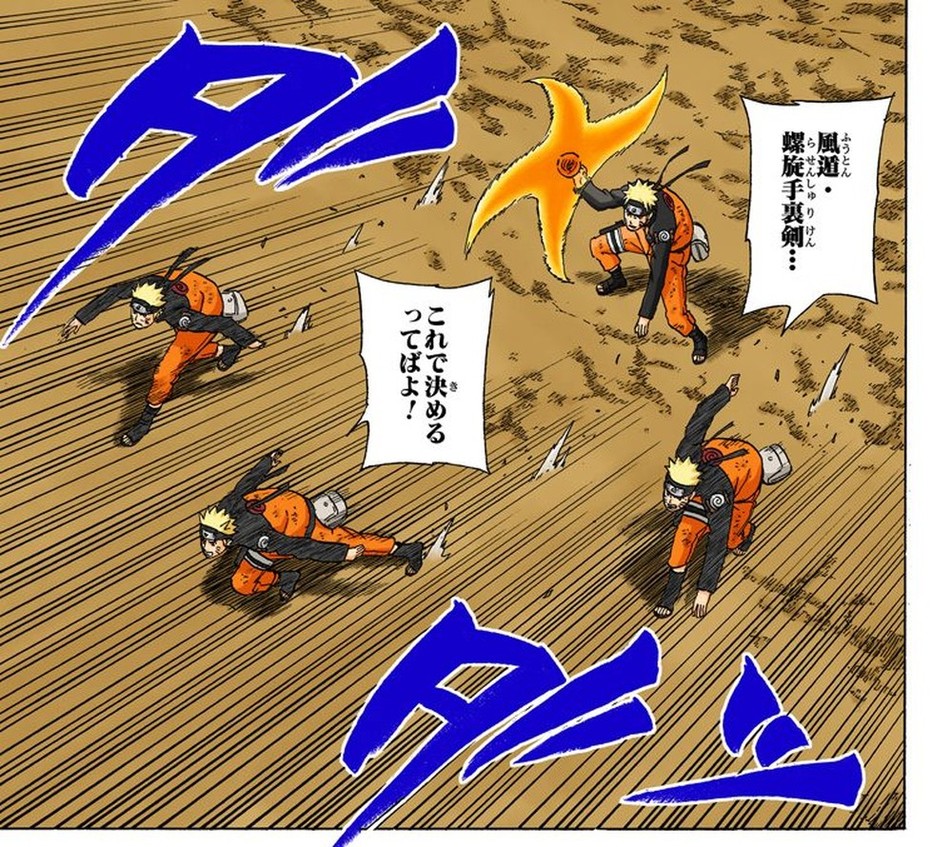
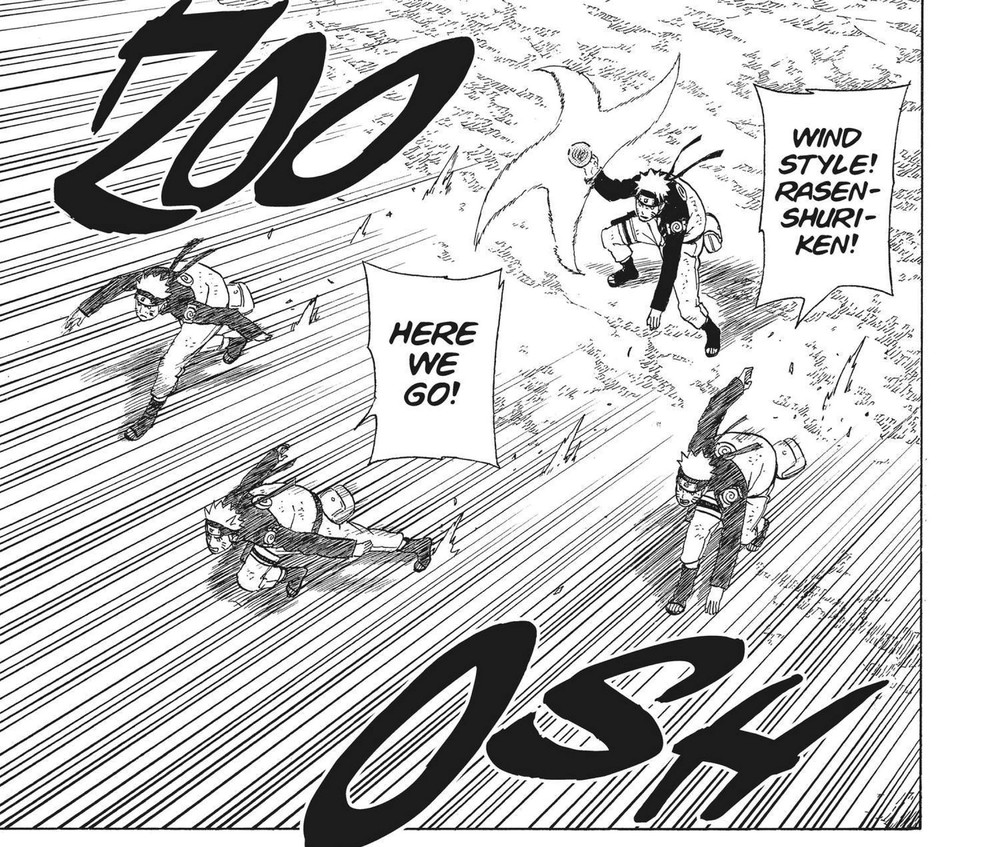
Rasen-Shuriken is a direct sequel-technique to Rasengan within this dictionary's naming logic, and the corpus shows the connection is spoken out loud in-story, not just implied by the shared kanji. The technique's debut, at the climax of the Kakuzu fight (Vol. 37 p.188 / Vol. 38 p.007), has Naruto shout the full compound name together in one breath: "風遁・螺旋手裏剣!!" ("Wind Style: Rasenshuriken!!"). That's notable because Rasengan itself, per this dictionary's own Rasengan entry, is explicitly built on pure shape manipulation (形態変化) with no nature-chakra component — which is exactly why it's compatible with so many elemental prefixes without ever needing a new base name. Rasen-Shuriken is the corpus's first on-page proof of that design principle actually working: take the shape-only Rasengan, add wind nature, and the result is sharp enough to shred a target's cells instead of just battering them.
VIZ's localization choice here is more surgical than for most other terms in this dictionary. Rather than fully romanizing the compound (as it eventually does for Rasengan) or fully translating it (as it does for some other techniques), VIZ splits the difference: the elemental prefix 風遁 becomes the English "WIND STYLE," while 螺旋手裏剣 stays romanized as "RASEN-SHURIKEN" — hyphenated, and frequently broken mid-word across word-balloon line breaks ("RASEN-/SHURIKEN"). That's a deliberate hybrid strategy: the elemental system (fire/wind/water/etc. releases) is common enough across the series that VIZ translates those prefixes consistently everywhere, while proper-noun technique names stay in Japanese. Later power-scaled variants keep exactly this pattern — "SUPER ŌDAMA RASEN-SHURIKEN," "SAGE ART: SUPER TAILED BEAST RASENSHURIKEN" — modifying the same fixed romanized core with new English or hybrid prefixes each time, mirroring how this dictionary's Rasengan entry shows the same core noun absorbing new modifiers (Wind Style Rasengan, Sage Rasengan) without ever being renamed.
The corpus also captures real strain on the OCR pipeline for this term specifically — heavier than most other entries in this dictionary. Because 螺旋手裏剣 is a five-character technical compound usually rendered in bold, jagged battle-shout lettering, several occurrences show visible corruption in the raw text extraction: 風遁 misread as 風道 (Vol. 38 p.007), scrambled reading-aid furigana bleeding into the main line ("風遁・ちせんしゅ螺旋手裏剣", Vol. 38 p.128), and outright garbled strings on later, more chaotic War-arc panels (Vol. 66 p.128's raw OCR reads as unrelated noise before correction restores "風遁・超大玉螺旋手裏剣!!!"). None of this affects VIZ's English rendering, which stays legible and consistent throughout, but it's a reminder that stylized battle-cry lettering is the least OCR-reliable text in the whole bilingual corpus, and any byte-exact Japanese quote drawn from these pages should be spot-checked against the actual page image before reuse.